We earn a commission if you buy through the links on this page, at no extra cost to you. It never changes which products we pick or how we rank them - read the full disclosure.
Our top pick
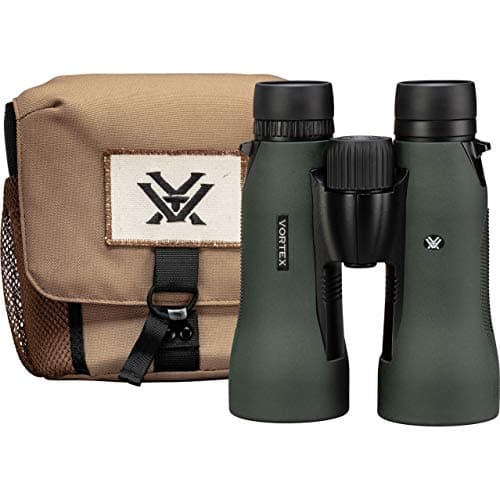
Vortex Diamondback HD 15x56
A 3.73 mm exit pupil and 230 ft of field: the cheapest credible way to sit behind a tripod all morning without carrying a spotting scope.
Price as of November 12, 2026. #ad How we earn
A 15x56 does one job better than anything else you can hang on a tripod for the money: it finds animals that a 10x42 looks straight past. It is also 35 to 45 oz, unusable handheld, and useless in timber. If you already own a good 10x42 and you hunt open country, this is the most valuable second optic you can buy. If it would be your only binocular, stop reading and go to the 10x42 roundup.
What 15x56 actually buys you
The case for 15x is resolving power at distance. At 10x, a bedded mule deer at 1,200 yards in sage is a gray smudge you will scan over without registering it. At 15x the same animal has an outline, and more importantly an ear or an antler tine that catches light. That is the whole argument: not that 15x shows you more detail on an animal you already found, but that it finds animals you otherwise would not have found at all.
The case against is also arithmetic. The exit pupil of a 15x56 is 56 divided by 15, which is 3.73 mm. A 10x42 gives 4.2 mm and an 8x42 gives 5.25 mm. Your pupil dilates to roughly 5 to 7 mm in low light depending on your age, so a 15x56 is feeding your eye a smaller cone of light than your 10x42 does at exactly the hour you most want to see. The 56 mm objective is what keeps that from being a disaster - a 15x42 would give 2.8 mm and be genuinely unusable at dusk - but it does not reverse it. Exit pupil and twilight factor, worked through has the full arithmetic.
The twilight factor tells the other half of the story. It is the square root of magnification times objective, so for a 15x56 that is the square root of 840, which is 29. A 10x42 gives 20.5 and a 12x50 gives 24.5. Twilight factor is a measure of detail-resolving ability in poor light rather than brightness, and 29 against 20.5 is the reason a 15x56 can pick an antler out of shadow that a 10x42 shows as mush. The two figures point opposite directions on purpose: the 15x56 is dimmer and more detailed at the same time.
How we ranked these
Every number on this page came off the manufacturer's own published specification table on 2026-10-26, and the five units were scored against the published binocular rubric on how we review. For a 15x56 specifically, the weights land like this.
- Eye relief first. On a tripod optic you spend hours behind, eye relief decides comfort, and a 15x56 is a tripod optic. Anything under 15 mm will vignette for a glasses wearer. The spread here is 15 mm to 18.5 mm, which is a real difference.
- Then weight, because it decides your tripod. A 34.8 oz binocular is stable on a mid-weight ball head; a 45.2 oz binocular wants a leveling head or a fluid head, which can cost as much as the cheaper binocular on this page.
- Then field of view. At 15x the field is narrow no matter what - 226 to 240 ft against 300-plus for a 10x42 - so every extra foot is proportionally worth more when you are grid-searching a basin.
- Then what the maker will put in writing about the glass. A published transmission percentage or a named glass type beats a brand adjective. Only two of these five publish either.
- Then warranty, because a 15x56 lives on a tripod, and tripods fall over.
Quick picks
Ranked by the criteria published on how we review. Tap any row for the full write-up, or go straight to the current price.
| # | Product | Best for | Score | Price |
|---|---|---|---|---|
| 1 | Vortex Diamondback HD 15x5634.8 oz against 43.6-45.2 oz for everything else here, 230 ft of field, and roughly a quarter of what the European units cost. | Best value, and the floor of the categoryTripod glassing without a spotting scope | 9.1out of 10 | |
| 2 | 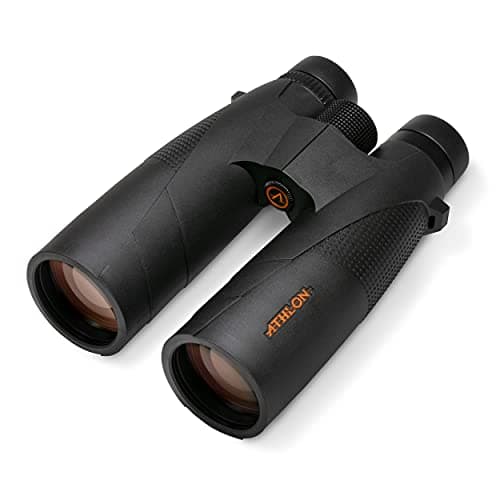 Athlon Cronus G2 UHD 15x5618.5 mm of eye relief, the most comfortable view on this page, with UHD extra-low-dispersion glass for roughly half the European price. | Best under $1,000Best 15x56 under $1,000 | 9.3out of 10 | |
| 3 | 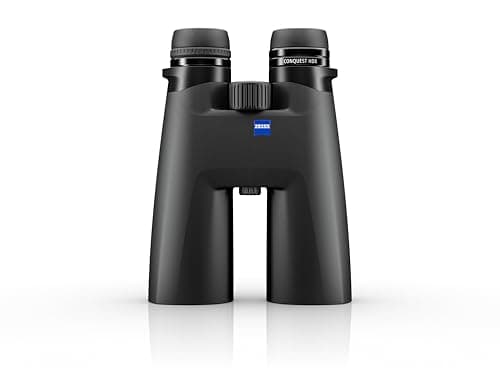 Zeiss Conquest HDX 15x56The only unit on this page whose maker publishes a light-transmission figure: 90 percent, with the widest field here at 240 ft. | Best low-light performanceBest low-light 15x56 | 9.4out of 10 | |
| 4 | 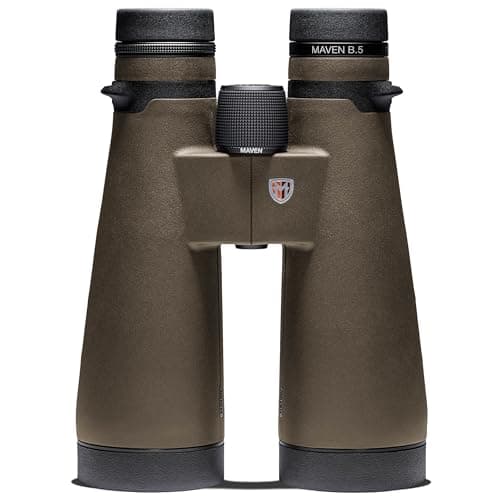 Maven B.5 15x56Fluorite glass behind Abbe-Koenig prisms and a 9.8 ft close focus - the only unit here whose maker names the glass type. | Best glass, and the shortest close focusBest glass in a 15x56 | 9.3out of 10 |
Prices are pulled live from Amazon and were last checked November 12, 2026; if a figure cannot be verified the button reads "Check price" instead. Scores are our editorial judgment against the published ranking criteria, on our published 8.4 to 9.8 recommendation scale. #ad How we earn.
The five units side by side
| Unit | Field @ 1,000 yd | Eye relief | Close focus | Weight | Exit pupil |
|---|---|---|---|---|---|
| Vortex Diamondback HD 15x56 | 230 ft | 15.6 mm | 14 ft | 34.8 oz | 3.73 mm |
| Athlon Cronus G2 UHD 15x56 | 235 ft | 18.5 mm | 13.1 ft | 45.2 oz | 3.73 mm |
| Zeiss Conquest HDX 15x56 | 240 ft | 18 mm | not published | 44.6 oz | 3.73 mm |
| Maven B.5 15x56 | 236 ft | 17.8 mm | 9.8 ft | 45 oz | 3.73 mm |
Twilight factor is 29 for all five, because it depends only on 15x and 56 mm. So does the exit pupil. No amount of money changes either number.
Read that table for a minute and the shape of the category appears. The optical specifications barely move: 14 ft of field separates the narrowest from the widest, and the exit pupil is identical across a five-fold price range. What does move is eye relief, which spreads 3.5 mm, and weight, where the Diamondback HD is nearly ten ounces lighter than anything else. Those two rows are where your money and your comfort actually go.
The tripod is not optional, and it is part of the price
Handholding 15x is not a skill issue. At 15x your own pulse and the micro-tremor in your forearms are magnified fifteen times along with the animal, and the image moves enough that you lose the resolving advantage you paid for. Across a full morning it also produces eye strain that will make you stop glassing early, which is the real cost. Every unit on this page assumes a tripod.
That changes the budget arithmetic in a way most roundups skip. A 34.8 oz binocular will sit still on a mid-weight tripod with a decent ball head. A 45 oz binocular on the same head will creep downward while you are looking through it, which is maddening. So the Athlon, the Zeiss and the Maven all carry an implied tripod upgrade that the Diamondback HD does not, and on the cheaper end of the market that upgrade can cost a meaningful fraction of the binocular. The best tripods for binoculars and the adapter that connects the two are the other half of this purchase.
All five of these are tripod-adaptable through the front hinge, which is the standard arrangement. You still need the stud adapter, and it is a separate purchase on every unit here.
15x56 or a spotting scope?
This is the real decision for most people reading this page, and the honest answer depends on whether you need to find animals or judge them. A 15x56 is a finding instrument: two eyes, 226 to 240 ft of field, comfortable for hours, and it will show you that something is bedded under the far rim. An 85 mm spotting scope at 20-60x is a judging instrument: one eye, 50 to 101 ft of field, tiring after twenty minutes, and it will tell you how many points that bedded animal carries.
If you hunt general-season deer where any legal animal is the animal, buy the 15x56 and skip the scope - you will find more game with it and carry four pounds less. If you are counting points on a draw tag, holding out for a specific animal, or judging sheep and goats, the scope is not optional and the 15x56 becomes the thing you grid-search with before you set up the scope on what you found. Most serious open-country hunters end up with both, in that order. Spotting scope vs binoculars argues it at length, and the Vortex Viper HD 20-60x85 review covers the scope most of these buyers step into.
Who should buy a 15x56, and who should not
- Buy one if you hunt open country - sage, burns, alpine basins, cut agricultural ground - and you already own a 10x42 you are happy with.
- Buy one if you glass from fixed vantage points for hours rather than still-hunting, and you own or will buy a tripod that can hold 35 to 45 oz steady.
- Buy one if you have been considering a spotting scope mainly to find animals rather than to judge them. This is lighter, cheaper and better at finding.
- Buy the Athlon instead of the Vortex if you glass in prescription glasses. 18.5 mm against 15.6 mm of eye relief is the clearest upgrade on this page.
- Buy the Zeiss or the Maven instead if your last hour of legal light is where your hunt gets decided, and you will use the optic enough seasons to amortize it.
- Skip it entirely if this would be your only binocular. A 15x56 cannot still-hunt, cannot be used handheld and is wrong for timber. Binocular magnification for hunting sets out what a first pair should be.
- Skip it if you will not carry a tripod. Without one you have bought a heavy, dim, narrow 10x42.
- Consider a 12x50 instead if you want one optic that can do both jobs passably. A 12x50 is handholdable braced, lighter, and gives a 4.17 mm exit pupil. The best 12x50 hunting binoculars covers that middle ground, and 10x42 vs 12x50 is the comparison.
The picks in full
Price as of November 12, 2026. #ad How we earn
Vortex Diamondback HD 15x56
A 3.73 mm exit pupil and 230 ft of field: the cheapest credible way to sit behind a tripod all morning without carrying a spotting scope.
| Magnification | 15x |
|---|---|
| Objective lens | 56 mm |
| Eye relief | 15.6mm |
| Field of view | 230' @ 1000 yds |
| Angular field of view | 4.4º |
| Close focus | 14.0' |
| Weight | 34.8 oz. |
| Height | 7.1" |
| Width | 5.8" |
| Exit pupil (computed) | 3.73 mm |
| Twilight factor (computed) | 29 |
Specs verified 2026-10-05 from Vortex's published specification. Exit pupil and twilight factor are computed, not quoted.
What it does well
- 15x finds animals a 10x walks past
- 56 mm objective keeps it usable at dawn
- Much lighter and cheaper than a spotting scope setup
Where it gives ground
- 34.8 oz and 15x means a tripod is mandatory, not optional
- Too much magnification for timber or still-hunting
Skip it if
This is your only pair of binoculars. 15x is a second optic, not a first one.
How this score breaks down
- Low-light performance (weight 5)8.0
- Optical quality per dollar (weight 4)9.0
- Field of view (weight 3)6.1
- Eye relief (weight 3)7.6
- Weight and ergonomics (weight 2)5.8
- Warranty (weight 2)10.0
Criterion scores are on the 0-10 rubric scale. Their weighted mean is 7.8, which maps to 9.1 on our published recommendation scale of 8.4 to 9.8 - the band of products we are willing to recommend at all. The weights, the definitions and the mapping are all published, so any score here can be checked against our own rules. These are editorial judgments from published specifications, computed optical arithmetic and documented consensus.
This is the pick for one specification: 34.8 oz. Every other 15x56 on this page weighs between 43.6 and 45.2 oz, which is 9 to 10 oz more - over half a pound of difference in an optic you are carrying to a vantage point and back. On a 15x that matters twice over, because the weight also decides which tripod head will hold it still.
The optical numbers are mid-pack rather than poor. Vortex publishes 230 ft of field at 1,000 yards, 15.6 mm of eye relief, a 4.4 degree angular field and a 14 ft close focus. Against the Zeiss Conquest HDX's 240 ft and the Cronus G2 UHD's 235 ft, you are giving up 5 to 10 ft of field - visible when you look for it, invisible when you are glassing. The exit pupil is 3.73 mm, identical to every other unit on this page, because 56 / 15 is 3.73 whether the glass costs $369 or $1,800.
The honest cons: HD glass rather than the ED or fluorite glass above it, which shows as more color fringing on high-contrast edges at dusk, and 15.6 mm of eye relief that sits only just above the 15 mm floor where a glasses wearer starts losing the edge of the field. If you glass in prescription lenses, the Cronus G2 UHD's 18.5 mm is a real upgrade and the single best reason on this page to spend more.
What makes it the recommendation anyway is the ratio. It is the cheapest credible 15x56 sold, it is the lightest by a wide margin, and it carries Vortex's unlimited unconditional lifetime warranty, which on a tripod optic that will get knocked over is worth more than a coating specification. The full Diamondback HD line sits in the under-$500 roundup.
Price as of November 12, 2026. #ad How we earn
Athlon Cronus G2 UHD 15x56
235 ft of field and 18.5 mm of eye relief on ED-glass UHD optics, for roughly half what the European 15x56s cost.
| Magnification | 15x |
|---|---|
| Objective lens | 56 mm |
| Eye relief | 18.5 mm |
| Field of view | 235 ft @ 1,000 yds |
| Angular field of view | 4.5º |
| Close focus | 4 m / 13.1 ft |
| Interpupillary distance | 59-74 mm |
| Weight | 45.2 oz |
| Dimensions | 8.7" x 6.2" |
| Exit pupil (computed) | 3.73 mm |
| Twilight factor (computed) | 29 |
Specs verified 2026-10-26 from Athlon's published specification. Exit pupil and twilight factor are computed, not quoted.
What it does well
- 18.5 mm of eye relief - comfortable in glasses, which matters over a four-hour sit
- 235 ft of field at 1,000 yards, 5 ft wider than the Diamondback HD
- UHD extra-low-dispersion glass with ESP dielectric prism coating
- Magnesium chassis and Athlon's lifetime warranty
Where it gives ground
- 45.2 oz is the heaviest unit on this page - a tripod is not optional
- 13.1 ft close focus is long, so it is useless for anything near you
- Athlon's published table gives no exit-pupil or transmission figure
- Resale is weaker than Vortex or Zeiss in the used market
Skip it if
You want one optic that does everything. This is a tripod instrument and nothing else.
How this score breaks down
- Low-light performance (weight 5)8.8
- Optical quality per dollar (weight 4)8.8
- Field of view (weight 3)7.5
- Eye relief (weight 3)9.5
- Weight and ergonomics (weight 2)5.0
- Warranty (weight 2)9.0
Criterion scores are on the 0-10 rubric scale. Their weighted mean is 8.3, which maps to 9.3 on our published recommendation scale of 8.4 to 9.8 - the band of products we are willing to recommend at all. The weights, the definitions and the mapping are all published, so any score here can be checked against our own rules. These are editorial judgments from published specifications, computed optical arithmetic and documented consensus.
The reason to buy this one is 18.5 mm of eye relief, which is the longest figure on this page and 2.9 mm longer than the Diamondback HD's. That gap is the difference between a glasses wearer seeing the whole 235 ft field and seeing a circle inside a black ring, and over a four-hour tripod sit it is the specification you will actually notice.
Athlon publishes 235 ft of field at 1,000 yards, a 4.5 degree angular field, a 13.1 ft close focus, 59 to 74 mm of interpupillary adjustment and 45.2 oz, on a magnesium chassis with UHD extra-low-dispersion glass and ESP dielectric prism coating that Athlon states reflects 99 percent of light through the prism assembly. Those are honest mid-alpha numbers. What Athlon does not publish is a light-transmission figure, which is the number that would settle the argument against the Zeiss.
The cons are weight and resale. 45.2 oz is the heaviest unit on this page, so the tripod head question becomes real - a cheap ball head will creep under it. And Athlon resells for less than Vortex or Zeiss, so if you are the sort of buyer who rotates glass every few seasons, the discount you got going in is a discount you give back coming out. What a tripod actually changes about glassing covers the head choice.
Price as of November 12, 2026. #ad How we earn
Zeiss Conquest HDX 15x56
240 ft of field, 90 percent published light transmission and 44.6 oz: the widest and brightest 15x56 here, at a price that assumes this is your glassing optic for a decade.
| Magnification | 15x |
|---|---|
| Objective lens | 56 mm |
| Eye relief | 18 mm |
| Field of view | 240 ft @ 1,000 yds |
| Light transmission | 90 % |
| Interpupillary distance | 54-74 mm |
| Diopter adjustment | +/- 4 dpt |
| Lens coatings | LotuTec / ZEISS T* |
| Waterproof | 400 mbar |
| Fogproof | Nitrogen purged |
| Weight | 44.6 oz |
| Dimensions (L x W x H) | 8.3 x 5.7 x 8.3 in |
| Exit pupil (published) | 3.7 mm |
| Exit pupil (computed) | 3.73 mm |
| Twilight factor (computed) | 29 |
Specs verified 2026-10-26 from Zeiss's published specification. Exit pupil and twilight factor are computed, not quoted.
What it does well
- 90 percent light transmission is the only transmission figure published by any brand on this page
- 240 ft of field at 1,000 yards - the widest 15x56 here
- 18 mm eye relief with FieldFlattener optics for edge-to-edge sharpness
- 54 mm minimum interpupillary distance, the narrowest here, so it fits more faces
- Transferable lifetime warranty plus a transferable five-year no-fault policy
Where it gives ground
- Costs roughly four Diamondback HD 15x56s
- Zeiss does not publish a close-focus figure for this model
- 44.6 oz still needs a tripod
- The HDX is a 2024 relabel of the Conquest HD line, so used HD stock can be much cheaper
Skip it if
You glass a few mornings a year. The light-transmission advantage is real and it is not worth four times the money at that usage.
How this score breaks down
- Low-light performance (weight 5)9.5
- Optical quality per dollar (weight 4)7.0
- Field of view (weight 3)9.5
- Eye relief (weight 3)9.0
- Weight and ergonomics (weight 2)6.5
- Warranty (weight 2)9.5
Criterion scores are on the 0-10 rubric scale. Their weighted mean is 8.6, which maps to 9.4 on our published recommendation scale of 8.4 to 9.8 - the band of products we are willing to recommend at all. The weights, the definitions and the mapping are all published, so any score here can be checked against our own rules. These are editorial judgments from published specifications, computed optical arithmetic and documented consensus.
Every brand on this page claims good low-light performance. Zeiss is the only one that publishes a number for it: 90 percent light transmission, with ZEISS T* coating, LotuTec hydrophobic treatment, ED glass, aspheric lenses and FieldFlattener optics. On a 56 mm objective at 15x, where the 3.73 mm exit pupil is already smaller than your dilated pupil at dusk, transmission is the specification that decides how long into legal light you can still judge an animal. A published figure beats five brands' adjectives.
The rest of the table supports it. 240 ft of field at 1,000 yards is the widest on this page, 18 mm of eye relief is second only to the Cronus G2 UHD, 44.6 oz is marginally lighter than the Athlon and the Maven, and the interpupillary range starts at 54 mm - the narrowest here, which matters if standard binoculars have always sat too wide for your face. Sealing is 400 mbar with nitrogen purging, and the warranty is a transferable limited lifetime plus a transferable five-year no-fault policy, which is unusual and genuinely valuable on resale.
Two honest cons. Zeiss publishes no close-focus figure for this model, so if you need to focus on something near you, that is unanswered. And the HDX designation is recent - it is the relabeled successor to the Conquest HD line - which means used and clearance Conquest HD 15x56 stock exists at a much lower price with substantially the same optical argument. If you are willing to buy used, look there first.
Price as of November 12, 2026. #ad How we earn
Maven B.5 15x56
Fluorite glass behind Abbe-Koenig prisms and a 9.8 ft close focus: the most completely specified 15x56 here, and the most expensive.
| Magnification | 15x |
|---|---|
| Objective lens | 56 mm |
| Eye relief | 17.8 mm |
| Field of view | 236 ft @ 1,000 yds |
| Angular field of view | 4.5º |
| Close focus | 9.8 ft |
| Prism | Abbe-Koenig |
| Glass | Fluorite |
| Interpupillary distance | 56-75 mm |
| Waterproof | 1 m for 30 min (IPX7) |
| Weight | 45 oz |
| Dimensions (W x H x D) | 6.1 x 8.2 x 2.6 in |
| Exit pupil (published) | 3.7 mm |
| Exit pupil (computed) | 3.73 mm |
| Twilight factor (computed) | 29 |
Specs verified 2026-10-26 from Maven's published specification. Exit pupil and twilight factor are computed, not quoted.
What it does well
- Fluorite glass - the only unit on this page where the manufacturer names the glass type
- Abbe-Koenig prisms, which have no silvered surface to lose light at
- 9.8 ft close focus, by far the shortest of any 15x56 here
- 236 ft of field with 17.8 mm of eye relief
- Lifetime warranty, sold direct
Where it gives ground
- The most expensive unit on this page by a clear margin
- 45 oz, effectively tied for heaviest here
- 17.8 mm eye relief is shorter than the Cronus G2 UHD's 18.5 mm
- Maven sells direct, so Amazon stock is intermittent
Skip it if
You will not use 15x on a tripod regularly enough to notice fluorite over ED glass. That is most hunters.
How this score breaks down
- Low-light performance (weight 5)9.5
- Optical quality per dollar (weight 4)6.5
- Field of view (weight 3)9.0
- Eye relief (weight 3)8.5
- Weight and ergonomics (weight 2)6.0
- Warranty (weight 2)9.5
Criterion scores are on the 0-10 rubric scale. Their weighted mean is 8.3, which maps to 9.3 on our published recommendation scale of 8.4 to 9.8 - the band of products we are willing to recommend at all. The weights, the definitions and the mapping are all published, so any score here can be checked against our own rules. These are editorial judgments from published specifications, computed optical arithmetic and documented consensus.
Two specifications make this one interesting rather than just expensive. First, Maven names the glass: fluorite, not "ED" or "UHD" or "HD", which are marketing tiers that mean different things at different brands. Second, the prisms are Abbe-Koenig rather than Schmidt-Pechan. An Abbe-Koenig prism works entirely by total internal reflection, so it has no silvered surface to lose light at, which is why it shows up in alpha glass and almost never below it. Roof prism vs porro prism explains what the prism choice does.
The published table: 236 ft of field at 1,000 yards, a 4.5 degree angular field, 17.8 mm of eye relief, a 9.8 ft close focus, 56 to 75 mm interpupillary, IPX7 sealing, 45 oz and a lifetime warranty sold direct. The 9.8 ft close focus deserves a note - it is less than a third of the Cronus G2 UHD's 13.1 ft and well under the Diamondback HD's 14 ft, which makes this the one 15x56 here you could also use to look at something close to you.
The cons are the price and the stock. This is the most expensive unit on the page by a clear margin, 17.8 mm of eye relief is actually shorter than the Athlon's, and Maven sells direct, so the Amazon listing comes and goes. If it is out of stock when you look, the Zeiss is the alternative with the published transmission figure, and the Maven B1.2 review covers what buying Maven direct is like.
Our recommendation
If you take one thing from this page, take this.
Vortex Diamondback HD 15x56
Best value, and the floor of the category
34.8 oz against 43.6-45.2 oz for everything else here, 230 ft of field, and roughly a quarter of what the European units cost.
Athlon Cronus G2 UHD 15x56
Best under $1,000
18.5 mm of eye relief, the most comfortable view on this page, with UHD extra-low-dispersion glass for roughly half the European price.
Prices are pulled live and shown on each button. #ad How we earn.
Questions people actually ask
Are 15x56 binoculars good for hunting?
Do you need a tripod for 15x56 binoculars?
How far can you see with 15x56 binoculars?
15x56 or a spotting scope?
Is a 15x56 brighter than a 10x42?
What is the lightest 15x56 binocular?
Which 15x56 has the best eye relief?
Sources
- Vortex Diamondback HD 15x56 - published specifications - read 2026-10-05
- Athlon Cronus G2 UHD 15x56 - published specifications - read 2026-10-26
- ZEISS Conquest HDX 15x56 - published technical data - read 2026-10-26
- Maven B.5 56 mm series - published specifications (15x56 column) - read 2026-10-26
- Leupold BX-5 Santiam HD 15x56 - published specifications - read 2026-10-26