We earn a commission if you buy through the links on this page, at no extra cost to you. It never changes which products we pick or how we rank them - read the full disclosure.
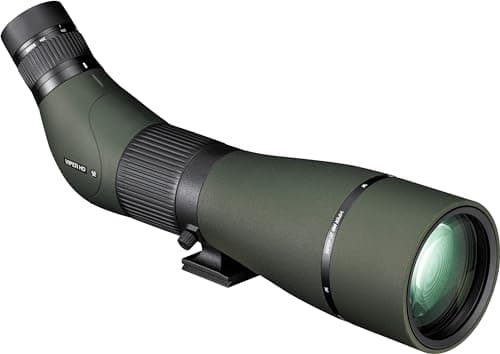
Reviewed here
Vortex Viper HD 20-60x85
The step where a spotting scope stops being a compromise: usable detail at 60x instead of giving up at 45x.
Price as of November 12, 2026. #ad How we earn
The Viper HD 20-60x85 is the scope hunters buy when the $500 tier stops being enough, and the glass genuinely earns the step. What nobody tells you at the counter is that it is also the heaviest 85 mm scope on this site at 76.6 oz - eleven ounces heavier than the premium Razor HD above it, which also has a wider field and a shorter close focus. That is the tension this review is about.
What Vortex publishes
Read off Vortex's own specification table: 20-60x magnification, an 85 mm objective, 17.8 to 19.6 mm of eye relief across the zoom, 101 ft of linear field at 20x falling to 50 ft at 60x, an angular field of 1.9 to 1.0 degrees, a 36 ft close focus, 76.6 oz of weight and 17.5 in of length, in a 45-degree angled body, with XR Plus fully multi-coated optics, an apochromatic lens system, ArmorTek exterior lens coatings, argon purging and O-ring sealing, and Vortex's unlimited unconditional lifetime VIP warranty.
Two figures below are ours rather than Vortex's, because they are arithmetic rather than measurement. The exit pupil at 20x is 85 / 20 = 4.25 mm, and at 60x it falls to 1.42 mm. The twilight factor at 20x is the square root of 20 x 85, which is 41.2. The 1.42 mm exit pupil at the top of the zoom is the honest limit on this and every other 85 mm scope - it is why nobody judges antler at 60x in the last ten minutes of light, regardless of what the glass cost. Exit pupil and twilight factor, worked through explains both numbers.
The apochromatic system is the thing you are paying for
An apochromatic lens system is designed to bring three wavelengths of light to the same focal point rather than two. The practical consequence is less chromatic aberration - the purple or green fringe you see on a high-contrast edge, which is most visible on exactly the thing a hunter is trying to resolve: a dark antler tine against a bright sky.
In a spotting scope this matters disproportionately at high magnification, because aberration scales with it. That is why the practical difference between this scope and the tier below it is not visible at 20x, where both look excellent, and is obvious at 55x, where one is still resolving and the other has gone soft. If you have been shopping 85 mm scopes and wondering what the price gap buys, that is the whole answer in one sentence. ED glass vs HD glass covers how the glass terminology actually maps to construction.
It is worth being clear about what it does not buy. It does not make the scope brighter - the exit pupil arithmetic above governs that, and it is identical on any 85 mm scope at the same magnification. It does not extend the hour you can judge in. It makes the detail you can already see cleaner, at the magnifications where the cheaper scope quits.
76.6 oz is the number to think hardest about
Nearly five pounds, plus a tripod rated to hold it steady at 60x, plus a head. In practice that is a seven to nine pound system, and it is the single most common reason a good spotting scope ends up living in a truck. An optic in the truck resolves nothing.
The comparison that makes this uncomfortable is internal to the Vortex lineup. The Razor HD 27-60x85 is 65.6 oz. The Diamondback HD 20-60x85 is 60.9 oz. The Athlon Ares G2 UHD 20-60x85 is 70 oz. The Viper HD is the heaviest of the four, and the two Vortex scopes on either side of it in price are both lighter. If you hunt from a vehicle, a blind or a short walk from camp, ignore this section entirely - the weight costs you nothing and the glass is excellent. If you carry your scope on your back for miles, it should make you look hard at the Razor HD, and at whether you need 85 mm at all.
The 36 ft close focus, and the field of view surprise
Two published rows on this scope are worse than the cheaper scope below it, and an honest review has to say so. The close focus is 36 ft against the Diamondback HD's 24.6 ft and the Razor HD's 16.4 ft, which makes this the longest close focus of any 85 mm scope on this site. For hunting, close focus is near-irrelevant - you are not judging an animal at 30 ft - but if you also want the scope for digiscoping something nearby or for range work on paper, it is a genuine limitation. The digiscoping phone adapter guide covers that use.
The field of view is the more surprising one. 101 ft at 20x is 7 ft narrower than the Diamondback HD's 108 ft at the same magnification, and at the top of the zoom 50 ft against the Razor HD's 68 ft is a wide gap. Field of view is what you grid-search with, so the cheaper scope is marginally better at finding and the more expensive scope is clearly better at it. The Viper HD's advantage is resolution, and it is purchased with field.
In practice this is an argument for not finding animals with your spotting scope at all. Searching through a 101 ft window at 20x is slow and tiring compared with searching through 230 ft of 15x56 binocular field, then setting the scope on what you found. The best 15x56 binoculars for hunting is the other half of that setup, and how to glass with a spotting scope is the method.
Angled body, and why that is the right default
The unit reviewed here is the 45-degree angled version, which is the one to buy for almost all hunting. An angled eyepiece lets you set the tripod lower, which is both more stable and less visible on a skyline, and it lets two people share the scope without re-leveling it. It is also far more comfortable when the animal is above you, which in mountain country is most of the time.
A straight body wins in two situations: digiscoping, where the camera sits more naturally in line, and glassing from a vehicle window, where you are looking roughly level and an angled eyepiece forces an awkward neck position. If neither of those is your main use, buy the angled one. Angled vs straight spotting scopes argues it properly.
Who should buy it, and who should not
- Buy it if you regularly judge animals past about 600 yards and you want the top third of the magnification range to actually work.
- Buy it if you glass in glasses - 17.8 to 19.6 mm of eye relief across the whole zoom is generous for a spotting scope and the field stays full.
- Buy it if you hunt from a vehicle, a blind, or within a short walk of camp, where 76.6 oz costs you nothing.
- Buy the Diamondback HD 20-60x85 instead if you stay between 20x and 45x. It is wider at 20x, nearly a pound lighter, and roughly half the money.
- Buy the Razor HD 27-60x85 instead if you find animals with binoculars and only use the scope to judge them. It is 11 oz lighter, wider at both ends of the zoom, and resolves better - you only give up the 20x floor.
- Consider the Athlon Ares G2 UHD 20-60x85 instead if price is the deciding factor at the 85 mm UHD tier. It is 70 oz and undercuts the Viper HD, with a narrower 99 ft field at 20x. The full Ares G2 UHD review sets out the trade.
- Skip it if you are carrying your optics on your back for miles. 76.6 oz plus a tripod stiff enough for 60x is the wrong system for that trip.
- Skip it if you glass inside 400 yards. Do you need a spotting scope is the page to read first, and the answer is often no.
This scope and its two closest alternatives
Price as of November 12, 2026. #ad How we earn
Vortex Viper HD 20-60x85
The step where a spotting scope stops being a compromise: usable detail at 60x instead of giving up at 45x.
| Magnification | 20-60x |
|---|---|
| Objective lens | 85 mm |
| Eye relief | 17.8mm - 19.6mm |
| Field of view | 101' - 50' @ 1000 yds |
| Angular field of view | 1.9º - 1.0º |
| Close focus | 36.0' |
| Weight | 76.6 oz. |
| Length | 17.5" |
| Exit pupil (computed) | 4.25 mm |
| Twilight factor (computed) | 41.2 |
Specs verified 2026-10-05 from Vortex's published specification. Exit pupil and twilight factor are computed, not quoted.
What it does well
- Holds resolution much deeper into the magnification range
- 17.8-19.6 mm eye relief across the zoom
- Apochromatic lens system controls color fringing
Where it gives ground
- 76.6 oz means a serious tripod
- Nearly twice the Diamondback HD's price
Skip it if
You judge animals inside 600 yards. The Diamondback HD does that.
How this score breaks down
- Resolution at top magnification (weight 5)9.0
- Usable magnification range (weight 4)9.1
- Eye relief across the zoom (weight 3)9.0
- Weight and packability (weight 3)6.2
- Build and sealing (weight 2)9.0
Criterion scores are on the 0-10 rubric scale. Their weighted mean is 8.5, which maps to 9.4 on our published recommendation scale of 8.4 to 9.8 - the band of products we are willing to recommend at all. The weights, the definitions and the mapping are all published, so any score here can be checked against our own rules. These are editorial judgments from published specifications, computed optical arithmetic and documented consensus.
The specification that justifies this scope is the apochromatic lens system, and the way it shows up is at the top of the zoom. A $500 85 mm scope will give you a clean, bright image from 20x to about 45x and then start to mush - contrast drops, color fringing appears on antler edges against sky, and the last third of the magnification range becomes a number on the ring rather than something you use. The Viper HD holds together to 60x. You are not buying more magnification; you are buying the magnification you already had.
The eyepiece is the other half of the argument. Vortex publishes 17.8 mm of eye relief at 60x rising to 19.6 mm at 20x, which is unusually generous for a spotting scope and means a glasses wearer can use the whole field at every magnification. That matters more on a scope than on a binocular, because you are pressing one eye to a single eyepiece and the vignetting is immediately obvious.
The cons are weight and close focus. 76.6 oz is nearly five pounds of scope, which is the heaviest 85 mm unit on this site - heavier than the Athlon Ares G2 UHD at 70 oz and, strangely, 11 oz heavier than the Razor HD above it. And the published close focus is 36 ft, which is more than double the Razor's 16.4 ft, so this is not the scope for watching anything near you. The field of view also sits at 101 ft at 20x against the Diamondback HD's 108 ft, so the cheaper scope actually shows you more at the bottom of the zoom.
Price as of November 12, 2026. #ad How we earn
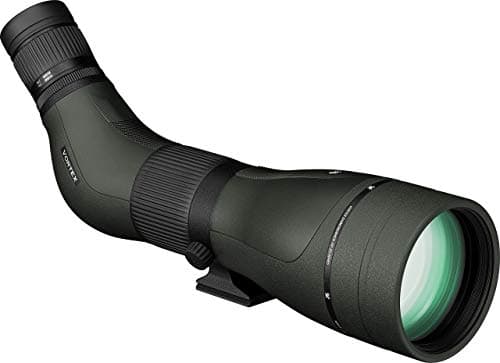
Vortex Diamondback HD 20-60x85
An 85 mm objective, 20-60x, and 18.3-20.3 mm of eye relief for around $500, which is the cheapest credible way into a real spotting scope.
| Magnification | 20-60x |
|---|---|
| Objective lens | 85 mm |
| Eye relief | 18.3mm - 20.3mm |
| Field of view | 108' - 60' @ 1000 yds |
| Angular field of view | 2.1º - 1.1º |
| Close focus | 24.6' |
| Weight | 60.9 oz. |
| Length | 16.0" |
| Exit pupil (computed) | 4.25 mm |
| Twilight factor (computed) | 41.2 |
Specs verified 2026-10-05 from Vortex's published specification. Exit pupil and twilight factor are computed, not quoted.
What it does well
- 85 mm objective gathers enough light for dawn judging
- 18.3-20.3 mm eye relief is unusually generous
- VIP warranty
Where it gives ground
- Image softens noticeably past about 45x
- Needs a tripod costing a meaningful fraction of the scope
Skip it if
You only glass inside 400 yards - 15x56 binoculars are lighter and cheaper.
How this score breaks down
- Resolution at top magnification (weight 5)7.9
- Usable magnification range (weight 4)8.4
- Eye relief across the zoom (weight 3)9.4
- Weight and packability (weight 3)6.8
- Build and sealing (weight 2)8.4
Criterion scores are on the 0-10 rubric scale. Their weighted mean is 8.1, which maps to 9.2 on our published recommendation scale of 8.4 to 9.8 - the band of products we are willing to recommend at all. The weights, the definitions and the mapping are all published, so any score here can be checked against our own rules. These are editorial judgments from published specifications, computed optical arithmetic and documented consensus.
This is the honest comparison, and for a lot of hunters it is the right answer. The Diamondback HD publishes the same 85 mm objective, 18.3 to 20.3 mm of eye relief - slightly more than the Viper HD - a wider 108 ft field at 20x, a much shorter 24.6 ft close focus, and 60.9 oz, which is nearly a pound lighter. On paper the only row the Viper HD clearly wins is the one the table cannot show you: resolution at the top of the zoom.
So the decision is about where you spend your time on the magnification ring. If you judge animals inside about 600 yards and mostly sit between 20x and 40x, the Diamondback HD does that job and keeps the money. If you regularly push past 45x on animals near a mile out, the Viper HD is the upgrade and the Diamondback HD will frustrate you. The full Diamondback HD 20-60x85 review makes the case for it, and the two compared head to head is the direct answer.
No buyable offer at the last price check.
Prices change; we show only live figures. #ad How we earn
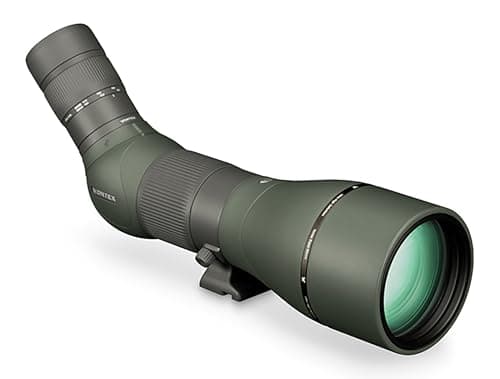
Vortex Razor HD 27-60x85
Starting at 27x rather than 20x, with 2.2-1.3 degrees of field: built for picking apart an animal you have already found, not for finding it.
| Magnification | 27-60x |
|---|---|
| Objective lens | 85 mm |
| Eye relief | 16.7mm - 17.0mm |
| Field of view | 117' - 68' @ 1000 yds |
| Angular field of view | 2.2º - 1.3º |
| Close focus | 16.4' |
| Weight | 65.6 oz. |
| Length | 15.5" |
| Exit pupil (computed) | 3.15 mm |
| Twilight factor (computed) | 47.9 |
Specs verified 2026-10-05 from Vortex's published specification. Exit pupil and twilight factor are computed, not quoted.
What it does well
- Resolution at the top of the zoom is genuinely usable
- Apochromatic optical system
- Rugged magnesium body
Where it gives ground
- 27x minimum makes initial scanning harder
- Premium price for a situational advantage
Skip it if
You use one optic to both find and judge animals.
How this score breaks down
- Resolution at top magnification (weight 5)9.6
- Usable magnification range (weight 4)8.6
- Eye relief across the zoom (weight 3)8.2
- Weight and packability (weight 3)6.2
- Build and sealing (weight 2)9.6
Criterion scores are on the 0-10 rubric scale. Their weighted mean is 8.5, which maps to 9.4 on our published recommendation scale of 8.4 to 9.8 - the band of products we are willing to recommend at all. The weights, the definitions and the mapping are all published, so any score here can be checked against our own rules. These are editorial judgments from published specifications, computed optical arithmetic and documented consensus.
Here is the fact that should change how you read the Viper HD: the Razor HD above it is 11 oz lighter at 65.6 oz, and it publishes a wider field at both ends of the zoom - 117 ft at 27x against the Viper HD's 101 ft at 20x, and 68 ft at 60x against 50 ft. Its close focus is 16.4 ft against 36 ft. So the premium tier is not just better glass here; it is a better-specified instrument on almost every published row.
What you give up is the bottom of the zoom. The Razor HD starts at 27x, which makes initial scanning harder - you have a narrower entry field to find the animal in before you zoom. If you use one optic to both find and judge, the Viper HD's 20x floor is genuinely more useful. If you find animals with 15x56 binoculars and only put the scope on something you have already located, the 27x floor costs you nothing and the Razor HD is the better scope. The Razor HD and Viper HD compared works through that trade in detail.
| Scope | Field @ 1,000 yd | Eye relief | Close focus | Weight | Length |
|---|---|---|---|---|---|
| Diamondback HD 20-60x85 | 108-60 ft | 18.3-20.3 mm | 24.6 ft | 60.9 oz | 16.0 in |
| Viper HD 20-60x85 | 101-50 ft | 17.8-19.6 mm | 36.0 ft | 76.6 oz | 17.5 in |
| Razor HD 27-60x85 | 117-68 ft | 16.7-17.0 mm | 16.4 ft | 65.6 oz | 15.5 in |
The Viper HD is the heaviest of the three and the narrowest at both ends of its zoom. What it buys over the Diamondback HD is resolution at the top of the magnification range, which no specification row can show you.
Our recommendation
If you take one thing from this page, take this.
Vortex Viper HD 20-60x85
The subject of this review
An apochromatic lens system that stays usable at 60x where the tier below gives up around 45x, with 17.8-19.6 mm of eye relief across the zoom.
Vortex Diamondback HD 20-60x85
The cheaper alternative most buyers should check first
Same 85 mm objective and a wider 108 ft field at 20x, for roughly half the money - with the image softening past about 45x.
Prices are pulled live and shown on each button. #ad How we earn.
Questions people actually ask
Is the Vortex Viper HD 20-60x85 worth it?
How much does the Vortex Viper HD 20-60x85 weigh?
Viper HD or Razor HD spotting scope?
Should I buy the angled or straight Viper HD?
What magnification do you actually use on a 20-60x spotting scope?
Is the Viper HD 20-60x85 good for backpack hunting?
Sources
- Vortex Viper HD 20-60x85 (angled) - published specifications - read 2026-10-05
- Vortex Diamondback HD 20-60x85 (angled) - published specifications - read 2026-10-05
- Vortex Razor HD 27-60x85 (angled) - published specifications - read 2026-10-05
- Athlon Ares G2 UHD 20-60x85 - published specifications (comparison figures) - read 2026-10-19