Digiscoping means holding a phone camera up to a spotting scope eyepiece so the scope acts as a very long telephoto lens. A clamp costs about $20. Here is the one thing it is genuinely good for and the three things it is not.
What it is genuinely good for
Sharing a judging call. You are looking at a bull across a basin and you are not sure. A photograph through the scope, shown to the person next to you or sent to someone who knows the area, turns a solitary judgment into a shared one. That is a real and specific benefit, and it is worth $20 on its own.
Secondarily: recording what you found for next season, documenting a specific animal across multiple days, and - prosaically - keeping a record that helps you learn what you were looking at when you got a call wrong.
What it is not good for
- Image quality you would call photography. A phone sensor behind a scope eyepiece at an effective focal length of several thousand millimeters produces a soft, low-contrast image by any photographic standard.
- Anything moving. The field of view is tiny and alignment is fiddly. By the time you have the phone clamped and aligned, a walking animal is gone.
- Low light. Exit pupil at the top of the zoom is already 1.42 mm on an 85 mm; a phone sensor behind that at dusk produces noise.
- Quick use. Clamping, aligning and focusing takes a minute or two. It is a deliberate act, not a reflex.
How to get a usable image
What you need
- A universal phone clamp
- A scope on a stable tripod
- A phone with a timer or a remote shutter
- 1
Set the scope to the bottom of the zoom first
20x or 25x. A wide field makes alignment far easier, and you can crop afterwards. Starting at 60x makes the dark-circle alignment problem much harder.
- 2
Focus the scope properly by eye before mounting the phone
Get the image sharp through the eyepiece with your own eye first. The phone's autofocus will then have something sharp to lock onto, rather than hunting.
- 3
Clamp the phone and align the lens over the eyepiece center
You are looking for the image to fill the frame rather than appearing as a small bright circle. Move the phone in and out from the eyepiece - this distance is the main variable, and it is why long eye relief helps.
- 4
Lock the phone's exposure and focus
On most phones, tap and hold on the subject. Without this the autofocus will hunt continuously as the image shifts, and the exposure will jump as bright sky enters the frame.
- 5
Use a timer or a remote, not the screen
Touching the screen vibrates the whole setup at an effective focal length where a tiny movement is a large blur. A two-second timer or a volume-button remote eliminates it.
- 6
Shoot a burst, and shoot video
Take ten frames and keep the best. Video is often more useful than stills for a judging call, because a few seconds of movement tells you more about an animal than one frame does.
The things that help most
Long eye relief, because it gives the phone lens room to sit at the correct distance - the Diamondback HD's published 18.3 to 20.3 mm is genuinely helpful here. A stable tripod, because at these effective focal lengths vibration is the dominant problem. And a low magnification setting, because alignment at 20x is manageable and at 60x it is not.
The three things that make it work
Price as of October 5, 2026. #ad How we earn
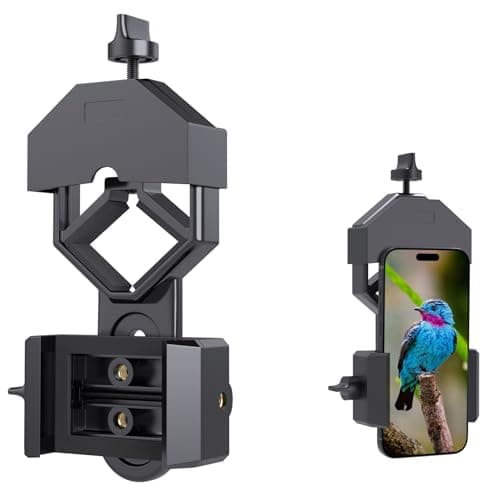
Gosky Universal Smartphone Digiscoping Adapter
A universal clamp that holds a phone over the eyepiece, which is how most hunters actually record what they are looking at.
Magnification and objective are the manufacturer's own model designation; exit pupil and twilight factor are computed from them. We could not machine-read Gosky's spec page, so the remaining published figures are not listed rather than guessed.
What it does well
- Fits most phones and most eyepieces
- Cheap enough to leave in the pack
- Makes sharing a judgment call possible
Where it gives ground
- Alignment is fiddly in the cold
- Adds vibration unless the tripod is solid
Skip it if
You need broadcast-quality footage.
How this score breaks down
- Resolution at top magnification (weight 5)7.0
- Usable magnification range (weight 4)7.0
- Eye relief across the zoom (weight 3)7.0
- Weight and packability (weight 3)9.5
- Build and sealing (weight 2)7.0
Weights and definitions are published on how we review. These are editorial judgments from published specs and documented consensus, not test results.
Fits most phones and most eyepieces. The fiddliness is inherent to the approach rather than to this product.
Price as of October 5, 2026. #ad How we earn
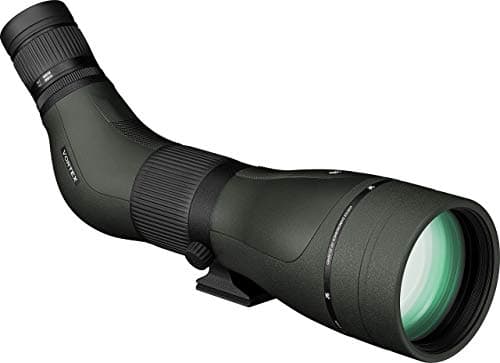
Vortex Diamondback HD 20-60x85
An 85 mm objective, 20-60x, and 18.3-20.3 mm of eye relief for around $500, which is the cheapest credible way into a real spotting scope.
| Magnification | 20-60x |
|---|---|
| Objective lens | 85 mm |
| Eye relief | 18.3mm - 20.3mm |
| Field of view | 108' - 60' @ 1000 yds |
| Angular field of view | 2.1º - 1.1º |
| Close focus | 24.6' |
| Weight | 60.9 oz. |
| Length | 16.0" |
| Exit pupil (computed) | 4.25 mm |
| Twilight factor (computed) | 41.2 |
Specs verified 2026-10-05 from Vortex's published specification. Exit pupil and twilight factor are computed, not quoted.
What it does well
- 85 mm objective gathers enough light for dawn judging
- 18.3-20.3 mm eye relief is unusually generous
- VIP warranty
Where it gives ground
- Image softens noticeably past about 45x
- Needs a tripod costing a meaningful fraction of the scope
Skip it if
You only glass inside 400 yards - 15x56 binoculars are lighter and cheaper.
How this score breaks down
- Resolution at top magnification (weight 5)8.0
- Usable magnification range (weight 4)8.5
- Eye relief across the zoom (weight 3)9.5
- Weight and packability (weight 3)7.0
- Build and sealing (weight 2)8.5
Weights and definitions are published on how we review. These are editorial judgments from published specs and documented consensus, not test results.
Long eye relief gives the phone lens room to sit at the right distance, which is the main variable in getting a full-frame image rather than a dark circle.
Price as of October 5, 2026. #ad How we earn
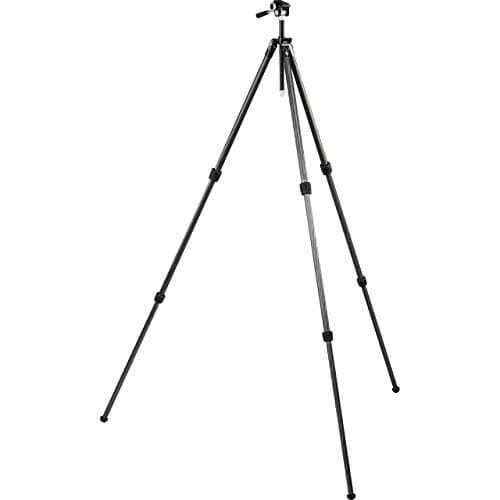
Vortex Ridgeview Carbon Tripod
Carbon legs at 3.2 lbs per Vortex's published spec, stiff enough to hold an 85 mm scope at 60x without the image breathing.
Magnification and objective are the manufacturer's own model designation; exit pupil and twilight factor are computed from them. We could not machine-read Vortex's spec page, so the remaining published figures are not listed rather than guessed.
What it does well
- Holds an 85 mm spotting scope steady at full magnification
- 3.2 lbs, verified in Vortex's published specification
- VIP warranty
Where it gives ground
- Costs as much as a Diamondback HD spotting scope
- Overbuilt for binocular-only use
Skip it if
You only tripod binoculars - the Mountain Pass is enough.
How this score breaks down
- Resolution at top magnification (weight 5)n/a
- Usable magnification range (weight 4)n/a
- Eye relief across the zoom (weight 3)n/a
- Weight and packability (weight 3)n/a
- Build and sealing (weight 2)n/a
Weights and definitions are published on how we review. These are editorial judgments from published specs and documented consensus, not test results.
Digiscoping is far more vibration-sensitive than looking through the scope, because the phone has no stabilization at effective focal lengths this long.
Questions people actually ask
What is digiscoping?
Is a phone adapter for a spotting scope worth it?
Why is my digiscoped image a small dark circle?
What magnification is best for digiscoping?
Sources
- Vortex Diamondback HD 20-60x85 published specifications - read 2026-10-05
- Vortex Ridgeview carbon tripod published specifications - read 2026-10-05