We earn a commission if you buy through the links on this page, at no extra cost to you. It never changes which products we pick or how we rank them - read the full disclosure.
Our top pick
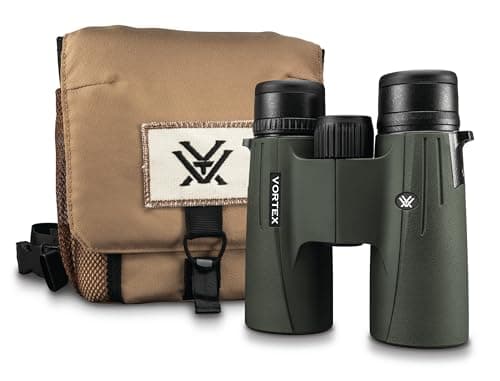
Vortex Viper HD 8x42
The same body and glass as the 10x42 with a 5.25 mm exit pupil instead of 4.2 mm, which is why it looks brighter in the final ten minutes of legal light.
Price as of October 5, 2026. #ad How we earn
Same objective lens, same body, same price, same warranty. The only difference is how much the image is magnified - and that one change pulls four separate specifications with it, two of which you can compute from the model name.
What actually changes
| Specification | 8x42 | 10x42 | Advantage |
|---|---|---|---|
| Exit pupil (computed: objective / magnification) | 5.25 mm | 4.20 mm | 8x42 by 25% |
| Twilight factor (computed: square root of mag x obj) | 18.3 | 20.5 | 10x42 by 12% |
| Published linear field at 1,000 yd | 409 ft | 341 ft | 8x42 by 68 ft |
| Published eye relief | 18.0 mm | 17.0 mm | 8x42 by 1 mm |
| Handheld steadiness | Noticeably better | Acceptable | 8x42 |
| Resolving detail past ~600 yd | Limited | Better | 10x42 |
| Published weight | 24.2 oz | 24.9 oz | Effectively equal |
So on paper the 8x42 wins four categories and the 10x42 wins one. That looks decisive until you notice that the one the 10x wins - resolvable detail at distance - is the entire reason people buy 10x. Specification tables cannot weight for your terrain. You have to.
The exit pupil argument, properly
Exit pupil is the diameter of the light column leaving the eyepiece, in millimeters, and it is simply objective divided by magnification. 42 / 8 = 5.25 mm. 42 / 10 = 4.20 mm.
Your own pupil dilates to roughly 5-7 mm in low light (less as you get older - a 50-year-old's dark-adapted pupil is typically smaller than a 20-year-old's). When the exit pupil is smaller than your pupil, you are feeding your eye less light than it could use, and the image looks dim. At the edges of legal light, an 8x42 delivers a visibly brighter image than a 10x42 of identical quality. This is not a close call and it is not subjective.
The twilight factor argument, properly
Twilight factor is the square root of magnification times objective: 18.3 for an 8x42, 20.5 for a 10x42. It is a crude attempt to index how much *detail* you can resolve in poor light, and it rewards magnification because magnification makes small details bigger than the eye's resolution limit.
The two figures genuinely conflict, and that is the honest core of this comparison. Exit pupil governs whether you can see that something is there. Twilight factor governs whether you can tell what it is. Which one you need depends on what is limiting you. Both, worked through in full.
Which to buy, by what you actually hunt
| If you mostly hunt | Buy | Because |
|---|---|---|
| Timber, thick cover, whitetail | 8x42 | Close shots, poor light, movement in brush. Our whitetail picks |
| Field edges and mixed farmland | 10x42 | Animals appear at 300-400 yd and need judging |
| Open western basins | 10x42, then add a tripod and 12x50 | Our western picks |
| From a treestand with a bow | 8x42 | Steady one-handed, bright at legal light. Bowhunting picks |
| You wear glasses | 8x42 | More eye relief and a more forgiving eyebox |
| You are over 50 | Either - the 8x advantage narrows | A smaller dark-adapted pupil cannot use the extra exit pupil |
The two models compared
Price as of October 5, 2026. #ad How we earn
Vortex Viper HD 8x42
The same body and glass as the 10x42 with a 5.25 mm exit pupil instead of 4.2 mm, which is why it looks brighter in the final ten minutes of legal light.
| Magnification | 8x |
|---|---|
| Objective lens | 42 mm |
| Eye relief | 18.0mm |
| Field of view | 409' @ 1000 yds |
| Angular field of view | 7.8º |
| Close focus | 6.0' |
| Weight | 24.5 oz. |
| Height | 5.6" |
| Width | 4.9" |
| Exit pupil (computed) | 5.25 mm |
| Twilight factor (computed) | 18.3 |
Specs verified 2026-10-05 from Vortex's published specification. Exit pupil and twilight factor are computed, not quoted.
What it does well
- 5.25 mm exit pupil is the brightest in the Viper 42 mm line
- 18.0 mm eye relief, the most forgiving in the range
- 409 ft field of view makes finding animals in cover faster
Where it gives ground
- 8x will not resolve a bedded buck at 800 yards
- Costs the same as the 10x42, so the choice is purely about terrain
Skip it if
Most of your glassing is across open basins - you will want the 10x or 12x.
How this score breaks down
- Low-light performance (weight 5)9.5
- Optical quality per dollar (weight 4)9.0
- Field of view (weight 3)9.5
- Eye relief (weight 3)9.5
- Weight and ergonomics (weight 2)8.0
- Warranty (weight 2)10.0
Weights and definitions are published on how we review. These are editorial judgments from published specs and documented consensus, not test results.
Brighter at dusk (5.25 mm exit pupil), wider field (409 ft at 1,000 yards), more eye relief (18.0 mm) and steadier in the hand. Published figures verified 2026-10-05.
Price as of October 5, 2026. #ad How we earn
Vortex Viper HD 10x42
The default answer when someone outgrows a $150 pair: 17 mm of eye relief, a 341 ft field of view and glass that holds its edges, at the price where diminishing returns start.
| Magnification | 10x |
|---|---|
| Objective lens | 42 mm |
| Eye relief | 17.0mm |
| Field of view | 341' @ 1000 yds |
| Angular field of view | 6.5º |
| Close focus | 6.0' |
| Weight | 24.9 oz. |
| Height | 5.6" |
| Width | 4.9" |
| Exit pupil (computed) | 4.2 mm |
| Twilight factor (computed) | 20.5 |
Specs verified 2026-10-05 from Vortex's published specification. Exit pupil and twilight factor are computed, not quoted.
What it does well
- 17.0 mm eye relief is generous enough for most glasses wearers
- 341 ft at 1,000 yards is a wide field for a 10x
- Vortex VIP warranty is unconditional and transferable
Where it gives ground
- 24.9 oz is noticeable on a chest harness over a long day
- The 12x50 costs little more if you glass open country
Skip it if
You hunt timber inside 200 yards - the 8x42 Diamondback does that job for less than half the money.
How this score breaks down
- Low-light performance (weight 5)8.5
- Optical quality per dollar (weight 4)9.0
- Field of view (weight 3)9.0
- Eye relief (weight 3)9.0
- Weight and ergonomics (weight 2)7.5
- Warranty (weight 2)10.0
Weights and definitions are published on how we review. These are editorial judgments from published specs and documented consensus, not test results.
Higher twilight factor (20.5 against 18.3), so more resolvable detail at distance, at the cost of a dimmer 4.2 mm exit pupil and 68 ft less field. Same body, same price, same warranty.
Questions people actually ask
Is 8x42 or 10x42 better for hunting?
Will I notice the difference between 8x and 10x?
Which is better for glassing from a tripod?
Does 8x42 really see less far than 10x42?
Sources
- Vortex Viper HD 8x42 published specifications - read 2026-10-05
- Vortex Viper HD 10x42 published specifications - read 2026-10-05