We earn a commission if you buy through the links on this page, at no extra cost to you. It never changes which products we pick or how we rank them - read the full disclosure.
Our top pick
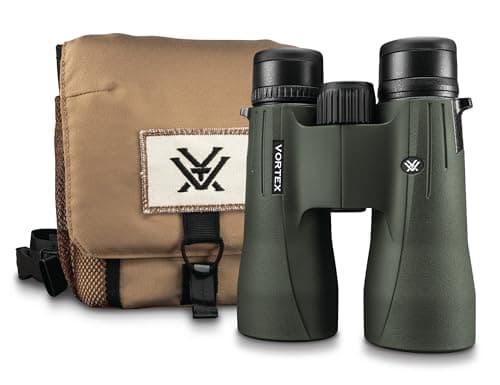
Vortex Viper HD 12x50
A 4.17 mm exit pupil and 288 ft of field, which is the trade you make for the extra detail; plan on a tripod, because 12x shows you your own pulse.
Price as of November 19, 2026. #ad How we earn
Most people assume stepping up from 10x42 to 12x50 means trading brightness for magnification. The arithmetic says otherwise, and that is the interesting part of this comparison.
The exit pupil barely changes
42 / 10 = 4.20 mm. 50 / 12 = 4.17 mm. A difference of three hundredths of a millimeter - which is to say, nothing. The 50 mm objective is doing exactly enough extra light-gathering to pay for the extra magnification.
Meanwhile the twilight factor goes from 20.5 to 24.5, a 20% rise in the index that tracks resolvable detail in poor light. So the 12x50 is a genuine upgrade in detail resolution for essentially no cost in apparent brightness. That is unusual in optics, where almost everything is a trade.
| Specification | 10x42 | 12x50 | Change |
|---|---|---|---|
| Exit pupil (computed) | 4.20 mm | 4.17 mm | Effectively none |
| Twilight factor (computed) | 20.5 | 24.5 | +20% to the 12x50 |
| Published field at 1,000 yd | 341 ft | 288 ft | -53 ft |
| Published eye relief | 17.0 mm | 16.0 mm | -1 mm |
| Published weight | 24.9 oz | 28.8 oz | +3.9 oz |
| Usable handheld for long sessions | Yes | No | The real cost |
So what is the catch
Two things, and the second is the one that decides it.
You lose 53 ft of field of view. That makes finding a moving animal slower, and in cover it is a real handicap. If you hunt timber, this alone rules the 12x50 out.
You cannot hold it still. This is the condition on everything above. At 12x, your pulse and your breathing are magnified along with the image, and the shake costs you more detail than the extra magnification gains. A 12x50 glassed handheld for twenty minutes resolves less than a steady 10x42 and leaves you with a headache. The 12x50 is only the better optic if you will actually carry a tripod, and most people who say they will do not. Tripod picks, and where the threshold sits.
The honest recommendation
- One binocular, carried all day, no tripod: 10x42. Not close.
- One binocular, mostly sitting and glassing, tripod in the pack: 12x50. The better tool for that job. The five 12x50s worth buying.
- Two binoculars: 10x42 on the chest, and 15x56 on the tripod rather than a 12x50 - if you are mounting anyway, go further. Western setups.
- Timber or whitetail: neither. An 8x42.
The two models compared
Price as of November 19, 2026. #ad How we earn
Vortex Viper HD 12x50
A 4.17 mm exit pupil and 288 ft of field, which is the trade you make for the extra detail; plan on a tripod, because 12x shows you your own pulse.
| Magnification | 12x |
|---|---|
| Objective lens | 50 mm |
| Eye relief | 16.0mm |
| Field of view | 288' @ 1000 yds |
| Angular field of view | 5.5º |
| Close focus | 8.0' |
| Weight | 28.8 oz. |
| Height | 6.5" |
| Width | 5.2" |
| Exit pupil (computed) | 4.17 mm |
| Twilight factor (computed) | 24.5 |
Specs verified 2026-10-05 from Vortex's published specification. Exit pupil and twilight factor are computed, not quoted.
What it does well
- 12x resolves antler detail a 10x leaves ambiguous
- 50 mm objective keeps the exit pupil close to the 10x42
- Still fits a standard bino harness
Where it gives ground
- Unusable handheld for sustained glassing - tripod required
- 288 ft field makes picking up moving animals harder
Skip it if
You will not carry a tripod. A shaky 12x sees less than a steady 10x.
How this score breaks down
- Low-light performance (weight 5)8.4
- Optical quality per dollar (weight 4)8.9
- Field of view (weight 3)7.2
- Eye relief (weight 3)8.1
- Weight and ergonomics (weight 2)6.8
- Warranty (weight 2)10.0
Criterion scores are on the 0-10 rubric scale. Their weighted mean is 8.3, which maps to 9.3 on our published recommendation scale of 8.4 to 9.8 - the band of products we are willing to recommend at all. The weights, the definitions and the mapping are all published, so any score here can be checked against our own rules. These are editorial judgments from published specifications, computed optical arithmetic and documented consensus.
A 4.17 mm computed exit pupil - essentially identical to a 10x42 - with a twilight factor of 24.5 against 20.5. Vortex publishes 288 ft and 16.0 mm (verified 2026-10-05).
No buyable offer at the last price check.
Prices change; we show only live figures. #ad How we earn
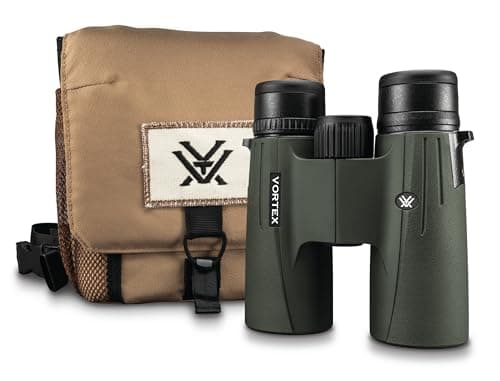
Vortex Viper HD 10x42
The default answer when someone outgrows a $150 pair: 17 mm of eye relief, a 341 ft field of view and glass that holds its edges, at the price where diminishing returns start.
| Magnification | 10x |
|---|---|
| Objective lens | 42 mm |
| Eye relief | 17.0mm |
| Field of view | 341' @ 1000 yds |
| Angular field of view | 6.5º |
| Close focus | 6.0' |
| Weight | 24.9 oz. |
| Height | 5.6" |
| Width | 4.9" |
| Exit pupil (computed) | 4.2 mm |
| Twilight factor (computed) | 20.5 |
Specs verified 2026-10-05 from Vortex's published specification. Exit pupil and twilight factor are computed, not quoted.
What it does well
- 17.0 mm eye relief is generous enough for most glasses wearers
- 341 ft at 1,000 yards is a wide field for a 10x
- Vortex VIP warranty is unconditional and transferable
Where it gives ground
- 24.9 oz is noticeable on a chest harness over a long day
- The 12x50 costs little more if you glass open country
Skip it if
You hunt timber inside 200 yards - the 8x42 Diamondback does that job for less than half the money.
How this score breaks down
- Low-light performance (weight 5)8.5
- Optical quality per dollar (weight 4)9.0
- Field of view (weight 3)8.9
- Eye relief (weight 3)9.1
- Weight and ergonomics (weight 2)7.6
- Warranty (weight 2)10.0
Criterion scores are on the 0-10 rubric scale. Their weighted mean is 8.8, which maps to 9.5 on our published recommendation scale of 8.4 to 9.8 - the band of products we are willing to recommend at all. The weights, the definitions and the mapping are all published, so any score here can be checked against our own rules. These are editorial judgments from published specifications, computed optical arithmetic and documented consensus.
341 ft of field against 288 ft, 24.9 oz against 28.8 oz, and genuinely usable handheld for sustained glassing. Published figures verified 2026-10-05.
Our recommendation
If you take one thing from this page, take this.
Vortex Viper HD 12x50
Pick the 12x50 if
You glass open country and will carry a tripod. Twilight factor 24.5.
Vortex Viper HD 10x42
Pick the 10x42 if
You walk more than you sit, or you will not carry a tripod.
No buyable offer at the last price check.
Prices are pulled live and shown on each button. #ad How we earn.
Questions people actually ask
Is 12x50 better than 10x42 for hunting?
Are 12x50 binoculars too heavy to carry?
Can you hold 12x binoculars steady?
Is a 12x50 brighter than a 10x42?
Sources
- Vortex Viper HD 12x50 published specifications - read 2026-10-05
- Vortex Viper HD 10x42 published specifications - read 2026-10-05