We earn a commission if you buy through the links on this page, at no extra cost to you. It never changes which products we pick or how we rank them - read the full disclosure.
Our top pick
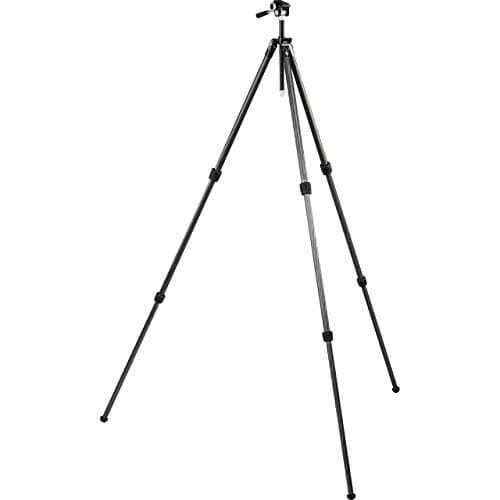
Vortex Ridgeview Carbon Tripod
Carbon legs at 3.2 lbs per Vortex's published spec, stiff enough to hold an 85 mm scope at 60x without the image breathing.
Price as of October 5, 2026. #ad How we earn
The most common way hunters waste money on optics is buying an $899 spotting scope and putting it on a $60 tripod. The scope then produces a soft, swimming image, and the owner concludes that spotting scopes are overrated.
Why the tripod is part of the optical system
At 60x, every angular movement of the scope is magnified 60 times at your eye. A tripod flexing by a fraction of a degree in a light breeze moves the image across a significant part of the field. You do not see it as movement - you see it as softness, because your eye cannot resolve detail in a moving image.
So the symptom of an inadequate tripod is exactly the symptom of poor glass, which is why the diagnosis goes wrong so often. If your scope seems soft at high magnification, check the tripod before you blame the scope. And check the focus, which is the other common culprit.
What stability costs
| Scope | Minimum sensible tripod | Cost | Note |
|---|---|---|---|
| 65 mm at 15-45x | 2.5 lb carbon | $399 | Complete system about 5 lbs |
| 80 mm at 20-40x | 3.1 lb aluminum | $149 | Workable if you do not exceed 40x |
| 85 mm at 20-45x | 3.1 lb aluminum, in calm conditions | $149 | Marginal in wind |
| 85 mm at 50-60x | 3.2 lb stiff carbon | $499 | Anything less wastes the scope |
Weights read from Vortex's published specifications on 2026-10-05. Notice that the stiffer carbon tripod is HEAVIER than the lighter carbon one - stiffness and weight are not inversely related within a material.
That last note is worth dwelling on, because it is counterintuitive. Vortex's Ridgeview at 3.2 lbs is heavier than its Summit Carbon II at 2.5 lbs, and both are carbon. The extra weight is extra material, and extra material is stiffness. You cannot buy stiffness and lightness simultaneously; you can only buy them more efficiently with carbon than with aluminum.
Quick picks
Ranked by the criteria published on how we review. Tap any row for the full write-up, or go straight to the current price.
| # | Product | Best for | Score | Price |
|---|---|---|---|---|
| 1 | Vortex Ridgeview Carbon Tripod3.2 lbs of carbon, built stiff, about $499. | Best for spotting scopesBest glassing tripod | 8.7out of 10 | |
| 2 | 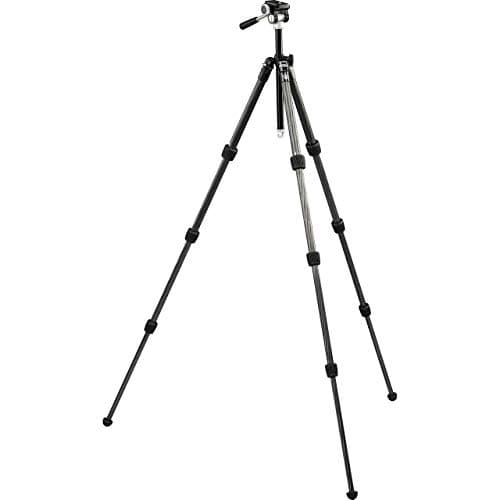 Vortex Summit Carbon II Tripod Kit2.5 lbs of carbon, about $399. | Best for a 65 mm scopeLightest credible tripod | 8.3out of 10 | |
| 3 | 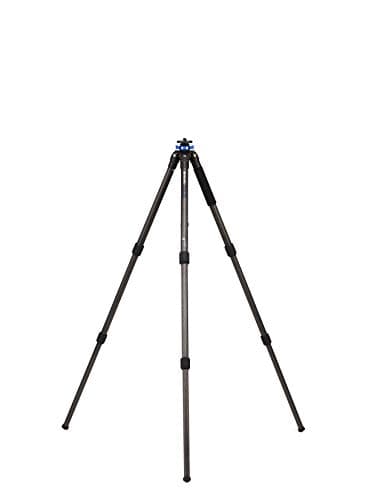 Benro Mach3 TripodCarbon with a high load rating, about $385. | Best stability per dollarStability per dollar | 8.3out of 10 | |
| 4 | 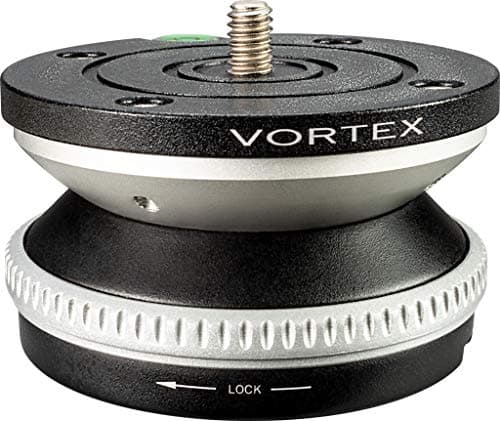 Vortex Pro Tripod Leveling HeadA leveling kit for about $69. | The accessory that helps mostLeveling a tripod fast | 8.4out of 10 | |
| 5 | 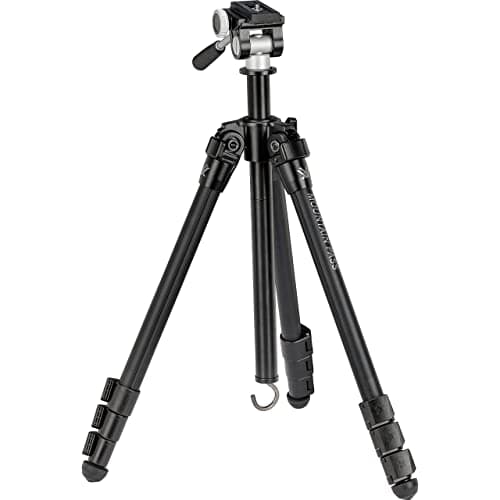 Vortex Mountain Pass Tripod Kit3.1 lbs of aluminum with a head, about $149. | The budget option, with a caveatBest tripod under $150 | 7.8out of 10 |
Prices are pulled live from Amazon and were last checked October 5, 2026; if a figure cannot be verified the button reads "Check price" instead. Scores are our editorial judgment against the published ranking criteria, not a test result. #ad How we earn.
The head, and the leveling problem
A ball head is fine for binoculars and workable for a scope. For a scope, a fluid or pan-tilt head makes smooth tracking easier, which matters when you are following an animal at 50x.
The bigger practical problem is leveling on a slope, and spotting scope work almost always happens on slopes. Without a leveling base, getting the head square means adjusting individual leg lengths, which is slow and gets worse every time you shift position. A $69 leveling kit lets you square the head independently of the legs, and on a side hill it is the difference between glassing and fighting equipment.
Three free things that improve any tripod
- Keep the center column retracted. It is the single biggest loss of stability on any tripod, and sitting down instead costs nothing.
- Let go of the scope after adjusting. Your hand on the body is a vibration source. Adjust, release, then look.
- Spread the legs wide and seat the feet. On soft ground, push the feet in. On rock, find three contact points rather than balancing on uneven ones.
The picks in detail
Price as of October 5, 2026. #ad How we earn
Vortex Ridgeview Carbon Tripod
Carbon legs at 3.2 lbs per Vortex's published spec, stiff enough to hold an 85 mm scope at 60x without the image breathing.
Magnification and objective are the manufacturer's own model designation; exit pupil and twilight factor are computed from them. We could not machine-read Vortex's spec page, so the remaining published figures are not listed rather than guessed.
What it does well
- Holds an 85 mm spotting scope steady at full magnification
- 3.2 lbs, verified in Vortex's published specification
- VIP warranty
Where it gives ground
- Costs as much as a Diamondback HD spotting scope
- Overbuilt for binocular-only use
Skip it if
You only tripod binoculars - the Mountain Pass is enough.
How this score breaks down
- Core function (stability or protection) (weight 5)9.5
- Noise and access speed (weight 4)8.0
- Fit, adjustability and comfort (weight 3)8.5
- Weather protection or build (weight 3)9.0
- Value for money (weight 3)8.0
Weights and definitions are published on how we review. These are editorial judgments from published specs and documented consensus, not test results.
Vortex publishes 3.2 lbs (verified 2026-10-05) - heavier than their Summit Carbon II specifically because it is built stiffer. For an 85 mm scope at 60x that stiffness is the whole point: this is the cheapest tripod here that will actually let an $899 scope deliver what it can.
Price as of October 5, 2026. #ad How we earn
Vortex Summit Carbon II Tripod Kit
2.5 lbs of carbon per Vortex's published spec: light enough to actually carry on a day hunt, which is the only tripod spec that matters.
Magnification and objective are the manufacturer's own model designation; exit pupil and twilight factor are computed from them. We could not machine-read Vortex's spec page, so the remaining published figures are not listed rather than guessed.
What it does well
- 2.5 lbs, verified in Vortex's published specification
- Carbon legs damp vibration better than aluminum
- Packs short enough to strap to a day pack
Where it gives ground
- Less stable than the Ridgeview under a heavy scope
- Leg locks need care in grit
Skip it if
You run an 85 mm scope at 60x in wind.
How this score breaks down
- Core function (stability or protection) (weight 5)8.5
- Noise and access speed (weight 4)8.0
- Fit, adjustability and comfort (weight 3)8.0
- Weather protection or build (weight 3)8.5
- Value for money (weight 3)8.5
Weights and definitions are published on how we review. These are editorial judgments from published specs and documented consensus, not test results.
Vortex publishes 2.5 lbs (verified 2026-10-05). Paired with a 40.4 oz 65 mm scope this makes a complete system at about 5 lbs, which is the lightest credible backcountry glassing setup. Under an 85 mm in wind it is working harder than the Ridgeview.
Price as of October 5, 2026. #ad How we earn
Benro Mach3 Tripod
Carbon legs with a high load rating at a price that undercuts hunting-branded carbon, if you can live with photographic ergonomics.
Magnification and objective are the manufacturer's own model designation; exit pupil and twilight factor are computed from them. We could not machine-read Benro's spec page, so the remaining published figures are not listed rather than guessed.
What it does well
- High load rating for the weight
- Carbon damping at a sub-$400 price
- Solid leg locks
Where it gives ground
- Head sold separately in some configurations
- No hunting-specific features
Skip it if
You want a complete kit out of the box.
How this score breaks down
- Core function (stability or protection) (weight 5)9.0
- Noise and access speed (weight 4)7.5
- Fit, adjustability and comfort (weight 3)8.0
- Weather protection or build (weight 3)8.0
- Value for money (weight 3)9.0
Weights and definitions are published on how we review. These are editorial judgments from published specs and documented consensus, not test results.
A photographic tripod with a high load rating for the weight, which undercuts hunting-branded carbon. What you give up is hunting-specific features and, depending on configuration, the head.
Price as of October 5, 2026. #ad How we earn
Vortex Pro Tripod Leveling Head
A leveling kit that lets you square the head without re-setting the legs, which is the difference between glassing and fighting a tripod on a side hill.
Magnification and objective are the manufacturer's own model designation; exit pupil and twilight factor are computed from them. We could not machine-read Vortex's spec page, so the remaining published figures are not listed rather than guessed.
What it does well
- Levels the head independently of the legs
- Useful on any uneven ground
- VIP warranty
Where it gives ground
- Adds weight and height to the stack
- Only worth it if you glass on slopes
Skip it if
You glass from flat ground or a vehicle.
How this score breaks down
- Core function (stability or protection) (weight 5)8.5
- Noise and access speed (weight 4)8.0
- Fit, adjustability and comfort (weight 3)8.5
- Weather protection or build (weight 3)8.5
- Value for money (weight 3)8.5
Weights and definitions are published on how we review. These are editorial judgments from published specs and documented consensus, not test results.
Lets you level the head without resetting the legs, which on a side hill is the difference between glassing and fighting the tripod. If you glass on slopes - and spotting scope work usually means slopes - this is a better $69 than almost any other upgrade.
Price as of October 5, 2026. #ad How we earn
Vortex Mountain Pass Tripod Kit
3.1 lbs of aluminum with a ball head included, which makes it the cheapest way to get binoculars genuinely steady.
Magnification and objective are the manufacturer's own model designation; exit pupil and twilight factor are computed from them. We could not machine-read Vortex's spec page, so the remaining published figures are not listed rather than guessed.
What it does well
- Ball head included at $149
- Stable enough for 15x56 binoculars
- VIP warranty
Where it gives ground
- 3.1 lbs of aluminum is heavy for the stability it gives
- Not stiff enough for an 85 mm scope at 60x
Skip it if
You own a spotting scope. Buy carbon.
How this score breaks down
- Core function (stability or protection) (weight 5)7.0
- Noise and access speed (weight 4)7.5
- Fit, adjustability and comfort (weight 3)8.0
- Weather protection or build (weight 3)8.0
- Value for money (weight 3)9.0
Weights and definitions are published on how we review. These are editorial judgments from published specs and documented consensus, not test results.
Here because many people will buy at this price anyway. It will hold a 65 mm scope at moderate magnification acceptably. Under an 85 mm at 60x in wind, it is the limiting component - and you will blame the scope.
Questions people actually ask
What tripod do I need for an 85 mm spotting scope?
Why does my spotting scope image look soft at high magnification?
Do I need a fluid head for a spotting scope?
Is a photographic tripod good enough for a spotting scope?
Sources
- Vortex Ridgeview carbon tripod published specifications - read 2026-10-05
- Vortex Summit Carbon II tripod published specifications - read 2026-10-05
- Vortex Mountain Pass tripod kit published specifications - read 2026-10-05