These are the only two numbers in binocular buying that you can calculate yourself, verify independently, and trust completely - because they are arithmetic rather than claims. They also contradict each other, which is why understanding both matters more than knowing either.
Exit pupil: how bright the image looks
Exit pupil (mm) = objective diameter / magnification.
It is the physical diameter of the cone of light emerging from the eyepiece. You can see it: hold binoculars at arm's length pointed at a bright sky and you will see two small discs of light in the eyepieces. That disc is the exit pupil, and you can measure it with a ruler.
Why it matters: your own pupil is the aperture receiving that light. In bright daylight your pupil is 2-3 mm, so every binocular here delivers more light than you can use and they all look similar. In low light your pupil opens to roughly 5-7 mm, and now a binocular delivering a 4.2 mm column is only filling part of your receiving aperture. One delivering 5.25 mm fills more of it. That is the entire mechanism, and it is why an 8x42 looks brighter at dusk than a 10x42 regardless of price.
Twilight factor: how much detail you can resolve
Twilight factor = the square root of (magnification x objective diameter).
For a 10x42: the square root of 420, which is 20.5. It is a German-derived index intended to predict how much *detail* you can resolve in poor light, and it rewards magnification because magnification makes fine detail larger than your eye's resolution limit.
It is crude. It takes no account of glass quality, coatings, or transmission, and it implies that a 15x56 is better in low light than an 8x42 - which is true for reading an antler tine and false for noticing that an animal is there at all. Treat it as a comparison tool between formats, not as a measure of a binocular.
Both figures, every common format
| Format | Exit pupil | Twilight factor | Best at |
|---|---|---|---|
| 8x32 | 4.00 mm | 16.0 | Daylight, in a small package |
| 10x32 | 3.20 mm | 17.9 | Daylight only - the lowest exit pupil here |
| 8x42 | 5.25 mm | 18.3 | Seeing that an animal is there, at dusk |
| 10x42 | 4.20 mm | 20.5 | The all-round compromise |
| 10x50 | 5.00 mm | 22.4 | Nearly 8x42 brightness with more reach. Heavy. |
| 12x50 | 4.17 mm | 24.5 | Judging detail at distance. Tripod. |
| 15x56 | 3.73 mm | 29.0 | Maximum detail from a tripod. Dim at dusk. |
| 20x60 | 3.00 mm | 34.6 | Tripod-only. Dim. |
Exit pupil = objective / magnification. Twilight factor = square root of (magnification x objective). Both computed by us; neither is quoted from a manufacturer.
Read down the two numeric columns and the contradiction is obvious: as you go down the table, exit pupil mostly falls while twilight factor rises steadily. They are measuring different things and they disagree by design.
How to use both without getting confused
- Ask what is limiting you. Not seeing animals at all in poor light is an exit pupil problem. Seeing a shape but not being able to judge it is a twilight factor problem.
- Set an exit pupil floor. 4 mm minimum for anything used at dawn or dusk; 5 mm if that is your main concern.
- Then maximize twilight factor within that floor. A 10x50 at 5.00 mm and 22.4 is a genuinely clever answer that almost nobody considers, because it is heavy.
- Remember the tripod constraint. Any format above 10x needs support to deliver what the arithmetic promises.
- Remember what neither figure covers. Transmission, resolution and color fidelity are where money goes and where arithmetic stops helping.
Three formats that demonstrate the trade
Price as of October 5, 2026. #ad How we earn
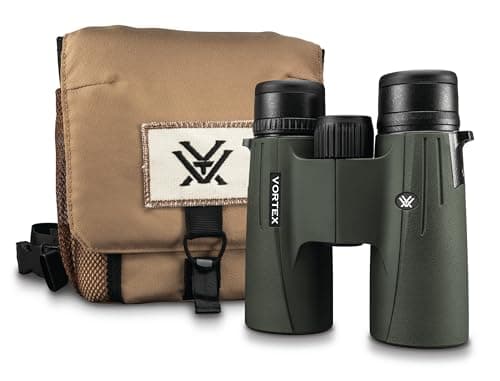
Vortex Viper HD 8x42
The same body and glass as the 10x42 with a 5.25 mm exit pupil instead of 4.2 mm, which is why it looks brighter in the final ten minutes of legal light.
| Magnification | 8x |
|---|---|
| Objective lens | 42 mm |
| Eye relief | 18.0mm |
| Field of view | 409' @ 1000 yds |
| Angular field of view | 7.8º |
| Close focus | 6.0' |
| Weight | 24.5 oz. |
| Height | 5.6" |
| Width | 4.9" |
| Exit pupil (computed) | 5.25 mm |
| Twilight factor (computed) | 18.3 |
Specs verified 2026-10-05 from Vortex's published specification. Exit pupil and twilight factor are computed, not quoted.
What it does well
- 5.25 mm exit pupil is the brightest in the Viper 42 mm line
- 18.0 mm eye relief, the most forgiving in the range
- 409 ft field of view makes finding animals in cover faster
Where it gives ground
- 8x will not resolve a bedded buck at 800 yards
- Costs the same as the 10x42, so the choice is purely about terrain
Skip it if
Most of your glassing is across open basins - you will want the 10x or 12x.
How this score breaks down
- Low-light performance (weight 5)9.5
- Optical quality per dollar (weight 4)9.0
- Field of view (weight 3)9.5
- Eye relief (weight 3)9.5
- Weight and ergonomics (weight 2)8.0
- Warranty (weight 2)10.0
Weights and definitions are published on how we review. These are editorial judgments from published specs and documented consensus, not test results.
42 / 8 = 5.25 mm. If your pupil opens to 5.5 mm in the dark, this format fills it and a 10x42 does not.
Price as of October 5, 2026. #ad How we earn
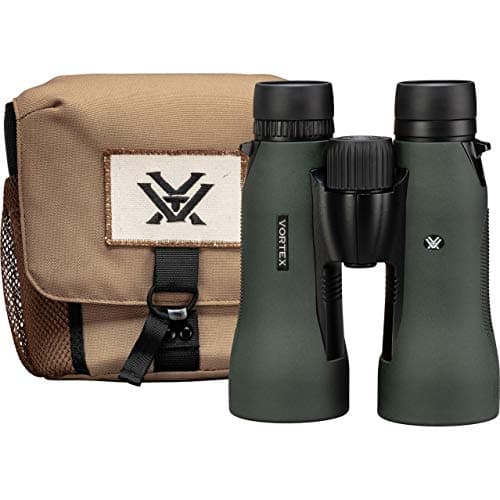
Vortex Diamondback HD 15x56
A 3.73 mm exit pupil and 230 ft of field: the cheapest credible way to sit behind a tripod all morning without carrying a spotting scope.
| Magnification | 15x |
|---|---|
| Objective lens | 56 mm |
| Eye relief | 15.6mm |
| Field of view | 230' @ 1000 yds |
| Angular field of view | 4.4º |
| Close focus | 14.0' |
| Weight | 34.8 oz. |
| Height | 7.1" |
| Width | 5.8" |
| Exit pupil (computed) | 3.73 mm |
| Twilight factor (computed) | 29 |
Specs verified 2026-10-05 from Vortex's published specification. Exit pupil and twilight factor are computed, not quoted.
What it does well
- 15x finds animals a 10x walks past
- 56 mm objective keeps it usable at dawn
- Much lighter and cheaper than a spotting scope setup
Where it gives ground
- 42.7 oz and 15x means a tripod is mandatory, not optional
- Too much magnification for timber or still-hunting
Skip it if
This is your only pair of binoculars. 15x is a second optic, not a first one.
How this score breaks down
- Low-light performance (weight 5)7.5
- Optical quality per dollar (weight 4)9.0
- Field of view (weight 3)6.0
- Eye relief (weight 3)7.5
- Weight and ergonomics (weight 2)5.5
- Warranty (weight 2)10.0
Weights and definitions are published on how we review. These are editorial judgments from published specs and documented consensus, not test results.
The square root of 15 x 56 is 29.0, the highest here - while the exit pupil of 3.73 mm is the lowest. The two figures pointing opposite ways is the whole subject of this page.
Price as of October 5, 2026. #ad How we earn
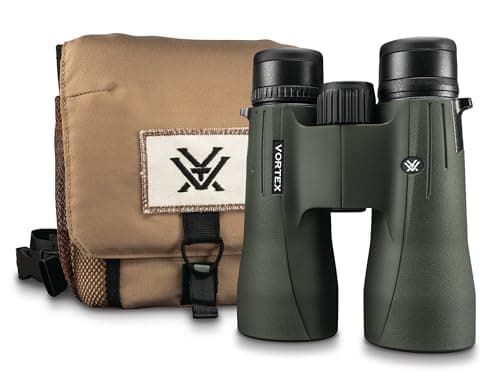
Vortex Viper HD 12x50
A 4.17 mm exit pupil and 288 ft of field, which is the trade you make for the extra detail; plan on a tripod, because 12x shows you your own pulse.
| Magnification | 12x |
|---|---|
| Objective lens | 50 mm |
| Eye relief | 16.0mm |
| Field of view | 288' @ 1000 yds |
| Angular field of view | 5.5º |
| Close focus | 8.0' |
| Weight | 28.8 oz. |
| Height | 6.5" |
| Width | 5.2" |
| Exit pupil (computed) | 3.5 mm |
| Twilight factor (computed) | 22.4 |
Specs verified 2026-10-05 from Vortex's published specification. Exit pupil and twilight factor are computed, not quoted.
What it does well
- 12x resolves antler detail a 10x leaves ambiguous
- 50 mm objective keeps the exit pupil close to the 10x42
- Still fits a standard bino harness
Where it gives ground
- Unusable handheld for sustained glassing - tripod required
- 288 ft field makes picking up moving animals harder
Skip it if
You will not carry a tripod. A shaky 12x sees less than a steady 10x.
How this score breaks down
- Low-light performance (weight 5)8.0
- Optical quality per dollar (weight 4)9.0
- Field of view (weight 3)7.0
- Eye relief (weight 3)8.0
- Weight and ergonomics (weight 2)6.5
- Warranty (weight 2)10.0
Weights and definitions are published on how we review. These are editorial judgments from published specs and documented consensus, not test results.
The format where the arithmetic works out best: nearly a 10x42's exit pupil with a 20% higher twilight factor.
Questions people actually ask
How do you calculate exit pupil?
What is a good exit pupil for hunting binoculars?
What is twilight factor and is it useful?
Does a bigger exit pupil always mean a brighter image?
Sources
- Vortex Viper HD 8x42 published specifications - read 2026-10-05
- Vortex Diamondback HD 15x56 published specifications - read 2026-10-05