We earn a commission if you buy through the links on this page, at no extra cost to you. It never changes which products we pick or how we rank them - read the full disclosure.
Our top pick
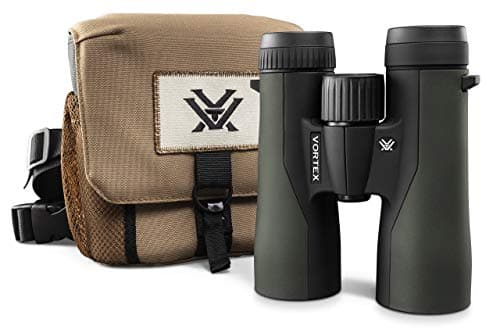
Vortex Crossfire HD 10x42
The entry point: HD glass, 325 ft of field, and the same VIP warranty, for roughly what a decent pair of boots costs.
Price as of October 5, 2026. #ad How we earn
You own a cheap pair of binoculars. You have found their limit - they gray out before legal light ends, or the edges smear, or you cannot hold them still. This page is about what the next few hundred dollars actually fixes, in order, with the arithmetic shown. It is the longest thing on this site because the honest answer has several parts.
First: name the complaint
This is the step that saves money, and almost nobody does it. "I want better binoculars" is not actionable. "They go gray twenty minutes before legal light ends" is, and it points at a specific fix that may not be the fix you were about to buy.
| What is annoying you | What actually fixes it | Cost |
|---|---|---|
| They go gray before legal light ends | An 8x42 format - 5.25 mm exit pupil, not more money | $239 |
| I cannot hold them still | Lower magnification, or a tripod | $0, or $149 |
| The edges are soft | Better glass and coatings | $250 to $500 |
| They fog up inside | Any gas-purged binocular | $149 |
| I lose the field edge with glasses on | Published eye relief above 17 mm | $239 |
| I cannot judge an animal at 600 yards | Magnification plus a tripod | $370 plus $149 |
| They swing, bang and end up in my pack | A harness | $29 |
| Everything looks fine, I just want better | Honestly? A tripod and a rangefinder | $216 and $200 |
Four of those eight rows are not solved by buying a better binocular. Two are fixed by a format change, one by a $29 harness, one by a tripod. That is the single most useful thing on this page.
The curve, step by step
What follows is the honest shape of the upgrade path. Each step is smaller than the one before it, and the first step is enormous.
$60 to $150: transformative
This is the only genuinely transformative step. Below about $120 you are buying a binocular whose coatings lose a quarter or more of the light entering them, whose prisms may be BK-7 rather than BaK-4 (which clips the edge of the exit pupil and grays the corners), and which may not be sealed against moisture.
At $149 with a specification that says fully multi-coated, BaK-4, nitrogen purged and HD glass, you have a binocular that will not let you down inside 300 yards in reasonable light. Vortex publishes 325 ft of field and 15.0 mm of eye relief for the Crossfire HD 10x42 (verified 2026-10-05). Nothing else you buy later will feel like this step did.
$150 to $250: clear and worth it
The second-largest improvement, and for most hunters this is where to stop. You get genuine HD glass, a wider field (Vortex publishes 330 ft for the Diamondback HD 10x42, verified 2026-10-05), better edge performance, and noticeably better light transmission.
The thing to understand is what does not change. Exit pupil is 4.2 mm on both, because 42 / 10 = 4.2 regardless of price. Twilight factor is 20.5 on both. The format fixes those, and no amount of money alters them. The arithmetic in full.
$250 to $500: real, and conditional
Here the improvement is specific rather than general: better transmission through better coatings, which shows in the last ten minutes of legal light, and 2 mm more eye relief, which matters enormously if you wear glasses and not at all if you do not.
Vortex publishes 341 ft and 17.0 mm for the Viper HD 10x42 against the Diamondback HD's 330 ft and 15 mm (both verified 2026-10-05). Eleven feet of field and two millimeters of eye relief, for $260. Whether that is worth it depends entirely on whether you hunt the edges of the day or wear glasses. If neither, this step is discretionary. The two compared directly.
$500 to $1,200: small
Premium prism designs - Abbe-Koenig prisms avoid the lossy reflective surface a Schmidt-Pechan needs - better glass formulations, and an image that holds together closer to the field edge. You will see it side by side on a tripod. On a hillside at 300 yards with an animal moving, you mostly will not.
The exit pupil is still 4.2 mm. The twilight factor is still 20.5. Where the money goes in detail.
$1,200 to $2,000: very small optically
The last increment of resolution and color neutrality, plus field service and resale value that make a binocular a twenty-year purchase. Those are legitimate reasons to buy alpha glass. "It will transform your hunting" is not one, and anybody telling you it will is selling something.
Quick picks
Ranked by the criteria published on how we review. Tap any row for the full write-up, or go straight to the current price.
| # | Product | Best for | Score | Price |
|---|---|---|---|---|
| 1 | Vortex Crossfire HD 10x42325 ft of field and HD glass for about $149. | Step 1: the floorThe cheapest pair worth owning | 8.0out of 10 | |
| 2 | 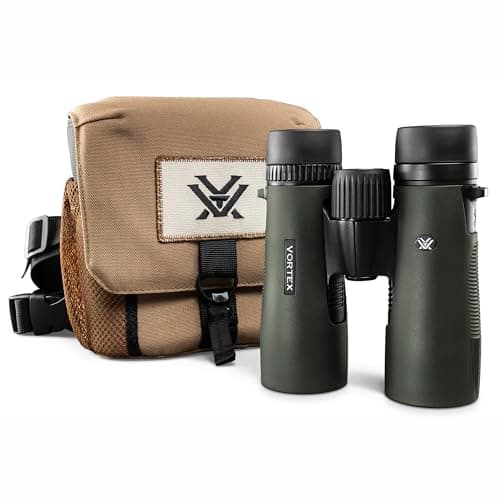 Vortex Diamondback HD 10x42330 ft of field and real HD glass for about $236. | Step 2: where most should stopBest value overall | 8.6out of 10 | $236.00 on Amazon $249.00 5% off |
| 3 | 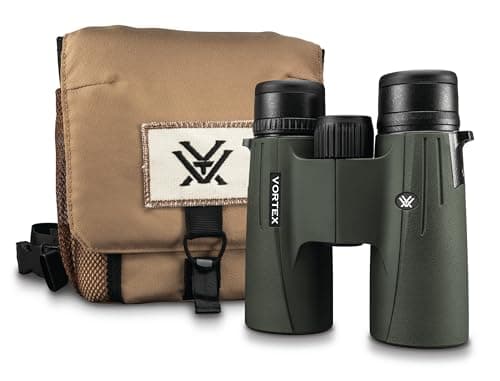 Vortex Viper HD 8x425.25 mm exit pupil, 409 ft of field, 18.0 mm eye relief. | Step 3: if low light is the problemLast light and timber | 9.1out of 10 | |
| 4 | 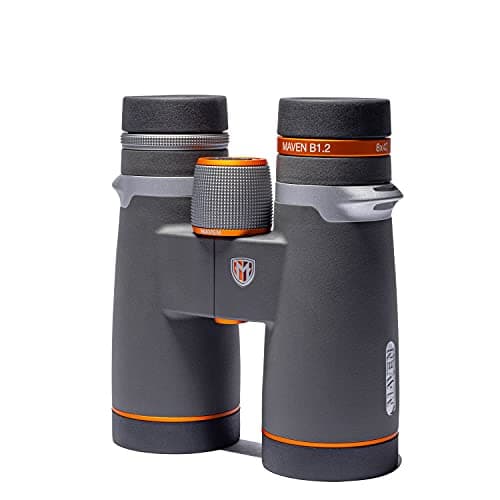 Maven B1.2 10x42Alpha-adjacent glass at about $1,150. | Step 4: diminishing returnsDirect-to-consumer alpha | 8.7out of 10 | |
| 5 | 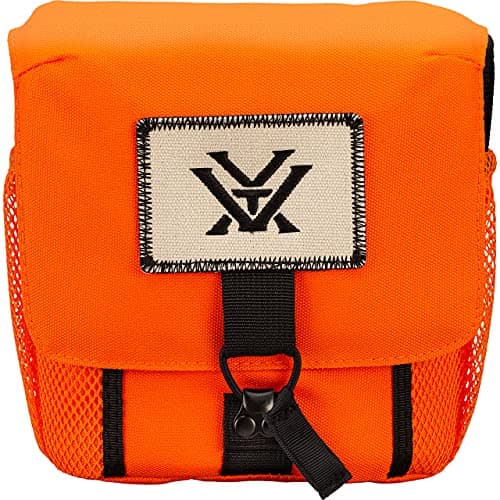 Vortex GlassPak Binocular HarnessA harness, which improves any binocular on this page. | The $29 that beats a stepCheapest harness worth buying | 8.5out of 10 |
Prices are pulled live from Amazon and were last checked October 5, 2026; if a figure cannot be verified the button reads "Check price" instead. Scores are our editorial judgment against the published ranking criteria, not a test result. #ad How we earn.
The three things money does not fix
Worth stating clearly, because each one gets people to spend money that does not help.
1. Exit pupil. 42 / 10 = 4.2 mm on a $149 binocular and on a $1,999 binocular. If your complaint is apparent brightness at dusk, the fix is an 8x42 at 5.25 mm, in any price bracket. The $239 Diamondback HD 8x42 beats the $1,999 Swarovski EL 10x42 at that specific task, and that is division rather than provocation.
2. Handheld shake. No binocular is steadier than another at the same magnification. If you cannot hold it still, you need either less magnification or a tripod. Where the threshold is.
3. Technique. The biggest single improvement available to most hunters is glassing slowly, in a system, from a braced position - and it is free. Sweeping a hillside finds animals you would have seen anyway. The grid method finds bedded ones. How to do it.
The alternative use of the money
Say you have $600 and you were going to spend it on a binocular. Here is the comparison this site keeps coming back to:
| One $600 binocular | A $236 binocular plus the rest | |
|---|---|---|
| Binocular | A $600 10x42 | Diamondback HD 10x42, $236 |
| Carry | Neck strap | GlassPak harness, $29 |
| Support | None | Mountain Pass tripod plus adapter, $216 |
| Yardage | None | $119 towards an RX-1400i |
| What you gain | Better transmission at dusk, 11 ft more field | Sustainable grid glassing, 12x-capability, trusted yardage |
The second column changes what you can see and what you can ethically shoot at. The first changes how pleasant the view is. For a hunter upgrading from cheap glass, the second column is the better purchase nearly every time - which is an awkward thing for a page about upgrading binoculars to conclude, and it is what we think is true.
The order to buy in
- A binocular at the $150 to $250 tier, in the right format for your terrain. Which format.
- A harness, $29. Non-negotiable. It determines whether you carry the binocular at all.
- A tripod and adapter, about $216. This is where most people would have bought better glass, and it is a mistake. Why.
- A rangefinder, about $200, with angle compensation. If you bowhunt, move this to second. Picks.
- Now better glass, if you can name what is limiting you. The $500 tier. What it buys.
- A spotting scope, last, and only when judging at 800 yards is specifically the constraint. When.
Every step on the curve, side by side
Price as of October 5, 2026. #ad How we earn
Vortex Crossfire HD 10x42
The entry point: HD glass, 325 ft of field, and the same VIP warranty, for roughly what a decent pair of boots costs.
| Magnification | 10x |
|---|---|
| Objective lens | 42 mm |
| Eye relief | 15.0mm |
| Field of view | 325' @ 1000 yds |
| Angular field of view | 6.2º |
| Close focus | 6.0' |
| Weight | 23.0 oz. |
| Height | 6.0" |
| Width | 5.2" |
| Exit pupil (computed) | 4.2 mm |
| Twilight factor (computed) | 20.5 |
Specs verified 2026-10-05 from Vortex's published specification. Exit pupil and twilight factor are computed, not quoted.
What it does well
- Cheapest Vortex with genuine HD glass
- 325 ft field of view is respectable at this price
- VIP warranty is identical to the $1,800 Razor
Where it gives ground
- Noticeably softer at the edges than the Diamondback HD
- Low-light performance is where the savings show
Skip it if
Your complaint about your current pair is that it grays out early - this will not fix that.
How this score breaks down
- Core function (weight 5)n/a
- Value per dollar (weight 4)9.0
- Low-light performance (weight 3)5.5
- Ergonomics and carry (weight 2)8.0
- Warranty (weight 2)10.0
Weights and definitions are published on how we review. These are editorial judgments from published specs and documented consensus, not test results.
The point at which a binocular stops being a false economy. Below this, coatings and prisms fail exactly when you need them.
Vortex Diamondback HD 10x42
The honest floor for hunting glass: HD optical system, 330 ft of field and 15 mm of eye relief for about half what the Viper costs.
| Magnification | 10x |
|---|---|
| Objective lens | 42 mm |
| Eye relief | 15 mm |
| Field of view | 330 feet/1000 yards |
| Angular field of view | 6.3 degrees |
| Close focus | 6.7 feet |
| Weight | 21.4 oz |
| Height | 5.8 inches |
| Width | 5.1 inches |
| Exit pupil (computed) | 4.2 mm |
| Twilight factor (computed) | 20.5 |
Specs verified 2026-10-05 from Vortex's published specification. Exit pupil and twilight factor are computed, not quoted.
What it does well
- Genuine HD glass at the $250 tier
- 330 ft field of view matches binoculars costing twice as much
- Same unconditional VIP warranty as the Viper
Where it gives ground
- 15 mm eye relief is tight for some glasses wearers
- Edge sharpness falls off before the Viper's does
Skip it if
You wear glasses and have struggled with eye relief before - try the 8x42, which gives 17 mm.
How this score breaks down
- Core function (weight 5)n/a
- Value per dollar (weight 4)9.5
- Low-light performance (weight 3)7.0
- Ergonomics and carry (weight 2)8.0
- Warranty (weight 2)10.0
Weights and definitions are published on how we review. These are editorial judgments from published specs and documented consensus, not test results.
The largest improvement per dollar anywhere on the curve, and genuinely sufficient for hunting inside 300 yards in reasonable light.
Price as of October 5, 2026. #ad How we earn
Vortex Viper HD 8x42
The same body and glass as the 10x42 with a 5.25 mm exit pupil instead of 4.2 mm, which is why it looks brighter in the final ten minutes of legal light.
| Magnification | 8x |
|---|---|
| Objective lens | 42 mm |
| Eye relief | 18.0mm |
| Field of view | 409' @ 1000 yds |
| Angular field of view | 7.8º |
| Close focus | 6.0' |
| Weight | 24.5 oz. |
| Height | 5.6" |
| Width | 4.9" |
| Exit pupil (computed) | 5.25 mm |
| Twilight factor (computed) | 18.3 |
Specs verified 2026-10-05 from Vortex's published specification. Exit pupil and twilight factor are computed, not quoted.
What it does well
- 5.25 mm exit pupil is the brightest in the Viper 42 mm line
- 18.0 mm eye relief, the most forgiving in the range
- 409 ft field of view makes finding animals in cover faster
Where it gives ground
- 8x will not resolve a bedded buck at 800 yards
- Costs the same as the 10x42, so the choice is purely about terrain
Skip it if
Most of your glassing is across open basins - you will want the 10x or 12x.
How this score breaks down
- Core function (weight 5)n/a
- Value per dollar (weight 4)9.0
- Low-light performance (weight 3)9.5
- Ergonomics and carry (weight 2)8.0
- Warranty (weight 2)10.0
Weights and definitions are published on how we review. These are editorial judgments from published specs and documented consensus, not test results.
Note this is the 8x42, not the 10x42. If your complaint is that your binoculars go gray early, the format change does more than the budget change.
Price as of October 5, 2026. #ad How we earn
Maven B1.2 10x42
Maven sells direct and skips the dealer margin, which is how a $1,150 binocular ends up competing with glass priced nearer $2,000.
| Magnification | 10x |
|---|---|
| Objective lens | 42 mm |
| Exit pupil (computed) | 4.2 mm |
| Twilight factor (computed) | 20.5 |
Magnification and objective are the manufacturer's own model designation; exit pupil and twilight factor are computed from them. We could not machine-read Maven's spec page, so the remaining published figures are not listed rather than guessed.
What it does well
- Optically competitive with binoculars costing far more
- Customizable finish when ordered direct
- Unconditional lifetime warranty
Where it gives ground
- Mostly a direct-sale product, so stock on Amazon moves
- No dealer network for hands-on comparison
Skip it if
You want to look through it before buying. Maven's model makes that hard.
How this score breaks down
- Core function (weight 5)n/a
- Value per dollar (weight 4)8.0
- Low-light performance (weight 3)9.5
- Ergonomics and carry (weight 2)8.0
- Warranty (weight 2)9.5
Weights and definitions are published on how we review. These are editorial judgments from published specs and documented consensus, not test results.
Better than step 3. Not better in proportion to the price, and the same 4.20 mm exit pupil as the $149 pair at step 1.
Price as of October 5, 2026. #ad How we earn
Vortex GlassPak Binocular Harness
At $29 this is the default: it holds the binoculars against your chest, closes over them in rain, and costs less than a tank of fuel.
Magnification and objective are the manufacturer's own model designation; exit pupil and twilight factor are computed from them. We could not machine-read Vortex's spec page, so the remaining published figures are not listed rather than guessed.
What it does well
- $29 for a harness that genuinely works
- Fully encloses the binoculars against weather
- VIP warranty
Where it gives ground
- No rangefinder pouch
- Fabric is noisier than premium harnesses
Skip it if
You carry a rangefinder too - get the Pro or a Marsupial.
How this score breaks down
- Core function (weight 5)8.5
- Value per dollar (weight 4)n/a
- Low-light performance (weight 3)n/a
- Ergonomics and carry (weight 2)n/a
- Warranty (weight 2)n/a
Weights and definitions are published on how we review. These are editorial judgments from published specs and documented consensus, not test results.
Included on a page about spending more money because it is the cheapest genuine improvement available and most people skip it.
Questions people actually ask
Are expensive binoculars worth it?
What should I upgrade from my cheap binoculars to?
Will better binoculars help me see animals in low light?
Should I buy better binoculars or a tripod?
How much should I spend upgrading?
Sources
- Vortex Crossfire HD 10x42 published specifications - read 2026-10-05
- Vortex Diamondback HD 10x42 published specifications - read 2026-10-05
- Vortex Viper HD 10x42 published specifications - read 2026-10-05
- Vortex Viper HD 8x42 published specifications - read 2026-10-05