We earn a commission if you buy through the links on this page, at no extra cost to you. It never changes which products we pick or how we rank them - read the full disclosure.
Our top pick
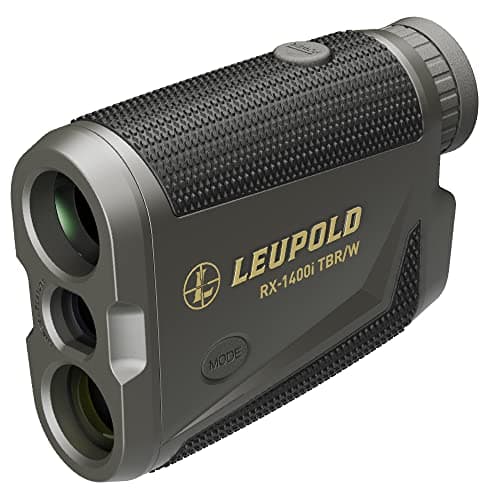
Leupold RX-1400i TBR/W Gen 2
TBR/W gives you the true horizontal distance and a holdover value in the same readout, which is the single most useful feature on a hunting rangefinder.
Price as of October 5, 2026. #ad How we earn
A rangefinder tells you how far away something is. A hunting rangefinder tells you how far to shoot - and those are different numbers the moment the ground is not flat. Everything on this page is ranked with that distinction first.
Angle compensation is the feature. Everything else is convenience.
Gravity acts over the horizontal distance, not the line-of-sight distance your laser measures. From 20 feet up a treestand, an animal at 30 yards of line of sight is about 28 yards horizontally - and a bow sighted for 30 shoots high. Across a canyon at a 25-degree downward angle, 500 yards of line of sight is roughly 453 yards of true ballistic range.
That is the whole case. A rangefinder without angle compensation gives you a precisely measured wrong number on any sloped ground. The full explanation, with the trigonometry.
The advertised range is not the range you get
| Stated figure | Measured against | Realistic on a dark animal |
|---|---|---|
| 450 yd | Reflective surfaces | Roughly 200-250 yd in good light |
| 1,400 yd | Reflective surfaces | Comfortable inside 400-500 yd |
| 1,800 yd | Reflective surfaces | Roughly 600-800 yd in good conditions |
| 3,000 yd and up | Reflective, often tripod-mounted | Beyond any ethical hunting distance |
Rain, snow, haze, heat shimmer and low light all reduce these figures, sometimes by half. This is physics rather than a manufacturing shortfall - deer hide is a poor reflector.
Quick picks
Ranked by the criteria published on how we review. Tap any row for the full write-up, or go straight to the current price.
| # | Product | Best for | Score | Price |
|---|---|---|---|---|
| 1 | Leupold RX-1400i TBR/W Gen 2TBR/W returns a holdover, not just a corrected distance, for about $200. | Best overallBest rangefinder under $250 | 8.9out of 10 | |
| 2 | 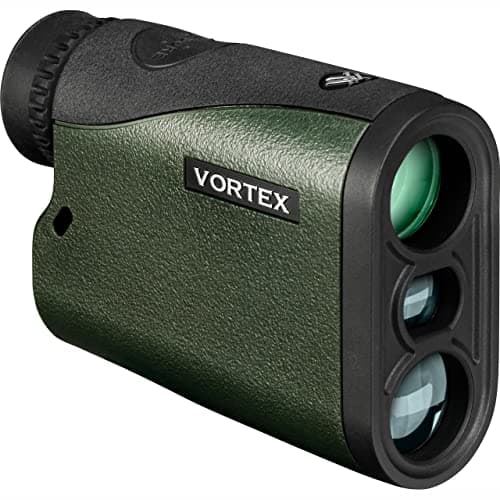 Vortex Crossfire HD 1400HCD angle compensation and a 5x21 optic for about $193. | Best valueSimplest reliable ranging | 7.9out of 10 | |
| 3 | 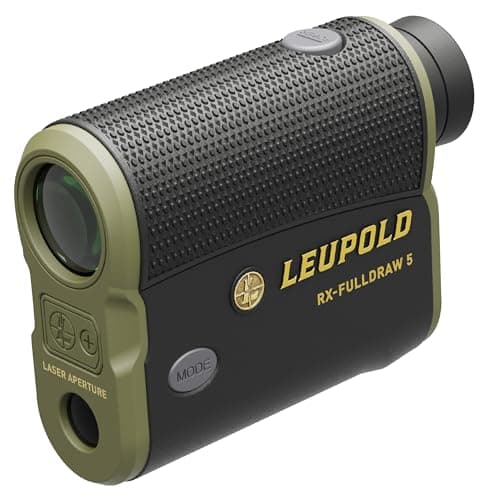 Leupold RX-FullDraw 5Takes your arrow weight and speed and returns a pin-matched distance. | Best for bowhuntingBowhunting | 9.0out of 10 | |
| 4 | 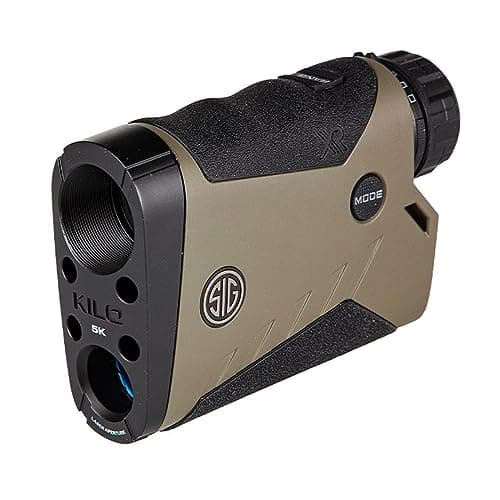 Sig Sauer KILO5KApplied Ballistics onboard in a 7x25 body, about $700. | Best for long rangeLong-range ballistic solving | 8.9out of 10 | |
| 5 | 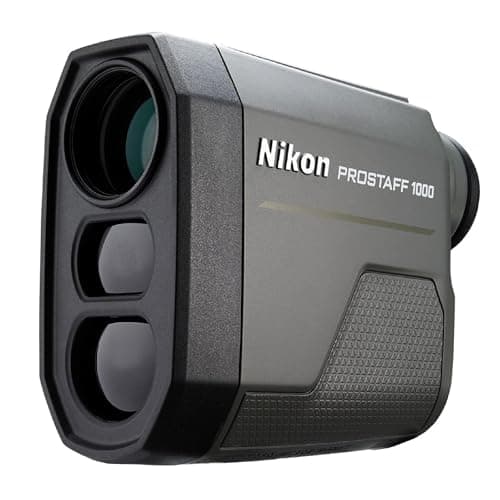 Nikon Prostaff 1000No angle compensation, reliable inside whitetail distances, about $157. | Best simple unitCheapest unit worth trusting | 5.9out of 10 | $157.06 on Amazon $199.95 21% off |
| 6 | 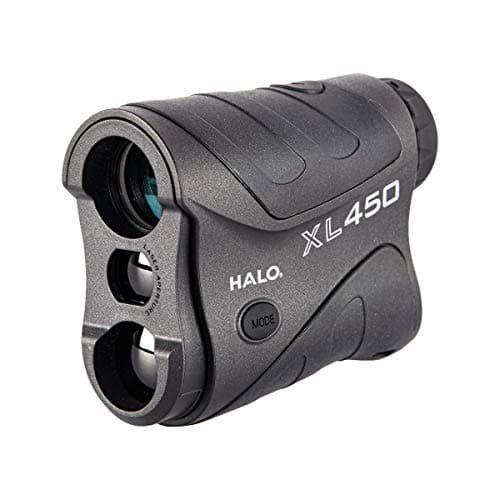 Halo Optics XL450Angle intelligence on a sub-$60 unit, with the limits you would expect. | The $55 optionThe $55 option | 6.1out of 10 | $54.96 on Amazon $69.95 21% off |
Prices are pulled live from Amazon and were last checked October 5, 2026; if a figure cannot be verified the button reads "Check price" instead. Scores are our editorial judgment against the published ranking criteria, not a test result. #ad How we earn.
How we ranked these
In weighted order: ranging accuracy and realistic range on game, angle compensation implementation, display legibility in low light, speed and scan mode, and one-handed ergonomics. Those weights are published on how we review, and each pick's breakdown is expandable on its card.
The three flavors of angle compensation
- Corrected distance only (Vortex HCD, most budget units). Returns the horizontal distance. Simple, fast, sufficient for most hunting.
- Ballistic holdover (Leupold TBR/W). Returns an aiming solution in inches, MOA or MIL for a selected ballistic group. More useful at distance, needs setup. What TBR/W does.
- Full ballistic solver (Sig with Applied Ballistics). Takes your load and environmentals and returns a firing solution. Powerful, and more than most hunters will configure.
The display matters more than people expect
An LCD display shows dark numbers against the background you are looking at. Point it at dark timber in the last twenty minutes of light and the numbers vanish. An illuminated red OLED display stays readable, and some units - Bushnell's ActivSync, for instance - flip between dark and light depending on the background.
This is the specification most commonly regretted, because it is invisible in a shop and decisive in the field. If you hunt the edges of legal light, treat an illuminated display as a requirement rather than a feature.
The picks in detail
Price as of October 5, 2026. #ad How we earn
Leupold RX-1400i TBR/W Gen 2
TBR/W gives you the true horizontal distance and a holdover value in the same readout, which is the single most useful feature on a hunting rangefinder.
Magnification and objective are the manufacturer's own model designation; exit pupil and twilight factor are computed from them. We could not machine-read Leupold's spec page, so the remaining published figures are not listed rather than guessed.
What it does well
- TBR/W reports true ballistic range, not line of sight
- Fast, legible red OLED display in low light
- Compact enough for a harness pouch
Where it gives ground
- Stated ranges assume reflective targets, not deer hide
- No bluetooth or ballistic app integration
Skip it if
You need ranges past 1,000 yards on game - this is not that unit.
How this score breaks down
- Ranging accuracy and range on game (weight 5)8.5
- Angle compensation implementation (weight 5)9.5
- Display legibility in low light (weight 3)9.0
- Speed and scan mode (weight 3)8.5
- One-handed ergonomics (weight 2)9.0
Weights and definitions are published on how we review. These are editorial judgments from published specs and documented consensus, not test results.
TBR/W is the most useful implementation of angle compensation at this price. Where most budget units return the corrected horizontal distance, TBR/W returns an aiming solution - a holdover based on a selected ballistic group - which removes a step of mental arithmetic at the moment you least want to be doing any. What TBR/W actually does.
The red OLED display is the other reason this heads the page. An LCD display disappears against dark timber at exactly the hour you need to read it; an illuminated one does not. Note that Leupold's stated maximum range refers to reflective targets - on a dark animal expect comfortable performance inside 400 to 500 yards in good light.
Price as of October 5, 2026. #ad How we earn
Vortex Crossfire HD 1400
A 5x21 monocular that ranges to 1,400 yards reflective with HCD angle compensation, at the price where rangefinders stop being a luxury.
| Magnification | 5x |
|---|---|
| Objective lens | 21 mm |
| Eye relief | 16.0mm |
| Field of view | 367' @ 1000 yds |
| Angular field of view | 7.0º |
| Stated accuracy | 1 yds. @100 yds. |
| Weight | 4.8 oz. |
| Length | 4.0" |
| Height | 2.9" |
| Width | 1.3" |
Specs verified 2026-10-05 from Vortex's published specification. Exit pupil and twilight factor are computed, not quoted.
What it does well
- HCD mode gives angle-compensated distance
- 16.0 mm eye relief with a 367 ft field at 5x
- VIP warranty
Where it gives ground
- Display is LCD, not illuminated, so it fades in deep shade
- No ballistic holdover output, just corrected distance
Skip it if
You hunt in low light often - an illuminated display is worth the upgrade.
How this score breaks down
- Ranging accuracy and range on game (weight 5)8.0
- Angle compensation implementation (weight 5)8.5
- Display legibility in low light (weight 3)6.5
- Speed and scan mode (weight 3)8.0
- One-handed ergonomics (weight 2)8.5
Weights and definitions are published on how we review. These are editorial judgments from published specs and documented consensus, not test results.
Vortex publishes 5x magnification, a 21 mm objective, 16.0 mm of eye relief and 367 ft of field at 1,000 yards for this unit (verified 2026-10-05) - which computes to a 4.2 mm exit pupil, so it is genuinely usable as a small monocular rather than just a readout. HCD mode returns the angle-corrected distance.
The compromise is the display: LCD rather than illuminated, which fades against dark backgrounds in low light. If you hunt timber at last light, the RX-1400i's OLED is worth the extra.
Price as of October 5, 2026. #ad How we earn
Leupold RX-FullDraw 5
Built specifically around arrow flight: it takes your arrow weight and speed and returns the pin-matched distance rather than a raw number.
Magnification and objective are the manufacturer's own model designation; exit pupil and twilight factor are computed from them. We could not machine-read Leupold's spec page, so the remaining published figures are not listed rather than guessed.
What it does well
- Archery-specific ballistics using your arrow weight and speed
- Flightpath shows whether your arrow clears a branch
- Fast ranging in Scan mode from a stand
Where it gives ground
- Overkill and over-priced if you only shoot a rifle
- Needs setup before the season, not in the stand
Skip it if
You hunt with a rifle. The RX-1400i does the job for less than half.
How this score breaks down
- Ranging accuracy and range on game (weight 5)9.0
- Angle compensation implementation (weight 5)9.5
- Display legibility in low light (weight 3)9.0
- Speed and scan mode (weight 3)8.5
- One-handed ergonomics (weight 2)8.5
Weights and definitions are published on how we review. These are editorial judgments from published specs and documented consensus, not test results.
Archery-specific rather than archery-capable. You enter your arrow weight and speed and it returns the distance your pins are actually calibrated for, plus a Flightpath indication of whether the arrow clears an intervening branch - which is the single most useful thing a bow rangefinder can tell you from an elevated stand.
Price as of October 5, 2026. #ad How we earn
Sig Sauer KILO5K
Applied Ballistics onboard and a 7x25 optic: it returns a firing solution rather than a distance, which is what long-range shooting actually needs.
Magnification and objective are the manufacturer's own model designation; exit pupil and twilight factor are computed from them. We could not machine-read Sig Sauer's spec page, so the remaining published figures are not listed rather than guessed.
What it does well
- Onboard Applied Ballistics solver
- Ranges well past practical rifle distances
- Bluetooth profile sync
Where it gives ground
- More capability than most hunters will ever configure
- Menu depth is real - plan on reading the manual
Skip it if
Your shots are inside 400 yards. You are paying for solving you will not use.
How this score breaks down
- Ranging accuracy and range on game (weight 5)9.5
- Angle compensation implementation (weight 5)9.0
- Display legibility in low light (weight 3)8.5
- Speed and scan mode (weight 3)9.5
- One-handed ergonomics (weight 2)7.0
Weights and definitions are published on how we review. These are editorial judgments from published specs and documented consensus, not test results.
Where other units give you a distance, this gives you a firing solution. Onboard Applied Ballistics with bluetooth profile sync means it accounts for your actual load rather than a generic group. The honest caveat is complexity: this is more capability than most hunters will ever configure, and a deep menu is a liability in the dark.
Nikon Prostaff 1000
No angle compensation and no frills, but it ranges deer-sized targets reliably inside 400 yards, which covers most whitetail hunting.
Magnification and objective are the manufacturer's own model designation; exit pupil and twilight factor are computed from them. We could not machine-read Nikon's spec page, so the remaining published figures are not listed rather than guessed.
What it does well
- Reliable inside typical whitetail distances
- Very light and pocketable
- Simple enough to operate in gloves
Where it gives ground
- No angle compensation, which matters from a treestand
- Display is hard to read against dark timber
Skip it if
You hunt from an elevated stand. Buy angle compensation; the math matters at close range.
How this score breaks down
- Ranging accuracy and range on game (weight 5)7.5
- Angle compensation implementation (weight 5)2.0
- Display legibility in low light (weight 3)6.0
- Speed and scan mode (weight 3)7.5
- One-handed ergonomics (weight 2)9.0
Weights and definitions are published on how we review. These are editorial judgments from published specs and documented consensus, not test results.
Included with a caveat attached, because it is the unit a lot of people actually buy. It ranges reliably inside typical whitetail distances and it is simple enough to operate in gloves. It has no angle compensation, which means from an elevated stand it gives you the wrong number - and the error is largest at close range, which is where bowhunters live. If you hunt from a treestand, buy something else on this page. Why.
Halo Optics XL450
The honest budget answer: it ranges to a few hundred yards on game and costs less than a box of premium ammunition.
Magnification and objective are the manufacturer's own model designation; exit pupil and twilight factor are computed from them. We could not machine-read Halo Optics's spec page, so the remaining published figures are not listed rather than guessed.
What it does well
- Cheapest working rangefinder here by a wide margin
- Angle intelligence mode on a sub-$60 unit
- Small enough to forget in a pocket
Where it gives ground
- Inconsistent on dark hides past 250 yards
- Build quality is what the price suggests
Skip it if
You hunt open country. Beyond 300 yards this unit guesses.
How this score breaks down
- Ranging accuracy and range on game (weight 5)5.5
- Angle compensation implementation (weight 5)7.0
- Display legibility in low light (weight 3)5.0
- Speed and scan mode (weight 3)6.0
- One-handed ergonomics (weight 2)7.0
Weights and definitions are published on how we review. These are editorial judgments from published specs and documented consensus, not test results.
Here because the floor matters. It has an angle mode, it works inside a few hundred yards on game, and it costs less than a box of premium ammunition. It is inconsistent on dark hides past about 250 yards and the build is what the price suggests. As a first rangefinder for a whitetail hunter inside 200 yards it is a defensible purchase.
Questions people actually ask
What is the best hunting rangefinder?
Do I need angle compensation on a rangefinder?
Why does my rangefinder not reach its advertised range?
How much should I spend on a hunting rangefinder?
Are rangefinding binoculars better than a separate rangefinder?
Sources
- Vortex Crossfire HD 1400 published specifications - read 2026-10-05
- Leupold RX-1400i TBR/W Gen 2 product page - read 2026-10-05
- Leupold RX-FullDraw 5 product page - read 2026-10-05