We earn a commission if you buy through the links on this page, at no extra cost to you. It never changes which products we pick or how we rank them - read the full disclosure.
Our top pick
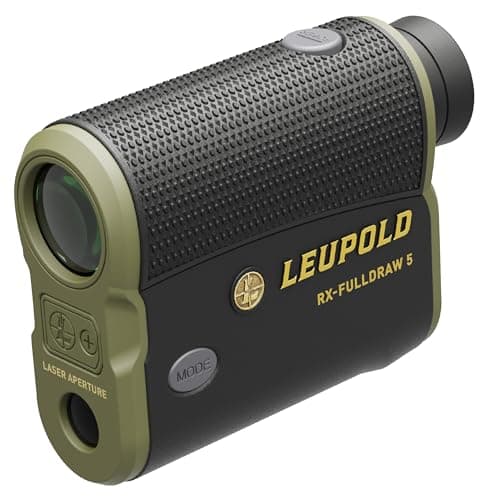
Leupold RX-FullDraw 5
Built specifically around arrow flight: it takes your arrow weight and speed and returns the pin-matched distance rather than a raw number.
Price as of November 12, 2026. #ad How we earn
The best archery rangefinder with angle compensation is the Leupold RX-FullDraw 5, because it is the only unit here that uses your arrow's weight and speed - so the number on the display is the distance your arrow will cover, not just the horizontal leg of a triangle. If you shoot inside 50 yards with a pin sight, the RX-1400i TBR/W Gen 2 gives you the geometry for considerably less.
Angle compensation is the single most important feature on a bow rangefinder, and it is also the most loosely described. Three manufacturers give it three names and two meaningfully different implementations. This page sorts out which is which, because the difference decides whether you need to spend $200 or $500.
Quick picks
Ranked by the criteria published on how we review. Tap any row for the full write-up, or go straight to the current price.
| # | Product | Best for | Score | Price |
|---|---|---|---|---|
| 1 | Leupold RX-FullDraw 5The only unit here that uses your arrow weight and speed, so the number it returns is a pin distance rather than a corrected distance. | Best archery angle compensationBowhunting | 9.6out of 10 | |
| 2 | 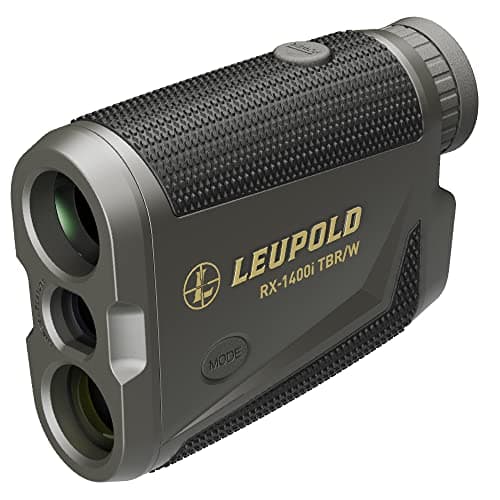 Leupold RX-1400i TBR/W Gen 2TBR/W returns horizontal distance and a holdover value, with a red display - the sensible default for most bowhunters. | Best value with angle compensationBest rangefinder under $250 | 9.6out of 10 | |
| 3 | 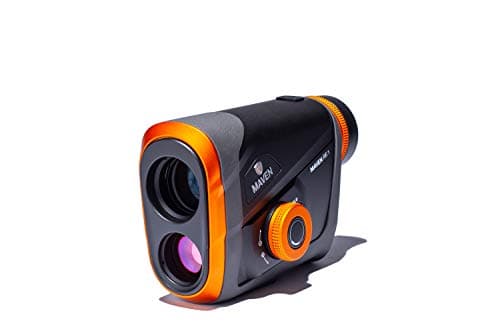 Maven RF.1Angle-compensated and ballistic modes behind optics good enough that the unit works as a monocular. | Best glass with angle compensationGlass quality in a rangefinder | 9.5out of 10 |
Prices are pulled live from Amazon and were last checked November 12, 2026; if a figure cannot be verified the button reads "Check price" instead. Scores are our editorial judgment against the published ranking criteria, on our published 8.4 to 9.8 recommendation scale. #ad How we earn.
Why the angle matters so much to an arrow
Shoot from a treestand and your laser measures the hypotenuse of a right triangle - your eye, the deer, and the base of your tree. Your arrow does not fly along the hypotenuse. Gravity acts over the horizontal distance, which is the shorter leg, so the uncorrected number is always too long.
At rifle velocities that error is often inside the margin your scope's reticle forgives. At 280 feet per second it is not. From 20 feet up at a deer whose slope distance reads 30 yards, the horizontal distance is roughly 28 yards - and a two-yard error at 30 yards moves the arrow several inches at the animal. That is the width of the difference between lungs and liver.
Price as of November 12, 2026. #ad How we earn
Leupold RX-FullDraw 5
Built specifically around arrow flight: it takes your arrow weight and speed and returns the pin-matched distance rather than a raw number.
| Magnification | 6x |
|---|---|
| Objective lens | 22 mm |
| Max range, reflective | 1,200 yd |
| Max range, trees | 1,100 yd |
| Max range, deer | 900 yd |
| Minimum range | 6 yd |
| Accuracy, to 125 yd | 0.5 yd |
| Accuracy, to 1,000 yd | 2 yd |
| Accuracy, beyond 1,000 yd | 0.5 % |
| Field of view | 315 ft @ 1,000 yd |
| Angular field of view | 6 degrees |
| Eye relief | 17 mm |
| Diopter range | -3 to +3 |
| Dimensions (L x W x H) | 3.8 x 1.4 x 3 in |
| Weight | 7.5 oz |
| Battery | CR2, more than 3,000 actuations |
| Display | Red OLED, adjustable brightness |
| Ranging modes | Line of Sight, Flightpath, Last Target |
| Laser classification | Class 1M |
Magnification and objective are the manufacturer's own model designation; exit pupil and twilight factor are computed from them. We could not machine-read Leupold's spec page, so the remaining published figures are not listed rather than guessed.
What it does well
- Archery-specific ballistics using your arrow weight and speed
- Flightpath shows whether your arrow clears a branch
- Fast ranging in Scan mode from a stand
Where it gives ground
- Overkill and over-priced if you only shoot a rifle
- Needs setup before the season, not in the stand
Skip it if
You hunt with a rifle. The RX-1400i does the job for less than half.
How this score breaks down
- Ranging accuracy and range on game (weight 5)9.0
- Angle compensation implementation (weight 5)9.5
- Display legibility in low light (weight 3)9.0
- Speed and scan mode (weight 3)8.5
- One-handed ergonomics (weight 2)8.5
Criterion scores are on the 0-10 rubric scale. Their weighted mean is 9.0, which maps to 9.6 on our published recommendation scale of 8.4 to 9.8 - the band of products we are willing to recommend at all. The weights, the definitions and the mapping are all published, so any score here can be checked against our own rules. These are editorial judgments from published specifications, computed optical arithmetic and documented consensus.
Angle compensation on most rangefinders is pure trigonometry: the unit measures slope distance and inclination, and returns the horizontal leg of the triangle. The RX-FullDraw 5 goes a step further. You enter your arrow weight and speed, and it returns the distance your arrow will actually cover on that shot - which is not the same number, because arrow flight is an arc and not a straight line.
Flightpath is the feature that justifies the price for anyone hunting in cover. It shows the highest point of your arrow's trajectory, which answers the question that ruins more bowhunting shots than range error does: will my arrow clear that branch? Nothing cheaper on this page can tell you that.
The honest caveat is setup. This is not a unit you configure in the stand - arrow weight and speed go in before the season, from a chronograph reading rather than a guess. And if you shoot a rifle more than a bow, you are paying for a solver you will not use.
Price as of November 12, 2026. #ad How we earn
Leupold RX-1400i TBR/W Gen 2
TBR/W gives you the true horizontal distance and a holdover value in the same readout, which is the single most useful feature on a hunting rangefinder.
| Magnification | 5x |
|---|---|
| Objective lens | 21 mm |
| Eye relief | 18.3 mm |
| Field of view | 368 ft @ 1,000 yd |
| Angular field of view | 7º |
| Max range, reflective | 1,400 yd |
| Max range, trees | 1,200 yd |
| Max range, deer | 900 yd |
| Minimum range | 6 yd |
| Accuracy | +/- 0.5 yd to 125 yd; +/- 2 yd to 1,000 yd; +/- 0.5 % beyond |
| Display | Red TOLED, adjustable brightness |
| Ranging modes | TBR/W, Bow with Flightpath, Line of Sight |
| Battery | CR2, approx. 3,000 actuations |
| Weight | 5.1 oz |
| Dimensions (L x W x H) | 4 x 1.4 x 3 in |
| Laser classification | Class 3R |
Specs verified 2026-10-26 from Leupold's published specification. Exit pupil and twilight factor are computed, not quoted.
What it does well
- TBR/W reports true ballistic range, not line of sight
- Fast, legible red OLED display in low light
- Compact enough for a harness pouch
Where it gives ground
- Stated ranges assume reflective targets, not deer hide - Leupold publishes 1,400 yd reflective but only 900 yd on deer
- No bluetooth or ballistic app integration
- Accuracy loosens to plus or minus 2 yd out at 1,000 yd
Skip it if
You need ranges past 1,000 yards on game - this is not that unit.
How this score breaks down
- Ranging accuracy and range on game (weight 5)8.5
- Angle compensation implementation (weight 5)9.5
- Display legibility in low light (weight 3)9.0
- Speed and scan mode (weight 3)8.5
- One-handed ergonomics (weight 2)9.0
Criterion scores are on the 0-10 rubric scale. Their weighted mean is 8.9, which maps to 9.6 on our published recommendation scale of 8.4 to 9.8 - the band of products we are willing to recommend at all. The weights, the definitions and the mapping are all published, so any score here can be checked against our own rules. These are editorial judgments from published specifications, computed optical arithmetic and documented consensus.
For a bowhunter whose shots are inside 50 yards, this is the unit that makes the most sense. TBR/W gives you the true ballistic range, and the readout is illuminated so you can read it against a dark animal in dark timber. That second point is worth repeating because spec sheets bury it: display legibility is the feature you interact with on every single range.
It knows nothing about your arrow. For a pin-sighted bow inside your effective range, that is fine - the sight tape already encodes your arrow's behavior, and all it needs from the rangefinder is the right distance. The full budget case is in best archery rangefinders under $200.
Price as of November 12, 2026. #ad How we earn
Maven RF.1
Maven's direct model buys you genuinely good glass in a rangefinder body, so the unit is usable as a monocular rather than just a distance readout.
| Magnification | 7x |
|---|---|
| Objective lens | 25 mm |
| Eye relief | 17 mm |
| Light transmission | 77 % |
| Max range, reflective | 4,500 yd |
| Max range, trees | 3,000 yd |
| Max range, deer | 2,700 yd |
| Minimum range | 5 yd |
| Accuracy, to 300 yd | 0.5 yd (0.1 yd display) |
| Accuracy, 300-2,000 yd | +/- 1 yd |
| Accuracy, 2,000-4,500 yd | +/- 3 yd |
| Angle modes | LOS / COMP |
| Brightness settings | 5 |
| Battery | CR2, over 3,500 range cycles |
| Waterproof | IPX7 |
| Weight | 10 oz with battery |
| Dimensions (W x H x D) | 4.6875 x 3.0625 x 1.875 in |
| Frame material | Magnesium / aluminum |
Specs verified 2026-10-26 from Maven's published specification. Exit pupil and twilight factor are computed, not quoted.
What it does well
- Optical quality well above typical rangefinder glass, with 77 percent published light transmission
- 2,700 yd published on deer - the longest game-animal rating of any handheld unit here
- Plus or minus 1 yd from 300 to 2,000 yd
- LOS and COMP angle modes with an obstruction filter
- Lifetime warranty, sold direct
Where it gives ground
- Amazon stock is intermittent because Maven sells direct
- Interface has a learning curve
- 10 oz is heavy for a handheld - twice the Leupold RX-1400i
- No onboard ballistic solver, so it returns a corrected distance and not a hold
Skip it if
You only need a number. The RX-1400i delivers that for a third of the price.
How this score breaks down
- Ranging accuracy and range on game (weight 5)9.3
- Angle compensation implementation (weight 5)8.7
- Display legibility in low light (weight 3)8.5
- Speed and scan mode (weight 3)8.7
- One-handed ergonomics (weight 2)7.8
Criterion scores are on the 0-10 rubric scale. Their weighted mean is 8.7, which maps to 9.5 on our published recommendation scale of 8.4 to 9.8 - the band of products we are willing to recommend at all. The weights, the definitions and the mapping are all published, so any score here can be checked against our own rules. These are editorial judgments from published specifications, computed optical arithmetic and documented consensus.
Most rangefinders have optics that exist only to put a reticle on a target. Maven's does not: the glass is genuinely good, which means the unit doubles as a monocular for picking apart a treeline before you decide to range anything. For a bowhunter sitting still for hours, that is more useful than it sounds.
It carries angle-compensated and ballistic modes, Maven's lifetime warranty, and the direct-sales pricing that makes the company's whole range interesting. Amazon stock is intermittent because direct is the main channel, and the interface takes a session to learn.
Two kinds of angle compensation
| Unit | Maker's name for it | What the readout gives you | Knows your arrow? |
|---|---|---|---|
| Leupold RX-FullDraw 5 | FullDraw ballistics | Pin distance for your arrow, plus Flightpath clearance | Yes - weight and speed |
| Leupold RX-1400i TBR/W Gen 2 | TBR/W | True horizontal distance plus a holdover value | No |
| Maven RF.1 | Angle-compensated and ballistic modes | Corrected distance with ballistic output | No |
Feature descriptions are taken from each manufacturer's published product documentation.
The distinction in that last column is the whole page. A geometric correction is exact and effectively free - it is a sine function, and a $70 unit computes it as accurately as a $700 one. An arrow-aware correction needs to know your setup, and only one unit here asks.
Which one you actually need
- Treestand whitetail, pin sight, shots inside 40 yards. Geometric correction is enough. Buy the RX-1400i TBR/W Gen 2 and spend the difference elsewhere.
- Hunting thick cover where branches are the real risk. Flightpath on the RX-FullDraw 5 is the feature, not the ballistics. Nothing else here shows arrow clearance.
- Western archery, shots to 70 or 80 yards. Arrow-aware. At the top of your range the arc matters and your sight tape's extrapolation gets thin.
- You also rifle hunt. Buy TBR/W. It serves both; FullDraw's arrow solver does nothing for a bullet.
- You sit still for hours and want to study a treeline. The Maven RF.1, because its glass is good enough to use as a monocular - see monocular vs rangefinder.
If you are still deciding whether angle compensation is worth paying for at all, the mechanics and the actual arithmetic are laid out in what is angle compensation, and the treestand case specifically in rangefinder for treestand hunting.
Our recommendation
If you take one thing from this page, take this.
Leupold RX-FullDraw 5
Best archery angle compensation
The only unit here that uses your arrow weight and speed, so the number it returns is a pin distance rather than a corrected distance.
Leupold RX-1400i TBR/W Gen 2
Best value with angle compensation
TBR/W returns horizontal distance and a holdover value, with a red display - the sensible default for most bowhunters.
Prices are pulled live and shown on each button. #ad How we earn.
Questions people actually ask
What is the best archery rangefinder with angle compensation?
Is angle compensation the same as slope compensation?
Do cheap rangefinders have real angle compensation?
Does angle compensation matter if I hunt from the ground?
Sources
- Leupold RX-FullDraw 5 product page - read 2026-10-17