There is a widespread assumption that angle compensation is a long-range feature. The arithmetic says the opposite: the proportional error is largest at the shortest distances from the highest stands, which is to say, in bowhunting.
The numbers, computed
| Stand height | Laser reads | True horizontal | Error | Percentage |
|---|---|---|---|---|
| 15 ft | 20 yd | 19.4 yd | 0.6 yd | 2.8% |
| 20 ft | 20 yd | 19.0 yd | 1.0 yd | 5.0% |
| 25 ft | 20 yd | 18.4 yd | 1.6 yd | 7.9% |
| 30 ft | 20 yd | 17.7 yd | 2.3 yd | 11.5% |
| 20 ft | 30 yd | 28.9 yd | 1.1 yd | 3.7% |
| 30 ft | 30 yd | 28.3 yd | 1.7 yd | 5.7% |
| 30 ft | 40 yd | 38.7 yd | 1.3 yd | 3.3% |
Computed by us from the geometry: horizontal = the square root of (line-of-sight squared minus height squared), with height converted to yards. Read the percentage column: it rises with stand height and FALLS with distance.
From 30 feet up, an animal that lasers at 20 yards is 17.7 yards away horizontally. If your 20-yard pin is on it, you are aiming for a distance 2.3 yards further than the arrow will travel over the ground, and the arrow hits high. On a broadside deer at 20 yards, high enough to matter.
Why it is worse for archery specifically
Three compounding reasons. Arrow trajectory is steep, so a given yardage error produces more vertical displacement than it would with a bullet. Pins are discrete, so you cannot hold a fine correction - you are on a pin or between two. And stand hunting is close-range by nature, which is where the proportional error peaks.
A rifle hunter in a stand at 100 yards has an angular error of under 1% and a flat enough trajectory that it vanishes. The problem is genuinely archery's. Our bowhunting rangefinder picks.
The branch problem, which is the other treestand issue
An arrow arcs. Shooting down from a stand through hardwoods, the branch you can see cleanly under on the direct line is not necessarily the branch your arrow clears, because the arrow rises above the line of sight before it falls.
This is what Leupold's Flightpath function addresses: it indicates whether your arrow's arc, for your arrow at that distance, clears the obstruction. It is the only implementation in our picks, and it is a genuinely treestand-specific capability rather than a general feature.
Pre-range your lanes before the sit
What you need
- An angle-compensating rangefinder
- Ten minutes before first light or on the way in
- 1
Range every shooting lane from the stand, in compensated mode
Pick a landmark in each lane - a stump, a trunk, a rock - and range it. Write the compensated numbers down or remember them. You now have a yardage map and you never have to range an animal at the worst moment.
- 2
Mark the boundaries of your comfortable range
Identify the tree or rock that sits at your maximum ethical distance. Anything past it, you do not shoot. Making that decision in daylight with nothing in front of you is far better than making it with a buck walking.
- 3
Check the branches in each lane
From the stand, look along each lane for anything that would catch an arrow's arc. If your unit has a branch-clearance function, use it on each lane now rather than during the shot sequence.
- 4
Put the rangefinder somewhere you can reach silently
A harness pouch, not a pocket, not a pack. If reaching for it requires turning or unzipping, you will not use it when it matters. Harnesses with a rangefinder pouch.
Three units for a stand
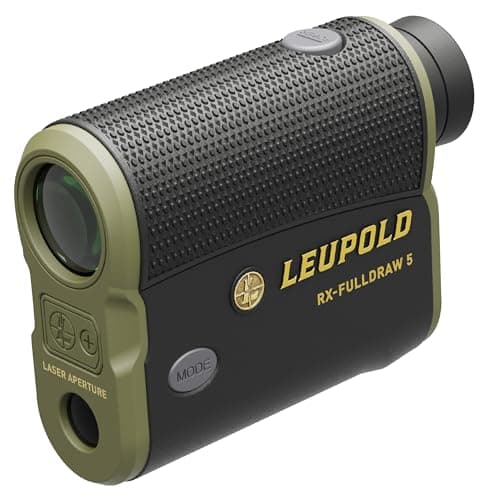
Price as of October 5, 2026. #ad How we earn
Leupold RX-FullDraw 5
Built specifically around arrow flight: it takes your arrow weight and speed and returns the pin-matched distance rather than a raw number.
Magnification and objective are the manufacturer's own model designation; exit pupil and twilight factor are computed from them. We could not machine-read Leupold's spec page, so the remaining published figures are not listed rather than guessed.
What it does well
- Archery-specific ballistics using your arrow weight and speed
- Flightpath shows whether your arrow clears a branch
- Fast ranging in Scan mode from a stand
Where it gives ground
- Overkill and over-priced if you only shoot a rifle
- Needs setup before the season, not in the stand
Skip it if
You hunt with a rifle. The RX-1400i does the job for less than half.
How this score breaks down
- Ranging accuracy and range on game (weight 5)9.0
- Angle compensation implementation (weight 5)9.5
- Display legibility in low light (weight 3)9.0
- Speed and scan mode (weight 3)8.5
- One-handed ergonomics (weight 2)8.5
Weights and definitions are published on how we review. These are editorial judgments from published specs and documented consensus, not test results.
Flightpath is specifically a treestand feature: it tells you whether the arrow's arc clears the branch you can see under.
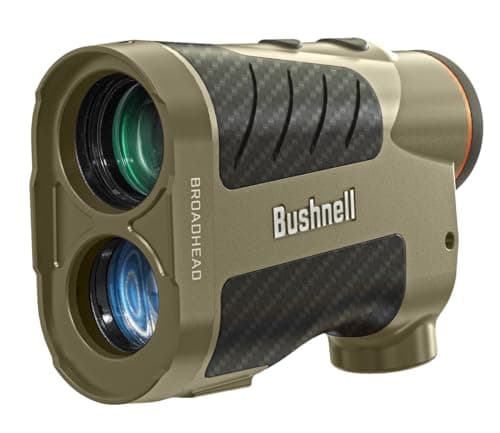
Price as of October 5, 2026. #ad How we earn
Bushnell Broadhead
Angle-compensated ranging aimed at archery distances, with ActivSync display that flips between dark and light to stay readable.
Magnification and objective are the manufacturer's own model designation; exit pupil and twilight factor are computed from them. We could not machine-read Bushnell's spec page, so the remaining published figures are not listed rather than guessed.
What it does well
- ActivSync display adapts to background brightness
- Angle compensation at an archery-focused price
- Compact and one-hand operable
Where it gives ground
- Less precise than the FullDraw 5 on true arrow ballistics
- Stated maximum range is optimistic for game
Skip it if
You want arrow-specific holdover rather than corrected distance.
How this score breaks down
- Ranging accuracy and range on game (weight 5)8.0
- Angle compensation implementation (weight 5)9.0
- Display legibility in low light (weight 3)8.5
- Speed and scan mode (weight 3)8.0
- One-handed ergonomics (weight 2)8.5
Weights and definitions are published on how we review. These are editorial judgments from published specs and documented consensus, not test results.
The adaptive display matters from a stand, where you are looking into shade rather than at sky.
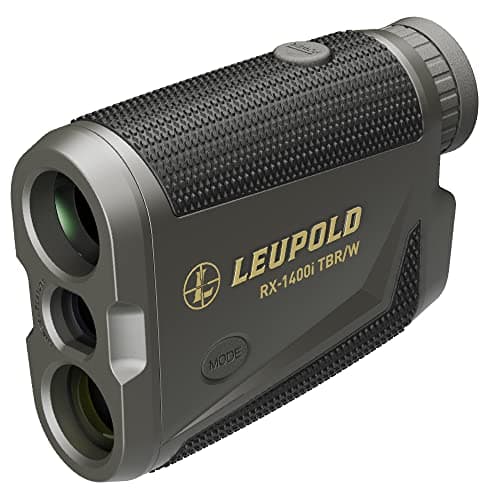
Price as of October 5, 2026. #ad How we earn
Leupold RX-1400i TBR/W Gen 2
TBR/W gives you the true horizontal distance and a holdover value in the same readout, which is the single most useful feature on a hunting rangefinder.
Magnification and objective are the manufacturer's own model designation; exit pupil and twilight factor are computed from them. We could not machine-read Leupold's spec page, so the remaining published figures are not listed rather than guessed.
What it does well
- TBR/W reports true ballistic range, not line of sight
- Fast, legible red OLED display in low light
- Compact enough for a harness pouch
Where it gives ground
- Stated ranges assume reflective targets, not deer hide
- No bluetooth or ballistic app integration
Skip it if
You need ranges past 1,000 yards on game - this is not that unit.
How this score breaks down
- Ranging accuracy and range on game (weight 5)8.5
- Angle compensation implementation (weight 5)9.5
- Display legibility in low light (weight 3)9.0
- Speed and scan mode (weight 3)8.5
- One-handed ergonomics (weight 2)9.0
Weights and definitions are published on how we review. These are editorial judgments from published specs and documented consensus, not test results.
One unit for both weapons, with the illuminated display a stand hunter needs.