10x42 means ten times magnification through a 42 millimeter objective lens. That is the easy part. The useful part is the figure you get by dividing one into the other.
The first number: magnification
10x means the image appears ten times closer than to the naked eye. An animal at 500 yards looks like it would at 50. That is the whole meaning, and it is the number most buyers over-weight.
What it costs you is less obvious. Higher magnification narrows the field of view, magnifies every tremor in your hands, and - critically - reduces the exit pupil for a given objective size. Above about 10x, handheld shake takes away more detail than the magnification adds, which is why a steady 10x sees more than a shaky 12x. What magnification to choose for hunting.
The second number: objective diameter
42 is the diameter of the front lens in millimeters. It controls how much light enters the binocular, and light collection scales with area, so the relationship is not linear: a 50 mm objective gathers about 42% more light than a 42 mm one, and a 32 mm gathers about 42% less.
It also controls size and weight, which is why nobody sells a pocketable 56 mm binocular. 42 mm is the dominant hunting size because it is the largest objective that still fits comfortably on a chest harness all day.
The third number: exit pupil, which you compute yourself
Exit pupil = objective / magnification. For a 10x42: 42 / 10 = 4.2 mm. It is the diameter of the light column leaving the eyepiece, and it is the most useful single figure for predicting low-light behavior.
Your own pupil opens to roughly 5-7 mm in the dark. When the exit pupil is smaller than your pupil, you are being fed less light than your eye can use, and the view looks dim. This is why an 8x42 (5.25 mm) looks brighter at dusk than a 10x42 (4.20 mm) with identical glass - and why no amount of money spent on a 10x42 changes it.
| Format | Magnification | Objective | Exit pupil |
|---|---|---|---|
| 8x32 | 8x | 32 mm | 4.00 mm |
| 8x42 | 8x | 42 mm | 5.25 mm |
| 10x42 | 10x | 42 mm | 4.20 mm |
| 10x50 | 10x | 50 mm | 5.00 mm |
| 12x50 | 12x | 50 mm | 4.17 mm |
| 15x56 | 15x | 56 mm | 3.73 mm |
Every figure in the last column is simply the third column divided by the second. No manufacturer claim is involved.
What 10x42 does not tell you
Quite a lot, and this is why specification shopping has limits. The designation says nothing about glass quality (ED elements or not), coatings (which determine how much of the collected light actually reaches your eye), prism type and coating, field of view (two 10x42s can differ by 20 ft at 1,000 yards), eye relief (which decides whether it works with glasses) or build quality.
A $149 10x42 and a $1,799 10x42 have an identical 4.2 mm exit pupil. Everything separating them is in the list above. Which is exactly what our 10x42 comparison shows.
Three binoculars that show the arithmetic working
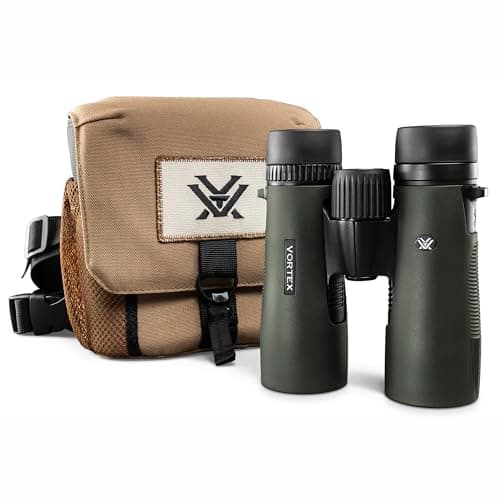
Vortex Diamondback HD 10x42
The honest floor for hunting glass: HD optical system, 330 ft of field and 15 mm of eye relief for about half what the Viper costs.
| Magnification | 10x |
|---|---|
| Objective lens | 42 mm |
| Eye relief | 15 mm |
| Field of view | 330 feet/1000 yards |
| Angular field of view | 6.3 degrees |
| Close focus | 6.7 feet |
| Weight | 21.4 oz |
| Height | 5.8 inches |
| Width | 5.1 inches |
| Exit pupil (computed) | 4.2 mm |
| Twilight factor (computed) | 20.5 |
Specs verified 2026-10-05 from Vortex's published specification. Exit pupil and twilight factor are computed, not quoted.
What it does well
- Genuine HD glass at the $250 tier
- 330 ft field of view matches binoculars costing twice as much
- Same unconditional VIP warranty as the Viper
Where it gives ground
- 15 mm eye relief is tight for some glasses wearers
- Edge sharpness falls off before the Viper's does
Skip it if
You wear glasses and have struggled with eye relief before - try the 8x42, which gives 17 mm.
How this score breaks down
- Low-light performance (weight 5)7.0
- Optical quality per dollar (weight 4)9.5
- Field of view (weight 3)8.5
- Eye relief (weight 3)6.5
- Weight and ergonomics (weight 2)8.0
- Warranty (weight 2)10.0
Weights and definitions are published on how we review. These are editorial judgments from published specs and documented consensus, not test results.
The format at a sensible price, with figures we verified from Vortex on 2026-10-05.
Price as of October 5, 2026. #ad How we earn
Vortex Diamondback HD 8x42
A 5.25 mm exit pupil and 17 mm of eye relief at the $250 tier, which is the combination most first upgrades actually need.
| Magnification | 8x |
|---|---|
| Objective lens | 42 mm |
| Eye relief | 17 mm |
| Field of view | 393 feet/1000 yards |
| Angular field of view | 7.5 degrees |
| Close focus | 5 feet |
| Weight | 21.8 oz |
| Height | 5.8 inches |
| Width | 5.1 inches |
| Exit pupil (computed) | 5.25 mm |
| Twilight factor (computed) | 18.3 |
Specs verified 2026-10-05 from Vortex's published specification. Exit pupil and twilight factor are computed, not quoted.
What it does well
- 5.25 mm exit pupil, the same figure as the Viper HD 8x42
- 17 mm eye relief works with glasses
- 393 ft field of view is wide for the money
Where it gives ground
- 8x limits you in genuinely open country
- Focus wheel is stiffer than the Viper's in the cold
Skip it if
You glass across canyons - the extra magnification matters more than the brightness there.
How this score breaks down
- Low-light performance (weight 5)8.5
- Optical quality per dollar (weight 4)9.5
- Field of view (weight 3)9.0
- Eye relief (weight 3)9.0
- Weight and ergonomics (weight 2)8.0
- Warranty (weight 2)10.0
Weights and definitions are published on how we review. These are editorial judgments from published specs and documented consensus, not test results.
Change only the first number and look what happens to the exit pupil: 42/8 = 5.25 mm instead of 4.20 mm.
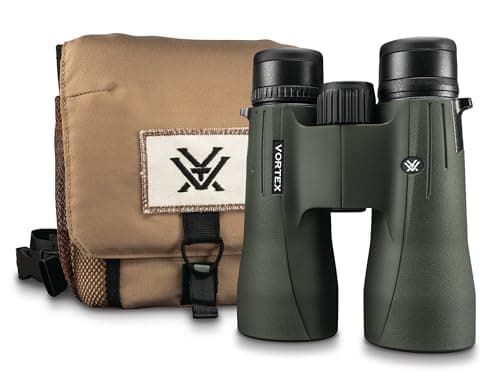
Price as of October 5, 2026. #ad How we earn
Vortex Viper HD 12x50
A 4.17 mm exit pupil and 288 ft of field, which is the trade you make for the extra detail; plan on a tripod, because 12x shows you your own pulse.
| Magnification | 12x |
|---|---|
| Objective lens | 50 mm |
| Eye relief | 16.0mm |
| Field of view | 288' @ 1000 yds |
| Angular field of view | 5.5º |
| Close focus | 8.0' |
| Weight | 28.8 oz. |
| Height | 6.5" |
| Width | 5.2" |
| Exit pupil (computed) | 3.5 mm |
| Twilight factor (computed) | 22.4 |
Specs verified 2026-10-05 from Vortex's published specification. Exit pupil and twilight factor are computed, not quoted.
What it does well
- 12x resolves antler detail a 10x leaves ambiguous
- 50 mm objective keeps the exit pupil close to the 10x42
- Still fits a standard bino harness
Where it gives ground
- Unusable handheld for sustained glassing - tripod required
- 288 ft field makes picking up moving animals harder
Skip it if
You will not carry a tripod. A shaky 12x sees less than a steady 10x.
How this score breaks down
- Low-light performance (weight 5)8.0
- Optical quality per dollar (weight 4)9.0
- Field of view (weight 3)7.0
- Eye relief (weight 3)8.0
- Weight and ergonomics (weight 2)6.5
- Warranty (weight 2)10.0
Weights and definitions are published on how we review. These are editorial judgments from published specs and documented consensus, not test results.
Raise both numbers together and the exit pupil stays almost the same while the twilight factor rises sharply.
Questions people actually ask
Is 10x42 better than 8x42?
What does the 42 mean on binoculars?
Is a higher magnification binocular always better?
What exit pupil do I need for hunting?
Sources
- Vortex Diamondback HD 10x42 published specifications - read 2026-10-05
- Vortex Diamondback HD 8x42 published specifications - read 2026-10-05