We earn a commission if you buy through the links on this page, at no extra cost to you. It never changes which products we pick or how we rank them - read the full disclosure.
Our top pick
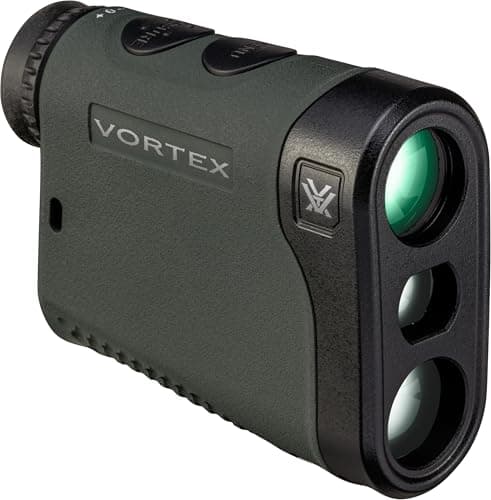
Vortex Triumph HD 850
The cheapest way onto the site: HCD angle compensation, a published 350 yd rating on deer and the VIP lifetime warranty, in a 4.6 oz body.
Price as of November 19, 2026. #ad How we earn
The best cheap hunting rangefinder is the Vortex Triumph HD 850: it publishes 350 yd on deer, includes HCD angle compensation and carries Vortex's lifetime VIP warranty, which no other unit at the price does. Rangefinders are one of the few optics categories where the cheap end is genuinely usable, because the core function - fire a laser, time the return - does not scale with price the way glass quality does. What scales is consistency, display quality and the sophistication of the angle correction.
The one feature not to cut
Angle compensation. If you hunt from a treestand, a ridge, or any ground that is not flat, a rangefinder without it gives you a precisely measured wrong number - and the proportional error is largest at close range, which is exactly where bowhunters operate.
The good news is that it is not an expensive feature any more. The cheapest unit we list includes HCD angle compensation and reads to plus or minus 89 degrees. There is no longer any price point at which you need to accept its absence, which is why every pick on this page has it. Why the angle matters most at close range.
What gets cut at each price
| Price | What you get | What is missing |
|---|---|---|
| $50-80 | A working laser, an angle mode, a few hundred yards on game | Consistency past 250 yd, display quality, build, warranty |
| $150-170 | Reliable ranging inside 300 yd, good ergonomics | Sometimes angle compensation. Check before buying. |
| $190-210 | Angle compensation, usable optics, a real warranty | An illuminated display, on some models |
| $230-250 | An illuminated or adaptive display, holdover output | Nothing most hunters need |
The gap between $80 and $200 buys consistency rather than capability - the same features, but working reliably at the distances you actually shoot.
Quick picks
Ranked by the criteria published on how we review. Tap any row for the full write-up, or go straight to the current price.
| # | Product | Best for | Score | Price |
|---|---|---|---|---|
| 1 | Vortex Triumph HD 850The cheapest unit on this site that still publishes a deer rating, includes angle compensation and is covered for life. | Best cheap hunting rangefinderBest value entry rangefinder | 9.1out of 10 | |
| 2 | 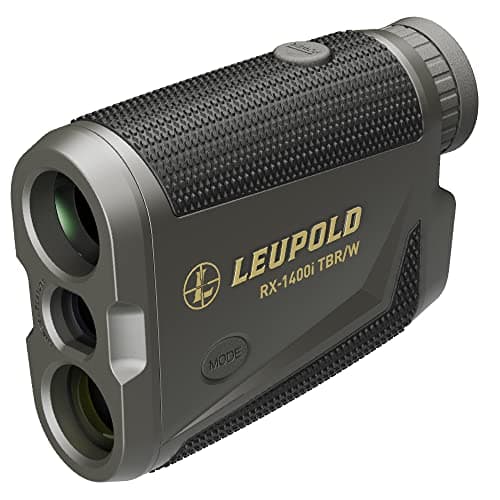 Leupold RX-1400i TBR/W Gen 2Published 900 yd on deer and a ballistic holdover rather than a raw distance, behind a red TOLED display that stays readable in timber. | The step up that is worth the moneyBest rangefinder under $250 | 9.6out of 10 |
Prices are pulled live from Amazon and were last checked November 19, 2026; if a figure cannot be verified the button reads "Check price" instead. Scores are our editorial judgment against the published ranking criteria, on our published 8.4 to 9.8 recommendation scale. #ad How we earn.
What to check on any budget listing
- An angle or slope mode. Named differently by every brand - HCD, TBR, ARC, Angle Intelligence - but if none of those words appears, it does not have it.
- The stated range, and what it refers to. If a listing says 1,000 yards without saying 'reflective', assume reflective and divide by three for game.
- Display type. LCD is normal at this price; if you hunt timber at last light, stretch for illuminated.
- Battery type. CR2 is standard and cheap. Proprietary rechargeable packs on budget units are a long-term risk.
- Warranty. Vortex VIP covers the Triumph HD 850 unconditionally, transferably and for life - at the bottom of the price range that is a real differentiator.
The picks in detail
Price as of November 19, 2026. #ad How we earn
Vortex Triumph HD 850
The cheapest way onto the site: HCD angle compensation, a published 350 yd rating on deer and the VIP lifetime warranty, in a 4.6 oz body.
| Magnification | 5x |
|---|---|
| Objective lens | 21 mm |
| Optical system | HD, fully multi-coated |
| Eye relief | 13 mm |
| Field of view | 335 ft @ 1,000 yd |
| Angular field of view | 6.4 degrees |
| Max range, reflective | 850 yd |
| Max range, trees | 500 yd |
| Max range, deer | 350 yd |
| Minimum range | 6 yd |
| Accuracy, to 100 yd | +/- 0.5 yd |
| Accuracy, 100-850 yd | +/- 2 yd |
| Angle compensation | HCD; line of sight and scan modes; reads to +/- 89 degrees |
| Target modes | Normal, first, last |
| Display | Black LCD |
| Battery | CR2, 4,000+ range cycles |
| Weight | 4.6 oz (130 g) |
| Dimensions (L x W x H) | 3.8 x 3.1 x 1.4 in |
| Sealing | Waterproof and shockproof |
| Warranty | Vortex VIP lifetime, transferable |
Specs verified 2026-11-04 from Vortex's published specification. Exit pupil and twilight factor are computed, not quoted.
What it does well
- HCD angle compensation included, which most units at this price leave out
- Published figures for all three target types, including 350 yd on deer
- Plus or minus 0.5 yd inside 100 yd - the tightest short-range figure of any entry unit here
- 4.6 oz, the lightest rangefinder on the site
- Vortex VIP lifetime warranty, transferable and no-fault
- Waterproof and shockproof, with 4,000+ range cycles on one CR2
Where it gives ground
- 350 yd on deer is a genuine ceiling - it is not an open-country unit
- A black LCD rather than an illuminated display, so it is harder to read against dark timber
- 13 mm of eye relief is short if you range in glasses
Skip it if
You hunt open country past about 350 yards. Buy the RX-1400i TBR/W Gen 2 instead.
How this score breaks down
- Ranging accuracy and range on game (weight 5)7.0
- Angle compensation implementation (weight 5)9.0
- Display legibility in low light (weight 3)6.0
- Speed and scan mode (weight 3)7.5
- One-handed ergonomics (weight 2)9.5
Criterion scores are on the 0-10 rubric scale. Their weighted mean is 7.8, which maps to 9.1 on our published recommendation scale of 8.4 to 9.8 - the band of products we are willing to recommend at all. The weights, the definitions and the mapping are all published, so any score here can be checked against our own rules. These are editorial judgments from published specifications, computed optical arithmetic and documented consensus.
This is the answer to the question in the title. Vortex publishes 5x on a 21 mm objective, 850 yd reflective, 500 yd on trees and 350 yd on deer, a 6 yd minimum, plus or minus 0.5 yd inside 100 yd loosening to plus or minus 2 yd beyond, 335 ft of field, HCD angle compensation reading to plus or minus 89 degrees, line-of-sight and scan modes, a CR2 good for over 4,000 range cycles, and 4.6 oz in a waterproof, shockproof body.
Cheap rangefinders usually ask you to give up one of three things: angle compensation, a published game-animal rating, or a warranty worth having. This one gives up none of them. The VIP cover is the same no-fault, transferable, lifetime policy Vortex puts on its flagship riflescopes, which is why a cheap Vortex outlasts a cheap anything else. Good to know: the published 350 yd figure on deer is the real ceiling, so this is a timber and field-edge unit rather than an open-country one.
Price as of November 19, 2026. #ad How we earn
Leupold RX-1400i TBR/W Gen 2
TBR/W gives you the true horizontal distance and a holdover value in the same readout, which is the single most useful feature on a hunting rangefinder.
| Magnification | 5x |
|---|---|
| Objective lens | 21 mm |
| Eye relief | 18.3 mm |
| Field of view | 368 ft @ 1,000 yd |
| Angular field of view | 7º |
| Max range, reflective | 1,400 yd |
| Max range, trees | 1,200 yd |
| Max range, deer | 900 yd |
| Minimum range | 6 yd |
| Accuracy | +/- 0.5 yd to 125 yd; +/- 2 yd to 1,000 yd; +/- 0.5 % beyond |
| Display | Red TOLED, adjustable brightness |
| Ranging modes | TBR/W, Bow with Flightpath, Line of Sight |
| Battery | CR2, approx. 3,000 actuations |
| Weight | 5.1 oz |
| Dimensions (L x W x H) | 4 x 1.4 x 3 in |
| Laser classification | Class 3R |
Specs verified 2026-10-26 from Leupold's published specification. Exit pupil and twilight factor are computed, not quoted.
What it does well
- TBR/W reports true ballistic range, not line of sight
- Fast, legible red OLED display in low light
- Compact enough for a harness pouch
Where it gives ground
- Stated ranges assume reflective targets, not deer hide - Leupold publishes 1,400 yd reflective but only 900 yd on deer
- No bluetooth or ballistic app integration
- Accuracy loosens to plus or minus 2 yd out at 1,000 yd
Skip it if
You need ranges past 1,000 yards on game - this is not that unit.
How this score breaks down
- Ranging accuracy and range on game (weight 5)8.5
- Angle compensation implementation (weight 5)9.5
- Display legibility in low light (weight 3)9.0
- Speed and scan mode (weight 3)8.5
- One-handed ergonomics (weight 2)9.0
Criterion scores are on the 0-10 rubric scale. Their weighted mean is 8.9, which maps to 9.6 on our published recommendation scale of 8.4 to 9.8 - the band of products we are willing to recommend at all. The weights, the definitions and the mapping are all published, so any score here can be checked against our own rules. These are editorial judgments from published specifications, computed optical arithmetic and documented consensus.
If the budget stretches, this is where it should go, and the jump is larger than the price gap suggests. Leupold publishes 1,400 yd reflective, 1,200 yd on trees and 900 yd on deer - roughly triple the Triumph's game-animal rating - with accuracy of plus or minus 0.5 yd inside 125 yd, 368 ft of field, 18.3 mm of eye relief, and roughly 3,000 actuations on one CR2. It weighs 5.1 oz.
The feature that separates it is TBR/W: instead of a corrected horizontal distance it returns a ballistic holdover, and Bow mode with Flightpath is included, so an archer does not need a separate unit. The display is a red TOLED with adjustable brightness rather than a black LCD, which is the difference you notice at last light. Good to know: there is no Bluetooth and no app, so it will never hand you a wind call. What TBR/W actually does covers the output in full.
Cheap and simple are not the same axis, and if what you actually want is the fewest buttons and the most legible display, see the easiest rangefinders to use.
Our recommendation
If you take one thing from this page, take this.
Vortex Triumph HD 850
Best cheap hunting rangefinder
The cheapest unit on this site that still publishes a deer rating, includes angle compensation and is covered for life.
Leupold RX-1400i TBR/W Gen 2
The step up that is worth the money
Published 900 yd on deer and a ballistic holdover rather than a raw distance, behind a red TOLED display that stays readable in timber.
Prices are pulled live and shown on each button. #ad How we earn.
Questions people actually ask
Are cheap rangefinders accurate?
What is the cheapest rangefinder worth buying?
Do budget rangefinders have angle compensation?
Is a rangefinder or binoculars a better first purchase?
Sources
Read next
Brands: want your product tested? For Brands.