The honest answer splits sharply by weapon, and most advice on this question does not make the split clearly enough to be useful.
Bowhunting: yes, almost unconditionally
An arrow has a steep trajectory and your sight has pins at discrete distances. The difference between 28 and 32 yards is the difference between a lung shot and a gut shot, and nothing else in your kit tells you which one you are looking at.
Add the angle problem: from 30 feet up, a 20-yard line-of-sight reading is about 17.7 yards horizontally - an 11.5% error at a distance where 11.5% is the whole margin. Estimating yardage by eye from an elevated position is genuinely hard, and being wrong by four yards is a wounded animal.
If you bowhunt and own no rangefinder, that is probably the most consequential gap in your optics setup - ahead of better binoculars. Our bowhunting picks.
Rifle hunting inside 200 yards: often no
Here is the case the category does not like to make. A modern cartridge zeroed at 200 yards has a maximum point-blank range covering roughly 25 to 250 yards within a few inches of aim. Inside that window, knowing the exact distance changes nothing - you hold center and shoot.
If you hunt timber, if your shots are inside 200 yards, and if you know your rifle's zero, a rangefinder is a reassurance purchase rather than a capability purchase. That is a legitimate thing to buy, and it is not the same as needing one. The $200 would do more in a tripod or a harness.
Rifle hunting past 300 yards: yes
Past maximum point-blank range, drop becomes significant and estimating distance by eye becomes unreliable in exactly the terrain where you are doing it - open country with few size references. Being wrong by 80 yards at 400 is a clean miss or worse.
| Situation | Worth it? | Why |
|---|---|---|
| Bowhunting, any distance | Yes | Pin distances are discrete and four yards changes the outcome |
| Bowhunting from an elevated stand | Yes, with angle compensation | The proportional angular error is largest at close range |
| Rifle, timber, inside 200 yd | Not really | Maximum point-blank range covers it |
| Rifle, 200-300 yd | Useful | Drop is becoming significant |
| Rifle, past 300 yd | Yes | Eye estimates fail in open country and drop is large |
| Muzzleloader or slug gun | Yes | Steep trajectories, like archery |
| Judging whether a shot is ethical at all | Yes | Knowing it is 480 yards and not 350 is a reason not to shoot |
The argument nobody makes, which may be the best one
A rangefinder stops you taking bad shots. The usual framing is that it helps you hit things; the more valuable function is telling you that the animal you were about to shoot at is 480 yards away rather than the 350 you estimated - and that you should not shoot.
Used that way, it is an ethics tool rather than a performance tool. That is the version of the argument we find most persuasive, and it applies regardless of weapon.
Three answers, depending on where you landed
Price as of October 5, 2026. #ad How we earn
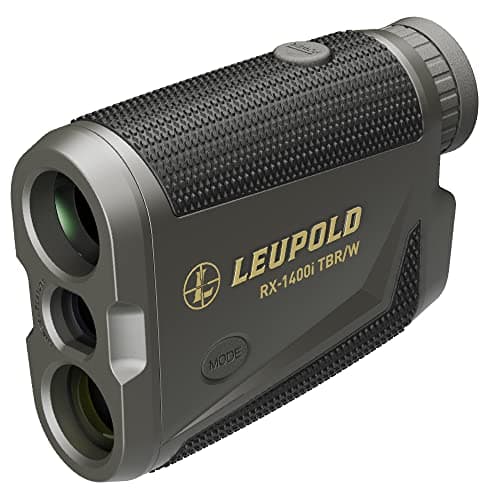
Leupold RX-1400i TBR/W Gen 2
TBR/W gives you the true horizontal distance and a holdover value in the same readout, which is the single most useful feature on a hunting rangefinder.
Magnification and objective are the manufacturer's own model designation; exit pupil and twilight factor are computed from them. We could not machine-read Leupold's spec page, so the remaining published figures are not listed rather than guessed.
What it does well
- TBR/W reports true ballistic range, not line of sight
- Fast, legible red OLED display in low light
- Compact enough for a harness pouch
Where it gives ground
- Stated ranges assume reflective targets, not deer hide
- No bluetooth or ballistic app integration
Skip it if
You need ranges past 1,000 yards on game - this is not that unit.
How this score breaks down
- Ranging accuracy and range on game (weight 5)8.5
- Angle compensation implementation (weight 5)9.5
- Display legibility in low light (weight 3)9.0
- Speed and scan mode (weight 3)8.5
- One-handed ergonomics (weight 2)9.0
Weights and definitions are published on how we review. These are editorial judgments from published specs and documented consensus, not test results.
The threshold purchase. Nothing cheaper gives you both features, and nothing dearer improves the outcome inside 400 yards.
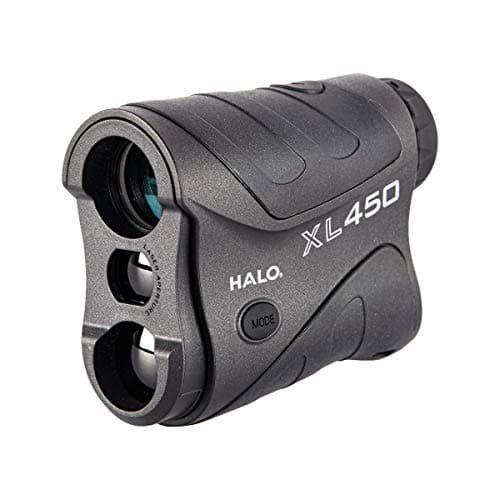
Halo Optics XL450
The honest budget answer: it ranges to a few hundred yards on game and costs less than a box of premium ammunition.
Magnification and objective are the manufacturer's own model designation; exit pupil and twilight factor are computed from them. We could not machine-read Halo Optics's spec page, so the remaining published figures are not listed rather than guessed.
What it does well
- Cheapest working rangefinder here by a wide margin
- Angle intelligence mode on a sub-$60 unit
- Small enough to forget in a pocket
Where it gives ground
- Inconsistent on dark hides past 250 yards
- Build quality is what the price suggests
Skip it if
You hunt open country. Beyond 300 yards this unit guesses.
How this score breaks down
- Ranging accuracy and range on game (weight 5)5.5
- Angle compensation implementation (weight 5)7.0
- Display legibility in low light (weight 3)5.0
- Speed and scan mode (weight 3)6.0
- One-handed ergonomics (weight 2)7.0
Weights and definitions are published on how we review. These are editorial judgments from published specs and documented consensus, not test results.
A legitimate way to answer the question empirically. It has an angle mode and works inside a couple of hundred yards.
Price as of October 5, 2026. #ad How we earn
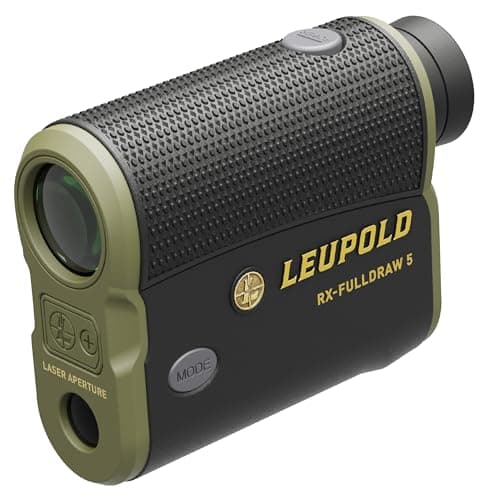
Leupold RX-FullDraw 5
Built specifically around arrow flight: it takes your arrow weight and speed and returns the pin-matched distance rather than a raw number.
Magnification and objective are the manufacturer's own model designation; exit pupil and twilight factor are computed from them. We could not machine-read Leupold's spec page, so the remaining published figures are not listed rather than guessed.
What it does well
- Archery-specific ballistics using your arrow weight and speed
- Flightpath shows whether your arrow clears a branch
- Fast ranging in Scan mode from a stand
Where it gives ground
- Overkill and over-priced if you only shoot a rifle
- Needs setup before the season, not in the stand
Skip it if
You hunt with a rifle. The RX-1400i does the job for less than half.
How this score breaks down
- Ranging accuracy and range on game (weight 5)9.0
- Angle compensation implementation (weight 5)9.5
- Display legibility in low light (weight 3)9.0
- Speed and scan mode (weight 3)8.5
- One-handed ergonomics (weight 2)8.5
Weights and definitions are published on how we review. These are editorial judgments from published specs and documented consensus, not test results.
Where the yes is strongest - archery is the case where yardage error directly changes where the arrow lands.