We earn a commission if you buy through the links on this page, at no extra cost to you. It never changes which products we pick or how we rank them - read the full disclosure.
Our top pick
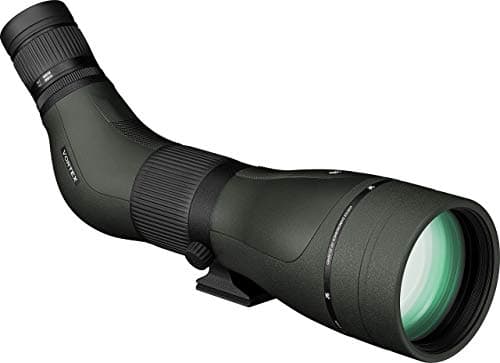
Vortex Diamondback HD 20-60x85
An 85 mm objective, 20-60x, and 18.3-20.3 mm of eye relief for around $500, which is the cheapest credible way into a real spotting scope.
Price as of October 5, 2026. #ad How we earn
An angled scope puts the eyepiece at 45 or 90 degrees to the barrel; a straight scope puts it in line. Most comparisons treat this as pure preference. It mostly is, with two genuine exceptions and one consequence that matters more than either.
The consequence nobody mentions: tripod height
A straight scope needs the tripod head at roughly eye level. An angled scope works with the head well below it. That has three knock-on effects that between them matter more than the ergonomic preference:
- Stability. A tripod extended to eye level is substantially less stable than the same tripod at chest height, especially in wind. At 60x that difference is visible in the image.
- Weight. A tripod that does not need to reach eye level can be shorter and lighter, which compounds with the scope weight. The weight arithmetic.
- Seated use. With an angled scope you can sit comfortably behind a low tripod for an hour. With a straight scope you are either standing or crouching awkwardly.
When straight genuinely wins
From a vehicle window. A window mount puts the scope at a fixed height and a straight scope points naturally through the opening. An angled scope in that position is awkward.
From prone or very low positions. If you are lying behind the scope - common in some long-range shooting setups - a straight scope lines up and an angled one does not.
Pointing it quickly. This is the real everyday advantage: with a straight scope you look along the barrel to aim it at the thing you want, which is intuitive. With a 90-degree angled scope, getting the scope onto a specific tree on a far hillside takes practice and often a couple of attempts.
| Angled (45 or 90 degrees) | Straight | |
|---|---|---|
| Seated use for long sessions | Much better | Awkward |
| Tripod height needed | Chest height or lower | Eye level |
| Resulting stability | Better - shorter extension | Worse in wind |
| Pointing at a specific object | Takes practice | Intuitive |
| From a vehicle window | Awkward | Natural |
| From prone | Poor | Good |
| Sharing with someone else | Easy | Needs tripod adjustment per person |
| Glassing steeply uphill | Easy | Uncomfortable |
The 45-degree middle ground
Less common and genuinely sensible. A 45-degree eyepiece is easier to point than a 90-degree one because you can still roughly sight along the body, while keeping most of the seated-comfort and tripod-height advantages. If you find 90 degrees disorienting but want to sit down, this is the answer.
Quick picks
Ranked by the criteria published on how we review. Tap any row for the full write-up, or go straight to the current price.
| # | Product | Best for | Score | Price |
|---|---|---|---|---|
| 1 | Vortex Diamondback HD 20-60x85The angled 85 mm with 18.3-20.3 mm of eye relief, about $499. | Angled, best valueBest spotting scope value | 8.3out of 10 | |
| 2 | 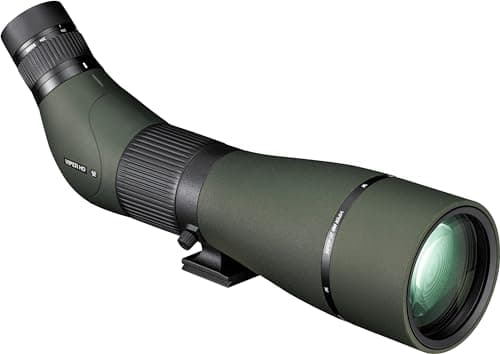 Vortex Viper HD 20-60x85Usable to 60x with 17.8-19.6 mm of eye relief, about $899. | Angled, best overallBest all-round spotting scope | 8.6out of 10 | |
| 3 | 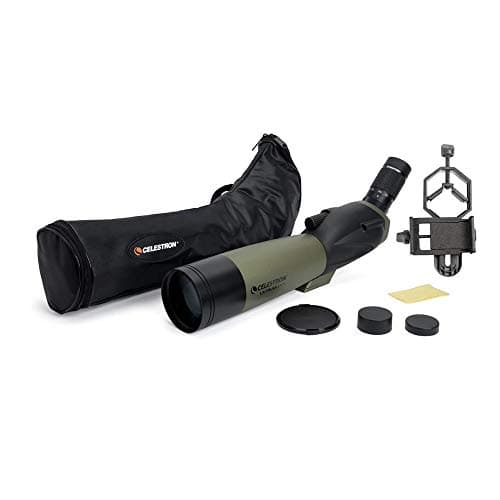 Celestron Ultima 80A 45-degree eyepiece rather than 90, about $270. | The 45-degree compromiseTarget shooting and range use | 6.8out of 10 |
Prices are pulled live from Amazon and were last checked October 5, 2026; if a figure cannot be verified the button reads "Check price" instead. Scores are our editorial judgment against the published ranking criteria, not a test result. #ad How we earn.
The practical recommendation
- Western hunting, long glassing sessions, packing in: angled. The tripod-height advantage alone decides it.
- Glassing from a truck or a blind window: straight.
- Long-range shooting from prone: straight.
- Range work from a bench: angled. Why.
- You cannot decide and will do a bit of everything: angled, or 45 degrees. Most people who try both end up angled.
One practical note: angled scopes take genuine practice to point. Set yours up in a field and practice getting it onto specific distant objects before you need to do it with an animal moving.
Three configurations
Price as of October 5, 2026. #ad How we earn
Vortex Diamondback HD 20-60x85
An 85 mm objective, 20-60x, and 18.3-20.3 mm of eye relief for around $500, which is the cheapest credible way into a real spotting scope.
| Magnification | 20-60x |
|---|---|
| Objective lens | 85 mm |
| Eye relief | 18.3mm - 20.3mm |
| Field of view | 108' - 60' @ 1000 yds |
| Angular field of view | 2.1º - 1.1º |
| Close focus | 24.6' |
| Weight | 60.9 oz. |
| Length | 16.0" |
| Exit pupil (computed) | 4.25 mm |
| Twilight factor (computed) | 41.2 |
Specs verified 2026-10-05 from Vortex's published specification. Exit pupil and twilight factor are computed, not quoted.
What it does well
- 85 mm objective gathers enough light for dawn judging
- 18.3-20.3 mm eye relief is unusually generous
- VIP warranty
Where it gives ground
- Image softens noticeably past about 45x
- Needs a tripod costing a meaningful fraction of the scope
Skip it if
You only glass inside 400 yards - 15x56 binoculars are lighter and cheaper.
How this score breaks down
- Resolution at top magnification (weight 5)8.0
- Usable magnification range (weight 4)8.5
- Eye relief across the zoom (weight 3)9.5
- Weight and packability (weight 3)7.0
- Build and sealing (weight 2)8.5
Weights and definitions are published on how we review. These are editorial judgments from published specs and documented consensus, not test results.
Vortex lists this model in both angled and straight configurations; the figures we verified on 2026-10-05 are from the angled version's page.
Price as of October 5, 2026. #ad How we earn
Vortex Viper HD 20-60x85
The step where a spotting scope stops being a compromise: usable detail at 60x instead of giving up at 45x.
| Magnification | 20-60x |
|---|---|
| Objective lens | 85 mm |
| Eye relief | 17.8mm - 19.6mm |
| Field of view | 101' - 50' @ 1000 yds |
| Angular field of view | 1.9º - 1.0º |
| Close focus | 36.0' |
| Weight | 76.6 oz. |
| Length | 17.5" |
| Exit pupil (computed) | 4.25 mm |
| Twilight factor (computed) | 41.2 |
Specs verified 2026-10-05 from Vortex's published specification. Exit pupil and twilight factor are computed, not quoted.
What it does well
- Holds resolution much deeper into the magnification range
- 17.8-19.6 mm eye relief across the zoom
- Apochromatic lens system controls color fringing
Where it gives ground
- 65.7 oz means a serious tripod
- Nearly twice the Diamondback HD's price
Skip it if
You judge animals inside 600 yards. The Diamondback HD does that.
How this score breaks down
- Resolution at top magnification (weight 5)9.0
- Usable magnification range (weight 4)9.0
- Eye relief across the zoom (weight 3)9.0
- Weight and packability (weight 3)6.5
- Build and sealing (weight 2)9.0
Weights and definitions are published on how we review. These are editorial judgments from published specs and documented consensus, not test results.
Also available in both configurations. The angled version is the more common choice among western hunters.
Price as of October 5, 2026. #ad How we earn
Celestron Ultima 80
A 45-degree 80 mm scope with published exit pupil figures from 4 mm down to 1.3 mm, aimed at range work more than mountain hunting.
| Magnification | 20x |
|---|---|
| Objective lens | 80 mm |
| Exit pupil (computed) | 4 mm |
| Twilight factor (computed) | 40 |
Magnification and objective are the manufacturer's own model designation; exit pupil and twilight factor are computed from them. We could not machine-read Celestron's spec page, so the remaining published figures are not listed rather than guessed.
What it does well
- Published exit pupil and field figures across the zoom
- 45-degree eyepiece is comfortable for seated range use
- Inexpensive for an 80 mm
Where it gives ground
- Not sealed to hunting standards
- Heavy for its optical quality
Skip it if
You are packing it into the backcountry.
How this score breaks down
- Resolution at top magnification (weight 5)6.5
- Usable magnification range (weight 4)8.0
- Eye relief across the zoom (weight 3)7.5
- Weight and packability (weight 3)5.5
- Build and sealing (weight 2)6.0
Weights and definitions are published on how we review. These are editorial judgments from published specs and documented consensus, not test results.
45 degrees sits between the two: easier to point than a 90-degree angled scope, more comfortable seated than a straight one.
Questions people actually ask
Should I buy an angled or straight spotting scope?
Why do angled spotting scopes need a shorter tripod?
Is an angled scope harder to aim?
What is a 45-degree spotting scope?
Sources
- Vortex Diamondback HD 20-60x85 angled published specifications - read 2026-10-05
- Celestron Ultima 80 45-degree published specifications - read 2026-10-05