Your laser measures the straight line to the target. Gravity acts over the horizontal component of that line. When you are shooting up or down a slope, those are different numbers - and the one your sights are calibrated for is the horizontal.
The geometry
It is a right triangle. Your line of sight to the animal is the hypotenuse. The horizontal distance is the base. Your height above (or below) the animal is the vertical side.
Horizontal distance = line-of-sight distance x the cosine of the angle. Equivalently, if you know your height above the target: horizontal = the square root of (line-of-sight squared minus height squared).
A bullet or arrow drops under gravity as a function of flight time, and flight time over the ground is governed by the horizontal distance. The vertical component contributes almost nothing to drop. So the horizontal distance is what your pins, your reticle, or your turret setting need.
The treestand numbers, computed
| Stand height | Laser reads (line of sight) | True horizontal | Error | Error as a percentage |
|---|---|---|---|---|
| 20 ft | 20 yd | 19.0 yd | 1.0 yd | 5.0% |
| 20 ft | 30 yd | 28.9 yd | 1.1 yd | 3.7% |
| 20 ft | 40 yd | 39.2 yd | 0.8 yd | 2.0% |
| 30 ft | 20 yd | 17.7 yd | 2.3 yd | 11.5% |
| 30 ft | 30 yd | 28.3 yd | 1.7 yd | 5.7% |
| 30 ft | 40 yd | 38.7 yd | 1.3 yd | 3.3% |
Computed by us from the geometry above (height converted to yards). Note that the percentage error FALLS as the distance increases - which is the opposite of what most people assume.
That last column is the surprise. The proportional error is largest at the shortest distances, because at 20 yards from a 30-foot stand the vertical drop is a large fraction of the total. At 40 yards it is a small one. Angle compensation therefore matters *most* to bowhunters shooting close from high stands - exactly the group most likely to assume it is a long-range feature.
The long-range case
Across a canyon the angles are smaller but the distances are large enough that a small percentage is many yards. A 500-yard reading at a 25-degree downward angle is about 453 yards of horizontal distance - a 47-yard error, which at that range is a comfortable miss.
Either way, the correction is the same arithmetic. What changes is whether you want it expressed as a distance, a holdover, or a full firing solution. The three implementations.
What the different modes return
- HCD, Angle Intelligence, ARC - the horizontal distance in yards. Simple and sufficient.
- TBR/W - a holdover in inches, MOA or MIL for a selected ballistic group. In detail.
- Arrow-matched (FullDraw) - the distance your pins are set for, from your arrow's weight and speed.
- Full solver (Applied Ballistics) - a complete firing solution including environmentals.
Three units, three kinds of correction
Price as of October 5, 2026. #ad How we earn
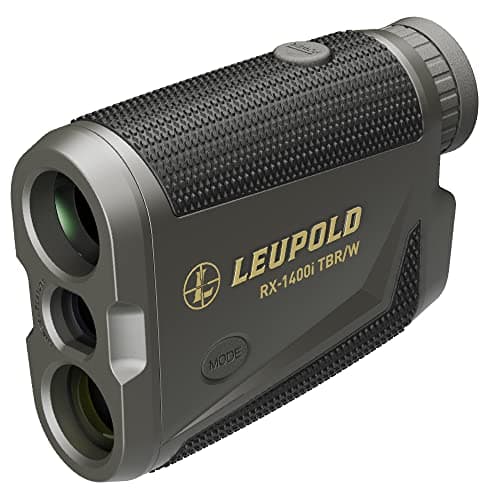
Leupold RX-1400i TBR/W Gen 2
TBR/W gives you the true horizontal distance and a holdover value in the same readout, which is the single most useful feature on a hunting rangefinder.
Magnification and objective are the manufacturer's own model designation; exit pupil and twilight factor are computed from them. We could not machine-read Leupold's spec page, so the remaining published figures are not listed rather than guessed.
What it does well
- TBR/W reports true ballistic range, not line of sight
- Fast, legible red OLED display in low light
- Compact enough for a harness pouch
Where it gives ground
- Stated ranges assume reflective targets, not deer hide
- No bluetooth or ballistic app integration
Skip it if
You need ranges past 1,000 yards on game - this is not that unit.
How this score breaks down
- Ranging accuracy and range on game (weight 5)8.5
- Angle compensation implementation (weight 5)9.5
- Display legibility in low light (weight 3)9.0
- Speed and scan mode (weight 3)8.5
- One-handed ergonomics (weight 2)9.0
Weights and definitions are published on how we review. These are editorial judgments from published specs and documented consensus, not test results.
One step further than correcting the distance: it tells you where to aim.
Price as of October 5, 2026. #ad How we earn
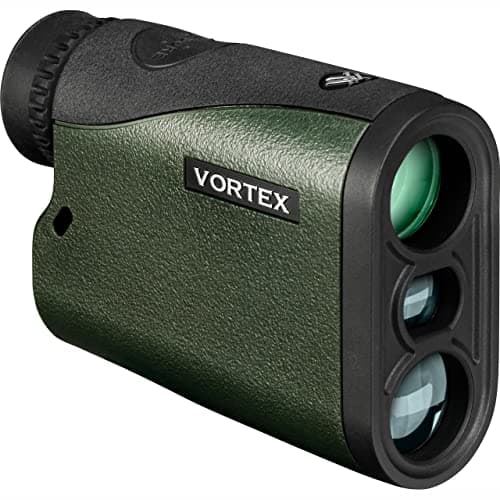
Vortex Crossfire HD 1400
A 5x21 monocular that ranges to 1,400 yards reflective with HCD angle compensation, at the price where rangefinders stop being a luxury.
| Magnification | 5x |
|---|---|
| Objective lens | 21 mm |
| Eye relief | 16.0mm |
| Field of view | 367' @ 1000 yds |
| Angular field of view | 7.0º |
| Stated accuracy | 1 yds. @100 yds. |
| Weight | 4.8 oz. |
| Length | 4.0" |
| Height | 2.9" |
| Width | 1.3" |
Specs verified 2026-10-05 from Vortex's published specification. Exit pupil and twilight factor are computed, not quoted.
What it does well
- HCD mode gives angle-compensated distance
- 16.0 mm eye relief with a 367 ft field at 5x
- VIP warranty
Where it gives ground
- Display is LCD, not illuminated, so it fades in deep shade
- No ballistic holdover output, just corrected distance
Skip it if
You hunt in low light often - an illuminated display is worth the upgrade.
How this score breaks down
- Ranging accuracy and range on game (weight 5)8.0
- Angle compensation implementation (weight 5)8.5
- Display legibility in low light (weight 3)6.5
- Speed and scan mode (weight 3)8.0
- One-handed ergonomics (weight 2)8.5
Weights and definitions are published on how we review. These are editorial judgments from published specs and documented consensus, not test results.
For most hunting, the corrected distance is all you need - and no setup is a real advantage.
Price as of October 5, 2026. #ad How we earn
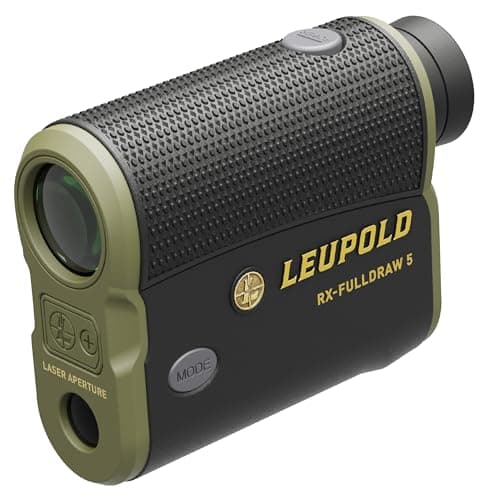
Leupold RX-FullDraw 5
Built specifically around arrow flight: it takes your arrow weight and speed and returns the pin-matched distance rather than a raw number.
Magnification and objective are the manufacturer's own model designation; exit pupil and twilight factor are computed from them. We could not machine-read Leupold's spec page, so the remaining published figures are not listed rather than guessed.
What it does well
- Archery-specific ballistics using your arrow weight and speed
- Flightpath shows whether your arrow clears a branch
- Fast ranging in Scan mode from a stand
Where it gives ground
- Overkill and over-priced if you only shoot a rifle
- Needs setup before the season, not in the stand
Skip it if
You hunt with a rifle. The RX-1400i does the job for less than half.
How this score breaks down
- Ranging accuracy and range on game (weight 5)9.0
- Angle compensation implementation (weight 5)9.5
- Display legibility in low light (weight 3)9.0
- Speed and scan mode (weight 3)8.5
- One-handed ergonomics (weight 2)8.5
Weights and definitions are published on how we review. These are editorial judgments from published specs and documented consensus, not test results.
Because an arrow's steep trajectory means the corrected distance still may not match a pin.