TBR/W stands for True Ballistic Range with Wind, and it is Leupold's name for taking angle compensation one step further than everyone else at the price.
What it does differently
A standard angle-compensating rangefinder gives you the corrected horizontal distance. If it reads 28 yards where the line of sight was 30, you now know the number - and you still have to decide what that means for your sights.
TBR/W returns the aiming solution instead. You tell the unit roughly what you shoot by picking one of its ballistic groups, and it gives you a holdover - in inches, MOA or MIL, depending on how you configure it. One fewer conversion at the moment you are least equipped to do arithmetic.
| Mode | What the display shows | What you do with it |
|---|---|---|
| LOS (line of sight) | The raw measured distance | Nothing yet - it is the uncorrected number |
| HCD / horizontal | The angle-corrected distance | Apply your own holdover for that distance |
| TBR/W holdover | A holdover, e.g. 7 in or 2.1 MOA | Hold or dial that amount |
| TBR/W archery | The pin distance | Use that pin |
How to pick a ballistic group
The unit offers a set of groups, each representing a broad trajectory class. You pick the one closest to your cartridge and load. Leupold publishes which groups correspond to which rough trajectories, and the selection takes about two minutes once.
This is the main limit of TBR/W and it is worth stating clearly: a group is an approximation of your load, not your load. Inside about 400 yards the approximation is tighter than your own shooting, so it does not matter. Past that, the gap between a group and your actual bullet's drag curve starts to matter in inches, which is where a full ballistic solver earns its cost. Where that line sits.
The W, and what it does not do
The wind component in TBR/W is a hold value for an assumed crosswind at an assumed speed. It is not a wind meter. It does not measure wind, it does not know the wind where the animal is, and it cannot account for the varying wind across the flight path.
Treat it as a sanity check on how much wind matters at that distance rather than as a value to hold off by. Wind is the hardest variable in long-range shooting and no rangefinder solves it.
Which mode to leave it in
- Rifle, inside 400 yards: TBR/W holdover, with a group matching your load. Set it once.
- Bow: TBR/W archery mode, or the FullDraw units if you want arrow-matched output. Bowhunting picks.
- You shoot several different rifles: HCD-style corrected distance may actually be simpler - one number, no group to remember which you set.
- Never leave it in LOS unless you are measuring something for a non-shooting reason. That is the uncorrected number.
Three units and three outputs
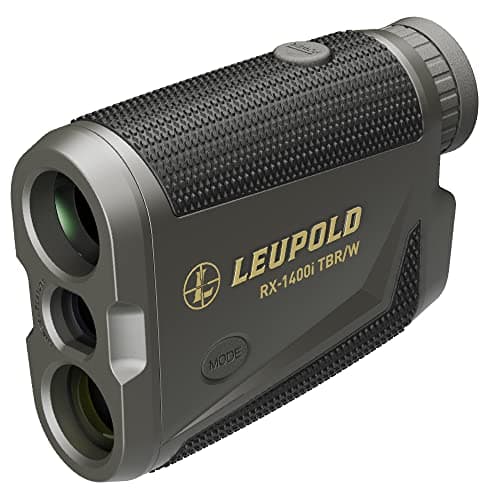
Price as of October 5, 2026. #ad How we earn
Leupold RX-1400i TBR/W Gen 2
TBR/W gives you the true horizontal distance and a holdover value in the same readout, which is the single most useful feature on a hunting rangefinder.
Magnification and objective are the manufacturer's own model designation; exit pupil and twilight factor are computed from them. We could not machine-read Leupold's spec page, so the remaining published figures are not listed rather than guessed.
What it does well
- TBR/W reports true ballistic range, not line of sight
- Fast, legible red OLED display in low light
- Compact enough for a harness pouch
Where it gives ground
- Stated ranges assume reflective targets, not deer hide
- No bluetooth or ballistic app integration
Skip it if
You need ranges past 1,000 yards on game - this is not that unit.
How this score breaks down
- Ranging accuracy and range on game (weight 5)8.5
- Angle compensation implementation (weight 5)9.5
- Display legibility in low light (weight 3)9.0
- Speed and scan mode (weight 3)8.5
- One-handed ergonomics (weight 2)9.0
Weights and definitions are published on how we review. These are editorial judgments from published specs and documented consensus, not test results.
The usual entry point to TBR/W and the one we recommend most often across this site.
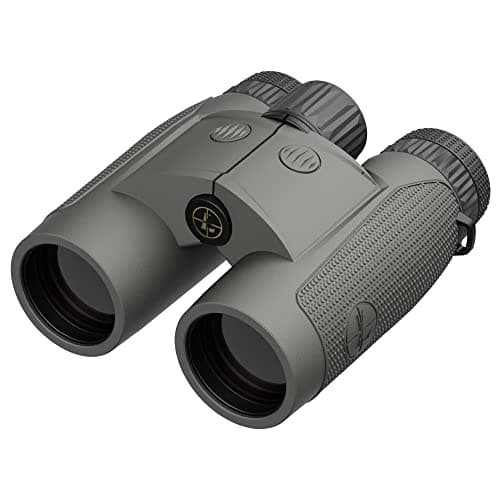
Price as of October 5, 2026. #ad How we earn
Leupold BX-4 Range HD TBR/W 10x42
Leupold's TBR/W output, which gives a holdover rather than a corrected distance, in a 10x42 binocular body.
Magnification and objective are the manufacturer's own model designation; exit pupil and twilight factor are computed from them. We could not machine-read Leupold's spec page, so the remaining published figures are not listed rather than guessed.
What it does well
- TBR/W holdover output, not just corrected distance
- Leupold build and lifetime guarantee
- Good glass independent of the laser
Where it gives ground
- Display is less bright than Sig's in deep shade
- Heavy on a harness
Skip it if
You want app-based ballistic profiles. Sig's ecosystem is deeper.
How this score breaks down
- Ranging accuracy and range on game (weight 5)9.0
- Angle compensation implementation (weight 5)9.5
- Display legibility in low light (weight 3)8.0
- Speed and scan mode (weight 3)8.5
- One-handed ergonomics (weight 2)7.5
Weights and definitions are published on how we review. These are editorial judgments from published specs and documented consensus, not test results.
The only rangefinding binocular in our picks that returns a holdover rather than a corrected distance.
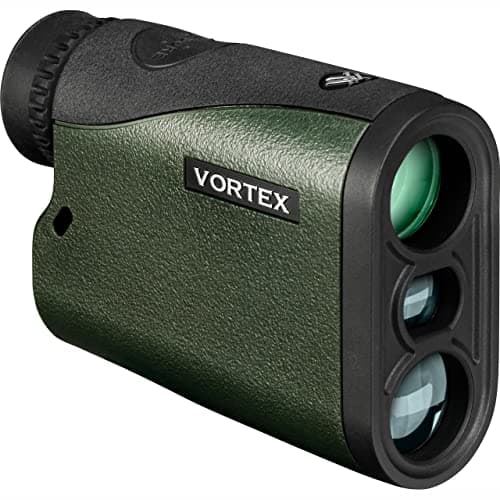
Price as of October 5, 2026. #ad How we earn
Vortex Crossfire HD 1400
A 5x21 monocular that ranges to 1,400 yards reflective with HCD angle compensation, at the price where rangefinders stop being a luxury.
| Magnification | 5x |
|---|---|
| Objective lens | 21 mm |
| Eye relief | 16.0mm |
| Field of view | 367' @ 1000 yds |
| Angular field of view | 7.0º |
| Stated accuracy | 1 yds. @100 yds. |
| Weight | 4.8 oz. |
| Length | 4.0" |
| Height | 2.9" |
| Width | 1.3" |
Specs verified 2026-10-05 from Vortex's published specification. Exit pupil and twilight factor are computed, not quoted.
What it does well
- HCD mode gives angle-compensated distance
- 16.0 mm eye relief with a 367 ft field at 5x
- VIP warranty
Where it gives ground
- Display is LCD, not illuminated, so it fades in deep shade
- No ballistic holdover output, just corrected distance
Skip it if
You hunt in low light often - an illuminated display is worth the upgrade.
How this score breaks down
- Ranging accuracy and range on game (weight 5)8.0
- Angle compensation implementation (weight 5)8.5
- Display legibility in low light (weight 3)6.5
- Speed and scan mode (weight 3)8.0
- One-handed ergonomics (weight 2)8.5
Weights and definitions are published on how we review. These are editorial judgments from published specs and documented consensus, not test results.
Sometimes the right answer: no ballistic group to choose, no assumptions baked in.
Questions people actually ask
What does TBR/W mean on a Leupold rangefinder?
How do I set up TBR/W?
Is TBR/W as good as a full ballistic solver?
Does the W in TBR/W measure wind?
Sources
- Leupold RX-1400i TBR/W Gen 2 product page - read 2026-10-05