We earn a commission if you buy through the links on this page, at no extra cost to you. It never changes which products we pick or how we rank them - read the full disclosure.
Reviewed here
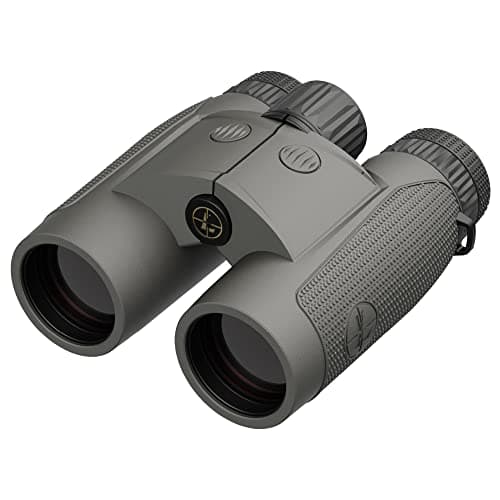
Leupold BX-4 Range HD TBR/W 10x42
Leupold's TBR/W output, which gives a holdover rather than a corrected distance, in a 10x42 binocular body.
$1,066.22 6% off
Price as of November 12, 2026. #ad How we earn
Most rangefinding binoculars are a compromised binocular with a laser bolted on. The BX-4 Range HD is the clearest exception on this site: 334 ft of field and 17 mm of eye relief are figures you would be happy with on a dedicated 10x42, and the TBR/W output behind them is the most complete angle-compensation implementation in the category. Then you pick it up, and it weighs 39 oz.
What Leupold publishes
Read off Leupold's own specification table on 2026-10-19: 10x magnification, 42 mm objective, 17 mm eye relief, 334 ft of linear field at 1,000 yards, a 6.2 degree angular field, a 13 ft close focus, 2,600 yd maximum reflective range, 1,600 yd on trees, 1,100 yd on deer, a 12 yd minimum range, accuracy of 1 yd out to 1,000 yd and 0.2 percent beyond, a red OLED display, TBR/W, Bow and Line of Sight ranging modes, a CR2 battery good for roughly 3,000 actuations, 39 oz, 5.9 in long, waterproof and fogproof, with a lifetime optical guarantee and a two-year electronics warranty.
Two figures are ours rather than Leupold's, because they are arithmetic. The exit pupil is 42 / 10 = 4.2 mm and the twilight factor is the square root of 10 x 42, which is 20.5. Both are identical to every 10x42 ever built, cheap or alpha, which is the useful thing to understand about this purchase: adding a laser does not buy you a brighter binocular. It buys you one device instead of two. (The arithmetic, worked through.)
TBR/W is the reason to buy this over the Fury
True Ballistic Range with Wind is Leupold's name for a computation that goes one step past what every other rangefinder in this price class does, and the difference is worth understanding because it is the whole argument for this unit. An ordinary angle-compensating rangefinder - Vortex's HCD, for instance - takes the line-of-sight distance to the animal and the angle, and returns the horizontal distance your projectile actually has to cover. That is geometry, and it is the correction that matters most for a steep shot.
TBR/W starts there and keeps going. You select one of Leupold's rifle ballistic groups to match your load, and instead of a distance it returns the number you dial or hold - in MOA, in mils, or as a bullet-drop figure in inches, depending on how you set it up. Leupold also states it will generate a hold point for a 10 mph full-value crosswind out to 800 yards. So the readout stops being information you have to convert under pressure and becomes an instruction. What TBR/W actually does covers the mode settings in detail, and what angle compensation is is the prerequisite if the geometry is new to you.
The honest limits of that feature, which Leupold's marketing does not emphasize. The ballistic groups are preset families, not your rifle - matching one to your load is a reasonable approximation, not a solved firing solution, and it is only as good as the zero you actually have. The wind hold assumes a 10 mph full-value wind, which means it is useful as a reference and useless as a substitute for reading the wind in front of you. And none of it knows the air density you are shooting in. If you want that, you want the ballistic solver in the KILO10K above, and you should know going in that it costs several times as much.
The binocular half, which is the half that decides
334 ft of field at 1,000 yards is the number that should sell this unit. For context on the same site: the Fury HD 5000 publishes 321 ft, a Vortex Viper HD 10x42 publishes 341 ft, a Vortex Crossfire HD 10x42 publishes 325 ft. So the BX-4 gives up only 7 ft to a dedicated mid-tier 10x42 - with a laser inside it - and beats a cheap one. That is unusual in this category and it is the specification that makes the unit worth carrying rather than tolerating.
17 mm of eye relief is the companion number and it is equally good. Below roughly 15 mm a glasses wearer cannot get their eye far enough back to see the whole field and ends up with a vignetted circle inside a black ring; 17 mm clears that with room to spare. If you glass in prescription or shooting glasses, this is the rangefinding binocular on this site that fits you best, and it is not close.
What you do not get is Viper HD resolution. The budget inside any rangefinding binocular is split between glass and laser electronics, so at equal money the dedicated optic out-resolves it - that is physics of the bill of materials, not a Leupold failing. If you are the hunter who glasses for four hours before ranging anything once, the split is the wrong way round for you, and rangefinder vs rangefinding binoculars is the page that argues it properly.
39 oz is the real decision
Everything above is the case for this unit. Here is the case against, and it is a single number. 39 oz is heavier than the Fury HD 5000 by 6.7 oz, heavier than a Viper HD 10x42 by about 14 oz, and heavier than the combined weight of some binocular-plus-rangefinder pairings. All of it hangs from your chest, on the strap or in the harness, for every step of every day you hunt.
Weight at that scale changes behavior, and that is the honest problem with it. A binocular that is unpleasant to carry gets left in the truck, and an optic in the truck resolves nothing and ranges nothing. If you hunt from a vehicle, a blind, a treestand or a short walk from camp, 39 oz costs you nothing and you should ignore this section. If you are ten miles in with a pack on, it is the single most important specification on the page, and the correct answer is probably a lighter binocular plus a pocket rangefinder.
A good bino harness genuinely changes how 39 oz feels, because it distributes the load across both shoulders instead of hanging it from your neck, and it should be part of the purchase rather than an afterthought. It does not make the unit light. It makes it carryable.
Who should buy it, and who should not
- Buy it if you want a holdover rather than a corrected distance, and you would otherwise be doing that arithmetic in your head on a slope.
- Buy it if you wear glasses while glassing - 17 mm of eye relief and 334 ft of field is the most comfortable view in this category.
- Buy it if you are replacing a binocular and a rangefinder at the same time, which is the one moment the combined price actually works out.
- Buy the Vortex Fury HD 5000 instead if weight matters and you only need the horizontal distance. It is 6.7 oz lighter and costs less.
- Buy a Viper HD plus a standalone rangefinder instead if glass quality is your priority. Better glass, less total money, two things on your chest - the right answer for most whitetail hunters.
- Step up to a ballistic solver instead if you shoot past 600 yards and want a real firing solution with live environmentals.
- Skip it entirely if you are counting ounces on a backcountry hunt. 39 oz is the wrong number for that trip.
This unit and its two closest alternatives
$1,066.22 6% off
Price as of November 12, 2026. #ad How we earn
Leupold BX-4 Range HD TBR/W 10x42
Leupold's TBR/W output, which gives a holdover rather than a corrected distance, in a 10x42 binocular body.
| Magnification | 10x |
|---|---|
| Objective lens | 42 mm |
| Eye relief | 17 mm |
| Field of view | 334 ft @ 1,000 yd |
| Angular field of view | 6.2° |
| Close focus | 13 ft |
| Max range, reflective | 2,600 yd |
| Max range, trees | 1,600 yd |
| Max range, deer | 1,100 yd |
| Minimum range | 12 yd |
| Accuracy | 1 yd to 1,000 yd; 0.2 % beyond |
| Display | Red OLED |
| Ranging modes | TBR/W, Bow, Line of Sight |
| Battery | CR2, approx. 3,000 actuations |
| Weight | 39 oz |
| Length | 5.9 in |
| Warranty | Lifetime optics; two-year electronics |
| Exit pupil (computed) | 4.2 mm |
| Twilight factor (computed) | 20.5 |
Specs verified 2026-10-19 from Leupold's published specification. Exit pupil and twilight factor are computed, not quoted.
What it does well
- TBR/W holdover output, not just corrected distance
- 334 ft of field and 17 mm of eye relief - the widest, most comfortable view of any rangefinding binocular here
- Published 1,100 yd range on deer and 1 yd accuracy out to 1,000 yd
- Lifetime optical guarantee behind the glass
Where it gives ground
- 39 oz is the heaviest rangefinding binocular on this site - 6.7 oz over the Vortex Fury HD 5000
- 13 ft close focus, against 6.0 ft for a standard 10x42
- Electronics carry a two-year warranty, not the lifetime cover the glass gets
- Leupold now also sells a Gen 2 of this unit at a substantially higher price
Skip it if
You want app-based ballistic profiles. Sig's ecosystem is deeper.
How this score breaks down
- Ranging accuracy and range on game (weight 5)8.9
- Angle compensation implementation (weight 5)9.5
- Display legibility in low light (weight 3)8.1
- Speed and scan mode (weight 3)8.4
- One-handed ergonomics (weight 2)7.4
Criterion scores are on the 0-10 rubric scale. Their weighted mean is 8.7, which maps to 9.5 on our published recommendation scale of 8.4 to 9.8 - the band of products we are willing to recommend at all. The weights, the definitions and the mapping are all published, so any score here can be checked against our own rules. These are editorial judgments from published specifications, computed optical arithmetic and documented consensus.
Read as a binocular first, which is the right order: Leupold publishes 334 ft of linear field at 1,000 yards, a 6.2 degree angular field and 17 mm of eye relief. Those are not rangefinding-binocular numbers, they are good 10x42 numbers - 13 ft wider than the Vortex Fury HD 5000 and a millimeter more eye relief - and that matters more than the laser specification, because a hunter spends hours behind the glass and seconds behind the laser.
The laser side publishes 2,600 yd to a reflective target, 1,600 yd to a tree and 1,100 yd on deer, with a 12 yd minimum, 1 yd of stated accuracy out to 1,000 yd and 0.2 percent beyond it. The deer figure is the honest one and the only one worth planning around - it is several times any ethical shot distance, which is the point of a long-rated laser: it returns a number instantly and in bad conditions rather than straining at the top of its range.
The cons are weight and warranty structure. At 39 oz this is the heaviest rangefinding binocular on this site, 6.7 oz over the Fury HD 5000 and roughly 14 oz over a Viper HD 10x42 - all of it hanging off your chest. And the glass carries Leupold's lifetime guarantee while the electronics carry two years, which is the industry norm and still worth knowing before you treat this as a lifetime purchase. The 13 ft close focus is a distant third complaint; it only matters if this is also the binocular you look at close things with.
$1,499.99 33% off
Price as of November 12, 2026. #ad How we earn
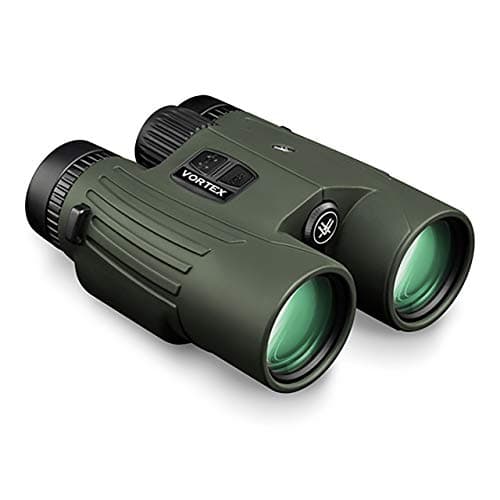
Vortex Fury HD 5000 10x42
The unit that made rangefinding binoculars mainstream: a credible 10x42 with a laser that reaches far past any ethical shot distance.
| Magnification | 10x |
|---|---|
| Objective lens | 42 mm |
| Eye relief | 16mm |
| Field of view | 321' @ 1000 yds |
| Angular field of view | 6.1º |
| Close focus | 18.5 ft. |
| Weight | 32.3 oz. |
| Height | 5.8" |
| Width | 5.0" |
Specs verified 2026-10-05 from Vortex's published specification. Exit pupil and twilight factor are computed, not quoted.
What it does well
- Good 10x42 glass with 16 mm eye relief, verified in Vortex's specs
- HCD angle compensation
- Ranges well beyond practical hunting distances
Where it gives ground
- 32.3 oz on a harness is a real weight penalty next to a 24.9 oz binocular
- Costs more than a Viper HD plus a good rangefinder
Skip it if
Weight is your binding constraint. Two lighter optics may carry better than one heavy one.
How this score breaks down
- Ranging accuracy and range on game (weight 5)9.0
- Angle compensation implementation (weight 5)8.6
- Display legibility in low light (weight 3)8.4
- Speed and scan mode (weight 3)8.7
- One-handed ergonomics (weight 2)7.1
Criterion scores are on the 0-10 rubric scale. Their weighted mean is 8.5, which maps to 9.4 on our published recommendation scale of 8.4 to 9.8 - the band of products we are willing to recommend at all. The weights, the definitions and the mapping are all published, so any score here can be checked against our own rules. These are editorial judgments from published specifications, computed optical arithmetic and documented consensus.
The real competitor, and the one most buyers are actually choosing between. The Fury is lighter at 32.3 oz, publishes a longer reflective range, and its HCD mode returns the horizontal component distance - the number your bullet or arrow has to cover - rather than a hold. For most hunting inside 500 yards that is the correct amount of computation and this unit's extra output goes unused. The full Fury HD 5000 review sets out where it wins.
No buyable offer at the last price check.
Prices change; we show only live figures. #ad How we earn
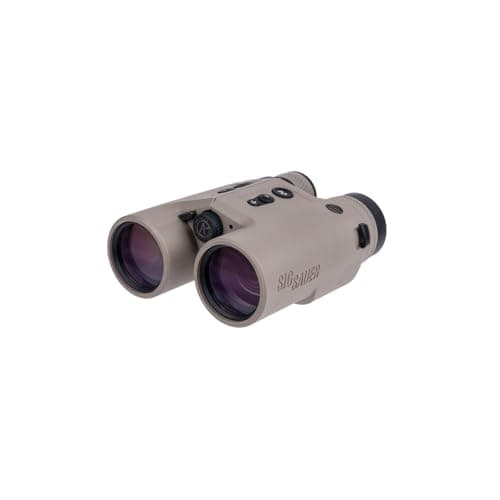
Sig Sauer KILO10K-ABS HD 10x42
Applied Ballistics Elite, onboard environmental sensors and a 10,000 yard laser: the ceiling of what this category currently does.
| Magnification | 10x |
|---|---|
| Objective lens | 42 mm |
| Max distance | 10,000 yd |
| Display | Segmented OLED |
| Reticle | Circle / Duplex / Box + Milling Grid |
| Ballistic solver | Applied Ballistics Elite, complete AB bullet database and custom drag curves |
| Eye relief | 18 mm |
| Field of view | 6.10 degrees |
| Battery | CR2 |
| Waterproof | IPX7 |
| Weight | 32 oz |
| Dimensions (L x W x H) | 5.70 x 5.0 x 2.50 in |
| Exit pupil (computed) | 4.2 mm |
| Twilight factor (computed) | 20.5 |
Specs verified 2026-11-09 from Sig Sauer's published specification. Exit pupil and twilight factor are computed, not quoted.
What it does well
- Applied Ballistics Elite with the complete AB bullet database and custom drag curves
- Laser reach far exceeds any hunting need
- IPX7 sealing, the only submersion rating of any SIG unit here
- Excellent glass independent of the electronics
Where it gives ground
- Priced like a rifle and a scope together
- 32 oz on a harness all day
- Complexity is a liability in the dark
- SIG publishes no game-animal range figure in the dealer specification table
Skip it if
You are a hunter rather than a long-range competitor.
How this score breaks down
- Ranging accuracy and range on game (weight 5)10.0
- Angle compensation implementation (weight 5)9.8
- Display legibility in low light (weight 3)9.4
- Speed and scan mode (weight 3)9.3
- One-handed ergonomics (weight 2)7.2
Criterion scores are on the 0-10 rubric scale. Their weighted mean is 9.4, which maps to 9.8 on our published recommendation scale of 8.4 to 9.8 - the band of products we are willing to recommend at all. The weights, the definitions and the mapping are all published, so any score here can be checked against our own rules. These are editorial judgments from published specifications, computed optical arithmetic and documented consensus.
If you want a genuine firing solution rather than a good approximation of one, this is the honest upgrade: Applied Ballistics onboard, live environmental sensors, Bluetooth profiles and a display built to show a solution. It costs a large multiple of the BX-4 and it is more rangefinder than the large majority of hunters will ever use. The case for and against solvers is in the Sig KILO5K review.
Our recommendation
If you take one thing from this page, take this.
Leupold BX-4 Range HD TBR/W 10x42
The subject of this review
334 ft of field, 17 mm of eye relief, a published 1,100 yd deer range and a TBR/W output that gives you a hold rather than a corrected distance.
Vortex Fury HD 5000 10x42
The closest alternative
6.7 oz lighter and cheaper, with HCD angle compensation instead of TBR/W and a 5,000 yd reflective rating.
$1,499.99 33% off
Prices are pulled live and shown on each button. #ad How we earn.
Questions people actually ask
Is the Leupold BX-4 Range HD worth it?
How far will the BX-4 Range HD range a deer?
What is the difference between TBR/W and ordinary angle compensation?
How heavy is the BX-4 Range HD?
BX-4 Range HD or Vortex Fury HD 5000?
Should I buy the BX-4 Range HD Gen 2 instead?
Sources
- Leupold BX-4 Range HD TBR/W 10x42mm - published specifications - read 2026-10-19
- Leupold BX-4 Range HD Gen 2 TBR/W 10x42mm - published specifications - read 2026-10-19
- Vortex Viper HD 10x42 published specifications (comparison figures) - read 2026-10-05
- Vortex Fury HD 5000 published technical specification (comparison figures) - read 2026-10-12