We earn a commission if you buy through the links on this page, at no extra cost to you. It never changes which products we pick or how we rank them - read the full disclosure.
Reviewed here
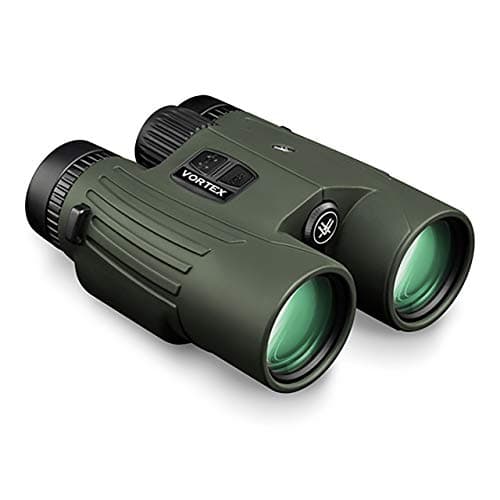
Vortex Fury HD 5000 10x42
The unit that made rangefinding binoculars mainstream: a credible 10x42 with a laser that reaches far past any ethical shot distance.
$1,499.99 33% off
Price as of November 12, 2026. #ad How we earn
The Fury HD 5000 is the unit that made rangefinding binoculars mainstream, and on its published numbers it earns that: a real 10x42 with 321 ft of field and 16 mm of eye relief, a laser rated to 1,600 yd on deer, and HCD angle compensation, all in one 32.3 oz package. Whether you should buy it comes down to a single question, and it is not an optical one.
What Vortex publishes
Read from a published Vortex specification table on 2026-10-12: 10x magnification, 42 mm objective, 16 mm eye relief, 4.2 mm exit pupil, 321 ft linear field of view at 1,000 yards, 6.1 degrees angular field, 18.5 ft close focus, 5,000 yd maximum reflective range, 2,400 yd tree range, 1,600 yd deer range, 5 yd minimum range, stated accuracy of plus or minus 0.1 yd, Line of Sight and Horizontal Component Distance ranging modes, Best, Last and Scan target modes, a red OLED display, 5.8 in high by 5.0 in wide, 32.3 oz, IPX7 waterproof, nitrogen purged, one CR2 battery.
Two of those we can check ourselves. Exit pupil is 42 / 10 = 4.2 mm, and the twilight factor is the square root of 10 x 42, which is 20.5 - identical to every other 10x42 ever made, cheap or alpha, and the first thing to understand before reading any binocular specification. The reason it matters here is that buying a rangefinding binocular does not buy you a brighter binocular; it buys you one device instead of two. (The arithmetic, in full.)
One figure deserves skepticism rather than repetition. Vortex's stated accuracy of plus or minus 0.1 yd is a best-case, reflective-target number, and it is effectively a display resolution claim. No handheld laser holds a tenth of a yard off a deer's chest at 900 yards through heat shimmer. Treat it as a statement that the unit is precise, not as a promise about field performance - how accurate hunting rangefinders really are sets out what the published accuracy specifications across this category do and do not mean.
The binocular half is the half that is easy to get wrong
The failure mode of this whole product category is a mediocre binocular with a laser bolted on. You end up carrying a heavier optic with a worse view than the binocular you already owned, in exchange for not carrying a rangefinder. The Fury avoids that. 321 ft of field at 1,000 yards sits between a Vortex Crossfire HD at 325 ft and a Zeiss Terra ED at 330 ft - respectable rather than wide - and 16 mm of eye relief is enough for most glasses wearers, 1 mm short of the Viper HD and well clear of the roughly 15 mm floor where glasses start costing you the edges of the field.
What you do not get is Viper HD resolution. The money inside this unit is split between glass and laser electronics, so at equal price the glass will be a tier behind a dedicated binocular. If you are the kind of hunter who glasses for four hours before ranging anything once, that split is the wrong way round for you.
The 18.5 ft close focus is the one specification that is genuinely poor, and it is worth knowing before you buy rather than after. A Viper HD 10x42 focuses to 6.0 ft. If you use binoculars to look at anything close - tracks, a blood trail, a bird in the yard - this unit simply will not do it.
HCD, and what it does not tell you
HCD stands for Horizontal Component Distance, and it is Vortex's angle-compensated mode: instead of the straight-line distance to the animal, it returns the horizontal distance your bullet or arrow actually has to cover. For a steep shot out of a tree stand or down into a canyon, that difference is the whole shot. Vortex states HCD gives the true shot range out to 800 yards on mild slopes, 400 yards on moderate slopes, and for all archery shooting - a sensible honest limit, because beyond those ranges a simple geometric correction is no longer the dominant source of error. What angle compensation is and why it matters.
What HCD does not do is ballistics. It does not know your load, your zero, the air density or the wind, and it will not give you a holdover. That is the line between a rangefinder and a solver, and it is the line the KILO10K above crosses. For the large majority of hunting - inside 500 yards, with a rifle you have shot enough to know - HCD is the correct amount of computation and a solver is a subscription to complexity you will not use. Rangefinders for treestand hunting is the specific case where this mode earns its money.
The only question that matters: one optic or two?
Everything above is detail. The decision is this: for the money the Fury HD 5000 costs, you could buy a very good 10x42 binocular and a very good angle-compensating rangefinder, separately, and have money left over. So the Fury has to win on something other than price, and it does win on two things - one device on your chest instead of two, and never putting the binocular down to pick the rangefinder up.
That second advantage is larger than it sounds for some hunters and nearly worthless to others. If you hunt open country, find animals at distance and need the number immediately while still looking at the animal, a rangefinding binocular is genuinely faster, and speed is the difference between a shot and a story. If you hunt timber, range a trail once before first light and then never touch the rangefinder again, you are carrying 32.3 oz and paying a premium for a feature you use twice a season.
The two-optic alternative is a specific and good one, and we would not be honest without naming it: a Vortex Viper HD 10x42 plus a Leupold RX-1400i TBR/W Gen 2 is better glass, a better angle-compensation implementation and less total money, at the cost of two things on your chest and one extra motion at the moment of truth. The full version of that argument, with the weights, is in rangefinder vs rangefinding binoculars.
Who should buy it, and who should not
- Buy it if you hunt open country, range animals often and at distance, and want the number without taking the glass off your eyes.
- Buy it if you are replacing both a binocular and a rangefinder at the same time - that is the moment the arithmetic works, because you are not paying for glass twice.
- Buy the [Leupold BX-4 Range HD](/rangefinders/leupold-bx-4-range-hd-review) instead if you want the most complete angle-compensation implementation in the category and a lifetime warranty with no receipt required.
- Buy the Viper HD plus a standalone rangefinder instead if glass quality is your priority, which it should be if you glass for hours and range rarely. This is the right answer for most whitetail hunters.
- Step up to the KILO10K-ABS instead if you shoot past 600 yards and want a firing solution rather than a distance.
- Skip it entirely if weight is your binding constraint on a backcountry hunt, or if you need a binocular that focuses closer than 18.5 ft.
This unit and its two closest alternatives
$1,499.99 33% off
Price as of November 12, 2026. #ad How we earn
Vortex Fury HD 5000 10x42
The unit that made rangefinding binoculars mainstream: a credible 10x42 with a laser that reaches far past any ethical shot distance.
| Magnification | 10x |
|---|---|
| Objective lens | 42 mm |
| Eye relief | 16mm |
| Field of view | 321' @ 1000 yds |
| Angular field of view | 6.1º |
| Close focus | 18.5 ft. |
| Weight | 32.3 oz. |
| Height | 5.8" |
| Width | 5.0" |
Specs verified 2026-10-05 from Vortex's published specification. Exit pupil and twilight factor are computed, not quoted.
What it does well
- Good 10x42 glass with 16 mm eye relief, verified in Vortex's specs
- HCD angle compensation
- Ranges well beyond practical hunting distances
Where it gives ground
- 32.3 oz on a harness is a real weight penalty next to a 24.9 oz binocular
- Costs more than a Viper HD plus a good rangefinder
Skip it if
Weight is your binding constraint. Two lighter optics may carry better than one heavy one.
How this score breaks down
- Ranging accuracy and range on game (weight 5)9.0
- Angle compensation implementation (weight 5)8.6
- Display legibility in low light (weight 3)8.4
- Speed and scan mode (weight 3)8.7
- One-handed ergonomics (weight 2)7.1
Criterion scores are on the 0-10 rubric scale. Their weighted mean is 8.5, which maps to 9.4 on our published recommendation scale of 8.4 to 9.8 - the band of products we are willing to recommend at all. The weights, the definitions and the mapping are all published, so any score here can be checked against our own rules. These are editorial judgments from published specifications, computed optical arithmetic and documented consensus.
The Fury HD 5000 is a competent 10x42 binocular first and a rangefinder second, which is the correct order and not how every unit in this category is built. Vortex publishes 321 ft of field at 1,000 yards, 16 mm of eye relief, a 4.2 mm exit pupil and an 18.5 ft close focus - specifications that would be unremarkable on a $300 binocular and are genuinely good on one carrying a laser.
The laser side publishes 5,000 yd to a reflective target, 2,400 yd to a tree and 1,600 yd to deer, with a 5 yd minimum. Those are Vortex's figures and the deer number is the only one that matters to a hunter: it is several times any ethical shot distance, which is the point - a laser rated far beyond your range is a laser that returns a number quickly and in poor conditions rather than one that struggles at the top of its spec.
The cons are weight and money. At 32.3 oz this is 7.4 oz heavier than a Viper HD 10x42, and all of it hangs on your chest. It also costs appreciably more than a good 10x42 and a good standalone rangefinder bought separately, which is the comparison that should decide this purchase.
$1,066.22 6% off
Price as of November 12, 2026. #ad How we earn
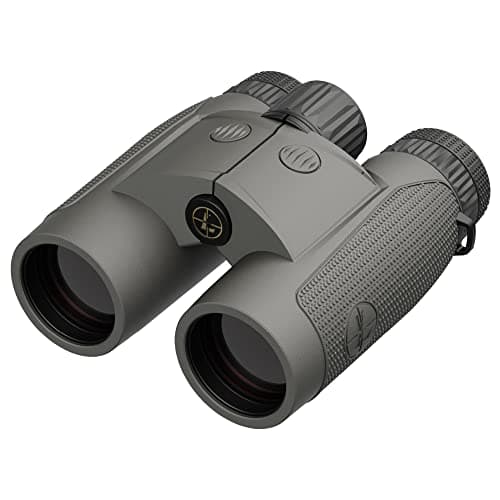
Leupold BX-4 Range HD TBR/W 10x42
Leupold's TBR/W output, which gives a holdover rather than a corrected distance, in a 10x42 binocular body.
| Magnification | 10x |
|---|---|
| Objective lens | 42 mm |
| Eye relief | 17 mm |
| Field of view | 334 ft @ 1,000 yd |
| Angular field of view | 6.2° |
| Close focus | 13 ft |
| Max range, reflective | 2,600 yd |
| Max range, trees | 1,600 yd |
| Max range, deer | 1,100 yd |
| Minimum range | 12 yd |
| Accuracy | 1 yd to 1,000 yd; 0.2 % beyond |
| Display | Red OLED |
| Ranging modes | TBR/W, Bow, Line of Sight |
| Battery | CR2, approx. 3,000 actuations |
| Weight | 39 oz |
| Length | 5.9 in |
| Warranty | Lifetime optics; two-year electronics |
| Exit pupil (computed) | 4.2 mm |
| Twilight factor (computed) | 20.5 |
Specs verified 2026-10-19 from Leupold's published specification. Exit pupil and twilight factor are computed, not quoted.
What it does well
- TBR/W holdover output, not just corrected distance
- 334 ft of field and 17 mm of eye relief - the widest, most comfortable view of any rangefinding binocular here
- Published 1,100 yd range on deer and 1 yd accuracy out to 1,000 yd
- Lifetime optical guarantee behind the glass
Where it gives ground
- 39 oz is the heaviest rangefinding binocular on this site - 6.7 oz over the Vortex Fury HD 5000
- 13 ft close focus, against 6.0 ft for a standard 10x42
- Electronics carry a two-year warranty, not the lifetime cover the glass gets
- Leupold now also sells a Gen 2 of this unit at a substantially higher price
Skip it if
You want app-based ballistic profiles. Sig's ecosystem is deeper.
How this score breaks down
- Ranging accuracy and range on game (weight 5)8.9
- Angle compensation implementation (weight 5)9.5
- Display legibility in low light (weight 3)8.1
- Speed and scan mode (weight 3)8.4
- One-handed ergonomics (weight 2)7.4
Criterion scores are on the 0-10 rubric scale. Their weighted mean is 8.7, which maps to 9.5 on our published recommendation scale of 8.4 to 9.8 - the band of products we are willing to recommend at all. The weights, the definitions and the mapping are all published, so any score here can be checked against our own rules. These are editorial judgments from published specifications, computed optical arithmetic and documented consensus.
The genuine rival at a similar price. Leupold's TBR/W is the most complete angle-compensation implementation in the category because it returns a wind-and-ballistic-corrected number rather than only a horizontal distance - what TBR/W actually does is worth reading before you choose between these two. Leupold's Guaranteed for Life cover is the other half of the argument.
No buyable offer at the last price check.
Prices change; we show only live figures. #ad How we earn
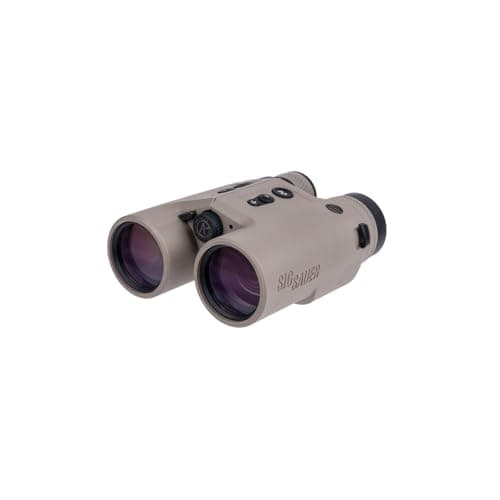
Sig Sauer KILO10K-ABS HD 10x42
Applied Ballistics Elite, onboard environmental sensors and a 10,000 yard laser: the ceiling of what this category currently does.
| Magnification | 10x |
|---|---|
| Objective lens | 42 mm |
| Max distance | 10,000 yd |
| Display | Segmented OLED |
| Reticle | Circle / Duplex / Box + Milling Grid |
| Ballistic solver | Applied Ballistics Elite, complete AB bullet database and custom drag curves |
| Eye relief | 18 mm |
| Field of view | 6.10 degrees |
| Battery | CR2 |
| Waterproof | IPX7 |
| Weight | 32 oz |
| Dimensions (L x W x H) | 5.70 x 5.0 x 2.50 in |
| Exit pupil (computed) | 4.2 mm |
| Twilight factor (computed) | 20.5 |
Specs verified 2026-11-09 from Sig Sauer's published specification. Exit pupil and twilight factor are computed, not quoted.
What it does well
- Applied Ballistics Elite with the complete AB bullet database and custom drag curves
- Laser reach far exceeds any hunting need
- IPX7 sealing, the only submersion rating of any SIG unit here
- Excellent glass independent of the electronics
Where it gives ground
- Priced like a rifle and a scope together
- 32 oz on a harness all day
- Complexity is a liability in the dark
- SIG publishes no game-animal range figure in the dealer specification table
Skip it if
You are a hunter rather than a long-range competitor.
How this score breaks down
- Ranging accuracy and range on game (weight 5)10.0
- Angle compensation implementation (weight 5)9.8
- Display legibility in low light (weight 3)9.4
- Speed and scan mode (weight 3)9.3
- One-handed ergonomics (weight 2)7.2
Criterion scores are on the 0-10 rubric scale. Their weighted mean is 9.4, which maps to 9.8 on our published recommendation scale of 8.4 to 9.8 - the band of products we are willing to recommend at all. The weights, the definitions and the mapping are all published, so any score here can be checked against our own rules. These are editorial judgments from published specifications, computed optical arithmetic and documented consensus.
If what you actually want is a firing solution rather than a distance, this is the honest upgrade path: a full Applied Ballistics solver with onboard environmentals, Bluetooth and a display built to show a solution rather than a number. It costs roughly three times the Fury and it is more rangefinder than most hunters will ever use - the case for and against solvers is in the Sig KILO5K review.
Our recommendation
If you take one thing from this page, take this.
Vortex Fury HD 5000 10x42
The subject of this review
321 ft of field, 16 mm of eye relief and a published 1,600 yd deer range in one 32.3 oz unit.
$1,499.99 33% off
Leupold BX-4 Range HD TBR/W 10x42
The closest alternative
Leupold's TBR/W angle compensation in a rangefinding binocular, with the Guaranteed for Life warranty behind it.
Prices are pulled live and shown on each button. #ad How we earn.