We earn a commission if you buy through the links on this page, at no extra cost to you. It never changes which products we pick or how we rank them - read the full disclosure.
Our top pick
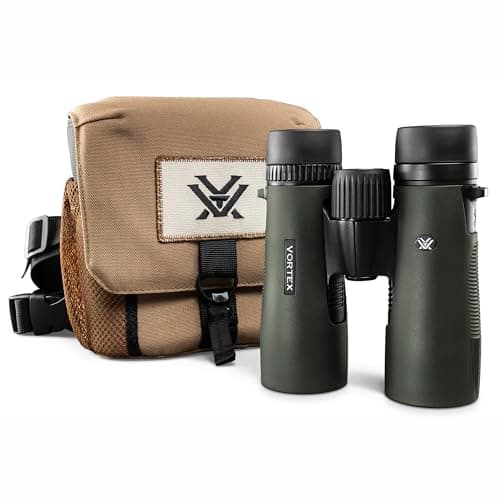
Vortex Diamondback HD 8x42
A 5.25 mm exit pupil and 17 mm of eye relief at the $250 tier, which is the combination most first upgrades actually need.
Price as of October 5, 2026. #ad How we earn
This comparison is unusually clean, because Vortex publishes the same 393 ft field of view for the Solo R/T 8x36 monocular and the Diamondback HD 8x42 binocular (both verified 2026-10-05). The field is identical, so everything that differs is about one eye against two.
What you lose with one eye
Low-contrast resolution. This is the big one and it is physiological rather than optical. Your visual system combines the two slightly different images from your eyes, and that combination is genuinely better at pulling a shape out of a cluttered background than either image alone. A bedded gray-brown animal in gray-brown sage is precisely a low-contrast problem, and two eyes solve it measurably better.
Endurance. Glassing through one eye is more tiring, partly because you are suppressing the other eye's input and partly because you tend to squint. Over an hour the difference is real, and tired eyes find less.
Depth perception. Minor for most hunting. It matters when you are judging whether an animal is in front of or behind a line of brush, which affects whether you have a shot.
What you gain
| Solo R/T 8x36 | Diamondback HD 8x42 | |
|---|---|---|
| Computed exit pupil | 4.50 mm | 5.25 mm |
| Published field at 1,000 yd | 393 ft | 393 ft |
| Published eye relief | 18.0 mm | 17 mm |
| Bulk | About a third | Reference |
| Viewing | One eye | Two eyes |
| Rough price | $149 | $239 |
| Ranging reticle | Yes | No |
Both sets of published figures read from Vortex on 2026-10-05. The monocular is cheaper, smaller, and has more eye relief. The binocular has more exit pupil and two eyes.
The bulk saving is the whole case, and it is bigger than the specification suggests because it changes behavior: a monocular lives in a harness pocket and gets used reflexively, while a binocular is a decision to carry.
The three cases where the monocular wins
- As a second optic. Not instead of binoculars - as well as. A few ounces in a pocket for quick checks, with the binoculars doing the real glassing.
- One-handed use. Holding a bow, holding a rifle, bracing on a tree. A monocular comes up one-handed with less motion.
- Thermal. The sensor is the product and a second channel would roughly double the cost for nothing. Thermal picks.
And the one case that is a mistake
Buying a monocular as your only glassing optic to save money or weight. The $90 saved and the few ounces are not worth the loss in low-contrast resolution and endurance, because those are exactly what finding animals depends on. If budget is the constraint, a $149 Crossfire HD binocular beats a $149 monocular for that job. Budget binoculars.
The two side by side
Price as of October 5, 2026. #ad How we earn
Vortex Diamondback HD 8x42
A 5.25 mm exit pupil and 17 mm of eye relief at the $250 tier, which is the combination most first upgrades actually need.
| Magnification | 8x |
|---|---|
| Objective lens | 42 mm |
| Eye relief | 17 mm |
| Field of view | 393 feet/1000 yards |
| Angular field of view | 7.5 degrees |
| Close focus | 5 feet |
| Weight | 21.8 oz |
| Height | 5.8 inches |
| Width | 5.1 inches |
| Exit pupil (computed) | 5.25 mm |
| Twilight factor (computed) | 18.3 |
Specs verified 2026-10-05 from Vortex's published specification. Exit pupil and twilight factor are computed, not quoted.
What it does well
- 5.25 mm exit pupil, the same figure as the Viper HD 8x42
- 17 mm eye relief works with glasses
- 393 ft field of view is wide for the money
Where it gives ground
- 8x limits you in genuinely open country
- Focus wheel is stiffer than the Viper's in the cold
Skip it if
You glass across canyons - the extra magnification matters more than the brightness there.
How this score breaks down
- Low-light performance (weight 4)8.5
- Size and weight (weight 4)6.0
- Optical quality per dollar (weight 4)9.5
- Eye relief (weight 2)9.0
- Build and sealing (weight 2)10.0
Weights and definitions are published on how we review. These are editorial judgments from published specs and documented consensus, not test results.
Vortex publishes 393 ft of field and 17 mm of eye relief (verified 2026-10-05). Better on every optical count than any monocular here.
Price as of October 5, 2026. #ad How we earn
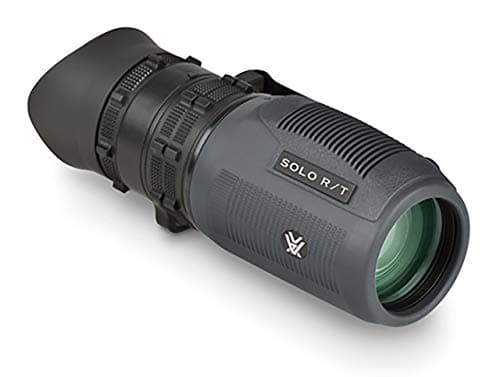
Vortex Solo R/T 8x36
A 4.5 mm exit pupil, 18 mm of eye relief and an MRAD ranging reticle in a unit that weighs a third of a binocular.
| Magnification | 8x |
|---|---|
| Objective lens | 36 mm |
| Eye relief | 18.0mm |
| Field of view | 393' @ 1000 yds |
| Angular field of view | 7.5º |
| Close focus | 16.4' |
| Weight | 9.7 oz. |
| Length | 4.9" |
| Exit pupil (computed) | 4.5 mm |
| Twilight factor (computed) | 17 |
Specs verified 2026-10-05 from Vortex's published specification. Exit pupil and twilight factor are computed, not quoted.
What it does well
- R/T ranging reticle estimates distance without batteries
- 18.0 mm eye relief, verified in Vortex's published specs
- Half the bulk of binoculars
Where it gives ground
- One eye tires faster than two over a long sit
- No depth perception, which matters in cover
Skip it if
You glass for more than a few minutes at a time.
How this score breaks down
- Low-light performance (weight 4)7.5
- Size and weight (weight 4)8.5
- Optical quality per dollar (weight 4)9.0
- Eye relief (weight 2)9.5
- Build and sealing (weight 2)9.0
Weights and definitions are published on how we review. These are editorial judgments from published specs and documented consensus, not test results.
Vortex publishes the same 393 ft of field and 18.0 mm of eye relief (verified 2026-10-05) - which makes this an unusually clean comparison, because the field of view is identical.
Questions people actually ask
Are binoculars better than a monocular for hunting?
Can I use a monocular instead of binoculars to save weight?
Why do monoculars have a smaller exit pupil?
Is a monocular good as a backup optic?
Sources
- Vortex Solo R/T 8x36 published specifications - read 2026-10-05
- Vortex Diamondback HD 8x42 published specifications - read 2026-10-05