We earn a commission if you buy through the links on this page, at no extra cost to you. It never changes which products we pick or how we rank them - read the full disclosure.
Our top pick
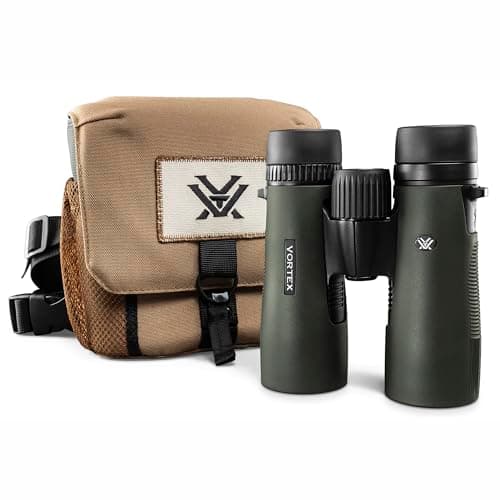
Vortex Diamondback HD 10x42
The honest floor for hunting glass: HD optical system, 330 ft of field and 15 mm of eye relief for about half what the Viper costs.
No buyable offer at the last price check.
Prices change; we show only live figures. #ad How we earn
This is the budget where the whole premise of this site becomes concrete. You can buy one $500 binocular, or you can buy a binocular, a rangefinder and a harness - and the second option changes what you can do rather than how nice the view is.
The kit
| Item | What | Rough cost | Why it is here |
|---|---|---|---|
| Binocular | Diamondback HD 10x42 or 8x42 | $236-239 | Genuine HD glass, 330 ft of field, a real warranty |
| Rangefinder | Leupold RX-1400i TBR/W Gen 2 | $200 | Angle compensation plus an illuminated display |
| Harness | TIDEWE with a rangefinder pouch | $66 | Both optics on your chest, reachable one-handed |
| Total | About $502-505 | Within rounding of $500 |
Why not the $499 binocular
Let us be specific about what you would be giving up to buy one. A Viper HD 10x42 against a Diamondback HD 10x42, from Vortex's own published figures read 2026-10-05:
- 11 ft more field of view (341 ft against 330 ft).
- 2 mm more eye relief (17.0 mm against 15 mm), which matters if you wear glasses.
- Better light transmission, which shows in the last ten minutes of legal light.
- The same 4.2 mm exit pupil and 20.5 twilight factor, because the format fixes those.
Against that, the rangefinder tells you that the animal is at 480 yards rather than the 350 you estimated - which changes whether you shoot at all. One of those is a better view; the other is a different decision. The two binoculars compared.
The exception, and it is real: if you wear glasses, the 2 mm of eye relief may be worth more to you than the rangefinder. 15 mm is marginal with glasses on. In that case buy the Viper HD, skip the rangefinder this year, and add it next.
Quick picks
Ranked by the criteria published on how we review. Tap any row for the full write-up, or go straight to the current price.
| # | Product | Best for | Score | Price |
|---|---|---|---|---|
| 1 | Vortex Diamondback HD 10x42330 ft of field and HD glass for about $236. | The binocularBest value overall | 9.3out of 10 | See today's price on the Diamondback HD 10x42Check price on Amazon No buyable offer at the last price check. |
| 2 | 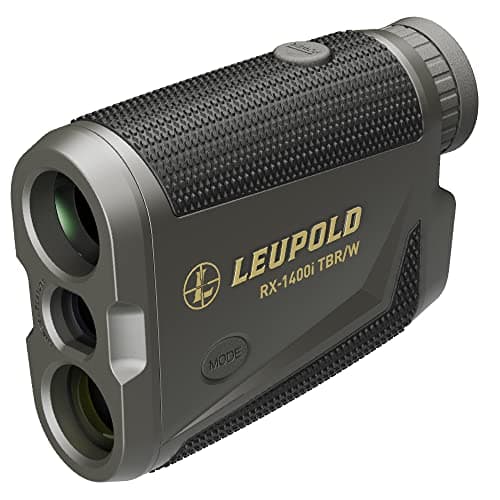 Leupold RX-1400i TBR/W Gen 2TBR/W holdover and an illuminated display, about $200. | The rangefinderBest rangefinder under $250 | 9.6out of 10 | |
| 3 | 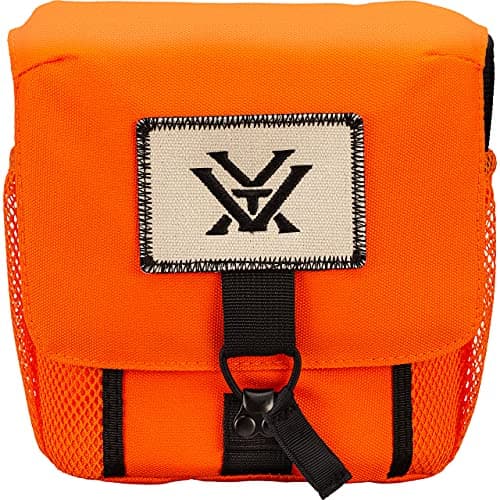 Vortex GlassPak Binocular Harness$29, and still non-negotiable. | The harnessCheapest harness worth buying | 9.3out of 10 | |
| 4 | 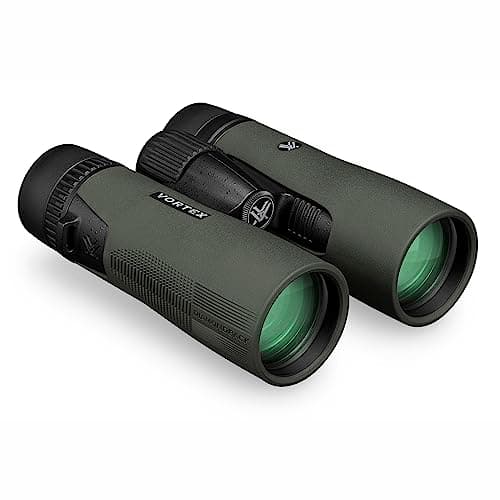 Vortex Diamondback HD 8x42Same price, 5.25 mm exit pupil, if dusk is your problem. | The low-light swapBudget low-light pick | 9.6out of 10 | |
| 5 | 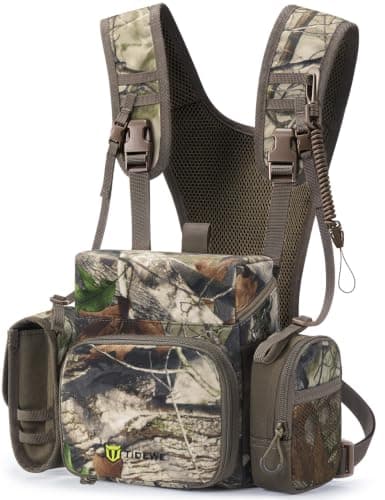 TIDEWE Binocular HarnessA rangefinder pouch included at about $66. | The two-optic harnessBudget harness with pouches | 9.0out of 10 |
Prices are pulled live from Amazon and were last checked November 19, 2026; if a figure cannot be verified the button reads "Check price" instead. Scores are our editorial judgment against the published ranking criteria, on our published 8.4 to 9.8 recommendation scale. #ad How we earn.
Why angle compensation, specifically
Because the plain distance is the wrong number on any sloped ground. From 20 feet up a treestand, an animal at 30 yards of line of sight is about 28 yards horizontally, and gravity only acts over the horizontal. Across a canyon at 25 degrees, 500 yards of line of sight is about 453 yards of true ballistic range.
A rangefinder without angle compensation gives you a precisely measured wrong number. It is not an expensive feature - units under $60 have it - so there is no price at which you should accept its absence. The trigonometry.
What this kit covers
- Hunting out to about 400 yards with trusted yardage. This is the big one, and it is most rifle hunting.
- Bowhunting properly, because the yardage from an elevated stand is now corrected rather than guessed.
- Finding and judging animals in timber and mixed country.
- Both optics reachable one-handed and silently, which is why the harness has a pouch.
What it does not cover, and what to add
Sustained glassing, because there is still no tripod - and that is the next purchase at about $216 for a tripod plus adapter. Judging at long range, which needs magnification and support. The last ten minutes of light, which is where the $500 binocular would have helped.
In order: tripod and adapter, then either better glass or 15x56 binoculars depending on whether your problem is dusk or distance. The $1,000 kit does both.
The kit in detail
No buyable offer at the last price check.
Prices change; we show only live figures. #ad How we earn
Vortex Diamondback HD 10x42
The honest floor for hunting glass: HD optical system, 330 ft of field and 15 mm of eye relief for about half what the Viper costs.
| Magnification | 10x |
|---|---|
| Objective lens | 42 mm |
| Eye relief | 15 mm |
| Field of view | 330 feet/1000 yards |
| Angular field of view | 6.3 degrees |
| Close focus | 6.7 feet |
| Weight | 21.4 oz |
| Height | 5.8 inches |
| Width | 5.1 inches |
| Exit pupil (computed) | 4.2 mm |
| Twilight factor (computed) | 20.5 |
Specs verified 2026-10-05 from Vortex's published specification. Exit pupil and twilight factor are computed, not quoted.
What it does well
- Genuine HD glass at the $250 tier
- 330 ft field of view matches binoculars costing twice as much
- Same unconditional VIP warranty as the Viper
Where it gives ground
- 15 mm eye relief is tight for some glasses wearers
- Edge sharpness falls off before the Viper's does
Skip it if
You wear glasses and have struggled with eye relief before - try the 8x42, which gives 17 mm.
How this score breaks down
- Low-light performance (weight 5)7.1
- Optical quality per dollar (weight 4)9.5
- Field of view (weight 3)8.4
- Eye relief (weight 3)6.8
- Weight and ergonomics (weight 2)8.1
- Warranty (weight 2)10.0
Criterion scores are on the 0-10 rubric scale. Their weighted mean is 8.2, which maps to 9.3 on our published recommendation scale of 8.4 to 9.8 - the band of products we are willing to recommend at all. The weights, the definitions and the mapping are all published, so any score here can be checked against our own rules. These are editorial judgments from published specifications, computed optical arithmetic and documented consensus.
Vortex publishes 330 ft of field and 15 mm of eye relief (verified 2026-10-05). Deliberately not the $499 Viper HD - the $260 saved buys the rangefinder.
Price as of November 19, 2026. #ad How we earn
Leupold RX-1400i TBR/W Gen 2
TBR/W gives you the true horizontal distance and a holdover value in the same readout, which is the single most useful feature on a hunting rangefinder.
| Magnification | 5x |
|---|---|
| Objective lens | 21 mm |
| Eye relief | 18.3 mm |
| Field of view | 368 ft @ 1,000 yd |
| Angular field of view | 7º |
| Max range, reflective | 1,400 yd |
| Max range, trees | 1,200 yd |
| Max range, deer | 900 yd |
| Minimum range | 6 yd |
| Accuracy | +/- 0.5 yd to 125 yd; +/- 2 yd to 1,000 yd; +/- 0.5 % beyond |
| Display | Red TOLED, adjustable brightness |
| Ranging modes | TBR/W, Bow with Flightpath, Line of Sight |
| Battery | CR2, approx. 3,000 actuations |
| Weight | 5.1 oz |
| Dimensions (L x W x H) | 4 x 1.4 x 3 in |
| Laser classification | Class 3R |
Specs verified 2026-10-26 from Leupold's published specification. Exit pupil and twilight factor are computed, not quoted.
What it does well
- TBR/W reports true ballistic range, not line of sight
- Fast, legible red OLED display in low light
- Compact enough for a harness pouch
Where it gives ground
- Stated ranges assume reflective targets, not deer hide - Leupold publishes 1,400 yd reflective but only 900 yd on deer
- No bluetooth or ballistic app integration
- Accuracy loosens to plus or minus 2 yd out at 1,000 yd
Skip it if
You need ranges past 1,000 yards on game - this is not that unit.
How this score breaks down
- Ranging accuracy and range on game (weight 5)8.5
- Angle compensation implementation (weight 5)9.5
- Display legibility in low light (weight 3)9.0
- Speed and scan mode (weight 3)8.5
- One-handed ergonomics (weight 2)9.0
Criterion scores are on the 0-10 rubric scale. Their weighted mean is 8.9, which maps to 9.6 on our published recommendation scale of 8.4 to 9.8 - the band of products we are willing to recommend at all. The weights, the definitions and the mapping are all published, so any score here can be checked against our own rules. These are editorial judgments from published specifications, computed optical arithmetic and documented consensus.
The single item that most changes what you can ethically shoot at. Angle compensation that returns a holdover rather than a corrected distance.
Price as of November 19, 2026. #ad How we earn
Vortex GlassPak Binocular Harness
At $29 this is the default: it holds the binoculars against your chest, closes over them in rain, and costs less than a tank of fuel.
Magnification and objective are the manufacturer's own model designation; exit pupil and twilight factor are computed from them. We could not machine-read Vortex's spec page, so the remaining published figures are not listed rather than guessed.
What it does well
- $29 for a harness that genuinely works
- Fully encloses the binoculars against weather
- VIP warranty
Where it gives ground
- No rangefinder pouch
- Fabric is noisier than premium harnesses
Skip it if
You carry a rangefinder too - get the Pro or a Marsupial.
How this score breaks down
- Core function (stability or protection) (weight 5)8.5
- Noise and access speed (weight 4)6.5
- Fit, adjustability and comfort (weight 3)8.0
- Weather protection or build (weight 3)8.5
- Value for money (weight 3)10.0
Criterion scores are on the 0-10 rubric scale. Their weighted mean is 8.2, which maps to 9.3 on our published recommendation scale of 8.4 to 9.8 - the band of products we are willing to recommend at all. The weights, the definitions and the mapping are all published, so any score here can be checked against our own rules. These are editorial judgments from published specifications, computed optical arithmetic and documented consensus.
Carries the binocular. Add a rangefinder pouch later or buy a $66 harness with one built in.
Price as of November 19, 2026. #ad How we earn
Vortex Diamondback HD 8x42
A 5.25 mm exit pupil and 17 mm of eye relief at the $250 tier, which is the combination most first upgrades actually need.
| Magnification | 8x |
|---|---|
| Objective lens | 42 mm |
| Eye relief | 17 mm |
| Field of view | 393 feet/1000 yards |
| Angular field of view | 7.5 degrees |
| Close focus | 5 feet |
| Weight | 21.8 oz |
| Height | 5.8 inches |
| Width | 5.1 inches |
| Exit pupil (computed) | 5.25 mm |
| Twilight factor (computed) | 18.3 |
Specs verified 2026-10-05 from Vortex's published specification. Exit pupil and twilight factor are computed, not quoted.
What it does well
- 5.25 mm exit pupil, the same figure as the Viper HD 8x42
- 17 mm eye relief works with glasses
- 393 ft field of view is wide for the money
Where it gives ground
- 8x limits you in genuinely open country
- Focus wheel is stiffer than the Viper's in the cold
Skip it if
You glass across canyons - the extra magnification matters more than the brightness there.
How this score breaks down
- Low-light performance (weight 5)8.5
- Optical quality per dollar (weight 4)9.5
- Field of view (weight 3)9.0
- Eye relief (weight 3)9.0
- Weight and ergonomics (weight 2)8.3
- Warranty (weight 2)10.0
Criterion scores are on the 0-10 rubric scale. Their weighted mean is 9.0, which maps to 9.6 on our published recommendation scale of 8.4 to 9.8 - the band of products we are willing to recommend at all. The weights, the definitions and the mapping are all published, so any score here can be checked against our own rules. These are editorial judgments from published specifications, computed optical arithmetic and documented consensus.
Swap the 10x42 for this at the same price if your terrain is timber or your complaint is low light.
Price as of November 19, 2026. #ad How we earn
TIDEWE Binocular Harness
A harness with a rangefinder pouch at $66, which is the cheapest way to carry two optics properly.
Magnification and objective are the manufacturer's own model designation; exit pupil and twilight factor are computed from them. We could not machine-read TIDEWE's spec page, so the remaining published figures are not listed rather than guessed.
What it does well
- Includes a rangefinder pouch at the price
- Adjustable straps fit over bulky layers
- Fully enclosing weather flap
Where it gives ground
- Fabric is noisy
- Hardware is not to premium standards
Skip it if
You hunt close-quarters whitetail where noise decides the hunt.
How this score breaks down
- Core function (stability or protection) (weight 5)8.0
- Noise and access speed (weight 4)6.0
- Fit, adjustability and comfort (weight 3)7.5
- Weather protection or build (weight 3)8.0
- Value for money (weight 3)9.0
Criterion scores are on the 0-10 rubric scale. Their weighted mean is 7.6, which maps to 9.0 on our published recommendation scale of 8.4 to 9.8 - the band of products we are willing to recommend at all. The weights, the definitions and the mapping are all published, so any score here can be checked against our own rules. These are editorial judgments from published specifications, computed optical arithmetic and documented consensus.
If the kit now includes a rangefinder, this is the better harness choice - a rangefinder in a pocket does not get used.
Our recommendation
If you take one thing from this page, take this.
Vortex Diamondback HD 10x42
The binocular
330 ft of field and HD glass for about $236.
No buyable offer at the last price check.
Leupold RX-1400i TBR/W Gen 2
The rangefinder
TBR/W holdover and an illuminated display, about $200.
Prices are pulled live and shown on each button. #ad How we earn.
Questions people actually ask
What is the best hunting optics setup for $500?
Should I buy a $500 binocular or split the budget?
What if I wear glasses?
What should I add after this kit?
Sources
- Vortex Diamondback HD 10x42 published specifications - read 2026-10-05
- Vortex Viper HD 10x42 published specifications - read 2026-10-05
- Leupold RX-1400i TBR/W Gen 2 product page - read 2026-10-05