The usual answer is "above 12x you need a tripod", which is true and incomplete. The magnification threshold is the less interesting half of the question.
The magnification answer
| Magnification | Handheld for 30 seconds | Handheld for 30 minutes | Verdict |
|---|---|---|---|
| 8x | Fine | Fine | No tripod needed |
| 10x | Fine | Tiring, and you lose detail | Tripod helps |
| 12x | Usable braced | No | Tripod effectively required |
| 15x | Shaky | No | Tripod required |
| 18x and up | Unusable | No | Tripod required |
The thing to notice is the middle column. At 10x and 12x a tripod is not about whether you CAN hold it, it is about what sustained use costs you.
A shaky 12x resolves less detail than a steady 10x. That is the key fact: beyond about 10x, handheld shake takes away more than the extra magnification adds, so buying a 12x50 and glassing it handheld makes your glassing worse rather than better. Which is why the 10x42 vs 12x50 comparison turns on the tripod question.
The more important answer: what a tripod lets you DO
This is the part most discussions miss, and it applies at 10x as much as at 15x.
A tripod makes systematic glassing possible. The method that actually finds bedded animals - dividing a hillside into overlapping squares and holding on each for ten to twenty seconds, working them in order for forty minutes - is physically exhausting handheld. Your arms ache, you start rushing, and you fall back into sweeping. Mounted, the same forty minutes is comfortable and you actually complete the grid.
The difference in what you find is not subtle, and it has nothing to do with image shake. It is about whether you can sustain the technique. The grid method in full.
What it costs, and what else that money would buy
A $149 tripod and a $67 adapter is $216. The honest comparison is against spending $216 on better glass:
| Tripod plus adapter | Binocular upgrade (e.g. Diamondback HD to Viper HD) | |
|---|---|---|
| What you gain | A still image and sustainable technique | 11 ft more field, 2 mm more eye relief, better dusk transmission |
| Applies at | Every magnification, all day | The last ten minutes of light, and the field edges |
| Unlocks new optics | Yes - 12x and 15x become usable | No |
| Lasts through | Several binoculars | This binocular |
For most hunters the tripod is the better $216, and the gap is widest for anyone who glasses for long periods. The binocular upgrade is the better buy only if you specifically hunt the edges of legal light or wear glasses and need the eye relief.
When you genuinely do not need one
- You hunt timber and still-hunt. You are moving, looking briefly, moving again. A tripod is dead weight.
- You hunt whitetail from a stand. Your looks are short, close and from a braced position, and the stand rail is a rest.
- All your glassing is under five minutes at a time. Handheld 8x or 10x is fine for that.
In other words: the tripod case is about sustained glassing in open or broken country, not about hunting generally.
What a tripod setup needs
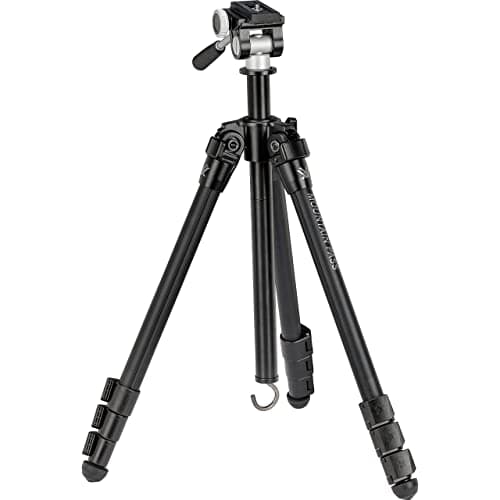
Price as of October 5, 2026. #ad How we earn
Vortex Mountain Pass Tripod Kit
3.1 lbs of aluminum with a ball head included, which makes it the cheapest way to get binoculars genuinely steady.
Magnification and objective are the manufacturer's own model designation; exit pupil and twilight factor are computed from them. We could not machine-read Vortex's spec page, so the remaining published figures are not listed rather than guessed.
What it does well
- Ball head included at $149
- Stable enough for 15x56 binoculars
- VIP warranty
Where it gives ground
- 3.1 lbs of aluminum is heavy for the stability it gives
- Not stiff enough for an 85 mm scope at 60x
Skip it if
You own a spotting scope. Buy carbon.
How this score breaks down
- Core function (stability or protection) (weight 5)8.0
- Noise and access speed (weight 4)7.5
- Fit, adjustability and comfort (weight 3)8.0
- Weather protection or build (weight 3)8.0
- Value for money (weight 3)9.5
Weights and definitions are published on how we review. These are editorial judgments from published specs and documented consensus, not test results.
Vortex publishes 3.1 lbs (verified 2026-10-05). Head included. For binoculars up to 15x56 this is enough tripod.
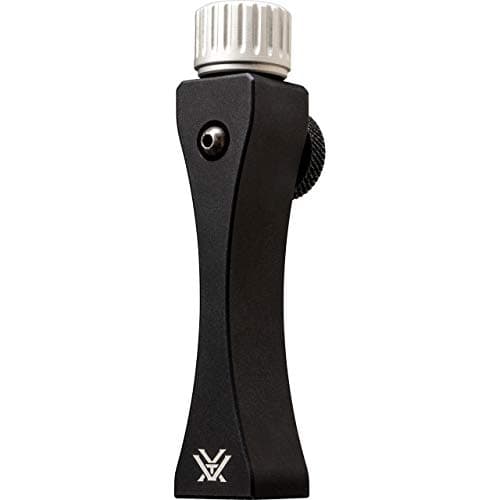
Vortex Pro Binocular Adapter
The adapter that actually stays put: it clamps the binocular rather than relying on the tripod socket thread alone.
Magnification and objective are the manufacturer's own model designation; exit pupil and twilight factor are computed from them. We could not machine-read Vortex's spec page, so the remaining published figures are not listed rather than guessed.
What it does well
- Secure clamping rather than thread-only mounting
- Works with most center-hinge binoculars
- VIP warranty
Where it gives ground
- $67 for an adapter feels steep until the cheap one slips
- Adds bulk to the binocular hinge
Skip it if
You tripod your binoculars twice a season.
How this score breaks down
- Core function (stability or protection) (weight 5)9.5
- Noise and access speed (weight 4)8.0
- Fit, adjustability and comfort (weight 3)9.0
- Weather protection or build (weight 3)8.5
- Value for money (weight 3)8.0
Weights and definitions are published on how we review. These are editorial judgments from published specs and documented consensus, not test results.
Needed, not optional - binoculars do not mount directly. The clamping design matters above 10x.
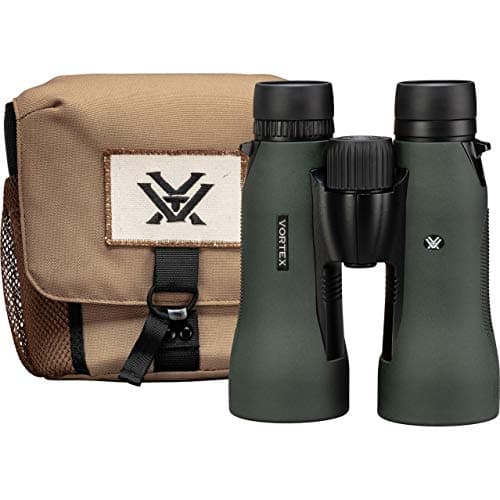
Price as of October 5, 2026. #ad How we earn
Vortex Diamondback HD 15x56
A 3.73 mm exit pupil and 230 ft of field: the cheapest credible way to sit behind a tripod all morning without carrying a spotting scope.
| Magnification | 15x |
|---|---|
| Objective lens | 56 mm |
| Eye relief | 15.6mm |
| Field of view | 230' @ 1000 yds |
| Angular field of view | 4.4º |
| Close focus | 14.0' |
| Weight | 34.8 oz. |
| Height | 7.1" |
| Width | 5.8" |
| Exit pupil (computed) | 3.73 mm |
| Twilight factor (computed) | 29 |
Specs verified 2026-10-05 from Vortex's published specification. Exit pupil and twilight factor are computed, not quoted.
What it does well
- 15x finds animals a 10x walks past
- 56 mm objective keeps it usable at dawn
- Much lighter and cheaper than a spotting scope setup
Where it gives ground
- 42.7 oz and 15x means a tripod is mandatory, not optional
- Too much magnification for timber or still-hunting
Skip it if
This is your only pair of binoculars. 15x is a second optic, not a first one.
How this score breaks down
- Core function (stability or protection) (weight 5)n/a
- Noise and access speed (weight 4)n/a
- Fit, adjustability and comfort (weight 3)n/a
- Weather protection or build (weight 3)n/a
- Value for money (weight 3)n/a
Weights and definitions are published on how we review. These are editorial judgments from published specs and documented consensus, not test results.
Vortex publishes 230 ft of field and 15.6 mm of eye relief (verified 2026-10-05). The reason to own a tripod is that it makes this format usable.
Questions people actually ask
At what magnification do you need a tripod for binoculars?
Is a tripod better than upgrading my binoculars?
Do I need a tripod for 10x42 binoculars?
What else do I need besides the tripod?
Sources
- Vortex Mountain Pass tripod kit published specifications - read 2026-10-05
- Vortex Diamondback HD 15x56 published specifications - read 2026-10-05