Nearly every hunting rangefinder claims accuracy within a yard or two, and nearly every one delivers it. The question is almost irrelevant, because the error that actually causes missed shots is a different error entirely.
The error that matters: which object did it hit
A laser rangefinder fires a pulse and times the return. The beam diverges as it travels - at 400 yards it may be covering an area several feet across. Everything in that cone produces a return. The unit then has to decide which return to report.
If there is a branch at 180 yards and an animal at 240, the beam hits both. A unit set to first-target priority reports 180. One set to distant-target priority reports 240. The measurement was accurate to within a yard in both cases, and one of them was useless.
This is why hunting rangefinders implement distant-target priority and golf rangefinders do not, and it is the single most important thing to understand about rangefinder accuracy. The full comparison.
Reflectivity, which sets your real maximum range
The laser has to return enough energy to be detected, and that depends on what it hit. A road sign returns a lot. A rock face returns a lot. Deer hide returns very little - it is matte, dark, and curved, which scatters rather than reflects.
| Stated reflective range | On a rock face or sign | On a deer in good light | On a deer in rain or haze |
|---|---|---|---|
| 450 yd | About 450 yd | 200-250 yd | Under 150 yd |
| 1,400 yd | About 1,400 yd | 400-500 yd | 250-350 yd |
| 1,800 yd | About 1,800 yd | 600-800 yd | 400-500 yd |
| 3,000 yd+ | About 3,000 yd | Well past ethical range | Still substantial |
These bands are consistent with the ranges manufacturers themselves publish for reflective, tree and deer targets where they break the figure out. Treat any single quoted number as the reflective one.
What degrades a reading
- Rain, snow and fog scatter the beam. Expect roughly half your clear-weather range.
- Heat shimmer across a hot slope defocuses the return and can prevent a lock entirely.
- Bright sun behind the target raises the noise floor the detector has to work against.
- Hand shake at distance. At 800 yards a small wobble moves the beam many feet across the target, which is why long-range readings are more reliable off a tripod or a rest.
- Shooting through a window or a screen can produce a return from the glass itself.
How to get a reliable reading
- Use scan mode and sweep across the animal rather than taking one reading. Consistent repeated numbers are the signal; a single number is a guess.
- Range something at the same distance if the animal will not return - a tree trunk beside it, a rock behind it. This is a standard technique and it works.
- Brace the unit for anything past 300 yards. Hand shake at distance moves the beam more than you think.
- Check the mode. A corrected-distance reading and an uncorrected one look identical on the display. Know which one you are in.
- Range before you need to. Mark known distances from your stand or your glassing position before an animal shows up.
Three units at different accuracy tiers
Price as of October 5, 2026. #ad How we earn
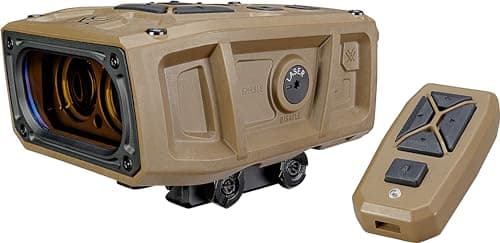
Vortex Impact 4000
A rail-mounted ballistic rangefinder that ranges and solves without you taking your hands off the rifle, accurate to 0.5 yd at 100 yd per Vortex's published spec.
| Stated accuracy | .5 yds @ 100 yds. |
|---|---|
| Weight | 16.0 oz. |
| Length | 4.6" |
| Height | 2.5" |
| Width | 3.2" |
Specs verified 2026-10-05 from Vortex's published specification. Exit pupil and twilight factor are computed, not quoted.
What it does well
- Ranges without breaking your position
- Published accuracy of 0.5 yd at 100 yd
- Integrates with ballistic apps
Where it gives ground
- Only useful on a rifle with rail space
- Adds 16 oz to the rifle
Skip it if
You hunt with a bow or still-hunt - a handheld unit is more use.
How this score breaks down
- Ranging accuracy and range on game (weight 5)9.5
- Angle compensation implementation (weight 5)9.0
- Display legibility in low light (weight 3)8.0
- Speed and scan mode (weight 3)9.0
- One-handed ergonomics (weight 2)6.5
Weights and definitions are published on how we review. These are editorial judgments from published specs and documented consensus, not test results.
Verified from Vortex's published specification on 2026-10-05 - one of the few accuracy figures in this category we could read directly.
Price as of October 5, 2026. #ad How we earn
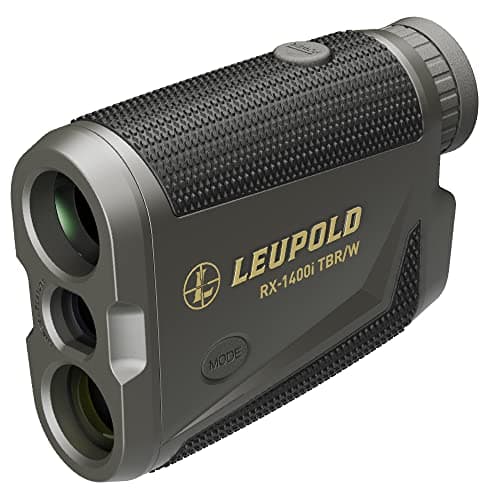
Leupold RX-1400i TBR/W Gen 2
TBR/W gives you the true horizontal distance and a holdover value in the same readout, which is the single most useful feature on a hunting rangefinder.
Magnification and objective are the manufacturer's own model designation; exit pupil and twilight factor are computed from them. We could not machine-read Leupold's spec page, so the remaining published figures are not listed rather than guessed.
What it does well
- TBR/W reports true ballistic range, not line of sight
- Fast, legible red OLED display in low light
- Compact enough for a harness pouch
Where it gives ground
- Stated ranges assume reflective targets, not deer hide
- No bluetooth or ballistic app integration
Skip it if
You need ranges past 1,000 yards on game - this is not that unit.
How this score breaks down
- Ranging accuracy and range on game (weight 5)8.5
- Angle compensation implementation (weight 5)9.5
- Display legibility in low light (weight 3)9.0
- Speed and scan mode (weight 3)8.5
- One-handed ergonomics (weight 2)9.0
Weights and definitions are published on how we review. These are editorial judgments from published specs and documented consensus, not test results.
A reminder that a yard of stated accuracy is worth nothing if you cannot read the number against timber.
Price as of October 5, 2026. #ad How we earn
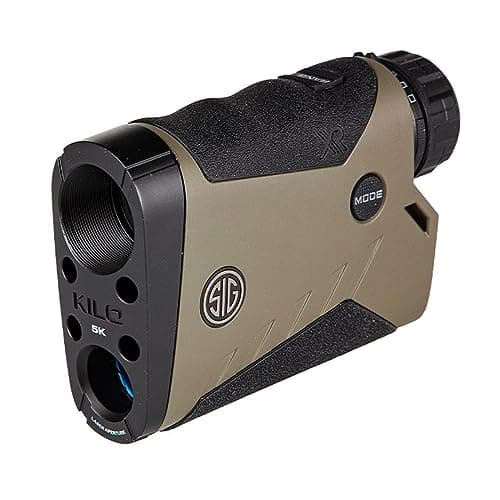
Sig Sauer KILO5K
Applied Ballistics onboard and a 7x25 optic: it returns a firing solution rather than a distance, which is what long-range shooting actually needs.
Magnification and objective are the manufacturer's own model designation; exit pupil and twilight factor are computed from them. We could not machine-read Sig Sauer's spec page, so the remaining published figures are not listed rather than guessed.
What it does well
- Onboard Applied Ballistics solver
- Ranges well past practical rifle distances
- Bluetooth profile sync
Where it gives ground
- More capability than most hunters will ever configure
- Menu depth is real - plan on reading the manual
Skip it if
Your shots are inside 400 yards. You are paying for solving you will not use.
How this score breaks down
- Ranging accuracy and range on game (weight 5)9.5
- Angle compensation implementation (weight 5)9.0
- Display legibility in low light (weight 3)8.5
- Speed and scan mode (weight 3)9.5
- One-handed ergonomics (weight 2)7.0
Weights and definitions are published on how we review. These are editorial judgments from published specs and documented consensus, not test results.
Where accuracy claims start mattering: at 800 yards, consistency of return matters more than the quoted tolerance.
Questions people actually ask
How accurate are hunting rangefinders?
Why does my rangefinder give different readings?
How far can a rangefinder read a deer?
Does rain affect rangefinder accuracy?
Sources
- Vortex Impact 4000 published specifications - read 2026-10-05