We earn a commission if you buy through the links on this page, at no extra cost to you. It never changes which products we pick or how we rank them - read the full disclosure.
Our top pick
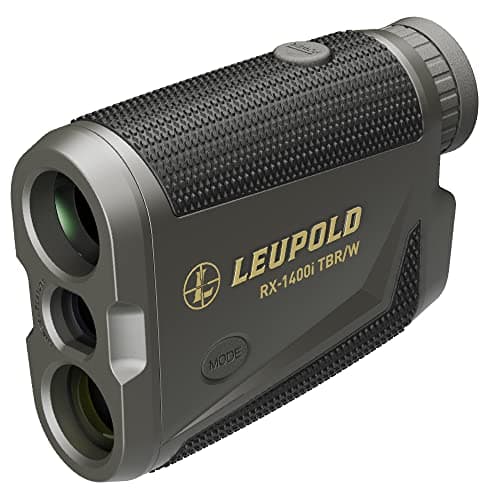
Leupold RX-1400i TBR/W Gen 2
TBR/W gives you the true horizontal distance and a holdover value in the same readout, which is the single most useful feature on a hunting rangefinder.
Price as of October 5, 2026. #ad How we earn
The hardware is nearly the same: a laser, a timer, a small optic and a display. The firmware is optimized for opposite problems, and that difference decides whether the number you get is the one you want.
The target priority problem
A golf rangefinder is built to find the flag. There is usually nothing between you and it, the flag is reflective, and if there is a tree in the way you want the tree ignored or the flag preferred. Many golf units implement first-target priority or pin-seeking logic to lock onto the nearest reflective object.
A hunting rangefinder is built to read past brush. There is almost always vegetation between you and the animal, and the animal is a poor reflector. So hunting units implement distant-target priority: when the laser gets multiple returns, report the furthest one, because that is the animal and the nearer returns are branches.
Point a golf rangefinder at a deer behind brush and it may confidently report the brush. That is not a malfunction - it is the unit doing exactly what it was designed for, in the wrong context.
The angle problem
Both categories offer slope compensation, and they implement it for different purposes. Golf slope correction tells you the playing distance for club selection, and - importantly - it is often switchable off because slope-enabled units are not tournament-legal. Some golfers leave it off by habit.
A hunting unit's angle compensation is sometimes further processed into a ballistic holdover (Leupold TBR/W) or a firing solution. A golf unit will not do that. What hunting angle compensation does.
| Golf rangefinder | Hunting rangefinder | |
|---|---|---|
| Target priority | Nearest / most reflective (the flag) | Furthest return (past the brush) |
| Target reflectivity assumed | High - a flag or a pin | Low - hide and hair |
| Slope output | Playing distance, often switchable off | Horizontal distance, holdover, or a solution |
| Display | Often bright-background optimized | Needs to read against dark timber |
| Housing color | Usually white or bright | Camo or dark |
| Typical price | $200-450 | $55-2,700 |
When a golf unit is usable for hunting
If you already own one and the alternative is nothing, it will work in open country at clear targets - a field edge, a cut cornfield, an animal with nothing in front of it. Turn slope mode on. Understand that in brush it may read the brush, and that it will not give you a holdover.
What you should not do is buy a golf rangefinder for hunting. A correctly optimized hunting unit with angle compensation costs about $193, which is less than most golf rangefinders, so the dual-use argument does not even save money. Budget hunting picks.
Going the other way - using a hunting rangefinder on a golf course - works better. Distant-target priority is a mild handicap at a flag with trees behind it, and slope-enabled hunting units are also not tournament-legal, so the same caveat applies.
Two correctly optimized hunting units
Price as of October 5, 2026. #ad How we earn
Leupold RX-1400i TBR/W Gen 2
TBR/W gives you the true horizontal distance and a holdover value in the same readout, which is the single most useful feature on a hunting rangefinder.
Magnification and objective are the manufacturer's own model designation; exit pupil and twilight factor are computed from them. We could not machine-read Leupold's spec page, so the remaining published figures are not listed rather than guessed.
What it does well
- TBR/W reports true ballistic range, not line of sight
- Fast, legible red OLED display in low light
- Compact enough for a harness pouch
Where it gives ground
- Stated ranges assume reflective targets, not deer hide
- No bluetooth or ballistic app integration
Skip it if
You need ranges past 1,000 yards on game - this is not that unit.
How this score breaks down
- Ranging accuracy and range on game (weight 5)8.5
- Angle compensation implementation (weight 5)9.5
- Display legibility in low light (weight 3)9.0
- Speed and scan mode (weight 3)8.5
- One-handed ergonomics (weight 2)9.0
Weights and definitions are published on how we review. These are editorial judgments from published specs and documented consensus, not test results.
Built to read past the brush to the animal, and to tell you what your sights need rather than what the flag is.
Price as of October 5, 2026. #ad How we earn
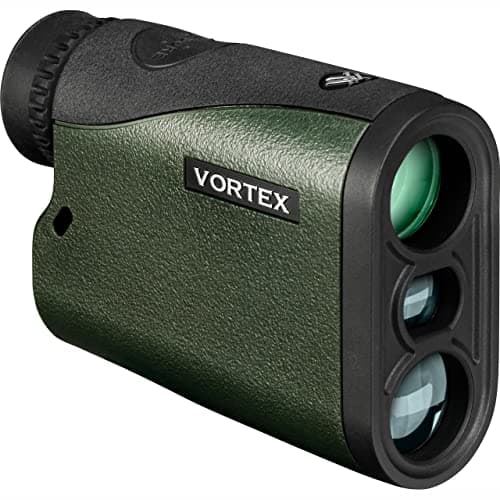
Vortex Crossfire HD 1400
A 5x21 monocular that ranges to 1,400 yards reflective with HCD angle compensation, at the price where rangefinders stop being a luxury.
| Magnification | 5x |
|---|---|
| Objective lens | 21 mm |
| Eye relief | 16.0mm |
| Field of view | 367' @ 1000 yds |
| Angular field of view | 7.0º |
| Stated accuracy | 1 yds. @100 yds. |
| Weight | 4.8 oz. |
| Length | 4.0" |
| Height | 2.9" |
| Width | 1.3" |
Specs verified 2026-10-05 from Vortex's published specification. Exit pupil and twilight factor are computed, not quoted.
What it does well
- HCD mode gives angle-compensated distance
- 16.0 mm eye relief with a 367 ft field at 5x
- VIP warranty
Where it gives ground
- Display is LCD, not illuminated, so it fades in deep shade
- No ballistic holdover output, just corrected distance
Skip it if
You hunt in low light often - an illuminated display is worth the upgrade.
How this score breaks down
- Ranging accuracy and range on game (weight 5)8.0
- Angle compensation implementation (weight 5)8.5
- Display legibility in low light (weight 3)6.5
- Speed and scan mode (weight 3)8.0
- One-handed ergonomics (weight 2)8.5
Weights and definitions are published on how we review. These are editorial judgments from published specs and documented consensus, not test results.
Cheaper than most golf rangefinders and correctly optimized for hunting, which makes the dual-use question largely moot.
Questions people actually ask
Can I use a golf rangefinder for hunting?
What is the difference between first-target and distant-target priority?
Can I use a hunting rangefinder for golf?
Is a golf rangefinder more accurate than a hunting one?
Sources
- Vortex Crossfire HD 1400 published specifications - read 2026-10-05