We earn a commission if you buy through the links on this page, at no extra cost to you. It never changes which products we pick or how we rank them - read the full disclosure.
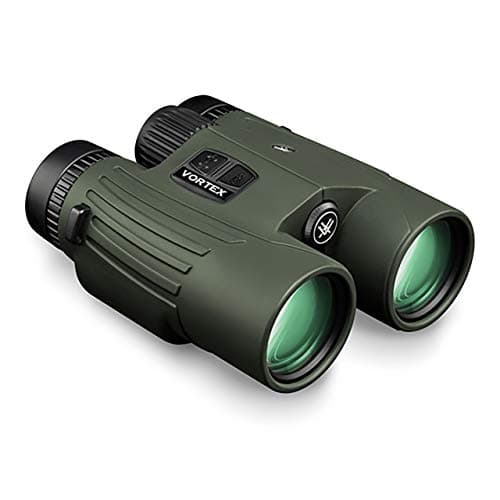
Our top pick
Vortex Fury HD 5000 10x42
The unit that made rangefinding binoculars mainstream: a credible 10x42 with a laser that reaches far past any ethical shot distance.
The honest version of this comparison is that integration solves one real problem and creates three. Whether that trade is worth it depends on how often you range and what you already own.
The problem integration solves
The sequence without it: glass an animal, lower the binoculars, find the rangefinder, re-acquire the animal through a different optic with a narrower field, range. That is several seconds, several movements, and occasionally a lost animal - especially one-handed while holding a bow or a rifle.
Integration collapses it to one button press through the optic you are already looking through. If you range thirty times a day in open country, that saving compounds into something real.
The three problems it creates
| Fury HD 5000 (integrated) | Viper HD + RX-1400i (separate) | |
|---|---|---|
| Cost | About $939 | About $700 |
| Weight on your chest | Around 42 oz | 24.9 oz plus a few oz in a pouch |
| Published field of view | 321 ft at 1,000 yd | 341 ft at 1,000 yd |
| Published eye relief | 16 mm | 17.0 mm |
| If electronics fail | You lose the binocular too | The binocular still works |
| Angle output | HCD corrected distance | TBR/W holdover |
| Upgrade path | Replace the whole unit | Replace either half |
All field-of-view and eye-relief figures read from Vortex's published specifications on 2026-10-05. The separate pairing is cheaper, lighter, wider, has more eye relief, gives a better angle output, and is more robust. Integration buys speed.
That table is deliberately stark because the usual framing of this choice is not. The separate pairing wins on six of seven lines. What it loses on is the one thing integration is for, and if ranging speed is genuinely your bottleneck that single line can outweigh the rest.
The decision
- You already own binoculars you like: add a $200 rangefinder. Not close.
- You own nothing and hunt open country: an integrated unit is a reasonable single purchase.
- Weight is your binding constraint: separate. 42 oz on a harness is felt.
- You hunt timber inside 200 yards: separate, and possibly no rangefinder at all unless you shoot a bow.
- You range constantly and hate chest clutter: integrated, accepting the cost and the failure risk.
All three options
Vortex Fury HD 5000 10x42
The unit that made rangefinding binoculars mainstream: a credible 10x42 with a laser that reaches far past any ethical shot distance.
| Magnification | 10x |
|---|---|
| Objective lens | 42 mm |
| Eye relief | 16mm |
| Field of view | 321' @ 1000 yds |
| Angular field of view | 6.1º |
| Close focus | 18.5 ft. |
| Weight | 32.3 oz. |
| Height | 5.8" |
| Width | 5.0" |
Specs verified 2026-10-05 from Vortex's published specification. Exit pupil and twilight factor are computed, not quoted.
What it does well
- Good 10x42 glass with 16 mm eye relief, verified in Vortex's specs
- HCD angle compensation
- Ranges well beyond practical hunting distances
Where it gives ground
- 42.8 oz on a harness is a real weight penalty
- Costs more than a Viper HD plus a good rangefinder
Skip it if
Weight is your binding constraint. Two lighter optics may carry better than one heavy one.
How this score breaks down
- Ranging accuracy and range on game (weight 5)9.0
- Angle compensation implementation (weight 5)8.5
- Display legibility in low light (weight 3)8.5
- Speed and scan mode (weight 3)8.5
- One-handed ergonomics (weight 2)7.0
Weights and definitions are published on how we review. These are editorial judgments from published specs and documented consensus, not test results.
Vortex publishes 16 mm of eye relief and 321 ft of field (verified 2026-10-05), so the binocular half is genuine rather than a token window around a laser.
Price as of October 5, 2026. #ad How we earn
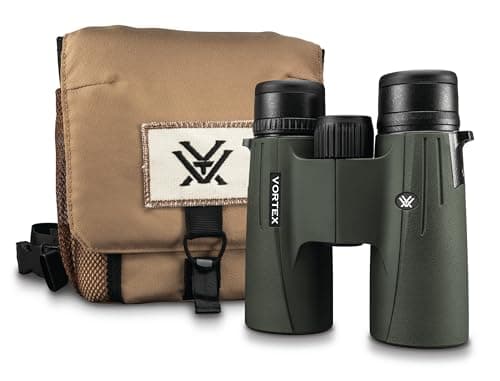
Vortex Viper HD 10x42
The default answer when someone outgrows a $150 pair: 17 mm of eye relief, a 341 ft field of view and glass that holds its edges, at the price where diminishing returns start.
| Magnification | 10x |
|---|---|
| Objective lens | 42 mm |
| Eye relief | 17.0mm |
| Field of view | 341' @ 1000 yds |
| Angular field of view | 6.5º |
| Close focus | 6.0' |
| Weight | 24.9 oz. |
| Height | 5.6" |
| Width | 4.9" |
| Exit pupil (computed) | 4.2 mm |
| Twilight factor (computed) | 20.5 |
Specs verified 2026-10-05 from Vortex's published specification. Exit pupil and twilight factor are computed, not quoted.
What it does well
- 17.0 mm eye relief is generous enough for most glasses wearers
- 341 ft at 1,000 yards is a wide field for a 10x
- Vortex VIP warranty is unconditional and transferable
Where it gives ground
- 24.9 oz is noticeable on a chest harness over a long day
- The 12x50 costs little more if you glass open country
Skip it if
You hunt timber inside 200 yards - the 8x42 Diamondback does that job for less than half the money.
How this score breaks down
- Ranging accuracy and range on game (weight 5)8.0
- Angle compensation implementation (weight 5)5.0
- Display legibility in low light (weight 3)5.0
- Speed and scan mode (weight 3)7.0
- One-handed ergonomics (weight 2)9.5
Weights and definitions are published on how we review. These are editorial judgments from published specs and documented consensus, not test results.
Wider field than the integrated unit, 17 oz lighter, and it keeps working if electronics fail. Published figures verified 2026-10-05.
Price as of October 5, 2026. #ad How we earn
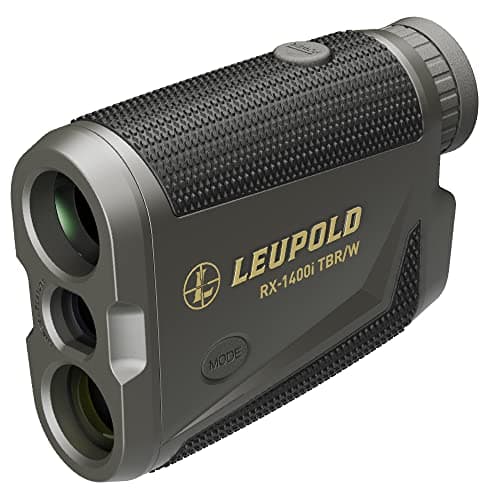
Leupold RX-1400i TBR/W Gen 2
TBR/W gives you the true horizontal distance and a holdover value in the same readout, which is the single most useful feature on a hunting rangefinder.
Magnification and objective are the manufacturer's own model designation; exit pupil and twilight factor are computed from them. We could not machine-read Leupold's spec page, so the remaining published figures are not listed rather than guessed.
What it does well
- TBR/W reports true ballistic range, not line of sight
- Fast, legible red OLED display in low light
- Compact enough for a harness pouch
Where it gives ground
- Stated ranges assume reflective targets, not deer hide
- No bluetooth or ballistic app integration
Skip it if
You need ranges past 1,000 yards on game - this is not that unit.
How this score breaks down
- Ranging accuracy and range on game (weight 5)8.5
- Angle compensation implementation (weight 5)9.5
- Display legibility in low light (weight 3)9.0
- Speed and scan mode (weight 3)8.5
- One-handed ergonomics (weight 2)9.0
Weights and definitions are published on how we review. These are editorial judgments from published specs and documented consensus, not test results.
Pairs with any binocular. Together with the Viper HD this is about $700 against $939 for the integrated unit - and better in both functions.
Questions people actually ask
Are rangefinding binoculars better than separate optics?
How much heavier are rangefinding binoculars?
Is it cheaper to buy a rangefinding binocular or two separate optics?
What happens if the laser in my rangefinding binocular stops working?
Sources
- Vortex Fury HD 5000 10x42 published specifications - read 2026-10-05
- Vortex Viper HD 10x42 published specifications - read 2026-10-05