We earn a commission if you buy through the links on this page, at no extra cost to you. It never changes which products we pick or how we rank them - read the full disclosure.
Our top pick
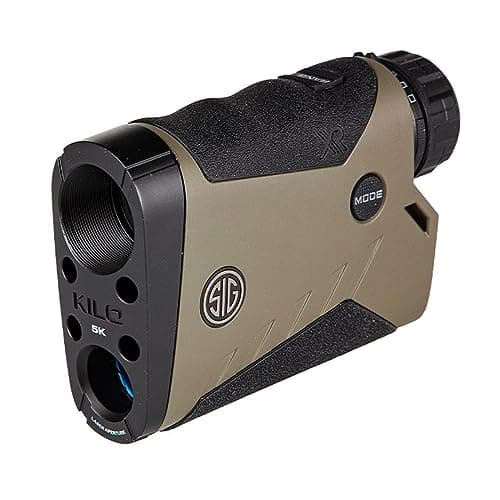
Sig Sauer KILO5K
Applied Ballistics onboard and a 7x25 optic: it returns a firing solution rather than a distance, which is what long-range shooting actually needs.
Price as of October 5, 2026. #ad How we earn
This is a comparison between two different kinds of product that happen to share a form factor. One measures distance and corrects for angle. The other computes a firing solution. Whether the second is worth $500 more depends entirely on how far you shoot.
What each one actually gives you
| Leupold RX-1400i TBR/W | Sig KILO5K | |
|---|---|---|
| What it returns | A holdover for a selected ballistic group | A firing solution from your profiled load |
| Ballistics source | Pre-set groups you choose from | Applied Ballistics, synced over bluetooth |
| Environmentals | Not accounted for | Accounted for onboard |
| Optic | 6x | 7x25 - computed exit pupil 3.57 mm |
| Display | Red OLED, illuminated | Illuminated |
| Setup required | Choose a group. Two minutes. | Profile the load and verify. An evening. |
| Rough price | $200 | $700 |
The distance where the difference starts mattering
Inside about 400 yards with a modern cartridge, a selected ballistic group gets you close enough that your own shooting is the larger error source. The Leupold's answer is good enough, and the KILO5K's extra precision is swallowed by everything else.
Past 400 yards that changes. Air density, temperature, altitude and your bullet's specific drag curve start producing differences measured in inches rather than fractions of an inch, and a generic group is no longer sufficient information. That is where the $500 starts earning, and it is the only honest justification for it.
The condition attached to the expensive one
You have to configure it. An unprofiled Applied Ballistics solver returns solutions based on default assumptions about a load you are not shooting, and it presents them with exactly the same confidence as a correct answer. A number you trust and should not is worse than a simpler number whose limitations you understand.
So the real question is not "do I shoot past 400 yards", it is "will I sit down with my actual bullet, measured velocity and verified zero and enter them, then confirm the solver against paper at distance?" If the honest answer is no, the $200 unit is the better purchase and the $500 is wasted.
The thing the Leupold does better
Simplicity, and it is not a consolation prize. A shallow menu you can operate in gloves with cold hands at 5am beats a deep one you have to think about. Several experienced shooters deliberately choose simpler units for exactly this reason, and it is a defensible position rather than a budget constraint.
The two side by side
Price as of October 5, 2026. #ad How we earn
Sig Sauer KILO5K
Applied Ballistics onboard and a 7x25 optic: it returns a firing solution rather than a distance, which is what long-range shooting actually needs.
Magnification and objective are the manufacturer's own model designation; exit pupil and twilight factor are computed from them. We could not machine-read Sig Sauer's spec page, so the remaining published figures are not listed rather than guessed.
What it does well
- Onboard Applied Ballistics solver
- Ranges well past practical rifle distances
- Bluetooth profile sync
Where it gives ground
- More capability than most hunters will ever configure
- Menu depth is real - plan on reading the manual
Skip it if
Your shots are inside 400 yards. You are paying for solving you will not use.
How this score breaks down
- Ranging accuracy and range on game (weight 5)9.5
- Angle compensation implementation (weight 5)9.0
- Display legibility in low light (weight 3)8.5
- Speed and scan mode (weight 3)9.5
- One-handed ergonomics (weight 2)7.0
Weights and definitions are published on how we review. These are editorial judgments from published specs and documented consensus, not test results.
A firing solution from your actual load rather than a distance. The computed exit pupil of a 7x25 is 3.57 mm, so the optic is adequate rather than excellent.
Price as of October 5, 2026. #ad How we earn
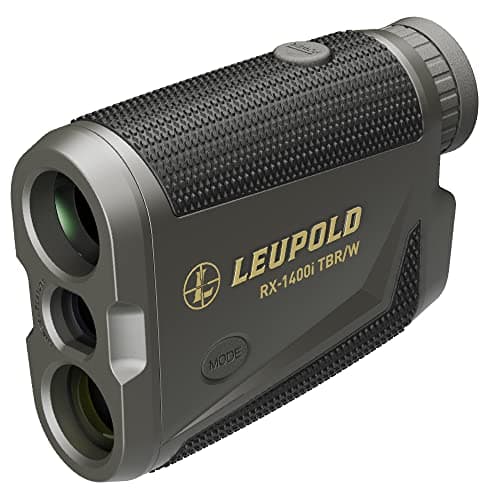
Leupold RX-1400i TBR/W Gen 2
TBR/W gives you the true horizontal distance and a holdover value in the same readout, which is the single most useful feature on a hunting rangefinder.
Magnification and objective are the manufacturer's own model designation; exit pupil and twilight factor are computed from them. We could not machine-read Leupold's spec page, so the remaining published figures are not listed rather than guessed.
What it does well
- TBR/W reports true ballistic range, not line of sight
- Fast, legible red OLED display in low light
- Compact enough for a harness pouch
Where it gives ground
- Stated ranges assume reflective targets, not deer hide
- No bluetooth or ballistic app integration
Skip it if
You need ranges past 1,000 yards on game - this is not that unit.
How this score breaks down
- Ranging accuracy and range on game (weight 5)8.5
- Angle compensation implementation (weight 5)9.5
- Display legibility in low light (weight 3)9.0
- Speed and scan mode (weight 3)8.5
- One-handed ergonomics (weight 2)9.0
Weights and definitions are published on how we review. These are editorial judgments from published specs and documented consensus, not test results.
Everything a hunter shooting inside 400 yards needs, with the better display of the two for low light and far less to configure.
Questions people actually ask
Is the Sig KILO5K worth three times the RX-1400i?
What is Applied Ballistics in a rangefinder?
Do I need bluetooth on a rangefinder?
Which has the better glass?
Sources
- Leupold RX-1400i TBR/W Gen 2 product page - read 2026-10-05