We earn a commission if you buy through the links on this page, at no extra cost to you. It never changes which products we pick or how we rank them - read the full disclosure.
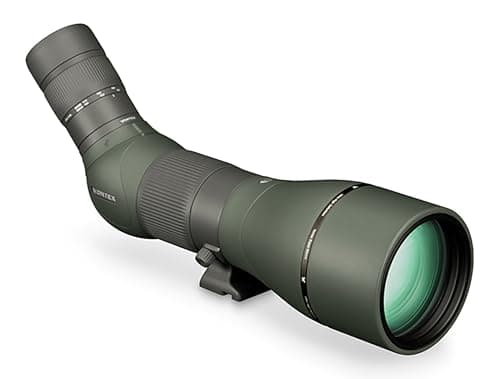
Our top pick
Vortex Razor HD 27-60x85
Starting at 27x rather than 20x, with 2.2-1.3 degrees of field: built for picking apart an animal you have already found, not for finding it.
Price as of October 5, 2026. #ad How we earn
Spotting impacts is a different job from judging animals, and the differences change what you should buy. Being specific about them saves you from buying a hunting scope for a range problem.
Four ways range work differs
- You know where the target is. No searching, so a wide field of view and a low bottom-end magnification matter far less. A scope starting at 27x is fine, and for hunting it would be a handicap.
- The light is usually good. Range sessions happen in daylight, so the exit pupil collapse at high magnification is much less of a constraint. An 85 mm at 60x computes to 1.42 mm, which is dim at dusk and perfectly workable at noon.
- Weight does not matter. The scope travels from a car to a bench. Take the 85 mm, take the heavy tripod, take whatever is optically best.
- Resolution is everything. You are trying to see a 0.3 inch hole in white paper at 600 yards, which is a pure resolution problem with no low-light component.
What that means for the specification
| Specification | Priority for hunting | Priority at the range |
|---|---|---|
| Resolution at top magnification | High | Highest - it is the whole job |
| Low bottom-end magnification | High - you are searching | Low - you know where to look |
| Exit pupil at high magnification | High - animals move at dusk | Low - good light |
| Weight | High | Irrelevant |
| Angled eyepiece | Preference | Strong advantage when seated |
| Weather sealing | High | Low |
Quick picks
Ranked by the criteria published on how we review. Tap any row for the full write-up, or go straight to the current price.
| # | Product | Best for | Score | Price |
|---|---|---|---|---|
| 1 | Vortex Razor HD 27-60x85Starts at 27x with 16.7-17.0 mm of eye relief, about $1,699. | Best for long rangeJudging antler at distance | 8.5out of 10 | |
| 2 | 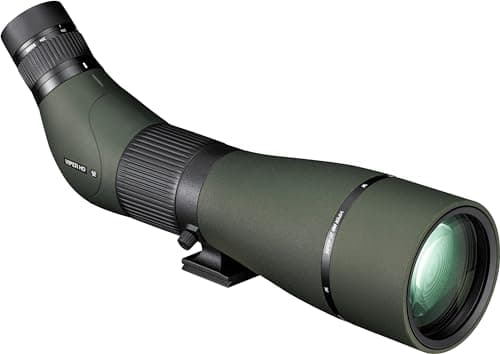 Vortex Viper HD 20-60x85Usable to 60x at about $899. | Best value for the rangeBest all-round spotting scope | 8.6out of 10 | |
| 3 | 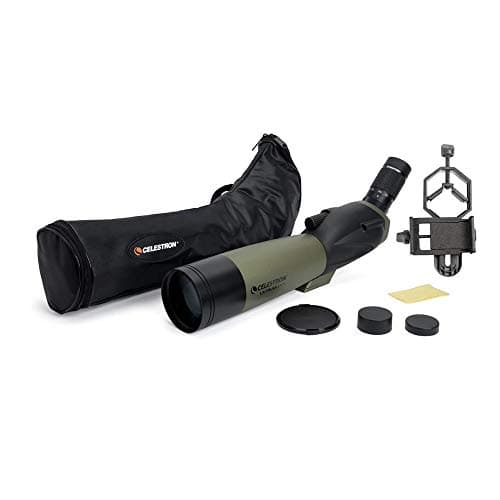 Celestron Ultima 80A 45-degree eyepiece and published exit pupils, about $270. | Best budget range scopeTarget shooting and range use | 6.8out of 10 | |
| 4 | 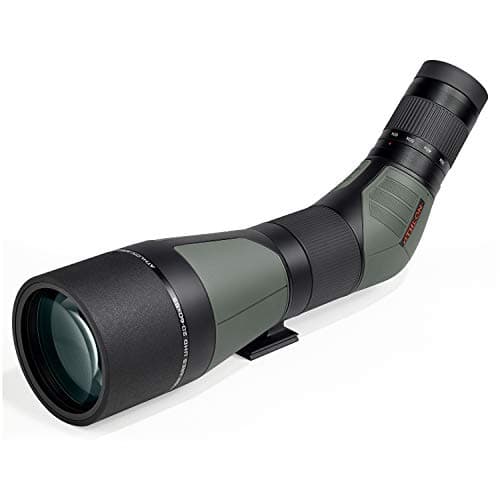 Athlon Ares G2 UHD 20-60x85UHD glass with ED elements at about $900. | Most resolution per dollarMost glass per dollar at 85 mm | 8.4out of 10 |
Prices are pulled live from Amazon and were last checked October 5, 2026; if a figure cannot be verified the button reads "Check price" instead. Scores are our editorial judgment against the published ranking criteria, not a test result. #ad How we earn.
Angled is clearly right here
For hunting, angled against straight is a genuine preference question. For range work it is not: an angled eyepiece is substantially more comfortable for extended seated use at a bench, it lets a shorter and therefore more stable tripod work, and it makes sharing the scope with the person next to you trivial. The full comparison.
What resolution you actually need
A rough working guide, with the caveat that it depends heavily on light, mirage and the contrast of the target:
- To 300 yards: almost anything. A $140 scope at 30x will show holes in white paper.
- 300 to 600 yards: a $500 85 mm scope at 40-45x. This is where cheap glass starts failing.
- 600 to 1,000 yards: a $900 scope at 50-60x, and a genuinely stiff tripod. Mirage becomes the limiting factor as often as the optic.
- Past 1,000 yards: the $1,699 class, and you will still be beaten by heat shimmer on most afternoons.
That last point is worth holding onto: past about 600 yards on a warm day, mirage limits what any scope resolves, and an expensive scope mostly gives you a clearer view of the shimmer. Shoot early, and do not expect glass to solve atmospheric physics.
The picks in detail
Price as of October 5, 2026. #ad How we earn
Vortex Razor HD 27-60x85
Starting at 27x rather than 20x, with 2.2-1.3 degrees of field: built for picking apart an animal you have already found, not for finding it.
| Magnification | 27-60x |
|---|---|
| Objective lens | 85 mm |
| Eye relief | 16.7mm - 17.0mm |
| Field of view | 117' - 68' @ 1000 yds |
| Angular field of view | 2.2º - 1.3º |
| Close focus | 16.4' |
| Weight | 65.6 oz. |
| Length | 15.5" |
| Exit pupil (computed) | 3.15 mm |
| Twilight factor (computed) | 47.9 |
Specs verified 2026-10-05 from Vortex's published specification. Exit pupil and twilight factor are computed, not quoted.
What it does well
- Resolution at the top of the zoom is genuinely usable
- Apochromatic optical system
- Rugged magnesium body
Where it gives ground
- 27x minimum makes initial scanning harder
- Premium price for a situational advantage
Skip it if
You use one optic to both find and judge animals.
How this score breaks down
- Resolution at top magnification (weight 5)9.5
- Usable magnification range (weight 4)9.0
- Eye relief across the zoom (weight 3)8.5
- Weight and packability (weight 3)5.5
- Build and sealing (weight 2)9.5
Weights and definitions are published on how we review. These are editorial judgments from published specs and documented consensus, not test results.
Vortex publishes 27-60x, an 85 mm objective, 16.7 to 17.0 mm of eye relief and 2.2 to 1.3 degrees of field (verified 2026-10-05). Starting at 27x rather than 20x is a disadvantage for hunting and an advantage here: you are looking at a known target location, not searching for one.
Note the field of view figures - at 2.2 degrees the bottom end is actually wider than the Viper HD's 1.9 degrees despite the higher magnification, which tells you something about the optical design.
Price as of October 5, 2026. #ad How we earn
Vortex Viper HD 20-60x85
The step where a spotting scope stops being a compromise: usable detail at 60x instead of giving up at 45x.
| Magnification | 20-60x |
|---|---|
| Objective lens | 85 mm |
| Eye relief | 17.8mm - 19.6mm |
| Field of view | 101' - 50' @ 1000 yds |
| Angular field of view | 1.9º - 1.0º |
| Close focus | 36.0' |
| Weight | 76.6 oz. |
| Length | 17.5" |
| Exit pupil (computed) | 4.25 mm |
| Twilight factor (computed) | 41.2 |
Specs verified 2026-10-05 from Vortex's published specification. Exit pupil and twilight factor are computed, not quoted.
What it does well
- Holds resolution much deeper into the magnification range
- 17.8-19.6 mm eye relief across the zoom
- Apochromatic lens system controls color fringing
Where it gives ground
- 65.7 oz means a serious tripod
- Nearly twice the Diamondback HD's price
Skip it if
You judge animals inside 600 yards. The Diamondback HD does that.
How this score breaks down
- Resolution at top magnification (weight 5)9.0
- Usable magnification range (weight 4)9.0
- Eye relief across the zoom (weight 3)9.0
- Weight and packability (weight 3)6.5
- Build and sealing (weight 2)9.0
Weights and definitions are published on how we review. These are editorial judgments from published specs and documented consensus, not test results.
The honest recommendation for most shooters: 60x that holds together, with the most generous eye relief in the class at 17.8-19.6 mm published. Half the price of the Razor.
Price as of October 5, 2026. #ad How we earn
Celestron Ultima 80
A 45-degree 80 mm scope with published exit pupil figures from 4 mm down to 1.3 mm, aimed at range work more than mountain hunting.
| Magnification | 20x |
|---|---|
| Objective lens | 80 mm |
| Exit pupil (computed) | 4 mm |
| Twilight factor (computed) | 40 |
Magnification and objective are the manufacturer's own model designation; exit pupil and twilight factor are computed from them. We could not machine-read Celestron's spec page, so the remaining published figures are not listed rather than guessed.
What it does well
- Published exit pupil and field figures across the zoom
- 45-degree eyepiece is comfortable for seated range use
- Inexpensive for an 80 mm
Where it gives ground
- Not sealed to hunting standards
- Heavy for its optical quality
Skip it if
You are packing it into the backcountry.
How this score breaks down
- Resolution at top magnification (weight 5)6.5
- Usable magnification range (weight 4)8.0
- Eye relief across the zoom (weight 3)7.5
- Weight and packability (weight 3)5.5
- Build and sealing (weight 2)6.0
Weights and definitions are published on how we review. These are editorial judgments from published specs and documented consensus, not test results.
Designed for seated use at a bench, which is exactly what range work is. Celestron publishes exit pupil from 4 mm to about 1.3 mm (verified 2026-10-05). Not sealed for hunting, which does not matter at a range.
Price as of October 5, 2026. #ad How we earn
Athlon Ares G2 UHD 20-60x85
UHD glass in an 85 mm body at a price that undercuts the Viper HD, which is Athlon's whole argument.
| Magnification | 20x |
|---|---|
| Objective lens | 85 mm |
| Exit pupil (computed) | 4.25 mm |
| Twilight factor (computed) | 41.2 |
Magnification and objective are the manufacturer's own model designation; exit pupil and twilight factor are computed from them. We could not machine-read Athlon's spec page, so the remaining published figures are not listed rather than guessed.
What it does well
- UHD glass with ED elements
- Priced below comparable Vortex and Leupold
- Lifetime transferable warranty
Where it gives ground
- Service turnaround is slower than the majors
- Resale demand is thinner
Skip it if
You need a walk-in dealer for service.
How this score breaks down
- Resolution at top magnification (weight 5)9.0
- Usable magnification range (weight 4)9.0
- Eye relief across the zoom (weight 3)8.5
- Weight and packability (weight 3)6.5
- Build and sealing (weight 2)8.0
Weights and definitions are published on how we review. These are editorial judgments from published specs and documented consensus, not test results.
ED elements control the chromatic aberration that makes a bullet hole on white paper hard to resolve at distance. The specification competes directly with the Viper HD.
Questions people actually ask
What magnification do I need to see bullet holes at 600 yards?
Is a hunting spotting scope good for the range?
Angled or straight spotting scope for shooting?
Why can I not see my hits past 600 yards?
Sources
- Vortex Razor HD 27-60x85 published specifications - read 2026-10-05
- Vortex Viper HD 20-60x85 published specifications - read 2026-10-05
- Celestron Ultima 80 published specifications - read 2026-10-05