We earn a commission if you buy through the links on this page, at no extra cost to you. It never changes which products we pick or how we rank them - read the full disclosure.
Reviewed here
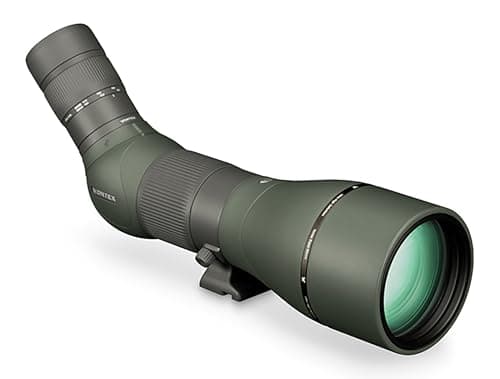
Vortex Razor HD 27-60x85
Starting at 27x rather than 20x, with 2.2-1.3 degrees of field: built for picking apart an animal you have already found, not for finding it.
No buyable offer at the last price check.
Prices change; we show only live figures. #ad How we earn
The Vortex Razor HD 27-60x85 is the scope people buy when they have decided that judging an animal at a mile is worth real money, and it is also the scope with the most repeated piece of received wisdom attached to it: that starting at 27x instead of 20x makes it harder to find things. Vortex's own field-of-view table does not agree, and once you look at the published numbers side by side, the actual trade-off turns out to be somewhere else entirely.
What it is, in published numbers
| Specification | Razor HD 27-60x85 | Viper HD 20-60x85 |
|---|---|---|
| Magnification | 27-60x | 20-60x |
| Objective lens | 85 mm | 85 mm |
| Field of view | 117-68 ft @ 1,000 yd | 101-50 ft @ 1,000 yd |
| Angular field of view | 2.2-1.3 degrees | 1.9-1.0 degrees |
| Eye relief | 16.7-17.0 mm | 17.8-19.6 mm |
| Close focus | 16.4 ft | 36.0 ft |
| Weight | 65.6 oz | 76.6 oz |
| Length | 15.5 in | 17.5 in |
| Exit pupil at minimum (computed) | 3.15 mm | 4.25 mm |
| Twilight factor at minimum (computed) | 47.9 | 41.2 |
The more expensive scope is wider at its minimum, shorter, lighter, and focuses closer. It is also dimmer at the bottom of the zoom. Both of those come from the same design decision.
Four rows in that table run against intuition. The Razor is wider at 27x than the Viper HD is at 20x. It is 11 oz lighter. It is 2 in shorter. And it focuses at less than half the distance. On a price-ordered shelf you would expect the cheaper scope to win the portability rows and lose the optical ones; here it is the reverse on three of four.
Why the 27x criticism is mostly wrong
The reasoning behind the criticism is sound in the abstract: higher magnification narrows the field, a narrower field makes sweeping a hillside slower, and sweeping is most of what a spotting scope does in the first hour. All true. The error is assuming that magnification is the only thing setting the field.
Field of view is set by the apparent field of the eyepiece divided by the magnification. Vortex's Razor eyepiece has a substantially wider apparent field than the Viper's, and the arithmetic works out in the Razor's favor: 2.2 degrees at 27x against 1.9 degrees at 20x. In practice, if you set both scopes on the same tripod and pointed them at the same basin, the Razor would show you a wider slice of it, at higher magnification, in a shorter and lighter body. There is no scanning penalty to collect.
Where the 27x minimum does cost you is brightness, and the number that shows it is exit pupil. Divide the objective by the magnification and you get the diameter of the cone of light leaving the eyepiece: 3.15 mm here, 4.25 mm on a 20-60x85. In daylight your pupil is around 2 to 3 mm and neither matters. In the last twenty minutes of light your pupil opens past 5 mm, and at that point the scope delivering a 4.25 mm cone is putting visibly more light into your eye than the one delivering 3.15 mm. On a page about a scope whose job is judging animals at first and last light, that is not a footnote.
You will see the twilight factor quoted the other way, because the twilight-factor formula is the square root of magnification times objective and therefore rewards magnification: 47.9 for the Razor against 41.2 for the 20x scopes. Both numbers are correct and they are measuring different things - twilight factor is about resolving detail in poor light, exit pupil is about how much light reaches your eye at all. The practical reading is that at the bottom of its zoom the Razor is a little dimmer and resolves a little finer. Which of those you care about is a real question, not a trick one.
Who this scope is actually for
The Razor HD earns its money in one specific situation: you have already found the animal, it is a long way off, and you now need to decide something about it - how many points, how wide, whether it is the one. That is a resolution-at-high-magnification problem, and it is the only problem on which this scope clearly beats a Viper HD. If the animals you glass are inside about 800 yards, or if you mostly want to know whether something is an elk or a stump, a $900 85 mm scope answers that identically and the extra money buys nothing you can see.
It is also a reasonable pick for the hunter who runs one optic for both finding and judging, which is the opposite of the conventional advice - precisely because of the field-of-view table above. A 117 ft field at 1,000 yards is enough to sweep with, and that makes the single-scope setup more practical on this model than on the Viper HD.
It is the wrong scope if you backpack. 65.6 oz is lighter than the Viper HD but it is still over four pounds of glass that needs a tripod stiff enough to hold 60x steady, and a tripod that does that is not a light tripod either. The best tripods for spotting scopes is the honest accounting of that second cost, and it is a cost people routinely forget when budgeting for a scope at this level.
The things the specification sheet will not tell you
Resolution at 60x is a design argument rather than a measurement. We score it highly because the apochromatic lens system is the correct design for controlling secondary color, and because documented consensus among users at this tier is consistent on the point. How we review sets out exactly what each of our numbers represents.
Eye relief of 16.7 to 17.0 mm is the one row where you should not take our word for it. Spotting scopes press one eye to one eyepiece, so vignetting with glasses is immediately obvious in a way it is not on a binocular. If you wear glasses, this is the shortest eye relief on this page and the Viper HD and Diamondback HD both give you more. Try it, or buy from somewhere with a return policy.
Angled or straight is a bigger decision than the tier. Vortex sells this model in both. The angled body is easier on your neck for long sessions and for sharing a scope between people of different heights; the straight body is faster to get onto an animal and better from a prone position or a truck window. Angled vs straight is the page, and it matters more to your season than the choice between this and the Viper HD.
Verdict
Buy the Razor HD 27-60x85 if judging animals at long range is the specific job, you glass mostly in usable light rather than at the edges of it, and you want the widest field and the lightest body of the 85 mm scopes - all three of which it genuinely delivers against published numbers. The received wisdom about its 27x minimum is wrong on field of view and right about brightness, and almost everyone has it the other way around.
Buy the Viper HD 20-60x85 instead if your honest use is finding and sorting animals rather than inspecting them, if you glass hardest in the first and last half hour, or if the price difference is the price of the tripod you still need. And buy the Maven CS.1A if the scope has to be carried rather than driven to - two pounds of saved weight beats a resolution advantage you never get to the top of the ridge to use.
The scopes compared
No buyable offer at the last price check.
Prices change; we show only live figures. #ad How we earn
Vortex Razor HD 27-60x85
Starting at 27x rather than 20x, with 2.2-1.3 degrees of field: built for picking apart an animal you have already found, not for finding it.
| Magnification | 27-60x |
|---|---|
| Objective lens | 85 mm |
| Eye relief | 16.7mm - 17.0mm |
| Field of view | 117' - 68' @ 1000 yds |
| Angular field of view | 2.2º - 1.3º |
| Close focus | 16.4' |
| Weight | 65.6 oz. |
| Length | 15.5" |
| Exit pupil (computed) | 3.15 mm |
| Twilight factor (computed) | 47.9 |
Specs verified 2026-10-05 from Vortex's published specification. Exit pupil and twilight factor are computed, not quoted.
What it does well
- Resolution at the top of the zoom is genuinely usable
- Apochromatic optical system
- Rugged magnesium body
Where it gives ground
- 27x minimum makes initial scanning harder
- Premium price for a situational advantage
Skip it if
You use one optic to both find and judge animals.
How this score breaks down
- Resolution at top magnification (weight 5)9.6
- Usable magnification range (weight 4)8.6
- Eye relief across the zoom (weight 3)8.2
- Weight and packability (weight 3)6.2
- Build and sealing (weight 2)9.6
Criterion scores are on the 0-10 rubric scale. Their weighted mean is 8.5, which maps to 9.4 on our published recommendation scale of 8.4 to 9.8 - the band of products we are willing to recommend at all. The weights, the definitions and the mapping are all published, so any score here can be checked against our own rules. These are editorial judgments from published specifications, computed optical arithmetic and documented consensus.
Start with the number that the internet gets wrong about this scope. Vortex publishes an angular field of 2.2 degrees at 27x, which is 117 ft at 1,000 yards. The Viper HD 20-60x85 one tier below publishes 1.9 degrees at 20x, which is 101 ft. The Diamondback HD publishes 2.1 degrees at 20x, or 108 ft. So the scope with the highest minimum magnification on this page shows you the widest piece of hillside at its minimum setting. The 27x eyepiece is not a scanning handicap. The eyepiece design simply gives more back than the extra magnification takes.
The second surprise is the weight. 65.6 oz is 11 oz lighter than the Viper HD's published 76.6 oz, despite the same 85 mm objective and a more complex apochromatic optical system, and it is 4.4 oz lighter than the Athlon Ares G2 UHD. For a scope that lives on a tripod on a ridge that is a real difference, and it is the opposite of what the price ordering would lead you to expect. The published close focus is 16.4 ft against the Viper HD's 36.0 ft, which also matters more than it sounds: 36 ft is too far to inspect anything in front of your own glassing knob.
What you are paying for is resolution at the top of the zoom. The apochromatic lens system is designed to bring three wavelengths to the same focal plane rather than two, and the practical effect on a spotting scope is that color fringing on a dark antler against bright sky stays off the image at 60x. Published figures cannot show you that, which is why this review leans on the figures that can be shown and says plainly that the resolution claim is a design-and-consensus argument rather than a measured one.
Now the honest con, and it is a real one. Exit pupil is objective divided by magnification: 85 / 27 = 3.15 mm at the bottom of this scope's range, against 85 / 20 = 4.25 mm on the Viper HD and the Diamondback HD. At the last twenty minutes of light, when your own pupil has opened past 5 mm, a 3.15 mm exit pupil delivers visibly less light to your eye than a 4.25 mm one. That is the true cost of the 27x minimum and nobody talks about it, because they are all busy talking about field of view. Note that the computed twilight factor runs the other way - 47.9 here against 41.2 for the 20x scopes - because that formula rewards magnification. The two numbers describe different things and both are real; exit pupil and twilight factor explains why they disagree.
The other cons: eye relief is 16.7 to 17.0 mm, the shortest span of any scope on this page, so a glasses wearer should try one before committing - the Viper HD gives 17.8 to 19.6 mm and the Diamondback HD 18.3 to 20.3 mm. The angled body is 15.5 in long. And the price is the price: this costs roughly twice the Viper HD, for an optical advantage you only collect at the top of the magnification range. Its Amazon listing has recently run well under Vortex's own MSRP, but it came back as scarce stock on our last check, which is worth knowing before you plan around it.
Price as of November 12, 2026. #ad How we earn
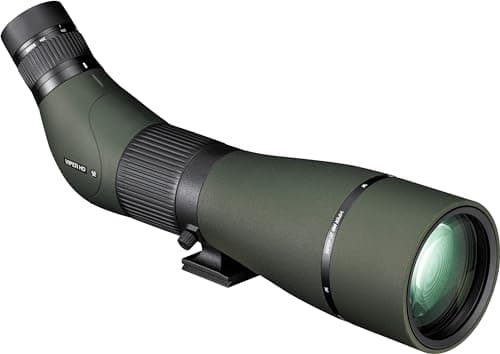
Vortex Viper HD 20-60x85
The step where a spotting scope stops being a compromise: usable detail at 60x instead of giving up at 45x.
| Magnification | 20-60x |
|---|---|
| Objective lens | 85 mm |
| Eye relief | 17.8mm - 19.6mm |
| Field of view | 101' - 50' @ 1000 yds |
| Angular field of view | 1.9º - 1.0º |
| Close focus | 36.0' |
| Weight | 76.6 oz. |
| Length | 17.5" |
| Exit pupil (computed) | 4.25 mm |
| Twilight factor (computed) | 41.2 |
Specs verified 2026-10-05 from Vortex's published specification. Exit pupil and twilight factor are computed, not quoted.
What it does well
- Holds resolution much deeper into the magnification range
- 17.8-19.6 mm eye relief across the zoom
- Apochromatic lens system controls color fringing
Where it gives ground
- 76.6 oz means a serious tripod
- Nearly twice the Diamondback HD's price
Skip it if
You judge animals inside 600 yards. The Diamondback HD does that.
How this score breaks down
- Resolution at top magnification (weight 5)9.0
- Usable magnification range (weight 4)9.1
- Eye relief across the zoom (weight 3)9.0
- Weight and packability (weight 3)6.2
- Build and sealing (weight 2)9.0
Criterion scores are on the 0-10 rubric scale. Their weighted mean is 8.5, which maps to 9.4 on our published recommendation scale of 8.4 to 9.8 - the band of products we are willing to recommend at all. The weights, the definitions and the mapping are all published, so any score here can be checked against our own rules. These are editorial judgments from published specifications, computed optical arithmetic and documented consensus.
This is the comparison that decides it for most people, and the Viper HD wins more rows than its price suggests. Vortex publishes the same 85 mm objective, 101 to 50 ft of field, 17.8 to 19.6 mm of eye relief, a 36.0 ft close focus, 17.5 in of length and 76.6 oz. Its own apochromatic lens system holds resolution to 60x where the $500 tier gives up around 45x. At the bottom of the zoom its 4.25 mm exit pupil is brighter than the Razor's 3.15 mm, which in the first and last half hour is the single most consequential difference between the two.
So the decision comes down to a narrow question: do you spend meaningful time above about 50x on animals far enough away that fringing on antler edges actually costs you a judgment call? If yes, the Razor's apochromatic system is the upgrade and the money is well spent. If no - if you mostly sit between 25x and 45x deciding whether a bull is worth the walk - the Viper HD does that job and leaves you with the price of a very good tripod. The cons are the weight, which is the heaviest here, and the 36 ft close focus. The full Viper HD 20-60x85 review and the two scopes head to head are both worth reading before you choose.
Price as of November 12, 2026. #ad How we earn
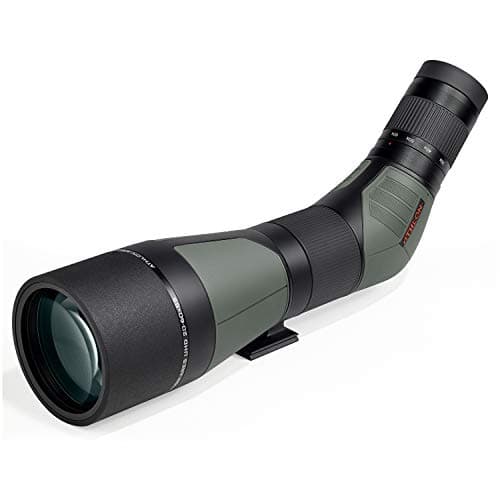
Athlon Ares G2 UHD 20-60x85
UHD glass in an 85 mm body at a price that undercuts the Viper HD, which is Athlon's whole argument.
| Magnification | 20-60x |
|---|---|
| Objective lens | 85 mm |
| Field of view | 99-47 ft @ 1,000 yd |
| Eye relief | 0.77-0.70 in (19.6-17.8 mm) |
| Eyepiece angle | 45 degrees |
| Weight | 70 oz |
| Dimensions | 16.9 x 4 in |
| Exit pupil at 20x (computed) | 4.25 mm |
| Exit pupil at 60x (computed) | 1.42 mm |
| Twilight factor at 20x (computed) | 41.2 |
Specs verified 2026-10-19 from Athlon's published specification. Exit pupil and twilight factor are computed, not quoted.
What it does well
- UHD glass with ED elements and an apochromatic lens system
- Priced below comparable Vortex and Leupold 85 mm scopes
- 19.6 mm of eye relief at 20x, which is generous for a spotting scope
- Lifetime transferable warranty
Where it gives ground
- 99 ft of field at 20x is the narrowest of the 85 mm scopes here - the Diamondback HD publishes 108 ft
- 70 oz is heavy for a backpack hunt, even though it undercuts the Viper HD's 76.6 oz
- Athlon publishes no close focus figure and no sealing specification
- Service turnaround is slower than the majors and resale demand is thinner
Skip it if
You need a walk-in dealer for service, or you are counting ounces on a backpack hunt.
How this score breaks down
- Resolution at top magnification (weight 5)8.9
- Usable magnification range (weight 4)8.9
- Eye relief across the zoom (weight 3)8.5
- Weight and packability (weight 3)6.3
- Build and sealing (weight 2)8.1
Criterion scores are on the 0-10 rubric scale. Their weighted mean is 8.3, which maps to 9.3 on our published recommendation scale of 8.4 to 9.8 - the band of products we are willing to recommend at all. The weights, the definitions and the mapping are all published, so any score here can be checked against our own rules. These are editorial judgments from published specifications, computed optical arithmetic and documented consensus.
Athlon's whole argument is that you can have ED elements and an apochromatic lens system without the Vortex badge, and on published specifications it largely holds. The Ares G2 UHD publishes the same 85 mm objective, 0.77 to 0.70 in of eye relief (19.6 to 17.8 mm), a 45-degree eyepiece, 70 oz of weight and a 16.9 by 4 in body. 70 oz undercuts the Viper HD's 76.6 oz, and the eye relief at 20x is the most generous number on this page.
The cons are specific. Its 99 ft of field at 20x is the narrowest published figure of every 85 mm scope on this site - the Razor shows 117 ft at a higher magnification, and even the cheap Diamondback HD shows 108 ft. Athlon publishes no close focus figure and no sealing specification at all, which on a scope that will sit out in weather is a gap rather than a quibble. Service turnaround is slower than the majors and resale demand is thinner. The full Athlon Ares G2 UHD review covers the trade in detail.
Price as of November 12, 2026. #ad How we earn
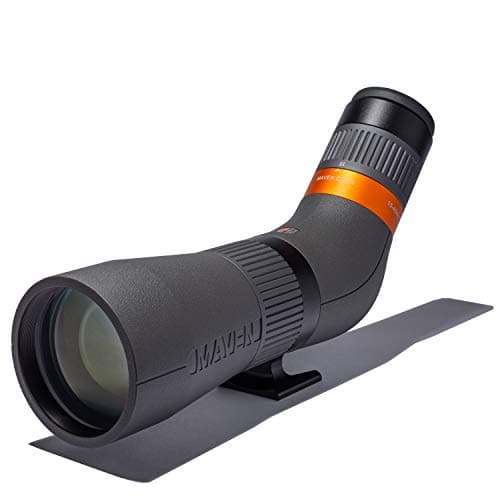
Maven CS.1A 15-45x65
A 65 mm objective at 40.4 oz per Maven's published spec: the weight compromise that actually gets carried on a backcountry hunt.
| Magnification | 15x |
|---|---|
| Objective lens | 65 mm |
| Magnification range | 15x-45x |
| Weight | 40.4 oz |
| Exit pupil (computed) | 4.33 mm |
| Twilight factor (computed) | 31.2 |
Specs verified 2026-10-05 from Maven's published specification. Exit pupil and twilight factor are computed, not quoted.
What it does well
- 40.4 oz, verified in Maven's published specification
- 15x minimum makes scanning practical
- Lifetime warranty, sold direct
Where it gives ground
- 65 mm gathers less light than an 85 mm at dawn
- 45x ceiling limits fine antler judging
Skip it if
You glass from a truck or a fixed camp - take the 85 mm.
How this score breaks down
- Resolution at top magnification (weight 5)8.3
- Usable magnification range (weight 4)7.6
- Eye relief across the zoom (weight 3)8.1
- Weight and packability (weight 3)9.6
- Build and sealing (weight 2)9.0
Criterion scores are on the 0-10 rubric scale. Their weighted mean is 8.4, which maps to 9.3 on our published recommendation scale of 8.4 to 9.8 - the band of products we are willing to recommend at all. The weights, the definitions and the mapping are all published, so any score here can be checked against our own rules. These are editorial judgments from published specifications, computed optical arithmetic and documented consensus.
If the honest answer to "where will this scope live" is "in a pack, five miles in", the Razor HD is the wrong tool regardless of how good the glass is, and this is the right one. Maven publishes 15-45x on a 65 mm objective at 40.4 oz - roughly 25 oz less than the Razor HD and 36 oz less than the Viper HD, which is more than two pounds off your back. The 15x minimum also makes finding animals easier than any 85 mm scope here, because exit pupil at 15x on 65 mm works out at 4.33 mm, the brightest figure on this page.
The cons are the physics you cannot argue with. A 65 mm objective gathers roughly 41 percent less light than an 85 mm one at the same magnification, and the computed twilight factor of 31.2 is the lowest here against the Razor's 47.9 - at first light, from a fixed camp, the 85 mm scope sees things this one does not. The 45x ceiling also limits fine antler judging at long range, which is exactly the job the Razor HD exists for. The Maven CS.1A review is the detail, and what magnification spotting scope you need is the page to read first if this trade is new to you.
Our recommendation
If you take one thing from this page, take this.
Vortex Razor HD 27-60x85
The subject of this review
117 ft of field at 27x, 16.4 ft close focus and 65.6 oz - a wider view at its minimum and 11 oz less weight than the Viper HD below it.
No buyable offer at the last price check.
Vortex Viper HD 20-60x85
The step down most buyers should price first
The same 85 mm objective with a 4.25 mm exit pupil at 20x and more eye relief, for roughly half the money - and 11 oz more to carry.
Prices are pulled live and shown on each button. #ad How we earn.
Questions people actually ask
Is the Vortex Razor HD 27-60x85 worth the money over the Viper HD?
Does the 27x minimum magnification make this scope hard to scan with?
What do you actually give up with a 27x minimum?
How heavy is the Vortex Razor HD 27-60x85?
Is the Razor HD 27-60x85 still in production?
What tripod do I need for a Razor HD 27-60x85?
Should I get the angled or the straight version?
Sources
- Vortex Razor HD spotting scopes - current product line and MSRP - read 2026-11-02
- Vortex Razor HD 27-60x85 - specification table as reproduced by stocking dealers (Vortex's own model page returns 404 to automated reads) - read 2026-11-02
- Vortex Razor HD 27-60x85 - close focus and field of view - read 2026-11-02
- Vortex Viper HD 20-60x85 - published specifications - read 2026-10-26
- Athlon Ares G2 UHD 20-60x85 - published specifications - read 2026-10-19
- Maven CS.1A 15-45x65 - published specifications - read 2026-10-05