We earn a commission if you buy through the links on this page, at no extra cost to you. It never changes which products we pick or how we rank them - read the full disclosure.
Our top pick
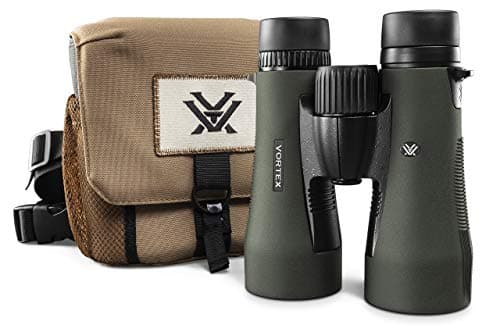
Vortex Diamondback HD 12x50
The cheapest 12x50 on this site worth owning: a 6.0 ft close focus and a 4.17 mm exit pupil, with 14 mm of eye relief as the one real compromise.
No buyable offer at the last price check.
Prices change; we show only live figures. #ad How we earn
Almost everyone who compares these two formats does it on the objective lens: 56 mm is bigger than 50 mm, bigger gathers more light, so the 15x56 must be the low-light pair. The arithmetic says otherwise. A 15x56 has a 3.73 mm exit pupil and a 12x50 has a 4.17 mm one, which means the format with the bigger front glass puts a narrower cone of light into your eye. The 15x56 is still the better glassing instrument for a specific kind of hunting - but not for the reason it gets sold on, and not for everyone.
The two formats, same line, every published row
To compare the formats rather than two different binoculars, this table uses the Vortex Diamondback HD in both. Same brand, same line, same HD glass and coatings, same warranty, same price tier. Every difference below is the format.
| Specification | 12x50 | 15x56 | Which wins |
|---|---|---|---|
| Field of view @ 1,000 yd | 271 ft | 230 ft | 12x50, by 41 ft |
| Angular field of view | 5.2 degrees | 4.4 degrees | 12x50 |
| Exit pupil (computed) | 4.17 mm | 3.73 mm | 12x50 |
| Twilight factor (computed) | 24.5 | 29 | 15x56 |
| Magnification | 12x | 15x | 15x56 for detail at range |
| Eye relief | 14.0 mm | 15.6 mm | 15x56 |
| Close focus | 6.0 ft | 14.0 ft | 12x50, by a wide margin |
| Weight | 28.9 oz | 34.8 oz | 12x50, by 5.9 oz |
| Body size (H x W) | 6.4 x 5.3 in | 7.1 x 5.8 in | 12x50 |
| Tripod required | For sustained glassing | Always | 12x50 |
The 15x56 wins two rows outright - twilight factor and eye relief - plus the magnification it is named for. The 12x50 wins six. Whether those six matter depends entirely on whether you are carrying the binocular or sitting behind it.
Why the 56 mm objective does not make it brighter
Exit pupil is the diameter of the cone of light leaving the eyepiece, and it is simple division: objective diameter divided by magnification. 50 / 12 = 4.17 mm. 56 / 15 = 3.73 mm. Going from 50 mm to 56 mm adds 12 percent to the objective diameter; going from 12x to 15x adds 25 percent to the magnification. The magnification outruns the glass, so the exit pupil shrinks.
Whether that matters depends on your own pupil. In daylight a human pupil sits around 2 to 3 mm, so both formats deliver more light than your eye can use and the difference is invisible. In the last twenty minutes of legal light your pupil opens past 5 mm, and at that point both formats are the limiting factor - and the 4.17 mm one is feeding your eye more light than the 3.73 mm one. This is why the 56 mm objective does not buy what the marketing implies.
What the 56 mm does buy is the thing twilight factor measures. Twilight factor is the square root of magnification times objective: the square root of 12 times 50 is 24.5, and the square root of 15 times 56 is 29.0. It is an index of how much fine detail you can resolve in poor light, and it rewards magnification heavily. So in the half hour either side of shooting light the 15x56 shows you finer detail on an animal while putting slightly less total light into your eye - a real and genuinely useful advantage, just a different one from "brighter". Exit pupil and twilight factor works through both formulas properly, and binocular objective lens size covers why bigger front glass is not a shortcut.
The question that actually decides it: are you carrying a tripod?
Strip out the optics and this comparison reduces to one logistical question, because at 15x there is no hand-held option at all. Your pulse moves the image by more than the detail you are trying to resolve, and a shaking 15x56 delivers less usable information than a steady 10x42. That is not a preference, it is the reason 15x binoculars exist - they are tripod instruments, and the industry sells them to people who then try to use them like binoculars.
A 12x50 sits right on the line. It is better on a tripod and nobody should pretend otherwise, but at 28.9 oz you can brace it against a pack, a tree or a shooting stick and get a usable look for thirty seconds, which is enough to answer "is that an animal". That makes it the format for a hunter who covers ground, glasses in bursts, and carries a tripod for the long sits. The 15x56 is the format for a hunter who walks to a vantage point, sets up, and grid-glasses a basin for two hours.
So the honest decision tree is short. If you will not reliably carry a tripod, buy the 12x50 and do not argue with it. If your glassing is sitting still and dissecting country, the 15x56 does that better than any 12x50 and nearly as well as an entry 85 mm spotting scope for a fraction of the bulk. Do you need a tripod for binoculars is the prerequisite reading, and the best tripods for binoculars is where the second half of a 15x56 budget goes.
Where each format fits the hunt
The 12x50 is the Western generalist's second pair. You already own a 10x42 for hanging on your chest; the 12x50 is what goes in the pack for the morning and evening glassing sessions and comes out braced or on a tripod. Its 271 to 288 ft of field is wide enough to sweep with, its 28.8 to 28.9 oz is light enough that taking it is not a decision, and the 6.0 ft close focus means it is still a binocular. If you own one glassing optic beyond your chest pair, this is the more versatile choice.
The 15x56 is the spotting scope you will actually carry. This is the strongest argument for the format and it has nothing to do with brightness. An entry 85 mm spotting scope plus the tripod it needs runs 60 oz or more of scope alone; a 15x56 is 34.8 to 45.2 oz and gives you two eyes on the image, which is far less fatiguing over two hours and better at picking movement out of cover. It will not let you count points at a mile the way a Razor HD 27-60x85 will - 15x is not 60x - but it finds the animal, and finding is the harder half. Spotting scope vs binoculars is the fuller comparison.
Neither is a first pair of binoculars. Both formats are specialist glassing instruments. If this would be your only binocular, the answer is a 10x42, and how to choose hunting binoculars is the page you want instead. The best size binoculars for western hunting covers how the formats stack into a sensible two-optic setup.
Three things people get wrong about both formats
Buying magnification instead of stability. A hand-held 15x shows you less than a braced 12x, and a braced 12x shows you less than a tripod-mounted 12x. The order of operations is stability first, then magnification. Spending the tripod budget on more magnification is the most common way to end up with an expensive pair of binoculars that finds fewer animals than the cheap pair did.
Ignoring eye relief because the glass is good. The Diamondback HD 12x50's 14.0 mm is the shortest figure of any 12x50 on this site, and for a glasses wearer it closes in the field exactly where field of view is the format's main advantage. Within the 15x56 format, Athlon's 18.5 mm and Zeiss's 18 mm are the comfort picks and the Diamondback HD's 15.6 mm is workable. If you glass in glasses, treat eye relief as a hard filter before you look at anything else.
Assuming more objective means more light. This is the one this page exists to correct. 56 mm of front glass behind 15x gives you less exit pupil than 50 mm behind 12x. If brightness at last light is your actual priority, the format to look at is a 10x50 or a high-transmission 10x42, not a 15x56 - and the only brand publishing a transmission figure anywhere in this comparison is Zeiss, at 90 percent on the Conquest HDX. The best low-light hunting binoculars is the page for that priority.
Verdict
- Buy a 12x50 if you cover ground, glass in bursts, and will not always have a tripod under you. It is 5.9 oz lighter, 41 ft wider, focuses to 6 ft, and has the larger exit pupil.
- Buy a 15x56 if your glassing is sitting still behind a tripod and dissecting country for hours. The twilight factor of 29 and the 15x magnification find bedded animals that a 12x reads as a shape.
- Buy the Vortex Diamondback HD in either format if value decides it - this comparison runs on that pair precisely because it is the cheapest credible entry to both.
- Step up to the Viper HD 12x50 if you wear glasses and want the 12x50 format - 16.0 mm of eye relief against 14.0 mm, and 17 ft more field.
- Step up to the Athlon Cronus G2 UHD 15x56 if you are doing four-hour sits in glasses. 18.5 mm of eye relief is the single most comfortable number in this comparison. Accept the 45.2 oz.
- Buy neither if this would be your only binocular. Buy a 10x42 and come back for the glassing optic later.
The four binoculars compared
No buyable offer at the last price check.
Prices change; we show only live figures. #ad How we earn
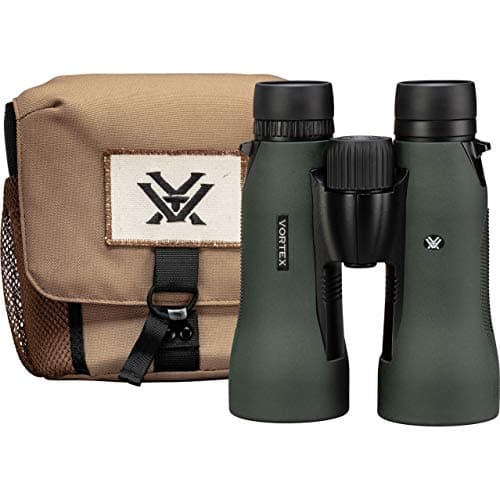
Vortex Diamondback HD 12x50
The cheapest 12x50 on this site worth owning: a 6.0 ft close focus and a 4.17 mm exit pupil, with 14 mm of eye relief as the one real compromise.
| Magnification | 12x |
|---|---|
| Objective lens | 50 mm |
| Eye relief | 14.0 mm |
| Field of view | 271' @ 1000 yds |
| Angular field of view | 5.2º |
| Close focus | 6.0' |
| Weight | 28.9 oz. |
| Height | 6.4" |
| Width | 5.3" |
| Interpupillary distance | 60-75 mm |
| Exit pupil (computed) | 4.17 mm |
| Twilight factor (computed) | 24.5 |
Specs verified 2026-10-19 from Vortex's published specification. Exit pupil and twilight factor are computed, not quoted.
What it does well
- 6.0 ft close focus - the shortest of any 12x50 here
- 28.9 oz, within an ounce of the Viper HD
- Ships with the GlassPak harness case rather than a bare neck strap
- Unlimited, unconditional lifetime warranty
Where it gives ground
- 14 mm of eye relief is the shortest here and will vignette for some glasses wearers
- 271 ft of field is 17 ft narrower than the Viper HD
- HD glass rather than the Viper HD's XR-coated glass, which shows at dusk
Skip it if
You wear glasses while glassing. 14 mm sits below the 15 mm floor where the field starts closing in.
How this score breaks down
- Low-light performance (weight 5)7.5
- Optical quality per dollar (weight 4)9.3
- Field of view (weight 3)7.5
- Eye relief (weight 3)5.8
- Weight and ergonomics (weight 2)7.8
- Warranty (weight 2)10.0
Criterion scores are on the 0-10 rubric scale. Their weighted mean is 7.9, which maps to 9.1 on our published recommendation scale of 8.4 to 9.8 - the band of products we are willing to recommend at all. The weights, the definitions and the mapping are all published, so any score here can be checked against our own rules. These are editorial judgments from published specifications, computed optical arithmetic and documented consensus.
This is half of the controlled comparison this page is built on. Vortex publishes 271 ft of field at 1,000 yd, 5.2 degrees angular, 14.0 mm of eye relief, a 6.0 ft close focus, 28.9 oz, a 6.4 by 5.3 in body and a 60-75 mm interpupillary range. Computed from those: a 4.17 mm exit pupil and a twilight factor of 24.5. It ships with the GlassPak harness case rather than a neck strap, and it carries Vortex's unlimited, unconditional lifetime warranty.
Against the 15x56 version of the same binocular, three published rows go this one's way and they are the three that decide most seasons. 271 ft of field is 41 ft wider - roughly 18 percent more country in the view, which is the difference between picking up a moving animal and losing it. 28.9 oz is 5.9 oz lighter, which is the difference between a pair you wear all day and a pair you leave in the truck. And the 6.0 ft close focus against 14.0 ft means this one is still a binocular for everything else you look at, not only for the far hillside.
The cons are real and two of them are shared with every 12x. 14.0 mm of eye relief is the shortest figure of any 12x50 we list and sits below the roughly 15 mm floor where glasses wearers start to see the field close in - if you glass in glasses, the Viper HD's 16.0 mm or the Athlon Midas G2 PRO's 15 mm is the safer buy. 12x shows you your own pulse: you can brace it against a pack or a tree for short looks, but sustained glassing needs a tripod or a solid rest. And it is HD glass rather than the Viper HD's XR-coated glass, which shows at dusk. The best 12x50 hunting binoculars is the full field in this format.
Price as of November 12, 2026. #ad How we earn
Vortex Diamondback HD 15x56
A 3.73 mm exit pupil and 230 ft of field: the cheapest credible way to sit behind a tripod all morning without carrying a spotting scope.
| Magnification | 15x |
|---|---|
| Objective lens | 56 mm |
| Eye relief | 15.6mm |
| Field of view | 230' @ 1000 yds |
| Angular field of view | 4.4º |
| Close focus | 14.0' |
| Weight | 34.8 oz. |
| Height | 7.1" |
| Width | 5.8" |
| Exit pupil (computed) | 3.73 mm |
| Twilight factor (computed) | 29 |
Specs verified 2026-10-05 from Vortex's published specification. Exit pupil and twilight factor are computed, not quoted.
What it does well
- 15x finds animals a 10x walks past
- 56 mm objective keeps it usable at dawn
- Much lighter and cheaper than a spotting scope setup
Where it gives ground
- 34.8 oz and 15x means a tripod is mandatory, not optional
- Too much magnification for timber or still-hunting
Skip it if
This is your only pair of binoculars. 15x is a second optic, not a first one.
How this score breaks down
- Low-light performance (weight 5)8.0
- Optical quality per dollar (weight 4)9.0
- Field of view (weight 3)6.1
- Eye relief (weight 3)7.6
- Weight and ergonomics (weight 2)5.8
- Warranty (weight 2)10.0
Criterion scores are on the 0-10 rubric scale. Their weighted mean is 7.8, which maps to 9.1 on our published recommendation scale of 8.4 to 9.8 - the band of products we are willing to recommend at all. The weights, the definitions and the mapping are all published, so any score here can be checked against our own rules. These are editorial judgments from published specifications, computed optical arithmetic and documented consensus.
The reason this pair is the right comparison is that nothing else changes. Same brand, same Diamondback HD line, same HD glass and coatings, same lifetime warranty, same price tier - so every difference in the numbers below is the format and only the format. Vortex publishes 230 ft of field, 4.4 degrees angular, 15.6 mm of eye relief, a 14.0 ft close focus, 34.8 oz and a 7.1 by 5.8 in body. Computed: a 3.73 mm exit pupil and a twilight factor of 29.
Read those two computed numbers together, because they are the whole argument of this page. The exit pupil goes down from 4.17 mm to 3.73 mm - the format with the bigger objective delivers a narrower cone of light to your eye, because 15x spends more than the extra 6 mm of glass collects. The twilight factor goes up from 24.5 to 29, which means more resolving power in poor light. So a 15x56 is not brighter than a 12x50; it shows you finer detail in dim light while putting slightly less light into your pupil. Those are different things and almost every buying guide blurs them. Exit pupil and twilight factor sets out the formulas.
What you are really buying is the 15x. At 15x you see an animal bedded in shadow at a mile that a 12x shows you as a shape and a 10x walks past entirely, and across a morning of grid-glassing that is the difference between finding animals and looking at country. The cons are the price of that: 34.8 oz behind 15x magnification makes a tripod mandatory rather than recommended - hand-held, a 15x delivers less usable detail than a steady 10x. The 14.0 ft close focus makes it useless for anything near you. And 15x is far too much magnification for timber or still-hunting, which is why this should be your second pair of binoculars and never your only one. The best 15x56 binoculars for hunting is the full field.
Price as of November 12, 2026. #ad How we earn
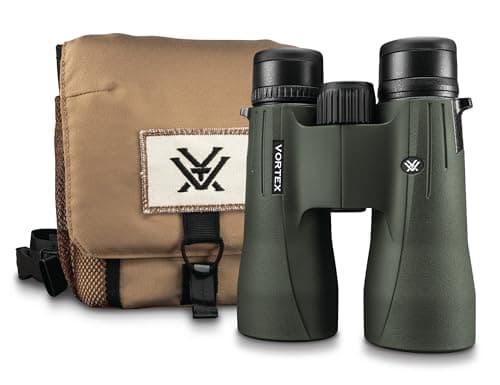
Vortex Viper HD 12x50
A 4.17 mm exit pupil and 288 ft of field, which is the trade you make for the extra detail; plan on a tripod, because 12x shows you your own pulse.
| Magnification | 12x |
|---|---|
| Objective lens | 50 mm |
| Eye relief | 16.0mm |
| Field of view | 288' @ 1000 yds |
| Angular field of view | 5.5º |
| Close focus | 8.0' |
| Weight | 28.8 oz. |
| Height | 6.5" |
| Width | 5.2" |
| Exit pupil (computed) | 4.17 mm |
| Twilight factor (computed) | 24.5 |
Specs verified 2026-10-05 from Vortex's published specification. Exit pupil and twilight factor are computed, not quoted.
What it does well
- 12x resolves antler detail a 10x leaves ambiguous
- 50 mm objective keeps the exit pupil close to the 10x42
- Still fits a standard bino harness
Where it gives ground
- Unusable handheld for sustained glassing - tripod required
- 288 ft field makes picking up moving animals harder
Skip it if
You will not carry a tripod. A shaky 12x sees less than a steady 10x.
How this score breaks down
- Low-light performance (weight 5)8.4
- Optical quality per dollar (weight 4)8.9
- Field of view (weight 3)7.2
- Eye relief (weight 3)8.1
- Weight and ergonomics (weight 2)6.8
- Warranty (weight 2)10.0
Criterion scores are on the 0-10 rubric scale. Their weighted mean is 8.3, which maps to 9.3 on our published recommendation scale of 8.4 to 9.8 - the band of products we are willing to recommend at all. The weights, the definitions and the mapping are all published, so any score here can be checked against our own rules. These are editorial judgments from published specifications, computed optical arithmetic and documented consensus.
If the 12x50 format is the answer and the Diamondback HD's 14.0 mm of eye relief is the problem, this is the fix. Vortex publishes 288 ft of field at 1,000 yd, 5.5 degrees angular, 16.0 mm of eye relief, an 8.0 ft close focus and 28.8 oz in a 6.5 by 5.2 in body - essentially the same weight as the cheaper pair with 17 ft more field and 2 mm more eye relief, on XR-coated glass that holds contrast noticeably better at dusk. The exit pupil is the same 4.17 mm, because that is arithmetic rather than a feature.
The cons: the 8.0 ft close focus is longer than the Diamondback HD's 6.0 ft, and the price step is real for an advantage you mostly collect in the last half hour of light. The 288 ft field is still 58 ft wider than the 15x56 Diamondback, which is the point worth holding onto - staying in the 12x50 format buys you more view than stepping up a tier within the 15x56 format does. The full Viper HD 12x50 context sits on the 10x42 vs 12x50 page if you are also weighing the step down.
Price as of November 12, 2026. #ad How we earn
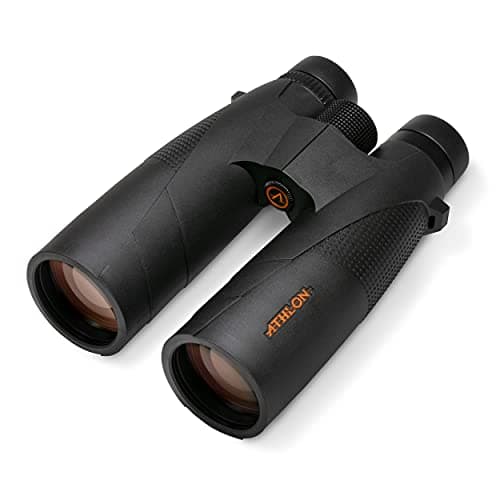
Athlon Cronus G2 UHD 15x56
235 ft of field and 18.5 mm of eye relief on ED-glass UHD optics, for roughly half what the European 15x56s cost.
| Magnification | 15x |
|---|---|
| Objective lens | 56 mm |
| Eye relief | 18.5 mm |
| Field of view | 235 ft @ 1,000 yds |
| Angular field of view | 4.5º |
| Close focus | 4 m / 13.1 ft |
| Interpupillary distance | 59-74 mm |
| Weight | 45.2 oz |
| Dimensions | 8.7" x 6.2" |
| Exit pupil (computed) | 3.73 mm |
| Twilight factor (computed) | 29 |
Specs verified 2026-10-26 from Athlon's published specification. Exit pupil and twilight factor are computed, not quoted.
What it does well
- 18.5 mm of eye relief - comfortable in glasses, which matters over a four-hour sit
- 235 ft of field at 1,000 yards, 5 ft wider than the Diamondback HD
- UHD extra-low-dispersion glass with ESP dielectric prism coating
- Magnesium chassis and Athlon's lifetime warranty
Where it gives ground
- 45.2 oz is the heaviest unit on this page - a tripod is not optional
- 13.1 ft close focus is long, so it is useless for anything near you
- Athlon's published table gives no exit-pupil or transmission figure
- Resale is weaker than Vortex or Zeiss in the used market
Skip it if
You want one optic that does everything. This is a tripod instrument and nothing else.
How this score breaks down
- Low-light performance (weight 5)8.8
- Optical quality per dollar (weight 4)8.8
- Field of view (weight 3)7.5
- Eye relief (weight 3)9.5
- Weight and ergonomics (weight 2)5.0
- Warranty (weight 2)9.0
Criterion scores are on the 0-10 rubric scale. Their weighted mean is 8.3, which maps to 9.3 on our published recommendation scale of 8.4 to 9.8 - the band of products we are willing to recommend at all. The weights, the definitions and the mapping are all published, so any score here can be checked against our own rules. These are editorial judgments from published specifications, computed optical arithmetic and documented consensus.
Within the 15x56 format the thing worth paying for is not field of view - it barely moves, 235 ft here against the Diamondback's 230 ft - it is eye relief and glass. Athlon publishes 18.5 mm of eye relief, which over a four-hour sit behind a tripod in glasses is the difference between glassing and enduring, on UHD extra-low-dispersion glass with ESP dielectric and phase coatings, in a magnesium chassis with a lifetime warranty. Published field is 235 ft at 4.5 degrees; close focus 13.1 ft; interpupillary 59-74 mm.
The cons are heavy, literally. 45.2 oz is 10.4 oz more than the Diamondback HD 15x56 and 16.3 oz - over a pound - heavier than the 12x50 - this is a tripod instrument and nothing else, and it is not going around your neck on a walk in. Athlon's published table gives no exit-pupil or light-transmission figure, so the 3.73 mm above is computed rather than published. Resale is weaker than Vortex or Zeiss. For reference at the top of this format, the Zeiss Conquest HDX 15x56 publishes 240 ft of field and 90 percent light transmission - the only transmission figure any brand publishes here - at roughly four times the Diamondback's price.
Our recommendation
If you take one thing from this page, take this.
Vortex Diamondback HD 12x50
The 12x50 side of the comparison - and the one most hunters should buy
271 ft of field, a 4.17 mm exit pupil, a 6.0 ft close focus and 28.9 oz: the format you can still carry and occasionally brace.
No buyable offer at the last price check.
Vortex Diamondback HD 15x56
The 15x56 side of the comparison - same line, same glass, format changed
230 ft of field, a 3.73 mm exit pupil, a twilight factor of 29 and 34.8 oz: more resolving power in poor light, and a tripod is no longer optional.
Prices are pulled live and shown on each button. #ad How we earn.
Questions people actually ask
Are 15x56 binoculars brighter than 12x50?
So what does the bigger 56 mm objective actually buy?
Can you hand-hold 15x56 binoculars?
Can you hand-hold 12x50 binoculars?
Which format has the wider field of view?
Is a 15x56 binocular a substitute for a spotting scope?
Should a 12x50 or 15x56 be my only pair of binoculars?
Does a 12x50 or a 15x56 need a bigger tripod?
Sources
- Vortex Diamondback HD 12x50 - published specifications - read 2026-10-19
- Vortex Diamondback HD 15x56 - published specifications - read 2026-10-05
- Vortex Viper HD 12x50 - published specifications - read 2026-10-05
- Athlon Cronus G2 UHD 15x56 - published specifications - read 2026-10-26
- ZEISS Conquest HDX 15x56 - published technical data, including 90 % light transmission - read 2026-10-26
- Athlon Midas G2 PRO UHD 12x50 - published specifications - read 2026-10-19