The objective lens size is the second number on a binocular - the 42 in 10x42 - and it is the diameter of the front lenses in millimeters. A bigger objective collects more light, which is why 50 mm and 56 mm binoculars exist. But the number only means something divided by the magnification: 42 divided by 8 gives a brighter view than 56 divided by 15.
The arithmetic that makes the number useful
Objective diameter divided by magnification gives the exit pupil in millimeters - the width of the beam of light leaving the eyepiece and entering your eye. Once that beam is narrower than your pupil, you are wasting your eye's capacity, and in low light a dark-adapted pupil opens to roughly 5-7 mm.
| Configuration | Objective | Exit pupil | Published weight | Handheld? |
|---|---|---|---|---|
| Vortex Viper HD 8x42 | 42 mm | 5.25 mm | 24.5 oz | Yes - all day |
| Vortex Viper HD 10x42 | 42 mm | 4.2 mm | 24.9 oz | Yes |
| Vortex Viper HD 12x50 | 50 mm | Objective divided by 12x | 28.8 oz | Not for sustained glassing |
| Vortex Diamondback HD 15x56 | 56 mm | 3.73 mm | 34.8 oz | No - tripod required |
Weights and objective sizes are Vortex's published figures. Exit pupil is objective diameter divided by magnification.
Read that table from the right-hand column backwards and the pattern is clear: objective size does not predict brightness on its own, and it predicts weight almost perfectly. The 56 mm pair carries 10 oz more than the 42 mm pair and shows you a dimmer image, because its magnification consumed the extra light.
What a bigger objective genuinely buys
- It makes high magnification usable. This is the real reason 50 mm and 56 mm exist. 15x on a 42 mm objective would give a 2.8 mm exit pupil, which is dim enough to be unpleasant. The 56 mm brings it back to 3.73 mm.
- It raises the twilight factor. Twilight factor - the square root of magnification times objective - rewards both numbers, and it tracks how much detail you can resolve in poor light rather than how bright the view looks. The Diamondback HD 15x56's published figure is 29 against 18.3 for an 8x42.
- It gives a little more resolution. A larger aperture has a higher theoretical resolution limit. In practice glass quality and atmospheric conditions bite long before that limit does.
Quick picks
Ranked by the criteria published on how we review. Tap any row for the full write-up, or go straight to the current price.
| # | Product | Best for | Score | Price |
|---|---|---|---|---|
| 1 | 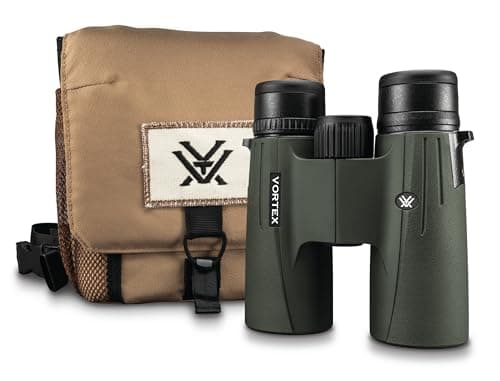 Vortex Viper HD 8x4242 mm at 8x gives a 5.25 mm exit pupil in 24.5 oz: the configuration that carries well and still works at dusk. | 42 mm - the all-day standardLast light and timber | 9.8out of 10 | |
| 2 | 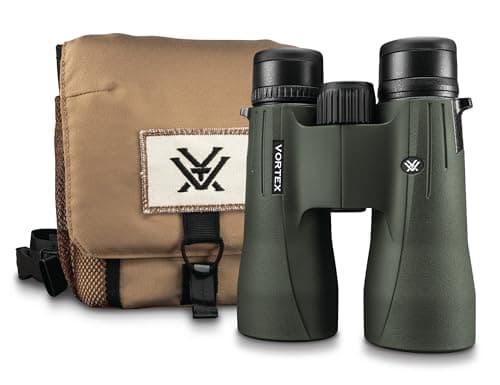 Vortex Viper HD 12x50The 50 mm objective exists to feed the 12x magnification; handheld use is not realistic. | 50 mm - magnification supportOpen country off a tripod | 9.3out of 10 | |
| 3 | 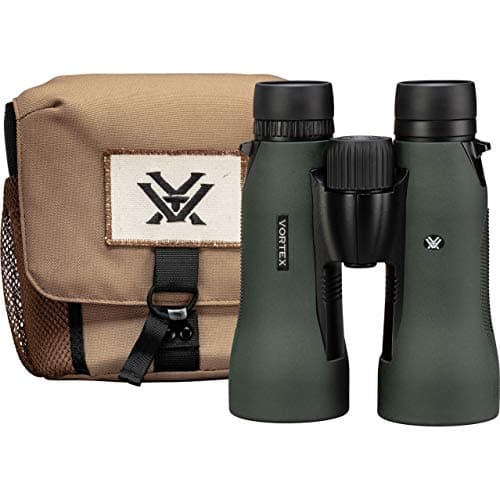 Vortex Diamondback HD 15x5656 mm and 15x gives a 3.73 mm exit pupil at 34.8 oz - a second optic, not a first one. | 56 mm - the tripod classTripod glassing without a spotting scope | 9.1out of 10 |
Prices are pulled live from Amazon and were last checked November 12, 2026; if a figure cannot be verified the button reads "Check price" instead. Scores are our editorial judgment against the published ranking criteria, on our published 8.4 to 9.8 recommendation scale. #ad How we earn.
What it costs
- Weight, immediately. 42 mm to 56 mm is roughly 10 extra ounces in these examples, and it hangs off your neck all day.
- Bulk. A 56 mm binocular does not fit a standard harness as comfortably and is harder to get under a coat.
- Field of view. Higher-magnification designs - which is what big objectives usually accompany - narrow the view: 409 ft for the 8x42 against 230 ft for the 15x56.
- The cost of a tripod. Above about 12x, a tripod stops being optional, which adds both money and weight - see what size tripod do I need.
Which objective size to buy
42 mm for anything you will carry. It is the standard because it is the point where exit pupil, weight and bulk balance for a binocular that lives on your chest. 50 mm if you specifically want 12x and will carry a tripod. 56 mm only as a second optic, bought to sit behind a tripod and glass open country as a cheaper alternative to a spotting scope.
And if you are choosing a first pair, choose the magnification first and let the objective follow from it. The reasoning is in binocular magnification for hunting, and the way to read any spec sheet without being misled by a big objective number is in reading a spec sheet without being fooled.
Questions people actually ask
What does the objective lens size mean on binoculars?
Is a 50 mm objective better than 42 mm for hunting?
What objective lens size is best for hunting binoculars?
Does a bigger objective lens mean a brighter image?
Sources
- Vortex Diamondback HD 15x56 published specifications - read 2026-10-17
- Vortex Viper HD 8x42 published specifications - read 2026-10-17