Magnification is the first number people look at and the one they most often get wrong, because the instinct is that more is better and the reality is that more costs you three things.
What magnification costs
- Field of view. A Vortex Viper HD 8x42 publishes 409 ft at 1,000 yards; the 10x42 publishes 341 ft; the 12x50 publishes 288 ft (all verified 2026-10-05). Narrower fields make finding a moving animal slower.
- Exit pupil, and therefore apparent brightness. 42 / 8 = 5.25 mm; 42 / 10 = 4.20 mm. The arithmetic is unavoidable.
- Stability. Your pulse and your breathing are magnified with the image. Above about 10x, handheld shake takes away more detail than the magnification adds.
What it buys is resolvable detail at distance, measured by twilight factor. That is genuinely valuable - when judging an animal is what is limiting you.
The decision, by terrain
| Terrain | Magnification | Why |
|---|---|---|
| Thick timber, close whitetail | 8x | Close shots, poor light, movement in brush. Whitetail picks |
| Mixed farmland and field edges | 10x | Animals appear at 300-400 yd and need judging |
| Open western basins, walking | 10x | The most reach you can use handheld |
| Open country, glassing from a vantage | 12x or 15x, on a tripod | Western picks |
| From a treestand with a bow | 8x | Steady one-handed, bright at legal light |
| You only want one pair for everything | 10x42 | The compromise, honestly labeled as one |
The tripod question decides everything above 10x
This is the single most useful thing on the page. If the answer is no, your ceiling is 10x. Not as a rule of thumb - as a practical limit, because a handheld 12x glassed for twenty minutes resolves less than a steady 10x and gives you a headache doing it.
If the answer is yes, the whole calculation changes and 12x50 or 15x56 become the sensible choices. A tripod and an adapter together cost less than most binocular upgrades and do more. Where the threshold sits exactly.
What about compacts and 8x32s
An 8x32 computes to a 4.00 mm exit pupil - below a 10x42's 4.20 mm. A compact binocular is dimmer at dusk than a full-size one with more magnification, which is the opposite of what most people assume. Compacts are a daylight tool, a backup, or a hike-in-and-look optic. If you hunt the last half hour of light, stay at 42 mm. Or consider a monocular, which is honest about being a compromise.
One binocular at each magnification
Price as of October 5, 2026. #ad How we earn
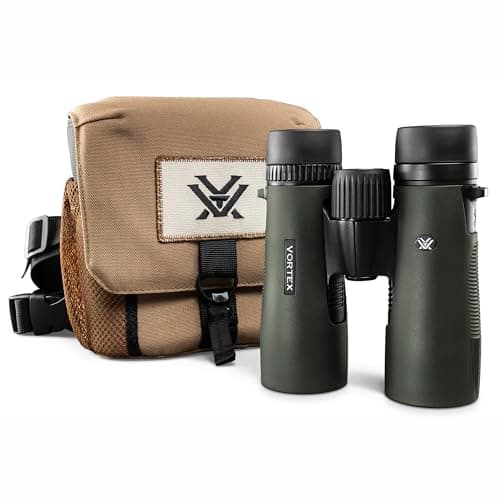
Vortex Diamondback HD 8x42
A 5.25 mm exit pupil and 17 mm of eye relief at the $250 tier, which is the combination most first upgrades actually need.
| Magnification | 8x |
|---|---|
| Objective lens | 42 mm |
| Eye relief | 17 mm |
| Field of view | 393 feet/1000 yards |
| Angular field of view | 7.5 degrees |
| Close focus | 5 feet |
| Weight | 21.8 oz |
| Height | 5.8 inches |
| Width | 5.1 inches |
| Exit pupil (computed) | 5.25 mm |
| Twilight factor (computed) | 18.3 |
Specs verified 2026-10-05 from Vortex's published specification. Exit pupil and twilight factor are computed, not quoted.
What it does well
- 5.25 mm exit pupil, the same figure as the Viper HD 8x42
- 17 mm eye relief works with glasses
- 393 ft field of view is wide for the money
Where it gives ground
- 8x limits you in genuinely open country
- Focus wheel is stiffer than the Viper's in the cold
Skip it if
You glass across canyons - the extra magnification matters more than the brightness there.
How this score breaks down
- Low-light performance (weight 5)8.5
- Optical quality per dollar (weight 4)9.5
- Field of view (weight 3)9.0
- Eye relief (weight 3)9.0
- Weight and ergonomics (weight 2)8.0
- Warranty (weight 2)10.0
Weights and definitions are published on how we review. These are editorial judgments from published specs and documented consensus, not test results.
393 ft of published field and 17 mm of eye relief (verified 2026-10-05), with a 5.25 mm computed exit pupil.
Price as of October 5, 2026. #ad How we earn
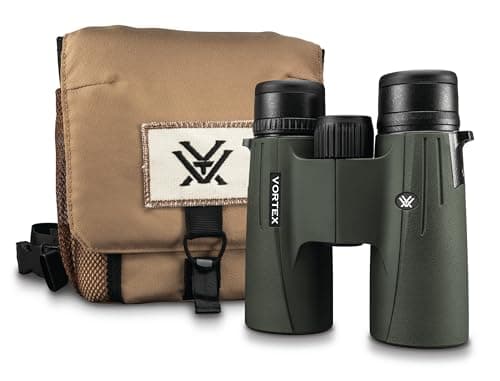
Vortex Viper HD 10x42
The default answer when someone outgrows a $150 pair: 17 mm of eye relief, a 341 ft field of view and glass that holds its edges, at the price where diminishing returns start.
| Magnification | 10x |
|---|---|
| Objective lens | 42 mm |
| Eye relief | 17.0mm |
| Field of view | 341' @ 1000 yds |
| Angular field of view | 6.5º |
| Close focus | 6.0' |
| Weight | 24.9 oz. |
| Height | 5.6" |
| Width | 4.9" |
| Exit pupil (computed) | 4.2 mm |
| Twilight factor (computed) | 20.5 |
Specs verified 2026-10-05 from Vortex's published specification. Exit pupil and twilight factor are computed, not quoted.
What it does well
- 17.0 mm eye relief is generous enough for most glasses wearers
- 341 ft at 1,000 yards is a wide field for a 10x
- Vortex VIP warranty is unconditional and transferable
Where it gives ground
- 24.9 oz is noticeable on a chest harness over a long day
- The 12x50 costs little more if you glass open country
Skip it if
You hunt timber inside 200 yards - the 8x42 Diamondback does that job for less than half the money.
How this score breaks down
- Low-light performance (weight 5)8.5
- Optical quality per dollar (weight 4)9.0
- Field of view (weight 3)9.0
- Eye relief (weight 3)9.0
- Weight and ergonomics (weight 2)7.5
- Warranty (weight 2)10.0
Weights and definitions are published on how we review. These are editorial judgments from published specs and documented consensus, not test results.
341 ft of field and 17.0 mm of eye relief (verified 2026-10-05). The default for a reason, not because it is optimal.
Price as of October 5, 2026. #ad How we earn
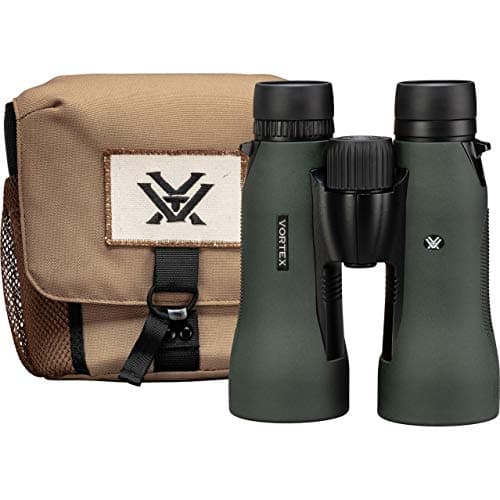
Vortex Diamondback HD 15x56
A 3.73 mm exit pupil and 230 ft of field: the cheapest credible way to sit behind a tripod all morning without carrying a spotting scope.
| Magnification | 15x |
|---|---|
| Objective lens | 56 mm |
| Eye relief | 15.6mm |
| Field of view | 230' @ 1000 yds |
| Angular field of view | 4.4º |
| Close focus | 14.0' |
| Weight | 34.8 oz. |
| Height | 7.1" |
| Width | 5.8" |
| Exit pupil (computed) | 3.73 mm |
| Twilight factor (computed) | 29 |
Specs verified 2026-10-05 from Vortex's published specification. Exit pupil and twilight factor are computed, not quoted.
What it does well
- 15x finds animals a 10x walks past
- 56 mm objective keeps it usable at dawn
- Much lighter and cheaper than a spotting scope setup
Where it gives ground
- 42.7 oz and 15x means a tripod is mandatory, not optional
- Too much magnification for timber or still-hunting
Skip it if
This is your only pair of binoculars. 15x is a second optic, not a first one.
How this score breaks down
- Low-light performance (weight 5)7.5
- Optical quality per dollar (weight 4)9.0
- Field of view (weight 3)6.0
- Eye relief (weight 3)7.5
- Weight and ergonomics (weight 2)5.5
- Warranty (weight 2)10.0
Weights and definitions are published on how we review. These are editorial judgments from published specs and documented consensus, not test results.
230 ft of field, 15.6 mm of eye relief (verified 2026-10-05), and a 3.73 mm computed exit pupil. A second optic.
Questions people actually ask
Is 10x or 12x better for hunting?
What magnification do I need to judge antlers?
Are 20x binoculars useful for hunting?
Is 8x enough magnification for hunting?
Sources
- Vortex Viper HD 8x42 published specifications - read 2026-10-05
- Vortex Viper HD 12x50 published specifications - read 2026-10-05