Most binocular buying guides are organized around price brackets, which means they ask you to decide how much to spend before you know what you need. This one runs in the useful order.
What you need
- Honest answers about where you hunt and when
- Whether you wear glasses while glassing
- A decision about whether you will carry a tripod
- 1
Pick magnification from terrain, not from the number
Thick timber and close whitetail: 8x. Mixed farmland and field edges: 10x. Open country where you glass from a vantage point for hours: 12x or 15x. Magnification is a trade, not a feature - it narrows your field, lowers your exit pupil, and amplifies your hand shake. The full breakdown by terrain.
- 2
Answer the tripod question honestly
Will you actually carry one? If no, your magnification ceiling is 10x, full stop - a handheld 12x resolves less than a steady 10x over a real glassing session. If yes, 12x and 15x open up and they are substantially better tools for judging animals. Most people who say yes do not, so be honest. Where the threshold sits.
- 3
If you wear glasses, filter on eye relief before anything else
Published eye relief under about 15 mm means you lose the edges of the field with glasses on, and no amount of glass quality compensates. Look for 17 mm or more. This single filter eliminates a lot of otherwise good binoculars and it is the most common regret we see described in owner reviews.
- 4
Compute the exit pupil and check it against your use
Objective divided by magnification. Set a floor of 4 mm for anything you will use at dawn or dusk, and 5 mm if low light is your main problem. This is where a lot of people discover that the format they were about to buy is wrong - a 10x32 computes to 3.20 mm and is a daylight-only optic. Both low-light figures explained.
- 5
Now set a budget, and check the coatings rather than the labels
At your chosen format, compare published field of view (above 330 ft at 1,000 yards for a 10x42 is good), and look for fully multi-coated optics, phase correction and dielectric prism coatings. Those three lines tell you more about low-light performance than ED or HD does. Why the labels mislead.
- 6
Weigh the warranty, then buy the harness at the same time
An unconditional transferable warranty is worth real money over a decade and props up resale value. And budget $29 to $65 for a harness in the same purchase - it is the difference between a binocular on your chest and a binocular in your pack. Harness picks.
What to ignore while you are doing this
- Zoom binoculars. The optics cannot support the range and nobody can hold the top end still.
- Magnification above 12x without a tripod plan. You will not get the benefit.
- Brand loyalty. Useful as a service-experience signal, useless as a specification.
- Reviews that say 'in our testing' without describing the test. If the method is not stated, the claim is not checkable.
- Compact binoculars, if you hunt the last half hour. An 8x32 computes to 4.00 mm - dimmer than a 10x42.
A worked example
Someone who hunts whitetail from a stand in hardwoods, wears glasses, will not carry a tripod, and has $300. Step 1 gives 8x (timber, close). Step 2 caps magnification anyway. Step 3 requires 17 mm or more of eye relief. Step 4 confirms 8x42 at 5.25 mm, comfortably above the floor. Step 5 at $300 points at the Diamondback HD 8x42, which publishes 17 mm and 393 ft. Step 6 says buy it with a $29 harness and stop.
Total: about $268, with $32 left over. The method does not push you up the price range, which is the point.
Where the method lands, in three cases
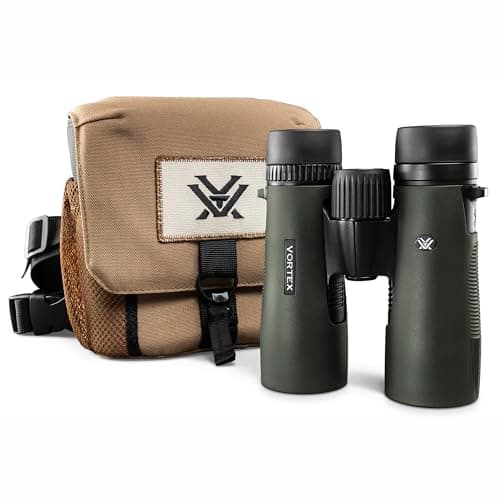
Price as of October 5, 2026. #ad How we earn
Vortex Diamondback HD 8x42
A 5.25 mm exit pupil and 17 mm of eye relief at the $250 tier, which is the combination most first upgrades actually need.
| Magnification | 8x |
|---|---|
| Objective lens | 42 mm |
| Eye relief | 17 mm |
| Field of view | 393 feet/1000 yards |
| Angular field of view | 7.5 degrees |
| Close focus | 5 feet |
| Weight | 21.8 oz |
| Height | 5.8 inches |
| Width | 5.1 inches |
| Exit pupil (computed) | 5.25 mm |
| Twilight factor (computed) | 18.3 |
Specs verified 2026-10-05 from Vortex's published specification. Exit pupil and twilight factor are computed, not quoted.
What it does well
- 5.25 mm exit pupil, the same figure as the Viper HD 8x42
- 17 mm eye relief works with glasses
- 393 ft field of view is wide for the money
Where it gives ground
- 8x limits you in genuinely open country
- Focus wheel is stiffer than the Viper's in the cold
Skip it if
You glass across canyons - the extra magnification matters more than the brightness there.
How this score breaks down
- Low-light performance (weight 5)8.5
- Optical quality per dollar (weight 4)9.5
- Field of view (weight 3)9.0
- Eye relief (weight 3)9.0
- Weight and ergonomics (weight 2)8.0
- Warranty (weight 2)10.0
Weights and definitions are published on how we review. These are editorial judgments from published specs and documented consensus, not test results.
Where the method lands for timber, whitetail and glasses wearers.
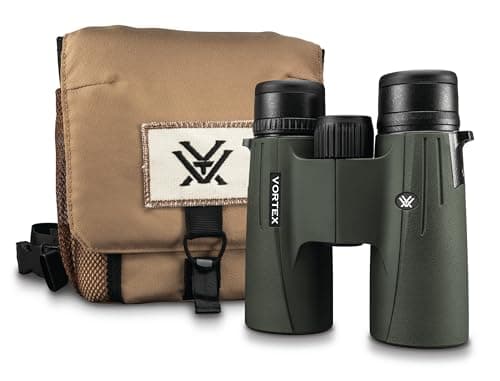
Price as of October 5, 2026. #ad How we earn
Vortex Viper HD 10x42
The default answer when someone outgrows a $150 pair: 17 mm of eye relief, a 341 ft field of view and glass that holds its edges, at the price where diminishing returns start.
| Magnification | 10x |
|---|---|
| Objective lens | 42 mm |
| Eye relief | 17.0mm |
| Field of view | 341' @ 1000 yds |
| Angular field of view | 6.5º |
| Close focus | 6.0' |
| Weight | 24.9 oz. |
| Height | 5.6" |
| Width | 4.9" |
| Exit pupil (computed) | 4.2 mm |
| Twilight factor (computed) | 20.5 |
Specs verified 2026-10-05 from Vortex's published specification. Exit pupil and twilight factor are computed, not quoted.
What it does well
- 17.0 mm eye relief is generous enough for most glasses wearers
- 341 ft at 1,000 yards is a wide field for a 10x
- Vortex VIP warranty is unconditional and transferable
Where it gives ground
- 24.9 oz is noticeable on a chest harness over a long day
- The 12x50 costs little more if you glass open country
Skip it if
You hunt timber inside 200 yards - the 8x42 Diamondback does that job for less than half the money.
How this score breaks down
- Low-light performance (weight 5)8.5
- Optical quality per dollar (weight 4)9.0
- Field of view (weight 3)9.0
- Eye relief (weight 3)9.0
- Weight and ergonomics (weight 2)7.5
- Warranty (weight 2)10.0
Weights and definitions are published on how we review. These are editorial judgments from published specs and documented consensus, not test results.
Where the method lands for someone who does a bit of everything.
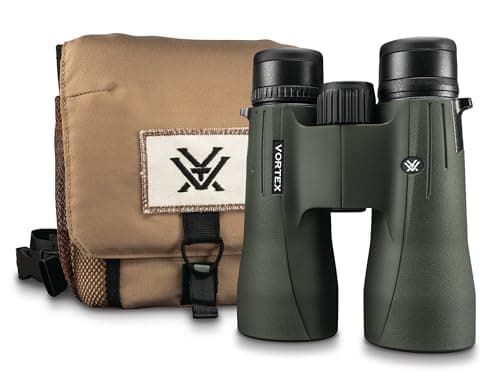
Price as of October 5, 2026. #ad How we earn
Vortex Viper HD 12x50
A 4.17 mm exit pupil and 288 ft of field, which is the trade you make for the extra detail; plan on a tripod, because 12x shows you your own pulse.
| Magnification | 12x |
|---|---|
| Objective lens | 50 mm |
| Eye relief | 16.0mm |
| Field of view | 288' @ 1000 yds |
| Angular field of view | 5.5º |
| Close focus | 8.0' |
| Weight | 28.8 oz. |
| Height | 6.5" |
| Width | 5.2" |
| Exit pupil (computed) | 3.5 mm |
| Twilight factor (computed) | 22.4 |
Specs verified 2026-10-05 from Vortex's published specification. Exit pupil and twilight factor are computed, not quoted.
What it does well
- 12x resolves antler detail a 10x leaves ambiguous
- 50 mm objective keeps the exit pupil close to the 10x42
- Still fits a standard bino harness
Where it gives ground
- Unusable handheld for sustained glassing - tripod required
- 288 ft field makes picking up moving animals harder
Skip it if
You will not carry a tripod. A shaky 12x sees less than a steady 10x.
How this score breaks down
- Low-light performance (weight 5)8.0
- Optical quality per dollar (weight 4)9.0
- Field of view (weight 3)7.0
- Eye relief (weight 3)8.0
- Weight and ergonomics (weight 2)6.5
- Warranty (weight 2)10.0
Weights and definitions are published on how we review. These are editorial judgments from published specs and documented consensus, not test results.
Where the method lands if step 2 was a yes.
Questions people actually ask
What should I look for when buying hunting binoculars?
Does brand matter when buying binoculars?
Should I buy binoculars online or in a shop?
How do I know if binoculars are right for my eyes?
Sources
- Vortex Diamondback HD 8x42 published specifications - read 2026-10-05
- Vortex Viper HD 10x42 published specifications - read 2026-10-05