The two standard answers to this question are both unhelpful. "Spend as much as you can afford" is advice-shaped noise. "Spend as much on glass as on your rifle" is a rule of thumb with no mechanism behind it. Here is a better method: decide what you are fixing.
Start by naming the problem
| What is actually annoying you | What fixes it | What it costs |
|---|---|---|
| They go gray before legal light ends | An 8x42 format change, then better coatings | $239, then $489 |
| I cannot hold them still | Lower magnification, or a tripod | $0 (change format) or $150 (tripod) |
| The edges are soft and mushy | ED glass and better coatings | $250 to $500 |
| They fog up inside | Any gas-purged binocular | $149 |
| I lose the field edge with glasses on | Published eye relief over 17 mm | $239 (8x42) or $499 |
| I cannot judge an animal at 600 yards | More magnification plus a tripod | $370 plus $150 |
| They swing and bang on everything | A harness. Not a binocular. | $29 |
| Nothing - I just want nicer glass | Honestly, nothing needs fixing | Spend it on a tripod instead |
Notice how many rows in that table are not solved by spending more on the same kind of binocular. Two are solved by changing format, one by a $29 harness, two by a tripod. That is the actual answer to how much to spend: often less than you think, on something other than what you were going to buy.
The three tiers, and who belongs in each
Around $250. The right answer for most hunters. If you hunt timber, if your shots are inside 300 yards, if you hunt in reasonable light, this is sufficient and the rest is discretionary. What $250 buys and what it does not.
Around $500. Worth it for a nameable reason: the edges of legal light are where you hunt, or you wear glasses and need the eye relief, or you glass long enough that eye comfort compounds. Those are checkable conditions. If none applies to you, this tier is discretionary too. What $500 buys.
$1,000 and up. Worth it if you already own competent glass and can say specifically what is limiting you, or if you are buying a twenty-year optic and the resale economics work. Not worth it as a first serious binocular. The honest case.
What to do with the money instead
If your budget is $600 and you are about to spend all of it on a binocular, consider this split instead: a $236 Diamondback HD, a $29 harness, a $150 tripod with an adapter, and about $190 towards an angle-compensating rangefinder. That kit will change what you can see and what you can ethically shoot at. A $600 binocular will change how pleasant the view is.
That is not a trick. It is the single most useful piece of advice on this site, and it is why the cross-category kit guides exist alongside the binocular pages.
One binocular per tier
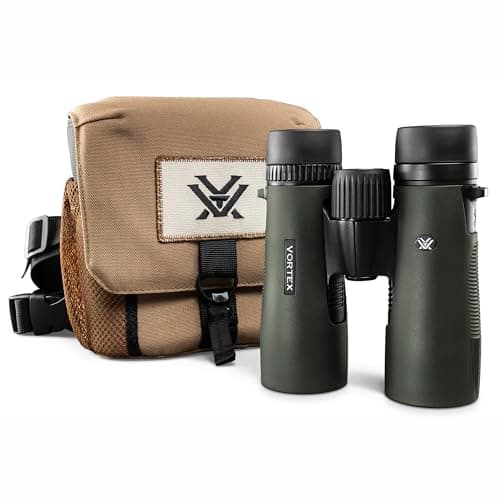
Vortex Diamondback HD 10x42
The honest floor for hunting glass: HD optical system, 330 ft of field and 15 mm of eye relief for about half what the Viper costs.
| Magnification | 10x |
|---|---|
| Objective lens | 42 mm |
| Eye relief | 15 mm |
| Field of view | 330 feet/1000 yards |
| Angular field of view | 6.3 degrees |
| Close focus | 6.7 feet |
| Weight | 21.4 oz |
| Height | 5.8 inches |
| Width | 5.1 inches |
| Exit pupil (computed) | 4.2 mm |
| Twilight factor (computed) | 20.5 |
Specs verified 2026-10-05 from Vortex's published specification. Exit pupil and twilight factor are computed, not quoted.
What it does well
- Genuine HD glass at the $250 tier
- 330 ft field of view matches binoculars costing twice as much
- Same unconditional VIP warranty as the Viper
Where it gives ground
- 15 mm eye relief is tight for some glasses wearers
- Edge sharpness falls off before the Viper's does
Skip it if
You wear glasses and have struggled with eye relief before - try the 8x42, which gives 17 mm.
How this score breaks down
- Low-light performance (weight 5)7.0
- Optical quality per dollar (weight 4)9.5
- Field of view (weight 3)8.5
- Eye relief (weight 3)6.5
- Weight and ergonomics (weight 2)8.0
- Warranty (weight 2)10.0
Weights and definitions are published on how we review. These are editorial judgments from published specs and documented consensus, not test results.
Where the majority of hunters should land, and stop.
Price as of October 5, 2026. #ad How we earn
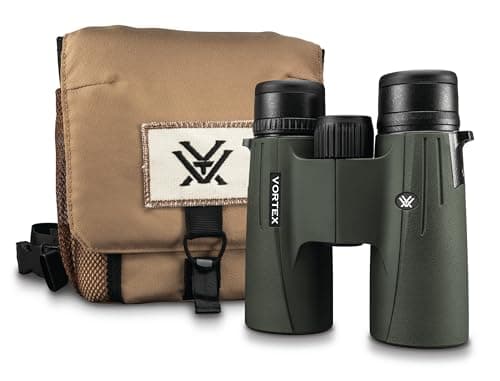
Vortex Viper HD 10x42
The default answer when someone outgrows a $150 pair: 17 mm of eye relief, a 341 ft field of view and glass that holds its edges, at the price where diminishing returns start.
| Magnification | 10x |
|---|---|
| Objective lens | 42 mm |
| Eye relief | 17.0mm |
| Field of view | 341' @ 1000 yds |
| Angular field of view | 6.5º |
| Close focus | 6.0' |
| Weight | 24.9 oz. |
| Height | 5.6" |
| Width | 4.9" |
| Exit pupil (computed) | 4.2 mm |
| Twilight factor (computed) | 20.5 |
Specs verified 2026-10-05 from Vortex's published specification. Exit pupil and twilight factor are computed, not quoted.
What it does well
- 17.0 mm eye relief is generous enough for most glasses wearers
- 341 ft at 1,000 yards is a wide field for a 10x
- Vortex VIP warranty is unconditional and transferable
Where it gives ground
- 24.9 oz is noticeable on a chest harness over a long day
- The 12x50 costs little more if you glass open country
Skip it if
You hunt timber inside 200 yards - the 8x42 Diamondback does that job for less than half the money.
How this score breaks down
- Low-light performance (weight 5)8.5
- Optical quality per dollar (weight 4)9.0
- Field of view (weight 3)9.0
- Eye relief (weight 3)9.0
- Weight and ergonomics (weight 2)7.5
- Warranty (weight 2)10.0
Weights and definitions are published on how we review. These are editorial judgments from published specs and documented consensus, not test results.
The step that is worth it for a specific, nameable reason.
Price as of October 5, 2026. #ad How we earn
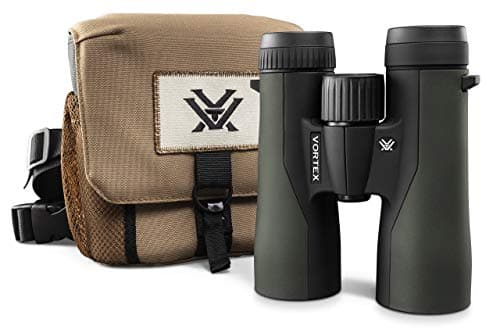
Vortex Crossfire HD 10x42
The entry point: HD glass, 325 ft of field, and the same VIP warranty, for roughly what a decent pair of boots costs.
| Magnification | 10x |
|---|---|
| Objective lens | 42 mm |
| Eye relief | 15.0mm |
| Field of view | 325' @ 1000 yds |
| Angular field of view | 6.2º |
| Close focus | 6.0' |
| Weight | 23.0 oz. |
| Height | 6.0" |
| Width | 5.2" |
| Exit pupil (computed) | 4.2 mm |
| Twilight factor (computed) | 20.5 |
Specs verified 2026-10-05 from Vortex's published specification. Exit pupil and twilight factor are computed, not quoted.
What it does well
- Cheapest Vortex with genuine HD glass
- 325 ft field of view is respectable at this price
- VIP warranty is identical to the $1,800 Razor
Where it gives ground
- Noticeably softer at the edges than the Diamondback HD
- Low-light performance is where the savings show
Skip it if
Your complaint about your current pair is that it grays out early - this will not fix that.
How this score breaks down
- Low-light performance (weight 5)5.5
- Optical quality per dollar (weight 4)9.0
- Field of view (weight 3)7.5
- Eye relief (weight 3)6.5
- Weight and ergonomics (weight 2)8.0
- Warranty (weight 2)10.0
Weights and definitions are published on how we review. These are editorial judgments from published specs and documented consensus, not test results.
Below this, coatings and sealing start failing and the saving stops being a saving.