A Vortex Crossfire HD 10x42 costs about $149. A Swarovski EL 10x42 costs about $1,999. Both have an exit pupil of 4.2 mm, both have a twilight factor of 20.5, and their published fields of view differ by around 20 ft at 1,000 yards. So what is the other $1,850 buying?
Four things, in descending order of how much you notice
1. Light transmission, which is the big one. A binocular has anywhere from eight to a dozen air-to-glass surfaces, and each one reflects away a percentage of the light unless it is coated. Multiply a few percent loss across ten surfaces and the compounding is substantial - this is why a cheap binocular can lose 25-30% of the light entering it while an excellent one loses under 10%. At noon you have more light than you need either way. In the last ten minutes of legal light, that difference is the whole ballgame. This is the single honest answer to why expensive binoculars are expensive.
2. Glass formulation. Extra-low-dispersion elements cut the color fringing around high-contrast edges. Better glass also holds resolution further from the center of the field, which is what people mean by edge-to-edge sharpness. What ED actually means.
3. Prism design and coating. Abbe-Koenig prisms avoid the lossy reflective surface a Schmidt-Pechan needs, and dielectric coatings push reflectivity above 99% where aluminum manages about 88%. These are manufacturing cost differences, not marketing. The prism explainer.
4. Mechanical tolerances and materials. Magnesium rather than polymer; focus mechanisms that stay smooth at 10 below; collimation that survives a decade of being dropped. You do not see this on day one. You see it on year eight.
The shape of the curve
| Step | What you gain | How much you notice it |
|---|---|---|
| $60 to $150 | Working coatings, BaK-4 prisms, real sealing, a warranty | Enormous. This is the only step that is transformative. |
| $150 to $250 | Genuine HD glass, a wider field, better edge performance | Clear and worth it for nearly everyone |
| $250 to $500 | Noticeably better transmission at dusk, 2 mm more eye relief | Real, and worth it if you hunt the edges of light |
| $500 to $1,000 | Premium prisms, better resolution at the top of the range | Small. Visible side by side, rarely decisive in the field. |
| $1,000 to $2,000 | The last increment of resolution, color neutrality, and service | Very small optically. Real for resale and longevity. |
The curve flattens hard after $500. Every honest optics comparison finds the same shape, and the reason is that the cheap fixes - coatings, prism glass, sealing - are cheap, and the remaining improvements are not.
What you are not paying for
- Exit pupil. Fixed by the format. 42 / 10 = 4.2 mm at every price.
- Twilight factor. Also fixed by the format. 20.5 for every 10x42 ever made.
- Magnification accuracy. A $149 10x is genuinely 10x.
- Waterproofing, above about $150. Gas purging and O-ring sealing are cheap and near-universal now.
Where the money is better spent
This is the practical conclusion and it is worth being blunt about. If you are choosing between a $1,150 binocular and a $500 binocular plus a tripod, an adapter and an angle-compensating rangefinder, take the second option. The second combination changes what you can see and what you can ethically shoot at. The first changes how pleasant the view is.
A tripod lets you use magnification you otherwise cannot hold. A rangefinder tells you something a binocular cannot. A harness means the binocular is on your chest rather than in your pack. None of that is true of better glass in the same format. The $1,000 kit page lays out exactly that split.
Three points on the curve
Price as of October 5, 2026. #ad How we earn
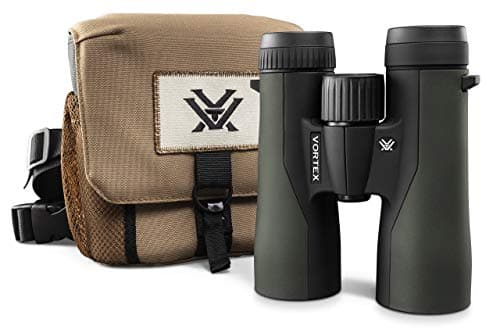
Vortex Crossfire HD 10x42
The entry point: HD glass, 325 ft of field, and the same VIP warranty, for roughly what a decent pair of boots costs.
| Magnification | 10x |
|---|---|
| Objective lens | 42 mm |
| Eye relief | 15.0mm |
| Field of view | 325' @ 1000 yds |
| Angular field of view | 6.2º |
| Close focus | 6.0' |
| Weight | 23.0 oz. |
| Height | 6.0" |
| Width | 5.2" |
| Exit pupil (computed) | 4.2 mm |
| Twilight factor (computed) | 20.5 |
Specs verified 2026-10-05 from Vortex's published specification. Exit pupil and twilight factor are computed, not quoted.
What it does well
- Cheapest Vortex with genuine HD glass
- 325 ft field of view is respectable at this price
- VIP warranty is identical to the $1,800 Razor
Where it gives ground
- Noticeably softer at the edges than the Diamondback HD
- Low-light performance is where the savings show
Skip it if
Your complaint about your current pair is that it grays out early - this will not fix that.
How this score breaks down
- Low-light performance (weight 5)5.5
- Optical quality per dollar (weight 4)9.0
- Field of view (weight 3)7.5
- Eye relief (weight 3)6.5
- Weight and ergonomics (weight 2)8.0
- Warranty (weight 2)10.0
Weights and definitions are published on how we review. These are editorial judgments from published specs and documented consensus, not test results.
The starting point of the curve.
Price as of October 5, 2026. #ad How we earn
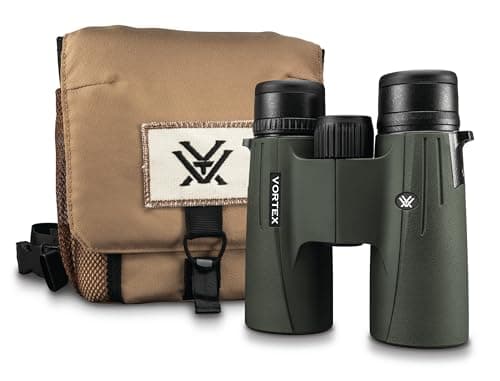
Vortex Viper HD 10x42
The default answer when someone outgrows a $150 pair: 17 mm of eye relief, a 341 ft field of view and glass that holds its edges, at the price where diminishing returns start.
| Magnification | 10x |
|---|---|
| Objective lens | 42 mm |
| Eye relief | 17.0mm |
| Field of view | 341' @ 1000 yds |
| Angular field of view | 6.5º |
| Close focus | 6.0' |
| Weight | 24.9 oz. |
| Height | 5.6" |
| Width | 4.9" |
| Exit pupil (computed) | 4.2 mm |
| Twilight factor (computed) | 20.5 |
Specs verified 2026-10-05 from Vortex's published specification. Exit pupil and twilight factor are computed, not quoted.
What it does well
- 17.0 mm eye relief is generous enough for most glasses wearers
- 341 ft at 1,000 yards is a wide field for a 10x
- Vortex VIP warranty is unconditional and transferable
Where it gives ground
- 24.9 oz is noticeable on a chest harness over a long day
- The 12x50 costs little more if you glass open country
Skip it if
You hunt timber inside 200 yards - the 8x42 Diamondback does that job for less than half the money.
How this score breaks down
- Low-light performance (weight 5)8.5
- Optical quality per dollar (weight 4)9.0
- Field of view (weight 3)9.0
- Eye relief (weight 3)9.0
- Weight and ergonomics (weight 2)7.5
- Warranty (weight 2)10.0
Weights and definitions are published on how we review. These are editorial judgments from published specs and documented consensus, not test results.
The point this site keeps arriving at, because it is where price and performance cross.
Price as of October 5, 2026. #ad How we earn
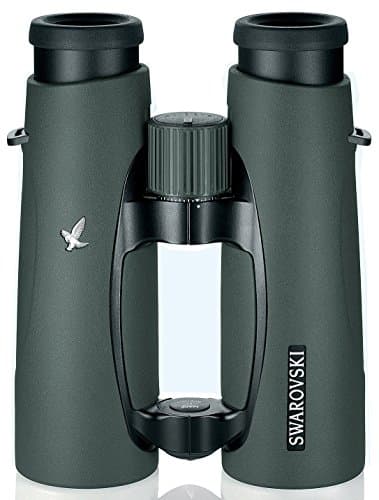
Swarovski EL 10x42
The binocular every other entry here is implicitly measured against; worth understanding even if it is not worth buying for most hunters.
| Magnification | 10x |
|---|---|
| Objective lens | 42 mm |
| Exit pupil (computed) | 4.2 mm |
| Twilight factor (computed) | 20.5 |
Magnification and objective are the manufacturer's own model designation; exit pupil and twilight factor are computed from them. We could not machine-read Swarovski's spec page, so the remaining published figures are not listed rather than guessed.
What it does well
- Optical performance remains the category reference
- Field service and parts support are unmatched
- Holds resale value better than anything else here
Where it gives ground
- Costs roughly eight Diamondback HDs
- The last 10% of performance is where the money goes
Skip it if
You are upgrading from a cheap pair. The jump you already made is bigger than this one.
How this score breaks down
- Low-light performance (weight 5)10.0
- Optical quality per dollar (weight 4)5.5
- Field of view (weight 3)9.0
- Eye relief (weight 3)9.0
- Weight and ergonomics (weight 2)9.5
- Warranty (weight 2)9.5
Weights and definitions are published on how we review. These are editorial judgments from published specs and documented consensus, not test results.
Included so the top of the curve is visible, not as a recommendation. Same 4.20 mm exit pupil as the $149 pair above.
Questions people actually ask
Why are good binoculars so expensive?
Are $2,000 binoculars worth it?
What is the sweet spot for hunting binocular price?
Do expensive binoculars last longer?
Sources
- Vortex Crossfire HD 10x42 published specifications - read 2026-10-05
- Vortex Razor UHD 10x42 published specifications - read 2026-10-05