We earn a commission if you buy through the links on this page, at no extra cost to you. It never changes which products we pick or how we rank them - read the full disclosure.
Reviewed here
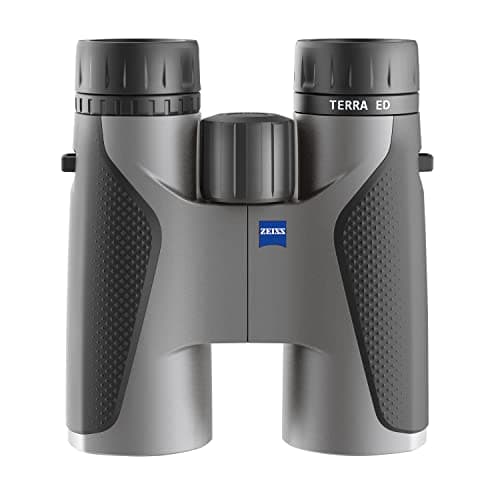
Zeiss Terra ED 10x42
Zeiss coatings and SCHOTT ED glass in the brand's entry line, which is the cheapest way to get a Zeiss view.
The Terra ED exists so that Zeiss has something to sell below its real binoculars, and it is a more interesting product than that makes it sound - because Zeiss does something here almost no competitor does at this price. It prints a transmission number.
What Zeiss publishes
Read from Zeiss's own product page on 2026-10-05: 10x magnification, 42 mm lens diameter, 4.2 mm exit pupil, twilight factor 20.5, 110 m (330 ft) field of view at 1,000, 60 degrees angular field of view, 1.6 m (5.3 ft) close focusing distance, 14.0 mm exit pupil distance, 58-76 mm interpupillary distance, 88 percent light transmission, LotuTec coating, nitrogen filled, 100 mbar water resistance, 142 mm (5.6 in) long, 725 g (25.6 oz).
Two of those figures we can also derive ourselves, which is a useful check: exit pupil is 42 / 10 = 4.2 mm, and twilight factor is the square root of 10 x 42, which is 20.5. Zeiss's published numbers match the arithmetic exactly. Those two numbers are identical on every 10x42 made, cheap or alpha, which is the first thing to understand before reading any binocular review. (Why, in full.)
The 88 percent is the reason to consider it
Light transmission is the specification that decides last light, and it is the one the industry mostly keeps to itself. Out of every binocular on this site, two makers publish it: Maven and Zeiss. The rest list coatings - phase correction, dielectric prism coatings, fully multi-coated - which describe intent rather than a result.
88 percent is a credible and good figure for a binocular in this class. For scale, alpha glass is generally claimed in the low-to-mid 90s, and Maven publishes 93.95 percent for its B1.2 - at two to three times the price. The Terra ED is therefore doing the thing people buy European glass for, at the bottom of the European price ladder, with a number attached.
What the number does not tell you is edge sharpness, color neutrality or how the image holds up against the sun. Transmission is one axis of optical quality. The Terra ED is a Schmidt-Pechan design with a modest field, and side by side against a Conquest HDX - Zeiss's own next step up - the difference is not transmission, it is resolution across the field.
The 14.0 mm of eye relief is the reason most people should not buy it
This is the single most important sentence in this review: if you wear glasses, do not buy this binocular. 14.0 mm of exit pupil distance is short. Under roughly 15 mm, a glasses wearer cannot get their eye close enough to see the whole field, and the 330 ft you paid for arrives as a vignetted circle inside a black ring.
The comparison is stark at the same money. Vortex publishes 17.0 mm for the Viper HD 10x42 and 15 mm for the much cheaper Diamondback HD. Nikon publishes 16.5 mm for the Monarch M7 10x42. Leupold publishes 17 mm for the BX-4 Pro Guide HD Gen 2 10x42. The Terra ED is last in its class on this specification by 1.5 to 3 mm, and eye relief is the one number where being last is felt immediately rather than at dusk.
Without glasses, 14.0 mm is usable and the complaint disappears. That is why this review's recommendation splits so sharply on one question rather than on price.
Field of view: the other place it trails
330 ft at 1,000 yards is narrow for the class. The Monarch M7 10x42 publishes 362 ft and the Viper HD 341 ft, both read on 2026-10-05. 32 ft is roughly a tenth of the view, and in practice it means more passes to sweep the same hillside. On a tripod, glassing methodically, this matters less than it sounds. Offhand, scanning quickly, it is the difference you notice first.
In its favor: 25.6 oz and 5.6 in make it compact and light for a 42 mm, the 5.3 ft close focus is shorter than most hunting-first designs, and the fiberglass-reinforced body is nitrogen filled and rated to 100 mbar. It is a pleasant binocular to carry, which is not nothing on day five.
Warranty, which is where the brand stops helping
Zeiss covers the Terra line under a limited warranty rather than the unconditional, no-questions, transferable cover that Vortex VIP and Leupold's Guaranteed for Life provide. For an optic whose life can end with one fall off a rock, that difference is worth real money - and it visibly supports used prices on the American brands. Check Zeiss's current terms before you buy, because they vary by region and have changed over time.
Who should buy it, and who should not
- Buy it if you do not wear glasses behind binoculars, you glass at dawn and dusk more than midday, and a published transmission figure is the kind of evidence you want to buy on.
- Buy the Viper HD instead if you wear glasses, want the wider field, or want warranty cover you will never argue about. For most hunters this is the right answer.
- Buy the Monarch M7 instead if field of view is your priority - 362 ft against 330 ft, for similar money.
- Buy the Diamondback HD instead if the budget is the constraint. It is most of this binocular for considerably less, with a better warranty and 1 mm more eye relief.
- Step up to a Conquest HDX instead if you want the Zeiss view rather than the Zeiss badge. The Terra is the entry line and it is honest about that.
This binocular and its two closest alternatives
Zeiss Terra ED 10x42
Zeiss coatings and SCHOTT ED glass in the brand's entry line, which is the cheapest way to get a Zeiss view.
| Magnification | 10 x |
|---|---|
| Objective lens | 42 mm |
| Eye relief (exit pupil distance) | 14.0 mm |
| Field of view | 110 m (330 ft) @ 1,000 |
| Angular field of view | 60° |
| Close focus | 1.6 m (5.3 ft) |
| Light transmission | 88 % |
| Weight | 725 g (25.6 oz) |
| Length | 142 mm (5.6 in) |
| Interpupillary distance | 58 - 76 mm |
| Exit pupil (computed) | 4.2 mm |
| Twilight factor (published and computed) | 20.5 |
Specs verified 2026-10-05 from Zeiss's published specification. Exit pupil and twilight factor are computed, not quoted.
What it does well
- SCHOTT ED glass with Zeiss multicoating
- Compact and light for a 42 mm
- Excellent contrast in flat light
Where it gives ground
- Built in China, not Germany, and priced accordingly
- Narrower field than the Japanese competition
- 14.0 mm of eye relief is the shortest in this price class
Skip it if
Field of view is your priority - the Monarch M7 gives you more of it.
How this score breaks down
- Low-light performance (weight 5)8.5
- Optical quality per dollar (weight 4)8.0
- Field of view (weight 3)7.0
- Eye relief (weight 3)5.0
- Weight and ergonomics (weight 2)9.0
- Warranty (weight 2)7.0
Weights and definitions are published on how we review. These are editorial judgments from published specs and documented consensus, not test results.
Zeiss publishes 88 percent light transmission for this binocular. Almost nobody in this price class publishes transmission at all, so the figure is the most useful thing about the Terra ED - and it is a good one for a binocular at this money. What comes with it is 330 ft of field and 14.0 mm of exit pupil distance, both from the same table (read 2026-10-05).
Price as of October 5, 2026. #ad How we earn
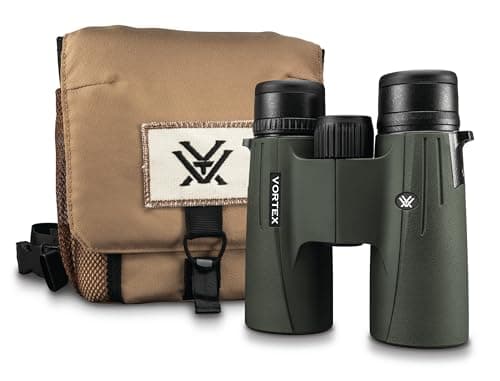
Vortex Viper HD 10x42
The default answer when someone outgrows a $150 pair: 17 mm of eye relief, a 341 ft field of view and glass that holds its edges, at the price where diminishing returns start.
| Magnification | 10x |
|---|---|
| Objective lens | 42 mm |
| Eye relief | 17.0mm |
| Field of view | 341' @ 1000 yds |
| Angular field of view | 6.5º |
| Close focus | 6.0' |
| Weight | 24.9 oz. |
| Height | 5.6" |
| Width | 4.9" |
| Exit pupil (computed) | 4.2 mm |
| Twilight factor (computed) | 20.5 |
Specs verified 2026-10-05 from Vortex's published specification. Exit pupil and twilight factor are computed, not quoted.
What it does well
- 17.0 mm eye relief is generous enough for most glasses wearers
- 341 ft at 1,000 yards is a wide field for a 10x
- Vortex VIP warranty is unconditional and transferable
Where it gives ground
- 24.9 oz is noticeable on a chest harness over a long day
- The 12x50 costs little more if you glass open country
Skip it if
You hunt timber inside 200 yards - the 8x42 Diamondback does that job for less than half the money.
How this score breaks down
- Low-light performance (weight 5)8.5
- Optical quality per dollar (weight 4)9.0
- Field of view (weight 3)9.0
- Eye relief (weight 3)9.0
- Weight and ergonomics (weight 2)7.5
- Warranty (weight 2)10.0
Weights and definitions are published on how we review. These are editorial judgments from published specs and documented consensus, not test results.
11 ft more field, 3 mm more eye relief, and a warranty that needs no receipt and transfers to the next owner. Vortex does not publish a transmission percentage, so you are trading a known number for a better-specified everything else. The full review.
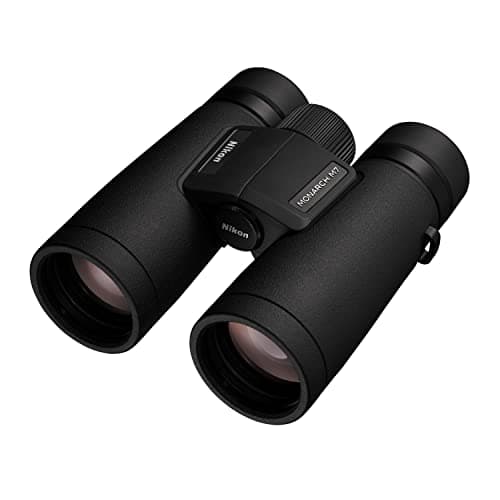
Nikon Monarch M7 10x42
The M5 with a wider field and better coatings; the strongest argument against the Viper HD at a slightly lower price.
| Magnification | 10x |
|---|---|
| Objective lens | 42 mm |
| Eye relief | 16.5 mm |
| Field of view | 362 ft @ 1,000 yd |
| Real angular field of view | 6.9° |
| Apparent field of view | 62.2° |
| Close focus | 8.2 ft |
| Weight | 24.0 oz |
| Length | 5.6 in |
| Width | 5.1 in |
| Exit pupil (computed) | 4.2 mm |
| Twilight factor (computed) | 20.5 |
Specs verified 2026-10-05 from Nikon's published specification. Exit pupil and twilight factor are computed, not quoted.
What it does well
- Wider field of view than the M5 and most 10x42s at this price
- ED glass with improved multicoating
- Comfortable eye relief for glasses wearers
Where it gives ground
- No unconditional transferable warranty
- Focus wheel has more travel than some will like
Skip it if
Warranty matters more to you than optics - Vortex VIP is the better long-term bet.
How this score breaks down
- Low-light performance (weight 5)8.5
- Optical quality per dollar (weight 4)8.5
- Field of view (weight 3)9.5
- Eye relief (weight 3)8.5
- Weight and ergonomics (weight 2)8.5
- Warranty (weight 2)6.5
Weights and definitions are published on how we review. These are editorial judgments from published specs and documented consensus, not test results.
32 ft wider than the Terra ED and 2.5 mm more eye relief, with ED glass of its own. Nikon's warranty is limited rather than unconditional, which is the trade. How it compares with the Viper HD.
Questions people actually ask
Is the Zeiss Terra ED worth it?
Is the Zeiss Terra ED made in Germany?
Zeiss Terra ED 10x42 or Vortex Viper HD 10x42?
What is the eye relief on the Zeiss Terra ED 10x42?
What is the twilight factor of the Zeiss Terra ED 10x42?
Sources
- ZEISS Terra ED 10x42 published technical data - read 2026-10-05
- Vortex Viper HD 10x42 published specifications - read 2026-10-05
- Nikon MONARCH M7 published specification table - read 2026-10-05
- Maven B1.2 published specification table - read 2026-10-05