We earn a commission if you buy through the links on this page, at no extra cost to you. It never changes which products we pick or how we rank them - read the full disclosure.
Our top pick
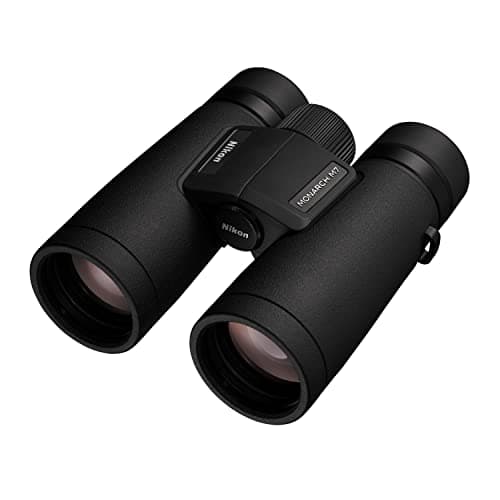
Nikon Monarch M7 10x42
The M5 with a wider field and better coatings; the strongest argument against the Viper HD at a slightly lower price.
These two land on the same shortlist constantly, because they sit close in price and both are the sensible step up from a first pair. The published specifications separate them more cleanly than most comparisons at this price - and they separate on different axes, so the answer depends on one question about you rather than on which binocular is better.
The published figures, side by side
| Specification | Monarch M7 10x42 | Viper HD 10x42 | Advantage |
|---|---|---|---|
| Field of view at 1,000 yd | 362 ft | 341 ft | Nikon, by 21 ft |
| Real angular field | 6.9° | 6.5° | Nikon |
| Eye relief | 16.5 mm | 17.0 mm | Vortex, by 0.5 mm |
| Close focus | 8.2 ft | 6.0 ft | Vortex, by 2.2 ft |
| Weight | 24.0 oz | 24.9 oz | Nikon, by 0.9 oz |
| Exit pupil (computed) | 4.2 mm | 4.2 mm | Identical - it is arithmetic |
| Twilight factor (computed) | 20.5 | 20.5 | Identical |
| Warranty | Limited | Unconditional, transferable | Vortex, decisively |
Exit pupil is objective divided by magnification and twilight factor is the square root of magnification times objective, so both are fixed by the format rather than by the price or the brand.
| Specification | Monarch M7 8x42 | Viper HD 8x42 | Advantage |
|---|---|---|---|
| Field of view at 1,000 yd | 435 ft | 409 ft | Nikon, by 26 ft |
| Real angular field | 8.3° | 7.8° | Nikon |
| Eye relief | 17.1 mm | 18.0 mm | Vortex, by 0.9 mm |
| Close focus | 8.2 ft | 6.0 ft | Vortex |
| Weight | 23.6 oz | 24.5 oz | Nikon |
| Exit pupil | 5.3 mm published | 5.25 mm computed | Same figure, rounded differently |
The 8x42 comparison runs the same way as the 10x42 and with a wider margin on field of view. If you are choosing the format as well as the model, start with the 8x42 vs 10x42 question - it changes more than the brand does.
What the Nikon wins, and how much it is worth
Field of view, by a real margin. 21 ft in the 10x42 and 26 ft in the 8x42 is the largest difference between these two binoculars, and field of view is the specification that does the most work in hunting. The job is usually finding the animal, not studying it. A wider field means fewer sweeps to cover the same hillside and less chance of passing over a bedded deer in shadow.
Weight, marginally. 0.9 oz is not a reason to choose a binocular on its own. Over a long day on a harness with a rangefinder alongside it, it is also not nothing. If you are already carrying as much as you want to carry, the Nikon is the lighter half of this decision.
Apparent field of view. Nikon publishes 62.2 degrees apparent on the 10x42. That number is the perceptual version of field of view - how wide the view feels rather than how much ground it covers - and Nikon's eyepiece design is genuinely good at it. It is also the figure most reviews are reacting to when they describe the M7 as immersive.
What the Vortex wins, and why it decides most purchases
Warranty, and this is the whole argument. Vortex VIP is unconditional, requires no receipt, needs no registration and transfers to whoever owns the binocular next. It does not matter whose fault the damage was. Nikon's cover is a limited warranty against defects. On an optic whose working life can end with one fall onto rock, that is a difference you can price: it shows up directly in used values, and it is the reason a used Viper HD holds its money better than a used M7.
Close focus, by 2.2 ft. 6.0 ft against 8.2 ft sounds like a birdwatcher's concern and mostly is. It matters if you also use your binocular for anything other than game.
Eye relief, barely. 17.0 mm against 16.5 mm is within the noise - both are comfortable with glasses, and anyone who tells you half a millimeter is decisive is reaching. In the 8x42 the gap widens to 0.9 mm, still in the Vortex's favor and still small.
Where neither one wins
Both are 42 mm binoculars, so in the same format they have the identical exit pupil and the identical twilight factor - 4.2 mm and 20.5 in the 10x42. Neither gathers more light than the other. Any claim that one of these is brighter has to be a claim about transmission through glass and coatings, and neither Nikon nor Vortex publishes a transmission percentage for these models. That is the honest limit of this comparison: the single specification that would settle the last-ten-minutes question is not published by either maker.
Both use ED or HD-marketed extra-low-dispersion glass, both are phase corrected, both are nitrogen purged and waterproof, and both are made to a standard that does not fail in ordinary weather. Nikon publishes its waterproof rating as 1 m for 10 minutes; Vortex describes the Viper HD as waterproof and fogproof without a stated immersion figure. (What ED and HD glass actually mean.)
The decision, in one question
Do you hunt hard enough on your gear that you can imagine needing the warranty? If yes, buy the Viper HD and accept 21 ft less field. If no - if your binocular lives in a harness and you are careful with it - the Monarch M7 gives you the better view of the two for about the same money, and the warranty you are giving up is one you were never going to use.
One thing that is not a tiebreaker: price. These two trade places month to month depending on rebates and street pricing, and the gap is usually smaller than the value of either one's advantage. Check both current prices before deciding, because it sometimes inverts.
Both binoculars, with current prices
Nikon Monarch M7 10x42
The M5 with a wider field and better coatings; the strongest argument against the Viper HD at a slightly lower price.
| Magnification | 10x |
|---|---|
| Objective lens | 42 mm |
| Eye relief | 16.5 mm |
| Field of view | 362 ft @ 1,000 yd |
| Real angular field of view | 6.9° |
| Apparent field of view | 62.2° |
| Close focus | 8.2 ft |
| Weight | 24.0 oz |
| Length | 5.6 in |
| Width | 5.1 in |
| Exit pupil (computed) | 4.2 mm |
| Twilight factor (computed) | 20.5 |
Specs verified 2026-10-05 from Nikon's published specification. Exit pupil and twilight factor are computed, not quoted.
What it does well
- Wider field of view than the M5 and most 10x42s at this price
- ED glass with improved multicoating
- Comfortable eye relief for glasses wearers
Where it gives ground
- No unconditional transferable warranty
- Focus wheel has more travel than some will like
Skip it if
Warranty matters more to you than optics - Vortex VIP is the better long-term bet.
How this score breaks down
- Low-light performance (weight 5)8.5
- Optical quality per dollar (weight 4)8.5
- Field of view (weight 3)9.5
- Eye relief (weight 3)8.5
- Weight and ergonomics (weight 2)9.0
- Warranty (weight 2)6.5
Weights and definitions are published on how we review. These are editorial judgments from published specs and documented consensus, not test results.
Nikon publishes 362 ft at 1,000 yards, 6.9 degrees real field, 62.2 degrees apparent field, 16.5 mm eye relief and 24.0 oz for the 10x42 (read 2026-10-05). That is 21 ft more field and nearly an ounce less weight than the Viper HD.
Price as of October 5, 2026. #ad How we earn
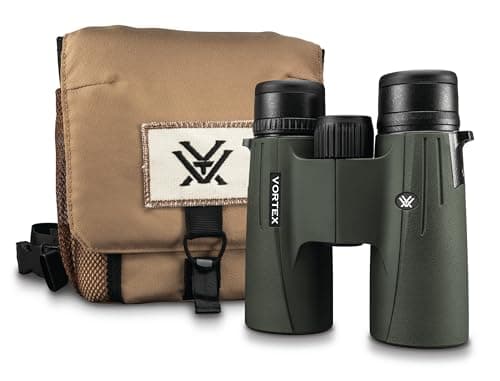
Vortex Viper HD 10x42
The default answer when someone outgrows a $150 pair: 17 mm of eye relief, a 341 ft field of view and glass that holds its edges, at the price where diminishing returns start.
| Magnification | 10x |
|---|---|
| Objective lens | 42 mm |
| Eye relief | 17.0mm |
| Field of view | 341' @ 1000 yds |
| Angular field of view | 6.5º |
| Close focus | 6.0' |
| Weight | 24.9 oz. |
| Height | 5.6" |
| Width | 4.9" |
| Exit pupil (computed) | 4.2 mm |
| Twilight factor (computed) | 20.5 |
Specs verified 2026-10-05 from Vortex's published specification. Exit pupil and twilight factor are computed, not quoted.
What it does well
- 17.0 mm eye relief is generous enough for most glasses wearers
- 341 ft at 1,000 yards is a wide field for a 10x
- Vortex VIP warranty is unconditional and transferable
Where it gives ground
- 24.9 oz is noticeable on a chest harness over a long day
- The 12x50 costs little more if you glass open country
Skip it if
You hunt timber inside 200 yards - the 8x42 Diamondback does that job for less than half the money.
How this score breaks down
- Low-light performance (weight 5)8.5
- Optical quality per dollar (weight 4)9.0
- Field of view (weight 3)9.0
- Eye relief (weight 3)9.0
- Weight and ergonomics (weight 2)7.5
- Warranty (weight 2)10.0
Weights and definitions are published on how we review. These are editorial judgments from published specs and documented consensus, not test results.
Vortex publishes 341 ft, 17.0 mm of eye relief, 6.0 ft close focus and 24.9 oz (read 2026-10-05). Half a millimeter of eye relief is trivial; the unconditional, receipt-free, transferable VIP warranty is not.
Questions people actually ask
Is the Nikon Monarch M7 better than the Vortex Viper HD?
Does the Nikon Monarch M7 have a lifetime warranty?
Monarch M7 or Viper HD for low light?
Which has the wider field of view, the Monarch M7 or the Viper HD?
Are they close enough that price should decide?
Sources
- Nikon MONARCH M7 8x42 / 10x42 published specification table - read 2026-10-05
- Vortex Viper HD 10x42 published specifications - read 2026-10-05
- Vortex Viper HD 8x42 published specifications - read 2026-10-05