These two abbreviations appear on nearly every binocular listing and only one of them has a fixed technical meaning. That asymmetry is worth understanding before you pay for a label.
ED is a specification
ED means extra-low dispersion. It refers to glass formulated so that different wavelengths of light bend by more similar amounts as they pass through it. Ordinary glass disperses light slightly like a prism does, so red, green and blue focus at marginally different points - and the result is a colored fringe around high-contrast edges. That is chromatic aberration.
You see it as a purple or green halo around a dark branch against bright sky, or around a dark animal against snow. It is at its worst exactly where you are trying hardest to read detail, and it gets worse with magnification. ED glass reduces it. That is a real, physical, describable effect.
HD is a marketing label
HD means whatever the brand that printed it decided it means. There is no standard, no threshold and no certifying body. In practice most brands use it to indicate a higher tier within their own range, and most implementations do involve better glass - often including ED elements.
Some brands are specific. Vortex describes its HD optical system as using selected glass elements to cut chromatic aberration and improve resolution, which is a meaningful claim. Others print HD on a product line and leave you to guess. The useful move is to ignore the label and look for what the specification actually says.
| Term | Standardized | What it describes | Trust it? |
|---|---|---|---|
| ED | Yes, as a glass type | Extra-low-dispersion elements that reduce color fringing | Yes |
| HD | No | A brand's higher tier. Usually better glass, sometimes ED | Read the detail |
| UHD | No | A brand's highest tier. Marketing escalation of HD | Read the detail |
| Fully multi-coated | Effectively yes | Every air-to-glass surface has multiple coating layers | Yes - and check for it |
| Phase corrected | Yes | A roof-prism coating that recovers resolution and contrast | Yes |
| Dielectric prism coating | Yes | A high-reflectivity prism coating that raises transmission | Yes |
The last three rows are more useful than the first three. Coating specifications are standardized and they describe transmission, which is what you are actually buying above $300.
When the difference is visible
ED glass earns its keep in specific conditions, and it is worth knowing which so you can judge whether you are in them:
- High contrast. Dark animal against snow, bare branches against bright overcast, a ridge line against sunrise.
- Higher magnification. Chromatic aberration scales with magnification, so it matters more at 12x and 15x than at 8x.
- Long sessions. Fringing contributes to eye fatigue in a way most people do not consciously notice until it is absent.
When it matters less: close range, flat even light, low magnification, short looks. A bowhunter at 30 yards in timber is in the least ED-sensitive situation there is.
What to prioritize instead
If you are choosing between two binoculars at the same price and one says ED while the other says HD, look past both labels at: published field of view, published eye relief, whether the coatings are described as fully multi-coated and dielectric, whether the prism is phase corrected, and the warranty. Those five tell you more than the glass label does.
Three binoculars that illustrate the point
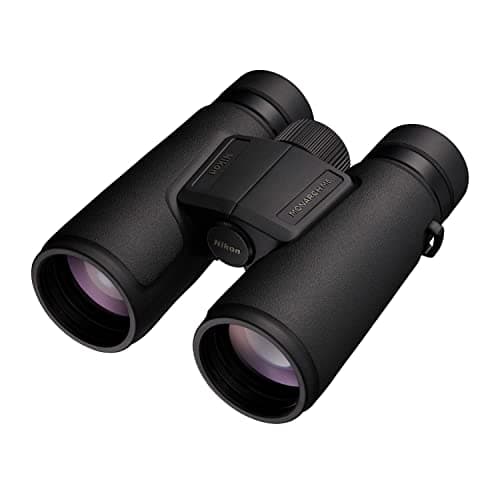
Nikon Monarch M5 10x42
ED glass and a long, comfortable eyecup at a price that undercuts most ED-glass competition, with Nikon's usual unfussy ergonomics.
| Magnification | 10x |
|---|---|
| Objective lens | 42 mm |
| Exit pupil (computed) | 4.2 mm |
| Twilight factor (computed) | 20.5 |
Magnification and objective are the manufacturer's own model designation; exit pupil and twilight factor are computed from them. We could not machine-read Nikon's spec page, so the remaining published figures are not listed rather than guessed.
What it does well
- ED glass at the $250 tier is unusual
- Light in the hand for a 42 mm
- Locking diopter holds its setting
Where it gives ground
- Field of view is narrower than the Diamondback HD
- Nikon's US warranty terms are less generous than Vortex VIP
Skip it if
You want the widest possible field for finding moving animals in cover.
How this score breaks down
- Low-light performance (weight 5)7.5
- Optical quality per dollar (weight 4)9.0
- Field of view (weight 3)7.5
- Eye relief (weight 3)8.0
- Weight and ergonomics (weight 2)9.0
- Warranty (weight 2)6.5
Weights and definitions are published on how we review. These are editorial judgments from published specs and documented consensus, not test results.
ED at this price is the whole reason this binocular is interesting.
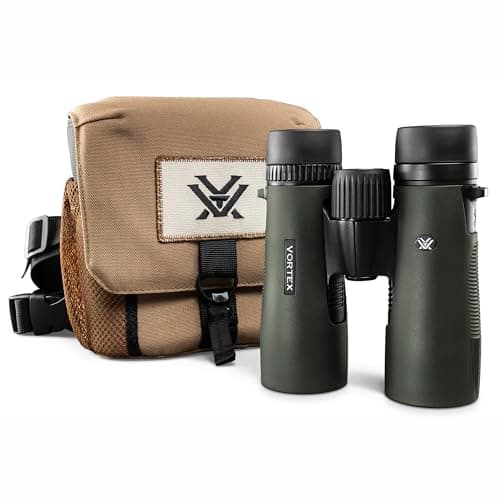
Vortex Diamondback HD 10x42
The honest floor for hunting glass: HD optical system, 330 ft of field and 15 mm of eye relief for about half what the Viper costs.
| Magnification | 10x |
|---|---|
| Objective lens | 42 mm |
| Eye relief | 15 mm |
| Field of view | 330 feet/1000 yards |
| Angular field of view | 6.3 degrees |
| Close focus | 6.7 feet |
| Weight | 21.4 oz |
| Height | 5.8 inches |
| Width | 5.1 inches |
| Exit pupil (computed) | 4.2 mm |
| Twilight factor (computed) | 20.5 |
Specs verified 2026-10-05 from Vortex's published specification. Exit pupil and twilight factor are computed, not quoted.
What it does well
- Genuine HD glass at the $250 tier
- 330 ft field of view matches binoculars costing twice as much
- Same unconditional VIP warranty as the Viper
Where it gives ground
- 15 mm eye relief is tight for some glasses wearers
- Edge sharpness falls off before the Viper's does
Skip it if
You wear glasses and have struggled with eye relief before - try the 8x42, which gives 17 mm.
How this score breaks down
- Low-light performance (weight 5)7.0
- Optical quality per dollar (weight 4)9.5
- Field of view (weight 3)8.5
- Eye relief (weight 3)6.5
- Weight and ergonomics (weight 2)8.0
- Warranty (weight 2)10.0
Weights and definitions are published on how we review. These are editorial judgments from published specs and documented consensus, not test results.
Vortex is specific about what its HD label covers - selected glass elements to cut chromatic aberration - which is more than many brands offer.
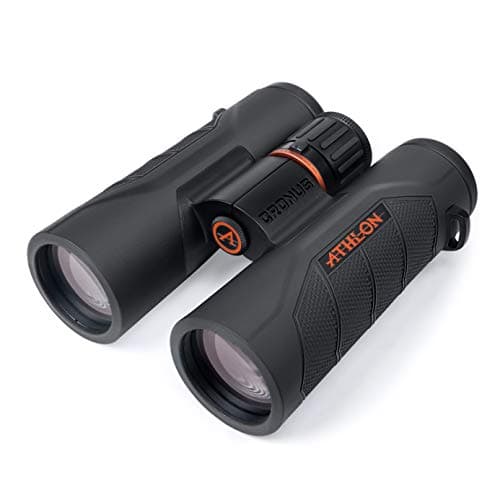
Price as of October 5, 2026. #ad How we earn
Athlon Cronus G2 UHD 10x42
UHD glass with Abbe-Koenig prisms at roughly half what comparable prism designs cost elsewhere - the clearest value argument above $500.
| Magnification | 10x |
|---|---|
| Objective lens | 42 mm |
| Exit pupil (computed) | 4.2 mm |
| Twilight factor (computed) | 20.5 |
Magnification and objective are the manufacturer's own model designation; exit pupil and twilight factor are computed from them. We could not machine-read Athlon's spec page, so the remaining published figures are not listed rather than guessed.
What it does well
- Abbe-Koenig prisms, normally a $1,000-plus feature
- UHD glass controls chromatic aberration well
- Long eye relief
Where it gives ground
- Heavier than the Viper HD
- Brand carries less weight on resale
Skip it if
You will only ever glass in good light. The money buys you edge-of-legal-light performance.
How this score breaks down
- Low-light performance (weight 5)9.0
- Optical quality per dollar (weight 4)9.5
- Field of view (weight 3)8.5
- Eye relief (weight 3)9.0
- Weight and ergonomics (weight 2)7.0
- Warranty (weight 2)8.5
Weights and definitions are published on how we review. These are editorial judgments from published specs and documented consensus, not test results.
A reminder that the prism design often matters more for transmission than the glass label does.