Binoculars need prisms because the objective lens produces an upside-down, left-right reversed image, and something has to flip it. There are two ways to do it, and the one that is optically better is not the one almost anyone sells for hunting.
Porro prisms: better optics, wrong shape
A porro prism uses two right-angle prisms set perpendicular to each other, which is why porro binoculars have that offset, stepped silhouette - the objectives sit wider apart than the eyepieces.
Optically this is the better arrangement, for a specific reason: the light path relies entirely on total internal reflection, which loses essentially nothing. A roof prism design has one surface where the angle is too shallow for total internal reflection, so it needs a reflective coating - and every coating, however good, loses some light.
The offset also produces slightly better depth perception, because the objectives are further apart than your eyes. A well-made porro binocular at $200 can outperform a roof prism at $350.
Roof prisms: worse optics, right shape
A roof prism folds the light path along a single axis, which lets the objective and eyepiece sit in a straight line. That produces the slim, straight-barrelled shape that fits a bino harness, packs flat and handles well one-handed.
That shape is why hunting binoculars are roof prisms, and it is a genuinely good reason. A porro binocular is bulkier at the same objective size, more awkward on a chest harness, and harder to seal against water because of the more complex internal geometry.
The two coatings roof prisms need
Because the roof design starts at an optical disadvantage, two specific coatings exist to claw it back. Check for both - a roof prism binocular without them is genuinely worse than a decent porro.
- Phase correction. The roof edge splits the light beam and the two halves come back slightly out of phase, which costs resolution and contrast. A phase-correction coating realigns them. Any serious roof-prism hunting binocular has this.
- Dielectric prism coating. The reflective surface the roof design needs can be coated with aluminum (about 88% reflective), silver (about 95%) or a dielectric stack (over 99%). Dielectric is substantially better and the difference compounds across multiple reflections.
| Porro | Roof (Schmidt-Pechan) | Roof (Abbe-Koenig) | |
|---|---|---|---|
| Light loss at the prism | Minimal - total internal reflection | Needs a reflective coating | Minimal - total internal reflection |
| Shape | Offset, bulky | Straight, slim | Straight but longer |
| Optics per dollar | Best | Worst | Good, but expensive to make |
| Needs phase correction | No | Yes | Yes |
| Sealing against water | Harder | Easier | Easier |
| Common in hunting | Rare | Almost universal | Premium models only |
What this means when you are buying
For hunting, buy a roof prism - the shape matters more than the few percent of transmission. But use the knowledge: check that it is phase corrected and dielectric coated, because those two lines on a spec sheet tell you more about low-light performance than the words HD or ED do. And if you see Abbe-Koenig prisms at a price you can afford, that is a genuine optical advantage rather than a label. Which is why the Cronus G2 UHD keeps appearing on this site.
Porro binoculars still make sense for one use: glassing from a fixed position where bulk does not matter and budget does. If you want maximum optics for $200 and will keep them in a truck, a good porro is an underrated answer.
Three binoculars that show the prism differences
Price as of October 5, 2026. #ad How we earn
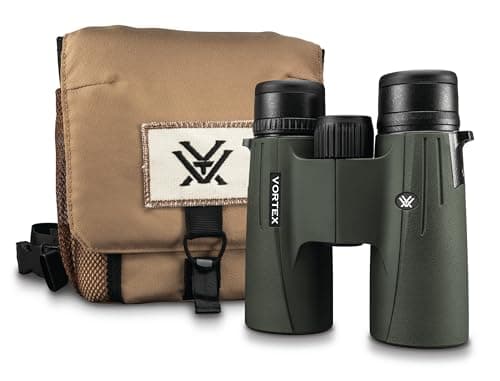
Vortex Viper HD 10x42
The default answer when someone outgrows a $150 pair: 17 mm of eye relief, a 341 ft field of view and glass that holds its edges, at the price where diminishing returns start.
| Magnification | 10x |
|---|---|
| Objective lens | 42 mm |
| Eye relief | 17.0mm |
| Field of view | 341' @ 1000 yds |
| Angular field of view | 6.5º |
| Close focus | 6.0' |
| Weight | 24.9 oz. |
| Height | 5.6" |
| Width | 4.9" |
| Exit pupil (computed) | 4.2 mm |
| Twilight factor (computed) | 20.5 |
Specs verified 2026-10-05 from Vortex's published specification. Exit pupil and twilight factor are computed, not quoted.
What it does well
- 17.0 mm eye relief is generous enough for most glasses wearers
- 341 ft at 1,000 yards is a wide field for a 10x
- Vortex VIP warranty is unconditional and transferable
Where it gives ground
- 24.9 oz is noticeable on a chest harness over a long day
- The 12x50 costs little more if you glass open country
Skip it if
You hunt timber inside 200 yards - the 8x42 Diamondback does that job for less than half the money.
How this score breaks down
- Low-light performance (weight 5)8.5
- Optical quality per dollar (weight 4)9.0
- Field of view (weight 3)9.0
- Eye relief (weight 3)9.0
- Weight and ergonomics (weight 2)7.5
- Warranty (weight 2)10.0
Weights and definitions are published on how we review. These are editorial judgments from published specs and documented consensus, not test results.
Vortex lists phase correction and dielectric prism coatings for this model. Both are roof-prism-specific fixes, and a roof prism without them is a worse optic than a cheap porro.
Price as of October 5, 2026. #ad How we earn
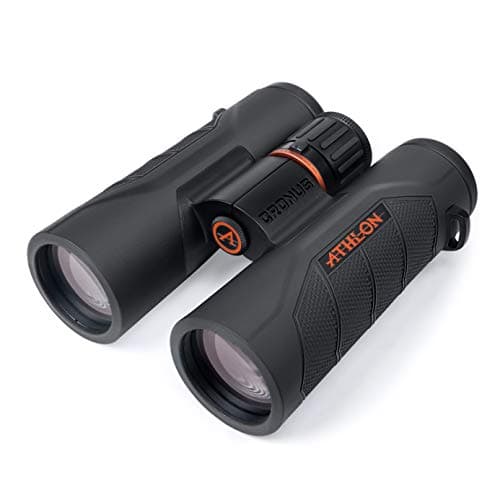
Athlon Cronus G2 UHD 10x42
UHD glass with Abbe-Koenig prisms at roughly half what comparable prism designs cost elsewhere - the clearest value argument above $500.
| Magnification | 10x |
|---|---|
| Objective lens | 42 mm |
| Exit pupil (computed) | 4.2 mm |
| Twilight factor (computed) | 20.5 |
Magnification and objective are the manufacturer's own model designation; exit pupil and twilight factor are computed from them. We could not machine-read Athlon's spec page, so the remaining published figures are not listed rather than guessed.
What it does well
- Abbe-Koenig prisms, normally a $1,000-plus feature
- UHD glass controls chromatic aberration well
- Long eye relief
Where it gives ground
- Heavier than the Viper HD
- Brand carries less weight on resale
Skip it if
You will only ever glass in good light. The money buys you edge-of-legal-light performance.
How this score breaks down
- Low-light performance (weight 5)9.0
- Optical quality per dollar (weight 4)9.5
- Field of view (weight 3)8.5
- Eye relief (weight 3)9.0
- Weight and ergonomics (weight 2)7.0
- Warranty (weight 2)8.5
Weights and definitions are published on how we review. These are editorial judgments from published specs and documented consensus, not test results.
Abbe-Koenig is a roof prism design that uses total internal reflection throughout, so it does not need the reflective coating a Schmidt-Pechan does. Higher transmission, bigger housing.
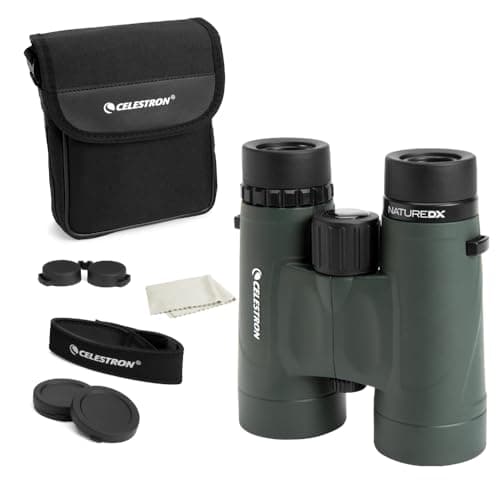
Celestron Nature DX 8x42
A 5.25 mm exit pupil, 17.5 mm of eye relief and a close focus near 6.5 ft, which makes it the best of these for wildlife watching as well as hunting.
| Magnification | 8x |
|---|---|
| Objective lens | 42 mm |
| Exit pupil (computed) | 5.25 mm |
| Twilight factor (computed) | 18.3 |
Magnification and objective are the manufacturer's own model designation; exit pupil and twilight factor are computed from them. We could not machine-read Celestron's spec page, so the remaining published figures are not listed rather than guessed.
What it does well
- 17.5 mm eye relief, verified in Celestron's published specs
- Close focus is far shorter than hunting-first designs
- Very light for a 42 mm
Where it gives ground
- BaK-4 prisms without ED glass - chromatic aberration is visible
- Not built to the same abuse standard as hunting-first brands
Skip it if
This is strictly a hunting optic for you - the Diamondback HD is tougher for the money.
How this score breaks down
- Low-light performance (weight 5)7.0
- Optical quality per dollar (weight 4)8.5
- Field of view (weight 3)8.0
- Eye relief (weight 3)9.5
- Weight and ergonomics (weight 2)8.5
- Warranty (weight 2)6.5
Weights and definitions are published on how we review. These are editorial judgments from published specs and documented consensus, not test results.
A reminder of what gets cut at the bottom of the range: the prism glass is fine, the dispersion control is not.
Questions people actually ask
Are porro prism binoculars better than roof prism?
What is phase correction in binoculars?
What is a dielectric prism coating?
Should I avoid roof prism binoculars under $200?
Sources
- Vortex Viper HD 10x42 published specifications and feature list - read 2026-10-05