The specification that sells spotting scopes is maximum magnification, and the magnification you will actually use most is near the bottom of the range. Both of those things are true and the arithmetic explains the gap.
Why you will live between 20x and 40x
Three reasons, all of them structural rather than about scope quality:
Exit pupil. Objective divided by magnification. An 85 mm scope gives 4.25 mm at 20x, 2.13 mm at 40x and 1.42 mm at 60x. Your pupil wants 5 to 7 mm in low light, so the top of the zoom is dim at exactly the times you are glassing.
Field of view. Vortex publishes 2.1 degrees at 20x falling to 1.1 degrees at 60x for the Diamondback HD (verified 2026-10-05). At 60x you are looking through a straw, and finding anything becomes slow.
Mirage and shake. Both scale with magnification. On a warm afternoon, heat shimmer at 60x can make the image worse than at 35x, regardless of how good the glass is. An expensive scope mostly gives you a clearer view of the shimmer.
| Magnification | Exit pupil (85 mm) | What you use it for |
|---|---|---|
| 15-20x | 5.67 - 4.25 mm | Scanning. Bright, wide, steady - the finding band if the scope has it. |
| 25-35x | 3.40 - 2.43 mm | The working band. Confirming animals, watching behavior, most judging calls. |
| 40-50x | 2.13 - 1.70 mm | Judging detail. Needs good light and a steady tripod. |
| 55-60x | 1.55 - 1.42 mm | A few seconds at a time, on a specific animal, in good light, on good glass. |
Exit pupil computed as 85 divided by the magnification. Note how quickly it falls - by 40x it is below half your dark-adapted pupil diameter.
So does maximum magnification matter at all
Yes, but not as a number. What matters is whether the top of the zoom is usable, and that is a function of glass quality rather than of the figure on the barrel. A $140 scope and a $1,699 scope both say 60x; one of them means it.
That is why our roundups rank on resolution at the top of the zoom rather than on the magnification range. Two scopes with identical ranges can differ enormously in where their usable ceiling sits.
What about the bottom end
Under-discussed and genuinely important. A scope starting at 15x can scan; a scope starting at 27x cannot. The Maven CS.1A's 15x minimum computes to 4.33 mm of exit pupil - brighter than an 85 mm scope at its 20x minimum - and gives a wide enough field to search with.
Conversely, the Razor HD's 27x minimum is a deliberate choice for someone who finds animals with binoculars and uses the scope only to examine them. For range shooting, where you know where the target is, a high minimum costs nothing. Why.
Three different magnification ranges
Price as of October 5, 2026. #ad How we earn
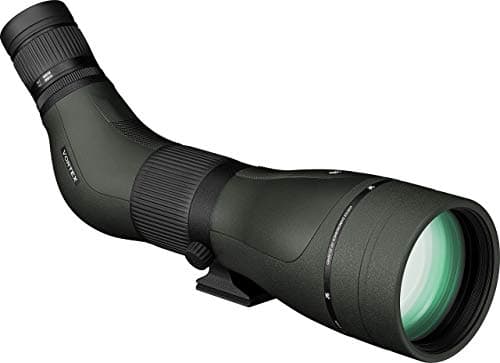
Vortex Diamondback HD 20-60x85
An 85 mm objective, 20-60x, and 18.3-20.3 mm of eye relief for around $500, which is the cheapest credible way into a real spotting scope.
| Magnification | 20-60x |
|---|---|
| Objective lens | 85 mm |
| Eye relief | 18.3mm - 20.3mm |
| Field of view | 108' - 60' @ 1000 yds |
| Angular field of view | 2.1º - 1.1º |
| Close focus | 24.6' |
| Weight | 60.9 oz. |
| Length | 16.0" |
| Exit pupil (computed) | 4.25 mm |
| Twilight factor (computed) | 41.2 |
Specs verified 2026-10-05 from Vortex's published specification. Exit pupil and twilight factor are computed, not quoted.
What it does well
- 85 mm objective gathers enough light for dawn judging
- 18.3-20.3 mm eye relief is unusually generous
- VIP warranty
Where it gives ground
- Image softens noticeably past about 45x
- Needs a tripod costing a meaningful fraction of the scope
Skip it if
You only glass inside 400 yards - 15x56 binoculars are lighter and cheaper.
How this score breaks down
- Resolution at top magnification (weight 5)8.0
- Usable magnification range (weight 4)8.5
- Eye relief across the zoom (weight 3)9.5
- Weight and packability (weight 3)7.0
- Build and sealing (weight 2)8.5
Weights and definitions are published on how we review. These are editorial judgments from published specs and documented consensus, not test results.
Vortex publishes 2.1 degrees of field at 20x falling to 1.1 degrees at 60x (verified 2026-10-05) - the narrowing is why you scan at the bottom of the zoom.
Price as of October 5, 2026. #ad How we earn
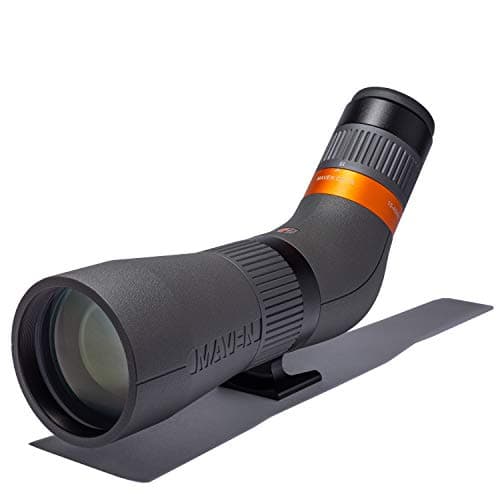
Maven CS.1A 15-45x65
A 65 mm objective at 40.4 oz per Maven's published spec: the weight compromise that actually gets carried on a backcountry hunt.
| Magnification | 15x |
|---|---|
| Objective lens | 65 mm |
| Magnification range | 15x-45x |
| Weight | 40.4 oz |
| Exit pupil (computed) | 4.33 mm |
| Twilight factor (computed) | 31.2 |
Specs verified 2026-10-05 from Maven's published specification. Exit pupil and twilight factor are computed, not quoted.
What it does well
- 40.4 oz, verified in Maven's published specification
- 15x minimum makes scanning practical
- Lifetime warranty, sold direct
Where it gives ground
- 65 mm gathers less light than an 85 mm at dawn
- 45x ceiling limits fine antler judging
Skip it if
You glass from a truck or a fixed camp - take the 85 mm.
How this score breaks down
- Resolution at top magnification (weight 5)8.5
- Usable magnification range (weight 4)7.5
- Eye relief across the zoom (weight 3)8.0
- Weight and packability (weight 3)9.5
- Build and sealing (weight 2)9.0
Weights and definitions are published on how we review. These are editorial judgments from published specs and documented consensus, not test results.
Maven publishes 15x-45x (verified 2026-10-05). The computed exit pupil at 15x is 4.33 mm, better than an 85 mm at its 20x minimum.
Price as of October 5, 2026. #ad How we earn
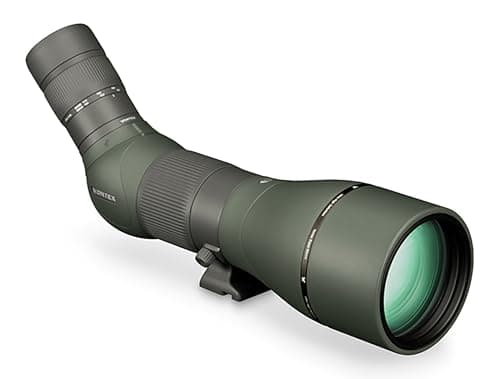
Vortex Razor HD 27-60x85
Starting at 27x rather than 20x, with 2.2-1.3 degrees of field: built for picking apart an animal you have already found, not for finding it.
| Magnification | 27-60x |
|---|---|
| Objective lens | 85 mm |
| Eye relief | 16.7mm - 17.0mm |
| Field of view | 117' - 68' @ 1000 yds |
| Angular field of view | 2.2º - 1.3º |
| Close focus | 16.4' |
| Weight | 65.6 oz. |
| Length | 15.5" |
| Exit pupil (computed) | 3.15 mm |
| Twilight factor (computed) | 47.9 |
Specs verified 2026-10-05 from Vortex's published specification. Exit pupil and twilight factor are computed, not quoted.
What it does well
- Resolution at the top of the zoom is genuinely usable
- Apochromatic optical system
- Rugged magnesium body
Where it gives ground
- 27x minimum makes initial scanning harder
- Premium price for a situational advantage
Skip it if
You use one optic to both find and judge animals.
How this score breaks down
- Resolution at top magnification (weight 5)9.5
- Usable magnification range (weight 4)9.0
- Eye relief across the zoom (weight 3)8.5
- Weight and packability (weight 3)5.5
- Build and sealing (weight 2)9.5
Weights and definitions are published on how we review. These are editorial judgments from published specs and documented consensus, not test results.
Vortex publishes 2.2 to 1.3 degrees of field (verified 2026-10-05) - notably, wider at the bottom than the Viper HD despite the higher magnification.
Questions people actually ask
What magnification spotting scope is best for hunting?
Is 60x magnification useful?
Why does my spotting scope get blurry at high magnification?
Should I buy a scope that starts at 15x or 20x?
Sources
- Vortex Diamondback HD 20-60x85 published specifications - read 2026-10-05
- Vortex Razor HD 27-60x85 published specifications - read 2026-10-05
- Maven CS.1A 15-45x65 published specifications - read 2026-10-05