We earn a commission if you buy through the links on this page, at no extra cost to you. It never changes which products we pick or how we rank them - read the full disclosure.
Our top pick
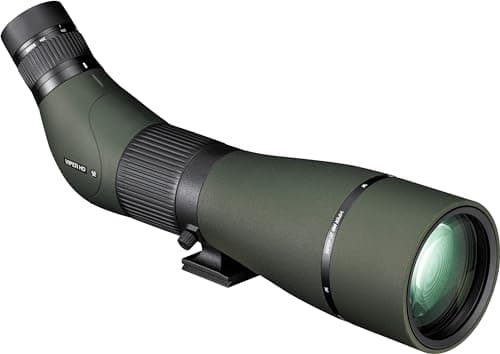
Vortex Viper HD 20-60x85
The step where a spotting scope stops being a compromise: usable detail at 60x instead of giving up at 45x.
Price as of November 18, 2026. #ad How we earn
The best 85mm spotting scopes for hunting are separated by three published numbers and one unpublished one. Every 85 mm scope ever made delivers the same 4.25 mm exit pupil at 20x - that is 85 divided by 20, and it is why none of these is meaningfully brighter than another at the bottom of the zoom. What the money actually buys is resolution at the top of the magnification range, field of view, and how much weight you carry to get it.
Why 85 mm, and why the aperture is not the variable
85 mm is the size the hunting market settled on because it is the largest objective most people will carry and the smallest that holds a usable image at 50x and beyond. Below it, 65 mm scopes give up real light; above it, 95 mm and 100 mm scopes exist but weigh enough that they live in a truck rather than a pack.
The thing to understand before comparing any two of them is that the objective is not what separates them. Exit pupil - the diameter of the cone of light leaving the eyepiece - is the objective divided by the magnification. At 20x, every scope on this page computes to 85 / 20 = 4.25 mm. The one exception is the Razor HD, which starts at 27x and therefore computes to 3.15 mm. So with a single exception, brightness at the bottom of the zoom is identical across a price range of roughly four to one. Exit pupil and twilight factor sets out the arithmetic in full.
How we ranked these
Scored against the published spotting-scope rubric on how we review, weighted for the job an 85 mm scope is bought to do: find an animal, then decide something about it.
- Resolution at the top of the zoom, weighted heaviest. A 60x ring that softens at 45x is a 45x scope with optimistic labeling. This is a design-and-consensus judgment rather than a measurement, and we say so.
- Usable magnification range. Related but distinct: how much of the published range you would actually choose to sit at.
- Eye relief across the zoom. A single eyepiece and one eye means vignetting is instantly obvious. Anything under about 17 mm is a hard filter if you glass in glasses.
- Weight and packability. Every scope here is between 60.9 and 76.6 oz, and that 15.7 oz spread is the difference between a scope that goes up the ridge and one that does not.
- Build and sealing, which is where a published figure often runs out and a service reputation has to stand in.
Quick picks
Ranked by the criteria published on how we review. Tap any row for the full write-up, or go straight to the current price.
| # | Product | Best for | Score | Price |
|---|---|---|---|---|
| 1 | Vortex Viper HD 20-60x85An apochromatic lens system that stays usable at 60x where the tier below softens around 45x, with 17.8-19.6 mm of eye relief across the whole zoom. | Best 85mm spotting scope overallBest all-round spotting scope | 9.4out of 10 | |
| 2 | 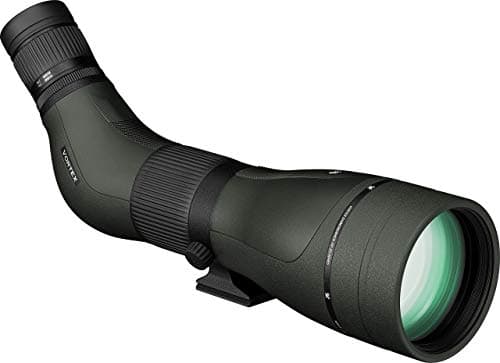 Vortex Diamondback HD 20-60x85The same 85 mm objective and the widest field at 20x on this page - 108 ft - for roughly half the Viper HD, with the image softening past about 45x. | Best budget 85mm spotting scopeBest spotting scope value | 9.2out of 10 | |
| 3 | 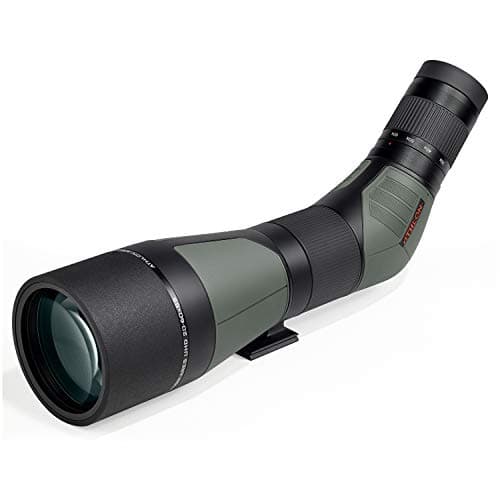 Athlon Ares G2 UHD 20-60x85UHD glass with ED elements and an apochromatic system at a price that undercuts the Viper HD, with 19.6 mm of eye relief at 20x and 6 oz less weight. | Best value at the top tierMost glass per dollar at 85 mm | 9.3out of 10 | |
| 4 | 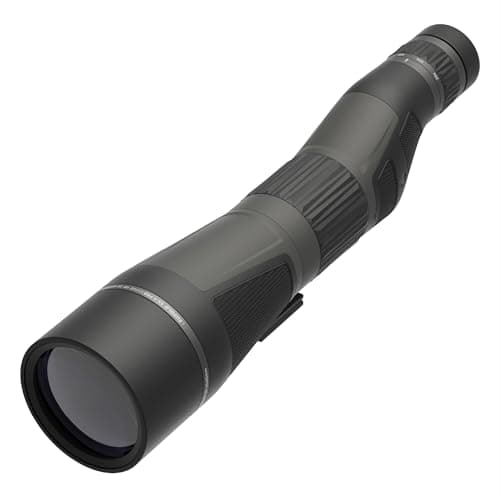 Leupold SX-4 Pro Guide HD 20-60x85Leupold's Twilight Max HD coatings in a body built to survive a week strapped to a pack frame - and the thinnest published specification on this page. | Best for hard country and US serviceToughest spotting scope here | 9.3out of 10 | |
| 5 | 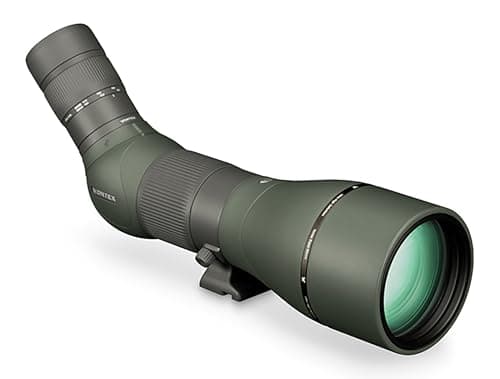 Vortex Razor HD 27-60x85117 ft of field at 27x - wider than the Viper HD manages at 20x - in a body 11 oz lighter, with a 3.15 mm exit pupil as the real cost. | Best for judging an animal at distanceJudging antler at distance | 9.4out of 10 |
Prices are pulled live from Amazon and were last checked November 18, 2026; if a figure cannot be verified the button reads "Check price" instead. Scores are our editorial judgment against the published ranking criteria, on our published 8.4 to 9.8 recommendation scale. #ad How we earn.
The published numbers side by side
| Scope | Field @ 1,000 yd | Eye relief | Close focus | Weight | Exit pupil at minimum |
|---|---|---|---|---|---|
| Vortex Diamondback HD 20-60x85 | 108-60 ft | 18.3-20.3 mm | 24.6 ft | 60.9 oz | 4.25 mm |
| Vortex Viper HD 20-60x85 | 101-50 ft | 17.8-19.6 mm | 36.0 ft | 76.6 oz | 4.25 mm |
| Athlon Ares G2 UHD 20-60x85 | 99-47 ft | 19.6-17.8 mm | not published | 70 oz | 4.25 mm |
| Leupold SX-4 Pro Guide HD 20-60x85 | not published | not published | not published | not published | 4.25 mm |
| Vortex Razor HD 27-60x85 | 117-68 ft | 16.7-17.0 mm | 16.4 ft | 65.6 oz | 3.15 mm |
Three things worth noticing. The cheapest scope has the widest field at 20x and the most eye relief. The most expensive scope is lighter than the one below it and focuses closer than any of them. And one maker publishes almost nothing, which is itself a comparison result.
That table is the argument against buying on price order. The Diamondback HD leads on field of view and eye relief and is the lightest of the lot; the Razor HD, at roughly three times the money, is 4.7 oz heavier than the Diamondback and dimmer at its minimum magnification. What the Razor buys is the top of the zoom, and what the Viper HD buys is the same thing for less.
The 20x question, and the one scope that answers it differently
Four of these five start at 20x because that is roughly the lowest magnification at which an 85 mm objective makes sense, and the widest field you can get before the eyepiece design starts fighting you. Starting low matters because the first job is finding the animal, and a wider field finds more.
The Razor HD starts at 27x instead, and the usual criticism - that this makes it harder to scan with - turns out to be wrong on the published numbers, because its eyepiece gives 117 ft at 27x where the Viper HD gives 101 ft at 20x. The genuine cost shows up in a different row: a 3.15 mm exit pupil instead of 4.25 mm. In daylight that is invisible, because your pupil is only 2 to 3 mm wide. In the last twenty minutes of shooting light your pupil opens past 5 mm and the scope delivering the wider cone of light is the brighter one.
What 85 mm does not fix
It does not replace a binocular. You find animals with two eyes and a wide field, then confirm with the scope. A hunter who tries to grid-glass a basin through an 85 mm scope will cover a fraction of the country and get a headache doing it. Spotting scope vs binoculars is the honest division of labor, and the best 15x56 binoculars are the middle option a lot of people actually want.
It does not make a bad tripod good. See the note above; at 60x the tripod is half the optical system.
It does not fix mirage. On a warm afternoon the atmosphere between you and the animal sets the ceiling on usable magnification, and no amount of glass beats it. That is why the resolution difference between these scopes shows up at first light and last light rather than at noon.
Who should buy what
- Buy the Vortex Viper HD 20-60x85 if you want one scope that does everything and holds its image to the top of the zoom. It is the default for a reason.
- Buy the Vortex Diamondback HD 20-60x85 if you judge animals inside about 600 yards. It is the widest and lightest here, and the money saved buys the tripod the scope needs.
- Buy the Athlon Ares G2 UHD 20-60x85 if you want the Viper HD's optical class with a lifetime transferable warranty and would rather spend the difference elsewhere - and you can live without a published close-focus or sealing figure.
- Buy the Leupold SX-4 Pro Guide HD if your scope is going to take real abuse a long way from a road and you value US service above a published spec sheet.
- Buy the Vortex Razor HD 27-60x85 if judging an animal at long range is the specific job, you glass mostly in usable light, and you want the widest field and the lightest 85 mm body here.
The picks in full
Price as of November 18, 2026. #ad How we earn
Vortex Viper HD 20-60x85
The step where a spotting scope stops being a compromise: usable detail at 60x instead of giving up at 45x.
| Magnification | 20-60x |
|---|---|
| Objective lens | 85 mm |
| Eye relief | 17.8mm - 19.6mm |
| Field of view | 101' - 50' @ 1000 yds |
| Angular field of view | 1.9º - 1.0º |
| Close focus | 36.0' |
| Weight | 76.6 oz. |
| Length | 17.5" |
| Exit pupil (computed) | 4.25 mm |
| Twilight factor (computed) | 41.2 |
Specs verified 2026-10-05 from Vortex's published specification. Exit pupil and twilight factor are computed, not quoted.
What it does well
- Holds resolution much deeper into the magnification range
- 17.8-19.6 mm eye relief across the zoom
- Apochromatic lens system controls color fringing
Where it gives ground
- 76.6 oz means a serious tripod
- Nearly twice the Diamondback HD's price
Skip it if
You judge animals inside 600 yards. The Diamondback HD does that.
How this score breaks down
- Resolution at top magnification (weight 5)9.0
- Usable magnification range (weight 4)9.1
- Eye relief across the zoom (weight 3)9.0
- Weight and packability (weight 3)6.2
- Build and sealing (weight 2)9.0
Criterion scores are on the 0-10 rubric scale. Their weighted mean is 8.5, which maps to 9.4 on our published recommendation scale of 8.4 to 9.8 - the band of products we are willing to recommend at all. The weights, the definitions and the mapping are all published, so any score here can be checked against our own rules. These are editorial judgments from published specifications, computed optical arithmetic and documented consensus.
This is the scope most hunters end up with, and the reason is what happens at the top of the zoom. A cheaper 85 mm gives you a clean image from 20x to about 45x and then mushes - contrast drops, color fringing appears on an antler edge against sky, and the last third of the magnification ring becomes a number rather than something you use. The Viper HD's apochromatic lens system holds together to 60x. You are not buying more magnification than the Diamondback HD offers; you are buying the magnification you already had.
Vortex publishes 101 to 50 ft of field at 1,000 yd, 1.9 to 1.0 degrees angular, 17.8 to 19.6 mm of eye relief, a 36.0 ft close focus, 17.5 in of length and 76.6 oz. The eye-relief span matters more on a spotting scope than on a binocular: you press one eye to a single eyepiece, so vignetting with glasses is immediately obvious, and nearly 18 mm at the top of the zoom is generous.
Good to know: at 76.6 oz this is the heaviest scope on the page - heavier than the Athlon Ares G2 UHD at 70 oz and, oddly, 11 oz heavier than the Razor HD above it. The 36.0 ft close focus is more than double the Razor's 16.4 ft, and its 101 ft of field at 20x is actually narrower than the cheaper Diamondback HD's 108 ft. The full Viper HD 20-60x85 review goes through all of it.
Price as of November 18, 2026. #ad How we earn
Vortex Diamondback HD 20-60x85
An 85 mm objective, 20-60x, and 18.3-20.3 mm of eye relief for around $500, which is the cheapest credible way into a real spotting scope.
| Magnification | 20-60x |
|---|---|
| Objective lens | 85 mm |
| Eye relief | 18.3mm - 20.3mm |
| Field of view | 108' - 60' @ 1000 yds |
| Angular field of view | 2.1º - 1.1º |
| Close focus | 24.6' |
| Weight | 60.9 oz. |
| Length | 16.0" |
| Exit pupil (computed) | 4.25 mm |
| Twilight factor (computed) | 41.2 |
Specs verified 2026-10-05 from Vortex's published specification. Exit pupil and twilight factor are computed, not quoted.
What it does well
- 85 mm objective gathers enough light for dawn judging
- 18.3-20.3 mm eye relief is unusually generous
- VIP warranty
Where it gives ground
- Image softens noticeably past about 45x
- Needs a tripod costing a meaningful fraction of the scope
Skip it if
You only glass inside 400 yards - 15x56 binoculars are lighter and cheaper.
How this score breaks down
- Resolution at top magnification (weight 5)7.9
- Usable magnification range (weight 4)8.4
- Eye relief across the zoom (weight 3)9.4
- Weight and packability (weight 3)6.8
- Build and sealing (weight 2)8.4
Criterion scores are on the 0-10 rubric scale. Their weighted mean is 8.1, which maps to 9.2 on our published recommendation scale of 8.4 to 9.8 - the band of products we are willing to recommend at all. The weights, the definitions and the mapping are all published, so any score here can be checked against our own rules. These are editorial judgments from published specifications, computed optical arithmetic and documented consensus.
This is the cheapest credible way into a real 85 mm scope, and for a lot of hunters it is the right answer rather than a compromise. Vortex publishes 108 to 60 ft of field at 1,000 yd - the widest 20x figure of any scope here, wider than both Vortex scopes above it - 18.3 to 20.3 mm of eye relief, which is also the most generous span on the page, a 24.6 ft close focus, 16.0 in of length and 60.9 oz. That weight is nearly a pound under the Viper HD.
On paper the only row it clearly loses is the one a table cannot show: resolution at the top of the zoom. So the decision is about where you spend your time on the magnification ring. If you judge animals inside about 600 yards and live between 20x and 40x, this does that job and keeps the difference - which, at this tier, is most of the price of a tripod worth owning.
Good to know: the image softens noticeably past about 45x, so the top of the range is less usable than the number suggests, and a scope at this price still needs a tripod costing a meaningful fraction of it. The full Diamondback HD 20-60x85 review and the two Vortex scopes head to head are the pages to read before choosing between them.
Price as of November 18, 2026. #ad How we earn
Athlon Ares G2 UHD 20-60x85
UHD glass in an 85 mm body at a price that undercuts the Viper HD, which is Athlon's whole argument.
| Magnification | 20-60x |
|---|---|
| Objective lens | 85 mm |
| Field of view | 99-47 ft @ 1,000 yd |
| Eye relief | 0.77-0.70 in (19.6-17.8 mm) |
| Eyepiece angle | 45 degrees |
| Weight | 70 oz |
| Dimensions | 16.9 x 4 in |
| Exit pupil at 20x (computed) | 4.25 mm |
| Exit pupil at 60x (computed) | 1.42 mm |
| Twilight factor at 20x (computed) | 41.2 |
Specs verified 2026-10-19 from Athlon's published specification. Exit pupil and twilight factor are computed, not quoted.
What it does well
- UHD glass with ED elements and an apochromatic lens system
- Priced below comparable Vortex and Leupold 85 mm scopes
- 19.6 mm of eye relief at 20x, which is generous for a spotting scope
- Lifetime transferable warranty
Where it gives ground
- 99 ft of field at 20x is the narrowest of the 85 mm scopes here - the Diamondback HD publishes 108 ft
- 70 oz is heavy for a backpack hunt, even though it undercuts the Viper HD's 76.6 oz
- Athlon publishes no close focus figure and no sealing specification
- Service turnaround is slower than the majors and resale demand is thinner
Skip it if
You need a walk-in dealer for service, or you are counting ounces on a backpack hunt.
How this score breaks down
- Resolution at top magnification (weight 5)8.9
- Usable magnification range (weight 4)8.9
- Eye relief across the zoom (weight 3)8.5
- Weight and packability (weight 3)6.3
- Build and sealing (weight 2)8.1
Criterion scores are on the 0-10 rubric scale. Their weighted mean is 8.3, which maps to 9.3 on our published recommendation scale of 8.4 to 9.8 - the band of products we are willing to recommend at all. The weights, the definitions and the mapping are all published, so any score here can be checked against our own rules. These are editorial judgments from published specifications, computed optical arithmetic and documented consensus.
Athlon's whole argument is that you can have ED elements and an apochromatic lens system without paying for the badge, and on published specifications it largely holds. The Ares G2 UHD publishes the same 85 mm objective, 0.77 to 0.70 in of eye relief (19.6 to 17.8 mm), a 45-degree eyepiece, 70 oz of weight and a 16.9 by 4 in body. The eye relief at 20x is the most generous number on this page after the Diamondback HD, and 70 oz undercuts the Viper HD by more than a third of a pound.
It also carries Athlon's lifetime transferable warranty, which is the same promise Vortex makes and the thing that usually separates a value brand from a cheap one. If the Viper HD is the default and the Diamondback HD is the value pick, this is the scope for a buyer who wants the Viper HD's optical class and would rather spend the difference on the tripod.
Good to know: its 99 ft of field at 20x is the narrowest published figure of every 85 mm scope on this site - the cheaper Diamondback HD shows 108 ft - and Athlon publishes no close-focus figure and no sealing specification at all, which on a scope that lives outdoors is a gap rather than a quibble. Service turnaround is slower than the majors and resale is thinner. The full Athlon Ares G2 UHD review covers the trade.
Price as of November 18, 2026. #ad How we earn
Leupold SX-4 Pro Guide HD 20-60x85
Leupold's Twilight Max HD coatings in a body built to survive being strapped to a pack frame for a week.
| Magnification | 20x |
|---|---|
| Objective lens | 85 mm |
| Exit pupil (computed) | 4.25 mm |
| Twilight factor (computed) | 41.2 |
Magnification and objective are the manufacturer's own model designation; exit pupil and twilight factor are computed from them. We could not machine-read Leupold's spec page, so the remaining published figures are not listed rather than guessed.
What it does well
- Twilight Max HD coatings favor dawn and dusk performance
- Built to Leupold's abuse standard
- Lifetime guarantee
Where it gives ground
- Heavier than the Vortex equivalents
- Eyepiece is less comfortable than Vortex's
Skip it if
Pack weight is your binding constraint.
How this score breaks down
- Resolution at top magnification (weight 5)8.7
- Usable magnification range (weight 4)9.1
- Eye relief across the zoom (weight 3)7.9
- Weight and packability (weight 3)5.7
- Build and sealing (weight 2)9.6
Criterion scores are on the 0-10 rubric scale. Their weighted mean is 8.2, which maps to 9.3 on our published recommendation scale of 8.4 to 9.8 - the band of products we are willing to recommend at all. The weights, the definitions and the mapping are all published, so any score here can be checked against our own rules. These are editorial judgments from published specifications, computed optical arithmetic and documented consensus.
Leupold's argument here is not an optical specification, it is survival. The SX-4 Pro Guide HD is built around the assumption that the scope is going to be strapped to the outside of a pack, dropped on shale and rained on, and Leupold's service reputation in the US is the best of any brand on this page - a walk-in-equivalent turnaround rather than a shipping saga. For a hunter who is hard on gear in genuinely remote country, that is worth more than a few feet of field.
The optical story is the Twilight Max HD coating system, which Leupold tunes for the first and last half hour rather than for bench resolution. The 85 mm objective gives the same 4.25 mm exit pupil at 20x as every other scope here, so the coatings are doing the work, not the aperture.
Good to know, and it is the honest problem with this pick: Leupold publishes far less about it than Vortex or Athlon do about theirs. There is no field-of-view table, no close-focus figure and no eye-relief span in Leupold's own specification for this model, so three of the rows in the table below read "not published" rather than carrying a number we would otherwise have compared. It is also heavier than the Vortex equivalents and its eyepiece is less comfortable than Vortex's. The full SX-4 Pro Guide HD review is the detail.
Price as of November 18, 2026. #ad How we earn
Vortex Razor HD 27-60x85
Starting at 27x rather than 20x, with 2.2-1.3 degrees of field: built for picking apart an animal you have already found, not for finding it.
| Magnification | 27-60x |
|---|---|
| Objective lens | 85 mm |
| Eye relief | 16.7mm - 17.0mm |
| Field of view | 117' - 68' @ 1000 yds |
| Angular field of view | 2.2º - 1.3º |
| Close focus | 16.4' |
| Weight | 65.6 oz. |
| Length | 15.5" |
| Exit pupil (computed) | 3.15 mm |
| Twilight factor (computed) | 47.9 |
Specs verified 2026-10-05 from Vortex's published specification. Exit pupil and twilight factor are computed, not quoted.
What it does well
- Resolution at the top of the zoom is genuinely usable
- Apochromatic optical system
- Rugged magnesium body
Where it gives ground
- 27x minimum makes initial scanning harder
- Premium price for a situational advantage
Skip it if
You use one optic to both find and judge animals.
How this score breaks down
- Resolution at top magnification (weight 5)9.6
- Usable magnification range (weight 4)8.6
- Eye relief across the zoom (weight 3)8.2
- Weight and packability (weight 3)6.2
- Build and sealing (weight 2)9.6
Criterion scores are on the 0-10 rubric scale. Their weighted mean is 8.5, which maps to 9.4 on our published recommendation scale of 8.4 to 9.8 - the band of products we are willing to recommend at all. The weights, the definitions and the mapping are all published, so any score here can be checked against our own rules. These are editorial judgments from published specifications, computed optical arithmetic and documented consensus.
The received wisdom about this scope is that its 27x minimum makes it harder to scan with than a 20x. Vortex's own field-of-view table says otherwise: 2.2 degrees at 27x is 117 ft at 1,000 yd, against the Viper HD's 1.9 degrees and 101 ft at 20x. The Razor eyepiece has a substantially wider apparent field, and that more than offsets the extra magnification. It is also 11 oz lighter than the Viper HD at 65.6 oz, 2 in shorter at 15.5 in, and focuses to 16.4 ft against 36.0 ft.
What you are paying for is resolution at the top of the zoom - the apochromatic system brings three wavelengths to the same focal plane rather than two, which is what keeps fringing off a dark antler against bright sky at 60x. That is a design-and-consensus argument rather than a measurement, and it is the one job this scope does better than anything else here.
Good to know: the real cost of the 27x minimum is light, not field. Exit pupil is objective divided by magnification, so 85 / 27 gives 3.15 mm against 4.25 mm for every 20x scope on this page - visibly dimmer in the last twenty minutes of legal light, which is when a spotting scope earns its keep. Eye relief of 16.7 to 17.0 mm is also the shortest here. The full Razor HD 27-60x85 review works through both.
Our recommendation
If you take one thing from this page, take this.
Vortex Viper HD 20-60x85
Best 85mm spotting scope overall
An apochromatic lens system that stays usable at 60x where the tier below softens around 45x, with 17.8-19.6 mm of eye relief across the whole zoom.
Vortex Diamondback HD 20-60x85
Best budget 85mm spotting scope
The same 85 mm objective and the widest field at 20x on this page - 108 ft - for roughly half the Viper HD, with the image softening past about 45x.
Prices are pulled live and shown on each button. #ad How we earn.
Questions people actually ask
What is the best 85mm spotting scope for hunting?
Is an 85mm spotting scope brighter than a 65mm?
Do all 85mm spotting scopes have the same exit pupil?
How heavy is an 85mm spotting scope?
What magnification do you actually use on an 85mm scope?
Sources
- Vortex Viper HD 20-60x85 - published specifications - read 2026-10-26
- Vortex Diamondback HD 20-60x85 - published specifications - read 2026-10-05
- Athlon Ares G2 UHD 20-60x85 - published specifications - read 2026-10-19
- Leupold SX-4 Pro Guide HD 20-60x85 - product page (Leupold publishes no field-of-view, close-focus or eye-relief table for this model) - read 2026-10-05
- Vortex Razor HD 27-60x85 - specification table as reproduced by stocking dealers (Vortex's own model page returns 404 to automated reads) - read 2026-11-02
Read next
Brands: want your product tested? For Brands.