We earn a commission if you buy through the links on this page, at no extra cost to you. It never changes which products we pick or how we rank them - read the full disclosure.
Our top pick
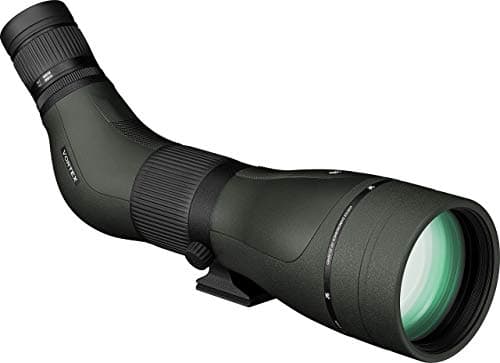
Vortex Diamondback HD 20-60x85
An 85 mm objective, 20-60x, and 18.3-20.3 mm of eye relief for around $500, which is the cheapest credible way into a real spotting scope.
Price as of October 5, 2026. #ad How we earn
Both are 20-60x85 angled scopes from the same manufacturer, so the comparison is unusually clean. And because we read both specifications from Vortex's own pages on the same day, the result is checkable.
The published figures
| Specification | Diamondback HD 20-60x85 | Viper HD 20-60x85 | Leads on paper |
|---|---|---|---|
| Magnification | 20-60x | 20-60x | Equal |
| Objective | 85 mm | 85 mm | Equal |
| Computed exit pupil at 20x | 4.25 mm | 4.25 mm | Equal |
| Computed exit pupil at 60x | 1.42 mm | 1.42 mm | Equal |
| Published eye relief | 18.3 - 20.3 mm | 17.8 - 19.6 mm | Diamondback HD |
| Published angular field | 2.1 - 1.1 degrees | 1.9 - 1.0 degrees | Diamondback HD |
| Rough price | $499 | $899 | Diamondback HD |
The cheaper scope leads on every published figure that differs. That is the surprise, and it is a useful illustration of why specification shopping has limits in this category.
So why is the Viper HD the better scope
Because the thing that separates spotting scopes is not in that table. It is resolution at the top of the zoom, and no manufacturer publishes it.
The Viper HD's apochromatic lens system corrects chromatic aberration across three wavelengths rather than two. Chromatic aberration scales with magnification, so at 20x the difference is invisible and at 60x it is the difference between an image you can judge an animal on and one that is merely larger.
Practically: the Diamondback HD gives a good image to about 45-50x and then starts trading detail for size. The Viper HD holds together to 60x. If you never go above 45x, you are paying $400 for nothing. If you judge animals at long range, that top 15x is the entire reason a spotting scope exists.
What to make of the eye relief result
It is genuinely useful rather than a curiosity. 18.3 to 20.3 mm is a lot of eye relief for a spotting scope, and on an optic you sit behind for an hour, eye relief is comfort - which affects how long you glass and therefore what you find.
For a glasses wearer, the cheaper scope may genuinely be the more comfortable one. That is a real consideration and not a consolation prize.
The decision
- Buy the Diamondback HD if your glassing is inside about 700 yards, you rarely exceed 45x, or you wear glasses and value the extra eye relief.
- Buy the Viper HD if you judge animals past 800 yards and need the top of the zoom to be usable. That is the only reason, and it is a good one.
- Buy neither if your glassing is inside 600 yards - 15x56 binoculars on a tripod are more comfortable and cheaper.
The two side by side
Price as of October 5, 2026. #ad How we earn
Vortex Diamondback HD 20-60x85
An 85 mm objective, 20-60x, and 18.3-20.3 mm of eye relief for around $500, which is the cheapest credible way into a real spotting scope.
| Magnification | 20-60x |
|---|---|
| Objective lens | 85 mm |
| Eye relief | 18.3mm - 20.3mm |
| Field of view | 108' - 60' @ 1000 yds |
| Angular field of view | 2.1º - 1.1º |
| Close focus | 24.6' |
| Weight | 60.9 oz. |
| Length | 16.0" |
| Exit pupil (computed) | 4.25 mm |
| Twilight factor (computed) | 41.2 |
Specs verified 2026-10-05 from Vortex's published specification. Exit pupil and twilight factor are computed, not quoted.
What it does well
- 85 mm objective gathers enough light for dawn judging
- 18.3-20.3 mm eye relief is unusually generous
- VIP warranty
Where it gives ground
- Image softens noticeably past about 45x
- Needs a tripod costing a meaningful fraction of the scope
Skip it if
You only glass inside 400 yards - 15x56 binoculars are lighter and cheaper.
How this score breaks down
- Resolution at top magnification (weight 5)8.0
- Usable magnification range (weight 4)8.5
- Eye relief across the zoom (weight 3)9.5
- Weight and packability (weight 3)7.0
- Build and sealing (weight 2)8.5
Weights and definitions are published on how we review. These are editorial judgments from published specs and documented consensus, not test results.
Vortex publishes 18.3-20.3 mm of eye relief and 2.1-1.1 degrees of angular field (verified 2026-10-05) - both ahead of the Viper HD on paper.
Price as of October 5, 2026. #ad How we earn
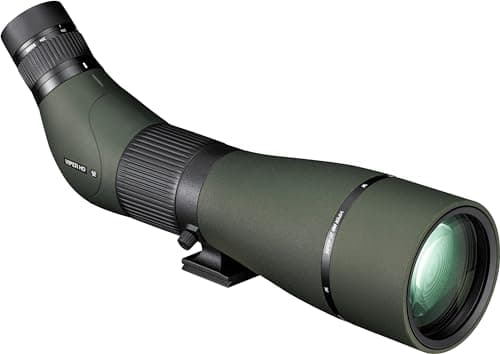
Vortex Viper HD 20-60x85
The step where a spotting scope stops being a compromise: usable detail at 60x instead of giving up at 45x.
| Magnification | 20-60x |
|---|---|
| Objective lens | 85 mm |
| Eye relief | 17.8mm - 19.6mm |
| Field of view | 101' - 50' @ 1000 yds |
| Angular field of view | 1.9º - 1.0º |
| Close focus | 36.0' |
| Weight | 76.6 oz. |
| Length | 17.5" |
| Exit pupil (computed) | 4.25 mm |
| Twilight factor (computed) | 41.2 |
Specs verified 2026-10-05 from Vortex's published specification. Exit pupil and twilight factor are computed, not quoted.
What it does well
- Holds resolution much deeper into the magnification range
- 17.8-19.6 mm eye relief across the zoom
- Apochromatic lens system controls color fringing
Where it gives ground
- 65.7 oz means a serious tripod
- Nearly twice the Diamondback HD's price
Skip it if
You judge animals inside 600 yards. The Diamondback HD does that.
How this score breaks down
- Resolution at top magnification (weight 5)9.0
- Usable magnification range (weight 4)9.0
- Eye relief across the zoom (weight 3)9.0
- Weight and packability (weight 3)6.5
- Build and sealing (weight 2)9.0
Weights and definitions are published on how we review. These are editorial judgments from published specs and documented consensus, not test results.
Vortex publishes 17.8-19.6 mm of eye relief and 1.9-1.0 degrees of field (verified 2026-10-05). Lower on both counts, and the better scope - which is the point of this page.
Questions people actually ask
Is the Vortex Viper HD spotting scope worth twice the Diamondback HD?
Which Vortex spotting scope has more eye relief?
Do both scopes have the same exit pupil?
What is an apochromatic lens system?
Sources
- Vortex Diamondback HD 20-60x85 published specifications - read 2026-10-05
- Vortex Viper HD 20-60x85 published specifications - read 2026-10-05