We earn a commission if you buy through the links on this page, at no extra cost to you. It never changes which products we pick or how we rank them - read the full disclosure.
Reviewed here
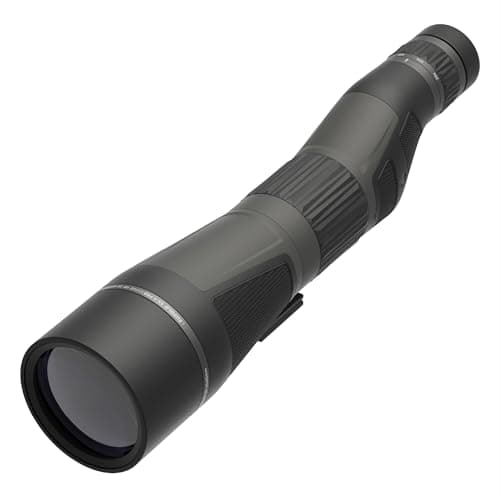
Leupold SX-4 Pro Guide HD 20-60x85
Leupold's Twilight Max HD coatings in a body built to survive being strapped to a pack frame for a week.
Price as of November 19, 2026. #ad How we earn
Leupold consistently loses specification comparisons in this category and consistently keeps its customers. Understanding why is the useful content of this review.
Twilight Max HD, and what tuning coatings means
Anti-reflective coatings are not uniform across the spectrum - a coating stack is optimized for particular wavelengths, and that optimization is a choice. Leupold's Twilight Max HD system is tuned towards performance in the light conditions at dawn and dusk rather than towards maximum resolution in bright midday light.
Given that animals move at the edges of the day, that is arguably the right thing to optimize, and it is a genuine design philosophy rather than a marketing line. It also means that a side-by-side comparison at noon - which is when most comparisons happen - will favor a competitor tuned the other way.
The build case
A spotting scope on a backcountry hunt lives strapped to a pack frame for a week, gets rained on, and gets set down on rock. Leupold builds for that, and the lifetime guarantee attaches to the product rather than a registered owner.
What this specifically protects against is the thing that kills spotting scopes: a knock that shifts the internal alignment. A scope whose elements have moved produces a soft image that you blame on the glass, and it is usually unrepairable economically.
What we could not verify
Being explicit, because it affects how you should read this page: Leupold's product page was not machine-readable for us, so this review quotes no eye relief figure, no field of view and no weight for this scope. We can compute that an 85 mm at 20x gives 4.25 mm of exit pupil and at 60x gives 1.42 mm, because that is arithmetic from the model designation.
The Vortex scopes on this site carry 9 to 10 verified published figures each. This one carries two computed ones. That is a weaker evidence base and you should weigh it accordingly - it is exactly the situation our methodology says to flag rather than fill in.
Who should buy it
- Your optics get genuinely abused. Pack frames, rock, a week of rain.
- You hunt a lot of flat light - fog, overcast, snow - where contrast-favoring coatings earn their place.
- You hunt the edges of legal light and value coatings tuned for it over peak midday resolution.
- You already own and trust Leupold service. Consistent service experience is a mild but real reason.
And who should not: if you want the most verified specification per dollar, the Vortex Viper HD is cheaper and publishes more. If you want maximum glass per dollar, the Athlon does that. All three on our $1,000 page.
This scope and two alternatives
Price as of November 19, 2026. #ad How we earn
Leupold SX-4 Pro Guide HD 20-60x85
Leupold's Twilight Max HD coatings in a body built to survive being strapped to a pack frame for a week.
| Magnification | 20x |
|---|---|
| Objective lens | 85 mm |
| Exit pupil (computed) | 4.25 mm |
| Twilight factor (computed) | 41.2 |
Magnification and objective are the manufacturer's own model designation; exit pupil and twilight factor are computed from them. We could not machine-read Leupold's spec page, so the remaining published figures are not listed rather than guessed.
What it does well
- Twilight Max HD coatings favor dawn and dusk performance
- Built to Leupold's abuse standard
- Lifetime guarantee
Where it gives ground
- Heavier than the Vortex equivalents
- Eyepiece is less comfortable than Vortex's
Skip it if
Pack weight is your binding constraint.
How this score breaks down
- Resolution at top magnification (weight 5)8.7
- Usable magnification range (weight 4)9.1
- Eye relief across the zoom (weight 3)7.9
- Weight and packability (weight 3)5.7
- Build and sealing (weight 2)9.6
Criterion scores are on the 0-10 rubric scale. Their weighted mean is 8.2, which maps to 9.3 on our published recommendation scale of 8.4 to 9.8 - the band of products we are willing to recommend at all. The weights, the definitions and the mapping are all published, so any score here can be checked against our own rules. These are editorial judgments from published specifications, computed optical arithmetic and documented consensus.
Leupold's page was not machine-readable for complete specifications, so this review computes only what the model designation establishes and describes the rest qualitatively.
Price as of November 19, 2026. #ad How we earn
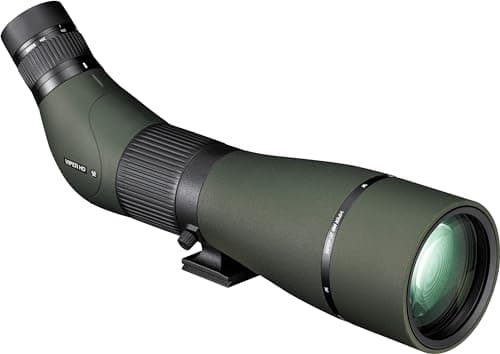
Vortex Viper HD 20-60x85
The step where a spotting scope stops being a compromise: usable detail at 60x instead of giving up at 45x.
| Magnification | 20-60x |
|---|---|
| Objective lens | 85 mm |
| Eye relief | 17.8mm - 19.6mm |
| Field of view | 101' - 50' @ 1000 yds |
| Angular field of view | 1.9º - 1.0º |
| Close focus | 36.0' |
| Weight | 76.6 oz. |
| Length | 17.5" |
| Exit pupil (computed) | 4.25 mm |
| Twilight factor (computed) | 41.2 |
Specs verified 2026-10-05 from Vortex's published specification. Exit pupil and twilight factor are computed, not quoted.
What it does well
- Holds resolution much deeper into the magnification range
- 17.8-19.6 mm eye relief across the zoom
- Apochromatic lens system controls color fringing
Where it gives ground
- 76.6 oz means a serious tripod
- Nearly twice the Diamondback HD's price
Skip it if
You judge animals inside 600 yards. The Diamondback HD does that.
How this score breaks down
- Resolution at top magnification (weight 5)9.0
- Usable magnification range (weight 4)9.1
- Eye relief across the zoom (weight 3)9.0
- Weight and packability (weight 3)6.2
- Build and sealing (weight 2)9.0
Criterion scores are on the 0-10 rubric scale. Their weighted mean is 8.5, which maps to 9.4 on our published recommendation scale of 8.4 to 9.8 - the band of products we are willing to recommend at all. The weights, the definitions and the mapping are all published, so any score here can be checked against our own rules. These are editorial judgments from published specifications, computed optical arithmetic and documented consensus.
Cheaper, with verified published figures and apochromatic optics. The direct alternative.
Price as of November 19, 2026. #ad How we earn
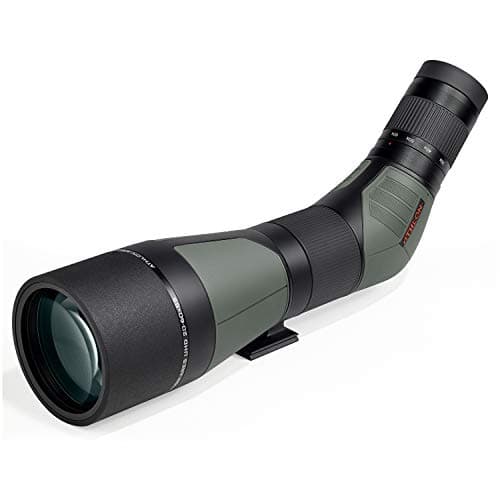
Athlon Ares G2 UHD 20-60x85
UHD glass in an 85 mm body at a price that undercuts the Viper HD, which is Athlon's whole argument.
| Magnification | 20-60x |
|---|---|
| Objective lens | 85 mm |
| Field of view | 99-47 ft @ 1,000 yd |
| Eye relief | 0.77-0.70 in (19.6-17.8 mm) |
| Eyepiece angle | 45 degrees |
| Weight | 70 oz |
| Dimensions | 16.9 x 4 in |
| Exit pupil at 20x (computed) | 4.25 mm |
| Exit pupil at 60x (computed) | 1.42 mm |
| Twilight factor at 20x (computed) | 41.2 |
Specs verified 2026-10-19 from Athlon's published specification. Exit pupil and twilight factor are computed, not quoted.
What it does well
- UHD glass with ED elements and an apochromatic lens system
- Priced below comparable Vortex and Leupold 85 mm scopes
- 19.6 mm of eye relief at 20x, which is generous for a spotting scope
- Lifetime transferable warranty
Where it gives ground
- 99 ft of field at 20x is the narrowest of the 85 mm scopes here - the Diamondback HD publishes 108 ft
- 70 oz is heavy for a backpack hunt, even though it undercuts the Viper HD's 76.6 oz
- Athlon publishes no close focus figure and no sealing specification
- Service turnaround is slower than the majors and resale demand is thinner
Skip it if
You need a walk-in dealer for service, or you are counting ounces on a backpack hunt.
How this score breaks down
- Resolution at top magnification (weight 5)8.9
- Usable magnification range (weight 4)8.9
- Eye relief across the zoom (weight 3)8.5
- Weight and packability (weight 3)6.3
- Build and sealing (weight 2)8.1
Criterion scores are on the 0-10 rubric scale. Their weighted mean is 8.3, which maps to 9.3 on our published recommendation scale of 8.4 to 9.8 - the band of products we are willing to recommend at all. The weights, the definitions and the mapping are all published, so any score here can be checked against our own rules. These are editorial judgments from published specifications, computed optical arithmetic and documented consensus.
Specification-competitive at a similar price, with weaker service support.
Our recommendation
If you take one thing from this page, take this.
Leupold SX-4 Pro Guide HD 20-60x85
The subject of this review
Twilight Max HD coatings and Leupold's build, about $999.
Vortex Viper HD 20-60x85
The spec-sheet competitor
17.8-19.6 mm of published eye relief, about $899.
Prices are pulled live and shown on each button. #ad How we earn.
Questions people actually ask
Is the Leupold SX-4 Pro Guide HD a good spotting scope?
What is Twilight Max HD?
SX-4 Pro Guide HD or Vortex Viper HD?
What is the exit pupil of an 85 mm scope?
Sources
- Leupold SX-4 Pro Guide HD 20-60x85 product page - read 2026-10-05
- Vortex Viper HD 20-60x85 published specifications - read 2026-10-05
Read next
Brands: want your product tested? For Brands.