We earn a commission if you buy through the links on this page, at no extra cost to you. It never changes which products we pick or how we rank them - read the full disclosure.
Reviewed here
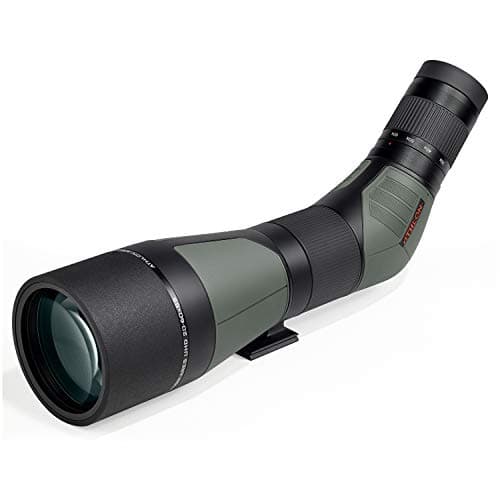
Athlon Ares G2 UHD 20-60x85
UHD glass in an 85 mm body at a price that undercuts the Viper HD, which is Athlon's whole argument.
Price as of November 12, 2026. #ad How we earn
Athlon's whole argument is that you are paying a brand tax everywhere else, and the Ares G2 UHD is the clearest test of it on this site: an apochromatic 85 mm spotting scope that undercuts the Vortex Viper HD on price and comes in 6.6 oz lighter. On the published numbers the argument mostly holds. The two places it does not are the field of view at 20x and the parts of the spec sheet Athlon declines to publish.
What Athlon publishes, and what it does not
Read off Athlon's own specification table on 2026-10-19: 20-60x magnification, an 85 mm objective, 99-47 ft of linear field at 1,000 yards across the zoom, eye relief of 0.77 in down to 0.70 in, a 45 degree angled eyepiece, 70 oz of weight and a 16.9 by 4 in body. Athlon states an apochromatic lens system, UHD glass, and an ESP dielectric prism coating it describes as reflecting over 99 percent of light.
Two numbers are ours, because they are arithmetic rather than claims. Exit pupil is objective divided by magnification: 85 / 20 = 4.25 mm at the bottom of the zoom, and 85 / 60 = 1.42 mm at the top. The twilight factor at 20x is the square root of 20 x 85, which is 41.2. Those figures are identical on every 20-60x85 ever made, at any price, which is the single most useful thing to understand before comparing spotting scopes - exit pupil and twilight factor works through why.
What Athlon does not publish is worth naming plainly, because the rest of this site quotes specifications rather than impressions. There is no close focus figure, no stated waterproof or nitrogen-purge rating, and no angular field of view on the product page we read. Athlon's marketing copy calls the scope waterproof and fogproof; that is a description, not a specification, and we are not going to convert it into one. If you need a sealing rating in writing - for a guided hunt in weather, say - ask Athlon directly before you buy.
The field of view at 20x is the real compromise
A spotting scope is used in two distinct ways, and the field of view at the bottom of the zoom governs the first of them. You search at 20x - panning across a hillside, letting the width of the circle do the work - and you judge at 45x to 60x, holding on an animal you have already found. 99 ft at 20x is the narrowest search field of the three 85 mm scopes on this page, 9 ft tighter than the Diamondback HD and 2 ft tighter than the Viper HD.
How much that costs you depends entirely on your method. If you find animals with binoculars and only put the scope up to judge them - which is the correct way to use a spotting scope, and the way this site recommends - then 99 ft is plenty and you will never notice the gap. If you search with the scope itself, you are panning a narrower circle across the same hillside and it is slower. How to glass with a spotting scope sets out the two-optic method that makes this specification almost irrelevant, and spotting scope vs binoculars is the argument for why you should be working that way regardless of which scope you buy.
Eye relief across the zoom, which is where it quietly wins
19.6 mm at 20x falling to 17.8 mm at 60x is a good set of numbers, and spotting scopes are where eye relief matters most. You are pressed against an eyepiece for minutes at a time, often in the cold, usually squinting at the edge of what the scope can resolve - and if you wear glasses, short eye relief at the top of the zoom means the picture closes down exactly when you need all of it. The Ares G2 UHD gives up nothing to the Viper HD here; both publish the same 17.8-19.6 mm range, in opposite order across the zoom.
The 45 degree angled eyepiece is the other ergonomic decision and it is the right default for hunting. Angled means you look down into the scope rather than through it, so the tripod can sit lower, you can glass from a seated position without craning, and sharing the scope with someone else does not involve re-levelling anything. The case for a straight body is narrower than most buyers think - angled vs straight covers when it applies.
70 oz, and whether this is a pack scope
It is lighter than the Viper HD by 6.6 oz, which Athlon deserves credit for, and it is still 70 oz - four and a third pounds before you add a tripod and a head. Call the realistic system weight six to seven pounds. That is not a backpack-hunting optic for most people, and no amount of 6.6 oz advantage changes that; it is a truck-and-day-hunt scope, or a base-camp scope you carry to a glassing knob and leave set up.
If you genuinely need to carry a scope in a pack for days, the honest answer is a 65 mm body and the acceptance that 60x will be soft - the best compact spotting scopes is that decision - or no scope at all, with a 15x56 binocular on a tripod doing the searching and a closer approach doing the judging. Whatever you choose, budget for the mount before the glass: a good 85 mm scope on an undersized tripod is a worse instrument than a cheap one on a solid mount, and the best tripods for spotting scopes is where that money should go.
The brand question, answered honestly
Athlon is a younger company than Vortex or Leupold, sells mostly online, and prices accordingly. The warranty is lifetime and transferable and Athlon honors it - that part of the pitch is real. What is also real is that service turnaround runs longer than the majors, there is no dealer counter to walk into with a problem, and resale demand is thinner, so you should expect to recover less of the purchase price if you sell it on.
Whether that matters is a question about you rather than about the scope. For a hunter who buys an optic and keeps it, it is close to irrelevant and the money saved goes into a better tripod. For someone who upgrades every few seasons, or who hunts in a place where a two-week service turnaround would cost a trip, the Vortex premium is buying something specific. Hunting optics brands is the broader version of that comparison.
Who should buy it, and who should not
- Buy it if you want 85 mm apochromatic glass for the least money and you intend to keep it rather than flip it.
- Buy it if you find animals with binoculars and use the scope only to judge them - then the 99 ft search field costs you nothing.
- Buy the Vortex Viper HD instead if you want a service operation you can phone and a dealer network, and the extra 6.6 oz is irrelevant to how you hunt.
- Buy the Vortex Diamondback HD instead if field of view and weight are what you shop on - 108 ft and 60.9 oz beat this scope on both, for less money.
- Skip it if you need a published sealing rating or close focus figure in writing. Athlon does not publish either.
- Skip it if you are carrying the scope on your back for days. 70 oz plus a tripod is the wrong number for that hunt.
This scope and its two closest alternatives
Price as of November 12, 2026. #ad How we earn
Athlon Ares G2 UHD 20-60x85
UHD glass in an 85 mm body at a price that undercuts the Viper HD, which is Athlon's whole argument.
| Magnification | 20-60x |
|---|---|
| Objective lens | 85 mm |
| Field of view | 99-47 ft @ 1,000 yd |
| Eye relief | 0.77-0.70 in (19.6-17.8 mm) |
| Eyepiece angle | 45 degrees |
| Weight | 70 oz |
| Dimensions | 16.9 x 4 in |
| Exit pupil at 20x (computed) | 4.25 mm |
| Exit pupil at 60x (computed) | 1.42 mm |
| Twilight factor at 20x (computed) | 41.2 |
Specs verified 2026-10-19 from Athlon's published specification. Exit pupil and twilight factor are computed, not quoted.
What it does well
- UHD glass with ED elements and an apochromatic lens system
- Priced below comparable Vortex and Leupold 85 mm scopes
- 19.6 mm of eye relief at 20x, which is generous for a spotting scope
- Lifetime transferable warranty
Where it gives ground
- 99 ft of field at 20x is the narrowest of the 85 mm scopes here - the Diamondback HD publishes 108 ft
- 70 oz is heavy for a backpack hunt, even though it undercuts the Viper HD's 76.6 oz
- Athlon publishes no close focus figure and no sealing specification
- Service turnaround is slower than the majors and resale demand is thinner
Skip it if
You need a walk-in dealer for service, or you are counting ounces on a backpack hunt.
How this score breaks down
- Resolution at top magnification (weight 5)8.9
- Usable magnification range (weight 4)8.9
- Eye relief across the zoom (weight 3)8.5
- Weight and packability (weight 3)6.3
- Build and sealing (weight 2)8.1
Criterion scores are on the 0-10 rubric scale. Their weighted mean is 8.3, which maps to 9.3 on our published recommendation scale of 8.4 to 9.8 - the band of products we are willing to recommend at all. The weights, the definitions and the mapping are all published, so any score here can be checked against our own rules. These are editorial judgments from published specifications, computed optical arithmetic and documented consensus.
Athlon publishes 20-60x on an 85 mm objective, 99 ft of field at 1,000 yards at 20x narrowing to 47 ft at 60x, eye relief of 0.77 in at the bottom of the zoom and 0.70 in at the top - 19.6 mm and 17.8 mm - a 45 degree eyepiece, 70 oz of weight and a 16.9 by 4 in body. The arithmetic adds a 4.25 mm exit pupil at 20x falling to 1.42 mm at 60x, and a twilight factor of 41.2 at 20x.
The reason to buy it is the glass specification at the price. Athlon describes an apochromatic lens system with UHD glass and ESP dielectric prism coatings, and apochromatic is a meaningful word rather than a marketing one: it describes a design corrected for three wavelengths rather than two, which is what suppresses the color fringing that otherwise makes 60x unusable on a high-contrast edge. In an 85 mm scope at this price that specification is genuinely unusual.
The cons are a narrow field and a thin spec sheet. 99 ft at 20x is the narrowest of the three 85 mm scopes here - the Vortex Diamondback HD publishes 108 ft and the Viper HD 101 ft - and at the low end of the zoom, where you do your searching, that difference is real. Athlon also publishes no close focus figure and no sealing specification, which is a transparency problem rather than an optical one: we will not quote numbers Athlon does not state, so if close focus matters to you, assume it is unverified.
Two further honest cons that are structural rather than optical. Athlon's warranty is a lifetime transferable one and Athlon honors it, but service turnaround runs slower than Vortex or Leupold and there is no dealer network to walk into. And resale demand is thinner, which matters if you expect to sell this on in three years to fund something else.
Price as of November 12, 2026. #ad How we earn
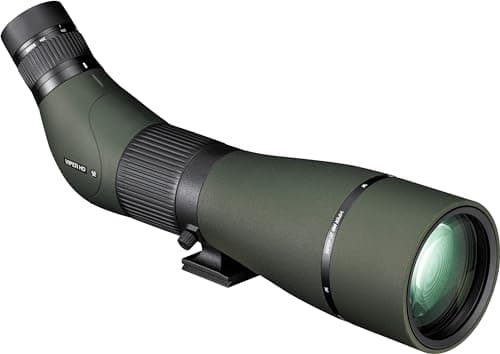
Vortex Viper HD 20-60x85
The step where a spotting scope stops being a compromise: usable detail at 60x instead of giving up at 45x.
| Magnification | 20-60x |
|---|---|
| Objective lens | 85 mm |
| Eye relief | 17.8mm - 19.6mm |
| Field of view | 101' - 50' @ 1000 yds |
| Angular field of view | 1.9º - 1.0º |
| Close focus | 36.0' |
| Weight | 76.6 oz. |
| Length | 17.5" |
| Exit pupil (computed) | 4.25 mm |
| Twilight factor (computed) | 41.2 |
Specs verified 2026-10-05 from Vortex's published specification. Exit pupil and twilight factor are computed, not quoted.
What it does well
- Holds resolution much deeper into the magnification range
- 17.8-19.6 mm eye relief across the zoom
- Apochromatic lens system controls color fringing
Where it gives ground
- 76.6 oz means a serious tripod
- Nearly twice the Diamondback HD's price
Skip it if
You judge animals inside 600 yards. The Diamondback HD does that.
How this score breaks down
- Resolution at top magnification (weight 5)9.0
- Usable magnification range (weight 4)9.1
- Eye relief across the zoom (weight 3)9.0
- Weight and packability (weight 3)6.2
- Build and sealing (weight 2)9.0
Criterion scores are on the 0-10 rubric scale. Their weighted mean is 8.5, which maps to 9.4 on our published recommendation scale of 8.4 to 9.8 - the band of products we are willing to recommend at all. The weights, the definitions and the mapping are all published, so any score here can be checked against our own rules. These are editorial judgments from published specifications, computed optical arithmetic and documented consensus.
The scope the Ares G2 UHD is priced against. Vortex publishes 101-50 ft of field, 17.8-19.6 mm of eye relief, a 36.0 ft close focus, 76.6 oz and a 17.5 in length - so it is 6.6 oz heavier and 2 ft wider at 20x, with a published close focus the Athlon lacks. You are paying for the VIP warranty and a service operation you can reach by phone in an afternoon. Razor HD vs Viper HD covers the step above it.
Price as of November 12, 2026. #ad How we earn
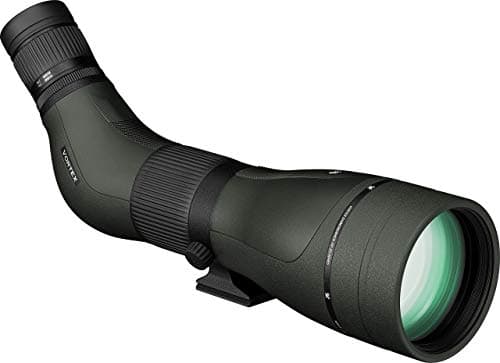
Vortex Diamondback HD 20-60x85
An 85 mm objective, 20-60x, and 18.3-20.3 mm of eye relief for around $500, which is the cheapest credible way into a real spotting scope.
| Magnification | 20-60x |
|---|---|
| Objective lens | 85 mm |
| Eye relief | 18.3mm - 20.3mm |
| Field of view | 108' - 60' @ 1000 yds |
| Angular field of view | 2.1º - 1.1º |
| Close focus | 24.6' |
| Weight | 60.9 oz. |
| Length | 16.0" |
| Exit pupil (computed) | 4.25 mm |
| Twilight factor (computed) | 41.2 |
Specs verified 2026-10-05 from Vortex's published specification. Exit pupil and twilight factor are computed, not quoted.
What it does well
- 85 mm objective gathers enough light for dawn judging
- 18.3-20.3 mm eye relief is unusually generous
- VIP warranty
Where it gives ground
- Image softens noticeably past about 45x
- Needs a tripod costing a meaningful fraction of the scope
Skip it if
You only glass inside 400 yards - 15x56 binoculars are lighter and cheaper.
How this score breaks down
- Resolution at top magnification (weight 5)7.9
- Usable magnification range (weight 4)8.4
- Eye relief across the zoom (weight 3)9.4
- Weight and packability (weight 3)6.8
- Build and sealing (weight 2)8.4
Criterion scores are on the 0-10 rubric scale. Their weighted mean is 8.1, which maps to 9.2 on our published recommendation scale of 8.4 to 9.8 - the band of products we are willing to recommend at all. The weights, the definitions and the mapping are all published, so any score here can be checked against our own rules. These are editorial judgments from published specifications, computed optical arithmetic and documented consensus.
The honest value answer, and it beats both scopes above it on three published specifications: 108 ft of field at 20x, 60.9 oz of weight and 18.3-20.3 mm of eye relief, with a 24.6 ft close focus. What you give up is resolution at the top of the zoom, which is exactly where an 85 mm scope is supposed to earn its weight. The full Diamondback HD 20-60x85 review is the detail.
Our recommendation
If you take one thing from this page, take this.
Athlon Ares G2 UHD 20-60x85
The subject of this review
An apochromatic 85 mm with UHD glass and 19.6 mm of eye relief at 20x, 6.6 oz lighter than the Viper HD and meaningfully cheaper.
Vortex Viper HD 20-60x85
The direct rival
101 ft at 20x and the same 4.25 mm exit pupil, with 76.6 oz of weight and a dealer network behind it.
Prices are pulled live and shown on each button. #ad How we earn.
Questions people actually ask
Is the Athlon Ares G2 UHD a good spotting scope?
Athlon Ares G2 UHD or Vortex Viper HD?
What is the exit pupil of a 20-60x85 spotting scope?
Does the Athlon Ares G2 UHD come in a straight version?
Is 85 mm worth the weight over a 65 mm spotting scope?
Sources
- Athlon Ares G2 UHD 20-60x85 45-degree - published specifications - read 2026-10-19
- Vortex Viper HD 20-60x85 published specifications (comparison figures) - read 2026-10-05
- Vortex Diamondback HD 20-60x85 published specifications (comparison figures) - read 2026-10-05