We earn a commission if you buy through the links on this page, at no extra cost to you. It never changes which products we pick or how we rank them - read the full disclosure.
Our top pick
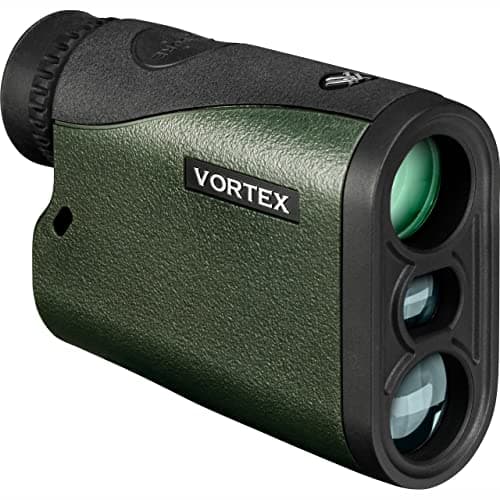
Vortex Crossfire HD 1400
A 5x21 monocular that ranges to 1,400 yards reflective with HCD angle compensation, at the price where rangefinders stop being a luxury.
No buyable offer at the last price check.
Prices change; we show only live figures. #ad How we earn
The easiest rangefinder to use is the Vortex Crossfire HD 1400: one button, angle compensation on by default, and no profile to configure. If you hunt into last light, the Leupold RX-1400i TBR/W Gen 2 is the easier one to read, because an illuminated red display stays legible against dark timber where an LCD fades.
What makes a rangefinder easy to use
Ease of use in this category is not about fewer features in the abstract. It is about how many decisions stand between pressing the button and knowing what to do. Four things decide it.
- One button that does the main job. Mode cycling is fine; mode cycling you must do before every reading is not.
- An answer you can read. An LCD display against a shaded hillside at dusk is the most common real-world failure in this category, and an illuminated display fixes it.
- The correction applied for you. A unit that hands you line-of-sight distance from a treestand has given you a number that is wrong for your shot, and left you to notice.
- No configuration you can get wrong. Ballistic profiles are powerful and they are also a thing to have set up incorrectly in February and forgotten by October.
Quick picks
Ranked by the criteria published on how we review. Tap any row for the full write-up, or go straight to the current price.
| # | Product | Best for | Score | Price |
|---|---|---|---|---|
| 1 | Vortex Crossfire HD 1400One button, HCD angle compensation on by default, 4.8 oz. | Easiest overallSimplest reliable ranging | 9.2out of 10 | See today's price on the Crossfire HD 1400Check price on Amazon No buyable offer at the last price check. |
| 2 | 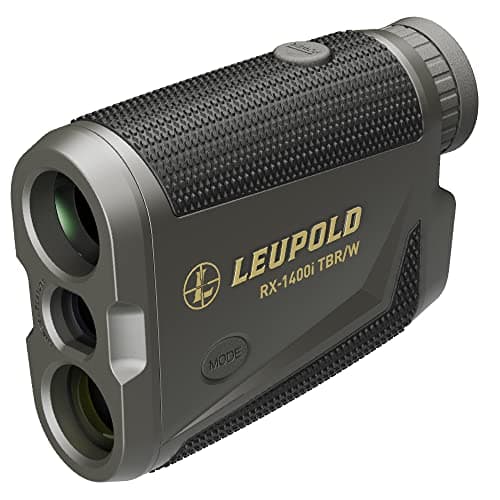 Leupold RX-1400i TBR/W Gen 2A red OLED display that stays legible against dark timber, plus TBR/W holdover. | Easiest to readBest rangefinder under $250 | 9.6out of 10 | |
| 3 | 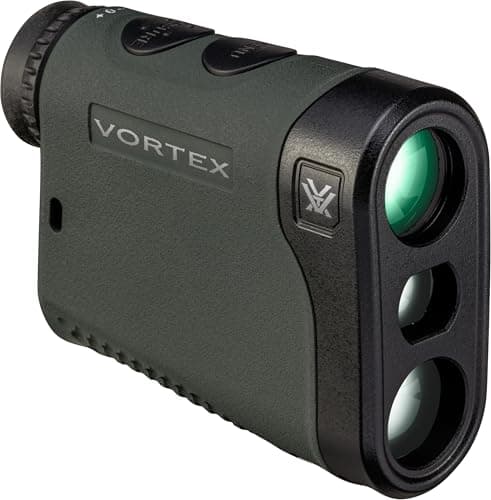 Vortex Triumph HD 850Two buttons, a 4.6 oz body and HCD angle compensation that needs no setup - press it and read the corrected distance. | Simplest to useBest value entry rangefinder | 9.1out of 10 | |
| 4 | 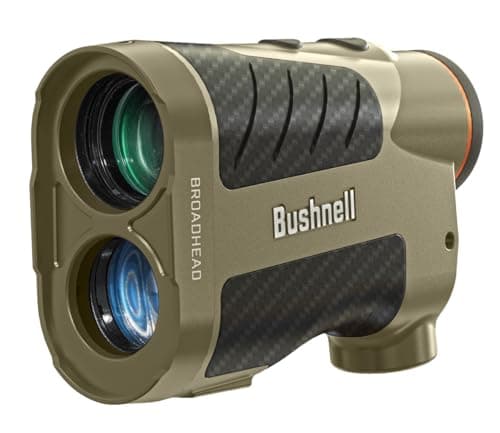 Bushnell BroadheadAngle-compensated ranging with a display that flips to stay readable against any background. | Easiest for bowhuntersBudget bow rangefinder | 9.3out of 10 | See today's price on the BroadheadCheck price on Amazon No buyable offer at the last price check. |
Prices are pulled live from Amazon and were last checked November 12, 2026; if a figure cannot be verified the button reads "Check price" instead. Scores are our editorial judgment against the published ranking criteria, on our published 8.4 to 9.8 recommendation scale. #ad How we earn.
The ease-of-use trap: buying capability you will not configure
The most common bad rangefinder purchase is not a cheap one. It is a capable one, bought by somebody whose shots are all inside 300 yards, configured once, never verified, and then used at speed in bad light. Applied Ballistics on a unit whose profile holds the wrong muzzle velocity is worse than a plain corrected distance, because it is wrong with authority.
If your hunting is inside 400 yards - which covers the large majority of whitetail, hog and timber hunting in this country - the simplest unit with angle compensation is not a compromise. It is the correct tool, and the money saved buys better glass.
| Your hunting | What you need | What you do not |
|---|---|---|
| Treestand whitetail, inside 60 yards | Angle compensation, a readable display | Ballistic solving, long laser reach |
| Timber and field edges, inside 300 yards | Angle compensation, one-button operation | Load profiles |
| Open country, 300-600 yards | Angle compensation plus a holdover output | Onboard environmentals |
| Deliberate long range, 600+ yards | A full ballistic solution | Simplicity - you are past it |
Two habits that make any rangefinder easier
- Range landmarks before the animal arrives. The rock, the fence post, the near edge of the field. When a deer steps out you already know the distance and you do not have to range a moving animal.
- Learn which mode yours is in, once, at home. Most field confusion is a unit sitting in line-of-sight mode when the owner believes it is compensating.
Both of those cost nothing and remove most of the pressure that makes a rangefinder feel hard to use in the first place.
The picks in detail
No buyable offer at the last price check.
Prices change; we show only live figures. #ad How we earn
Vortex Crossfire HD 1400
A 5x21 monocular that ranges to 1,400 yards reflective with HCD angle compensation, at the price where rangefinders stop being a luxury.
| Magnification | 5x |
|---|---|
| Objective lens | 21 mm |
| Eye relief | 16.0mm |
| Field of view | 367' @ 1000 yds |
| Angular field of view | 7.0º |
| Stated accuracy | 1 yds. @100 yds. |
| Weight | 4.8 oz. |
| Length | 4.0" |
| Height | 2.9" |
| Width | 1.3" |
Specs verified 2026-10-05 from Vortex's published specification. Exit pupil and twilight factor are computed, not quoted.
What it does well
- HCD mode gives angle-compensated distance
- 16.0 mm eye relief with a 367 ft field at 5x
- VIP warranty
Where it gives ground
- Display is LCD, not illuminated, so it fades in deep shade
- No ballistic holdover output, just corrected distance
Skip it if
You hunt in low light often - an illuminated display is worth the upgrade.
How this score breaks down
- Ranging accuracy and range on game (weight 5)8.1
- Angle compensation implementation (weight 5)8.7
- Display legibility in low light (weight 3)6.6
- Speed and scan mode (weight 3)8.1
- One-handed ergonomics (weight 2)8.8
Criterion scores are on the 0-10 rubric scale. Their weighted mean is 8.1, which maps to 9.2 on our published recommendation scale of 8.4 to 9.8 - the band of products we are willing to recommend at all. The weights, the definitions and the mapping are all published, so any score here can be checked against our own rules. These are editorial judgments from published specifications, computed optical arithmetic and documented consensus.
The simplicity here is structural rather than marketed. There is one button that matters, HCD mode gives you the angle-corrected distance without being asked, and there is no ballistic profile to configure wrongly. You press, you get the number your bullet cares about.
At 4.8 oz and 4 inches long it also fits any harness pouch, which is part of ease of use - a rangefinder you have to dig for is a rangefinder you do not use.
The one ease-of-use weakness is the display: it is LCD rather than illuminated, so against deep shade at dusk it fades. If you hunt the last light of the day, read the next pick.
Price as of November 12, 2026. #ad How we earn
Leupold RX-1400i TBR/W Gen 2
TBR/W gives you the true horizontal distance and a holdover value in the same readout, which is the single most useful feature on a hunting rangefinder.
| Magnification | 5x |
|---|---|
| Objective lens | 21 mm |
| Eye relief | 18.3 mm |
| Field of view | 368 ft @ 1,000 yd |
| Angular field of view | 7º |
| Max range, reflective | 1,400 yd |
| Max range, trees | 1,200 yd |
| Max range, deer | 900 yd |
| Minimum range | 6 yd |
| Accuracy | +/- 0.5 yd to 125 yd; +/- 2 yd to 1,000 yd; +/- 0.5 % beyond |
| Display | Red TOLED, adjustable brightness |
| Ranging modes | TBR/W, Bow with Flightpath, Line of Sight |
| Battery | CR2, approx. 3,000 actuations |
| Weight | 5.1 oz |
| Dimensions (L x W x H) | 4 x 1.4 x 3 in |
| Laser classification | Class 3R |
Specs verified 2026-10-26 from Leupold's published specification. Exit pupil and twilight factor are computed, not quoted.
What it does well
- TBR/W reports true ballistic range, not line of sight
- Fast, legible red OLED display in low light
- Compact enough for a harness pouch
Where it gives ground
- Stated ranges assume reflective targets, not deer hide - Leupold publishes 1,400 yd reflective but only 900 yd on deer
- No bluetooth or ballistic app integration
- Accuracy loosens to plus or minus 2 yd out at 1,000 yd
Skip it if
You need ranges past 1,000 yards on game - this is not that unit.
How this score breaks down
- Ranging accuracy and range on game (weight 5)8.5
- Angle compensation implementation (weight 5)9.5
- Display legibility in low light (weight 3)9.0
- Speed and scan mode (weight 3)8.5
- One-handed ergonomics (weight 2)9.0
Criterion scores are on the 0-10 rubric scale. Their weighted mean is 8.9, which maps to 9.6 on our published recommendation scale of 8.4 to 9.8 - the band of products we are willing to recommend at all. The weights, the definitions and the mapping are all published, so any score here can be checked against our own rules. These are editorial judgments from published specifications, computed optical arithmetic and documented consensus.
Ease of use is mostly about reading the answer, and this is where an illuminated display earns its premium. A red OLED readout against a dark hillside at last light is instantly legible where an LCD is a guess.
TBR/W gives you a holdover value as well as the corrected distance, which sounds like added complexity and is the opposite: it removes the mental arithmetic step that people get wrong with an animal in view.
It is also small enough for a harness pouch and simple enough to operate in gloves, which is the other half of the problem.
Price as of November 12, 2026. #ad How we earn
Vortex Triumph HD 850
The cheapest way onto the site: HCD angle compensation, a published 350 yd rating on deer and the VIP lifetime warranty, in a 4.6 oz body.
| Magnification | 5x |
|---|---|
| Objective lens | 21 mm |
| Optical system | HD, fully multi-coated |
| Eye relief | 13 mm |
| Field of view | 335 ft @ 1,000 yd |
| Angular field of view | 6.4 degrees |
| Max range, reflective | 850 yd |
| Max range, trees | 500 yd |
| Max range, deer | 350 yd |
| Minimum range | 6 yd |
| Accuracy, to 100 yd | +/- 0.5 yd |
| Accuracy, 100-850 yd | +/- 2 yd |
| Angle compensation | HCD; line of sight and scan modes; reads to +/- 89 degrees |
| Target modes | Normal, first, last |
| Display | Black LCD |
| Battery | CR2, 4,000+ range cycles |
| Weight | 4.6 oz (130 g) |
| Dimensions (L x W x H) | 3.8 x 3.1 x 1.4 in |
| Sealing | Waterproof and shockproof |
| Warranty | Vortex VIP lifetime, transferable |
Specs verified 2026-11-04 from Vortex's published specification. Exit pupil and twilight factor are computed, not quoted.
What it does well
- HCD angle compensation included, which most units at this price leave out
- Published figures for all three target types, including 350 yd on deer
- Plus or minus 0.5 yd inside 100 yd - the tightest short-range figure of any entry unit here
- 4.6 oz, the lightest rangefinder on the site
- Vortex VIP lifetime warranty, transferable and no-fault
- Waterproof and shockproof, with 4,000+ range cycles on one CR2
Where it gives ground
- 350 yd on deer is a genuine ceiling - it is not an open-country unit
- A black LCD rather than an illuminated display, so it is harder to read against dark timber
- 13 mm of eye relief is short if you range in glasses
Skip it if
You hunt open country past about 350 yards. Buy the RX-1400i TBR/W Gen 2 instead.
How this score breaks down
- Ranging accuracy and range on game (weight 5)7.0
- Angle compensation implementation (weight 5)9.0
- Display legibility in low light (weight 3)6.0
- Speed and scan mode (weight 3)7.5
- One-handed ergonomics (weight 2)9.5
Criterion scores are on the 0-10 rubric scale. Their weighted mean is 7.8, which maps to 9.1 on our published recommendation scale of 8.4 to 9.8 - the band of products we are willing to recommend at all. The weights, the definitions and the mapping are all published, so any score here can be checked against our own rules. These are editorial judgments from published specifications, computed optical arithmetic and documented consensus.
Simplicity here is a design choice rather than a missing feature. There is no ballistic profile to enter, no app to pair and no solver to configure: you press the button and the display gives you the horizontal distance, because HCD is the default. Vortex publishes 350 yd on deer, plus or minus 0.5 yd inside 100 yd, 335 ft of field at 5x, normal, first and last target modes, and a scan mode for following a moving animal.
At 4.6 oz it is the lightest rangefinder on the site and the easiest to work in gloves, and one CR2 lasts over 4,000 range cycles, so the battery is not something you think about during a season. The VIP lifetime warranty removes the other worry. Good to know: the published ceiling is 350 yd on deer, and the display is a black LCD rather than an illuminated one, so it reads best in daylight.
No buyable offer at the last price check.
Prices change; we show only live figures. #ad How we earn
Bushnell Broadhead
Angle-compensated ranging aimed at archery distances, with ActivSync display that flips between dark and light to stay readable.
| Magnification | 6x |
|---|---|
| Objective lens | 24 mm |
| Max range, reflective | 1,500 yd |
| Max range, non-reflective | 800 yd |
| Stated accuracy | +/- 0.3 yd to 150 yd |
| Angle compensation | Yes (true horizontal distance in Bow mode) |
| Display | ActivSync - switches between black and illuminated red |
| Ranging modes | Bow, Scan, target priority |
| Battery | CR2 |
| Weight | 5.9 oz |
| Dimensions (L x W) | 4.3 x 1.57 in |
| Water resistance | Water resistant; the owner's manual states IPX4 |
| Max range, deer | not published |
Magnification and objective are the manufacturer's own model designation; exit pupil and twilight factor are computed from them. We could not machine-read Bushnell's spec page, so the remaining published figures are not listed rather than guessed.
What it does well
- ActivSync display adapts to background brightness
- Angle compensation at an archery-focused price
- Compact and one-hand operable
Where it gives ground
- Less precise than the FullDraw 5 on true arrow ballistics
- Stated maximum range is optimistic for game
Skip it if
You want arrow-specific holdover rather than corrected distance.
How this score breaks down
- Ranging accuracy and range on game (weight 5)7.9
- Angle compensation implementation (weight 5)8.9
- Display legibility in low light (weight 3)8.7
- Speed and scan mode (weight 3)8.1
- One-handed ergonomics (weight 2)8.7
Criterion scores are on the 0-10 rubric scale. Their weighted mean is 8.4, which maps to 9.3 on our published recommendation scale of 8.4 to 9.8 - the band of products we are willing to recommend at all. The weights, the definitions and the mapping are all published, so any score here can be checked against our own rules. These are editorial judgments from published specifications, computed optical arithmetic and documented consensus.
The ActivSync display is the ease-of-use feature: it switches between dark and light text depending on what is behind it, so you are not squinting at black digits against a black trunk. For a bowhunter in a stand at first light that is a practical, daily benefit.
Angle compensation is built in and aimed at archery distances, which is where the correction matters most. Less precise on true arrow ballistics than the RX-FullDraw 5, and that is the step up if you want arrow-specific output.
Our recommendation
If you take one thing from this page, take this.
Vortex Crossfire HD 1400
Easiest overall
One button, HCD angle compensation on by default, 4.8 oz.
No buyable offer at the last price check.
Leupold RX-1400i TBR/W Gen 2
Easiest to read
A red OLED display that stays legible against dark timber, plus TBR/W holdover.
Prices are pulled live and shown on each button. #ad How we earn.
Questions people actually ask
What is the easiest rangefinder to use?
Do I need a complicated rangefinder?
Why can't I read my rangefinder display?
Can I use a rangefinder with gloves on?
Sources
- Vortex Crossfire HD 1400 product specifications - read 2026-10-11
- Leupold RX-1400i TBR/W Gen 2 product page - read 2026-10-11