There is no fixed limit: a 10x42 will show you a mountain 40 miles away and a deer at a mile, because magnification does not set a maximum distance. What it sets is how much detail you get at a given distance. In practice, with good 10x42 glass in decent light, expect to detect a deer-sized animal to roughly a mile, identify what it is to around 800-1,000 yards, and judge antler detail only to about 400-600 yards.
Why the question has no single number
Binocular magnification works by making the angle an object subtends ten times larger. It does not project light further, it does not cut through anything, and it has no range at which it stops working. A 10x42 pointed at the moon shows you the moon.
What limits how far you can usefully see is everything except the binocular: the curvature of the earth and the terrain between you and the target, the amount of haze, dust and heat shimmer in the air, the contrast between the animal and its background, and the resolving power of your own eye. On a clear, cool morning across a canyon you will see things that the same binocular cannot show you at half the distance on a hot afternoon over flat ground.
Detect, identify, judge - three different distances
The useful way to answer this is to split "see" into the three things a hunter actually needs, because they happen at very different ranges.
| Task | What it means | Realistic range |
|---|---|---|
| Detect | Something is there that was not there before | Out to roughly a mile on a deer-sized animal in open country |
| Identify | Deer or elk, cow or bull, buck or doe | Roughly 800-1,000 yards |
| Judge | Antler mass, points, whether it is the animal you want | Roughly 400-600 yards |
| Judge confidently at distance | The same decision past 600 yards | Not with 10x - this is 15x or a spotting scope |
These are field-realistic ranges for competent HD glass in good conditions, not laboratory figures. Haze, heat shimmer, flat light and a tired pair of eyes all shorten every row.
Quick picks
Ranked by the criteria published on how we review. Tap any row for the full write-up, or go straight to the current price.
| # | Product | Best for | Score | Price |
|---|---|---|---|---|
| 1 | 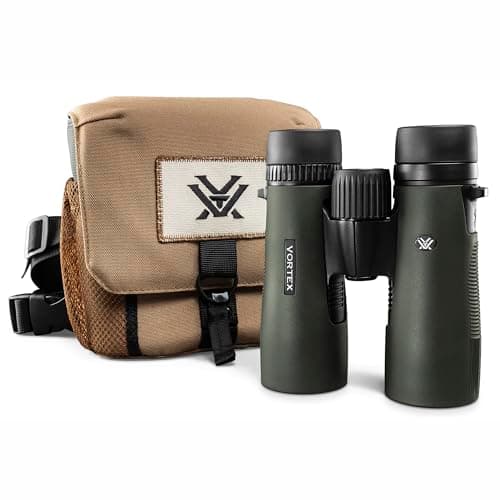 Vortex Diamondback HD 10x42HD glass at the entry tier - the pair most of these distances assume. | The baseline 10x42Best value overall | 9.3out of 10 | See today's price on the Diamondback HD 10x42Check price on Amazon No buyable offer at the last price check. |
| 2 | 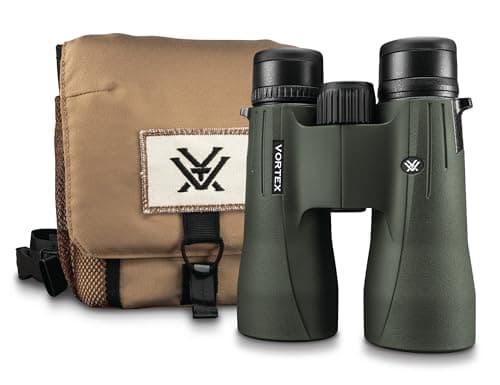 Vortex Viper HD 12x5012x50 resolves antler detail a 10x leaves ambiguous - with a tripod. | When you need more detailOpen country off a tripod | 9.3out of 10 | |
| 3 | 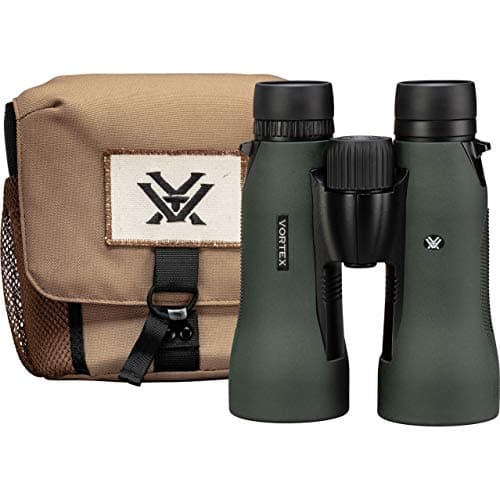 Vortex Diamondback HD 15x5615x56 on a tripod, for the distances where a 10x only shows texture. | For judging at long rangeTripod glassing without a spotting scope | 9.1out of 10 |
Prices are pulled live from Amazon and were last checked November 12, 2026; if a figure cannot be verified the button reads "Check price" instead. Scores are our editorial judgment against the published ranking criteria, on our published 8.4 to 9.8 recommendation scale. #ad How we earn.
The four things that shorten every number
- Atmosphere. Heat shimmer off a sunlit slope at midday destroys resolution more effectively than any optical flaw. The same country is transformed at dawn.
- Contrast. A gray mule deer in gray sage is far harder than a black bear in a green meadow at twice the distance. Detection is a contrast problem before it is a magnification problem.
- Stability. Handheld, your pulse blurs fine detail. On a tripod the same binocular resolves noticeably more - this is the biggest single variable you control.
- Light. In the first and last half hour the limiting factor is exit pupil, not magnification. A 10x42 gives 4.2 mm; your eye wants more.
What about 10x50, 12x50 and 15x56?
A larger objective at the same magnification - 10x50 rather than 10x42 - does not let you see further in daylight. It raises the exit pupil from 4.2 mm to 5 mm, which means it holds up better in the dark half hour and weighs more the rest of the time. That is a low-light upgrade, not a distance upgrade.
More magnification is the actual distance upgrade, and it comes with a narrower field, a dimmer image and a hard requirement for a tripod. The trade-offs are laid out in 10x42 vs 12x50, and the light arithmetic is in exit pupil and twilight factor.
The practical answer
For hunting inside 600 yards, a good 10x42 is enough glass and the limits you run into will be light, stability and shimmer rather than magnification. Past that, add a tripod first and a higher-magnification optic second. And if you are judging animals past 800 yards routinely, you want a spotting scope - that is what the category exists for.
Questions people actually ask
How far can you see with 10x42 binoculars?
How far can you see with 12x50 binoculars?
Does a bigger objective lens let you see further?
Why can I see less than the numbers suggest?
Sources
- Vortex Diamondback HD 10x42 product specifications - read 2026-10-11
- Vortex Diamondback HD 15x56 product specifications - read 2026-10-11