Spotting scopes are the most commonly bought-too-early optic in hunting. They are also genuinely necessary for a specific group of hunters. The test for which you are takes one honest question.
The test
When was the last time you could see an animal clearly, and could not decide whether to go after it because you could not resolve enough detail?
If that happens regularly, you need a spotting scope and the rest of this page is academic. If it has happened once, or never, the thing limiting you is something else - and the something else is usually cheaper to fix.
What is usually limiting people instead
| What is actually happening | The constraint | What fixes it | Cost |
|---|---|---|---|
| You are not finding animals at all | Technique, and handheld shake | A tripod, and the grid method | $149 |
| You find them but cannot judge at 400-600 yd | Magnification | 15x56 binoculars on that tripod | $369 |
| You lose animals in the last light | Exit pupil | An 8x42, not more magnification | $239 |
| Your binoculars are in your pack | Carry | A harness | $29 |
| You find and judge fine but shots feel uncertain | Yardage | An angle-compensating rangefinder | $200 |
| You can see the animal, not the detail, past 800 yd | Resolution | A spotting scope | $499+ |
Only the last row is a spotting scope problem. Every other row is cheaper and more common.
Why a tripod comes first
This is the single most under-bought item in hunting optics. Handheld glassing above about 10x is shaky, and over a long session the fatigue makes you glass worse and for less time. Mounted, you can work a hillside methodically for forty minutes - which is what actually finds bedded animals.
A $149 tripod and a $20 adapter applied to binoculars you already own will usually improve what you see more than a $499 scope would. The technique it enables, and the tripod picks.
When you genuinely do need one
- You hunt open western country and judge animals at 800 yards and beyond before committing to a long stalk.
- You hunt species where the judging call is fine - counting points, measuring horn curl against regulations, deciding on a trophy.
- Your hunt involves a draw tag you will not get again, where getting the judging call wrong is expensive in a way that justifies the gear.
- You glass from fixed vantage points for hours and the weight genuinely does not matter.
For those hunters a scope is not a luxury, and the right advice is to buy one good enough that the top of the zoom is usable. The $1,000 tier.
The buying order
Price as of October 5, 2026. #ad How we earn
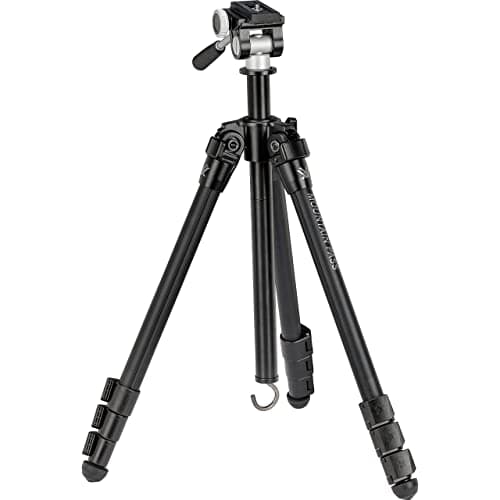
Vortex Mountain Pass Tripod Kit
3.1 lbs of aluminum with a ball head included, which makes it the cheapest way to get binoculars genuinely steady.
Magnification and objective are the manufacturer's own model designation; exit pupil and twilight factor are computed from them. We could not machine-read Vortex's spec page, so the remaining published figures are not listed rather than guessed.
What it does well
- Ball head included at $149
- Stable enough for 15x56 binoculars
- VIP warranty
Where it gives ground
- 3.1 lbs of aluminum is heavy for the stability it gives
- Not stiff enough for an 85 mm scope at 60x
Skip it if
You own a spotting scope. Buy carbon.
How this score breaks down
- Resolution at top magnification (weight 5)n/a
- Usable magnification range (weight 4)n/a
- Eye relief across the zoom (weight 3)n/a
- Weight and packability (weight 3)n/a
- Build and sealing (weight 2)n/a
Weights and definitions are published on how we review. These are editorial judgments from published specs and documented consensus, not test results.
Vortex publishes 3.1 lbs for this kit (verified 2026-10-05). Putting the binoculars you already own on a tripod is a bigger improvement than most people expect, and far cheaper than a scope.
Price as of October 5, 2026. #ad How we earn
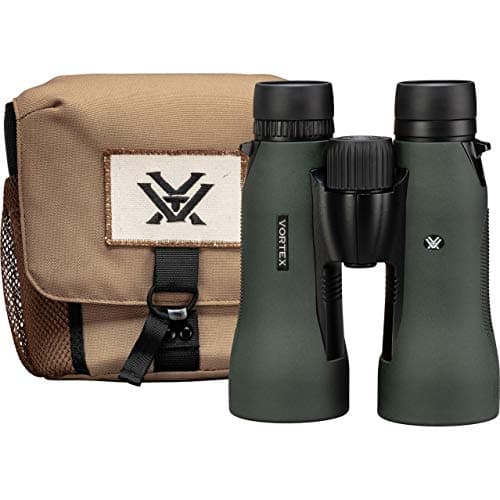
Vortex Diamondback HD 15x56
A 3.73 mm exit pupil and 230 ft of field: the cheapest credible way to sit behind a tripod all morning without carrying a spotting scope.
| Magnification | 15x |
|---|---|
| Objective lens | 56 mm |
| Eye relief | 15.6mm |
| Field of view | 230' @ 1000 yds |
| Angular field of view | 4.4º |
| Close focus | 14.0' |
| Weight | 34.8 oz. |
| Height | 7.1" |
| Width | 5.8" |
| Exit pupil (computed) | 3.73 mm |
| Twilight factor (computed) | 29 |
Specs verified 2026-10-05 from Vortex's published specification. Exit pupil and twilight factor are computed, not quoted.
What it does well
- 15x finds animals a 10x walks past
- 56 mm objective keeps it usable at dawn
- Much lighter and cheaper than a spotting scope setup
Where it gives ground
- 42.7 oz and 15x means a tripod is mandatory, not optional
- Too much magnification for timber or still-hunting
Skip it if
This is your only pair of binoculars. 15x is a second optic, not a first one.
How this score breaks down
- Resolution at top magnification (weight 5)7.5
- Usable magnification range (weight 4)6.0
- Eye relief across the zoom (weight 3)7.5
- Weight and packability (weight 3)8.5
- Build and sealing (weight 2)9.0
Weights and definitions are published on how we review. These are editorial judgments from published specs and documented consensus, not test results.
Vortex publishes 230 ft of field and 15.6 mm of eye relief (verified 2026-10-05). For glassing inside 600 yards this does what most people buy a scope for.
Price as of October 5, 2026. #ad How we earn
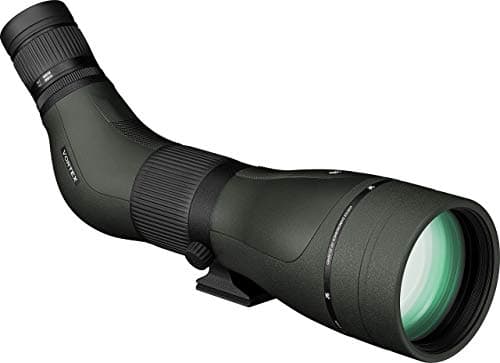
Vortex Diamondback HD 20-60x85
An 85 mm objective, 20-60x, and 18.3-20.3 mm of eye relief for around $500, which is the cheapest credible way into a real spotting scope.
| Magnification | 20-60x |
|---|---|
| Objective lens | 85 mm |
| Eye relief | 18.3mm - 20.3mm |
| Field of view | 108' - 60' @ 1000 yds |
| Angular field of view | 2.1º - 1.1º |
| Close focus | 24.6' |
| Weight | 60.9 oz. |
| Length | 16.0" |
| Exit pupil (computed) | 4.25 mm |
| Twilight factor (computed) | 41.2 |
Specs verified 2026-10-05 from Vortex's published specification. Exit pupil and twilight factor are computed, not quoted.
What it does well
- 85 mm objective gathers enough light for dawn judging
- 18.3-20.3 mm eye relief is unusually generous
- VIP warranty
Where it gives ground
- Image softens noticeably past about 45x
- Needs a tripod costing a meaningful fraction of the scope
Skip it if
You only glass inside 400 yards - 15x56 binoculars are lighter and cheaper.
How this score breaks down
- Resolution at top magnification (weight 5)8.0
- Usable magnification range (weight 4)8.5
- Eye relief across the zoom (weight 3)9.5
- Weight and packability (weight 3)7.0
- Build and sealing (weight 2)8.5
Weights and definitions are published on how we review. These are editorial judgments from published specs and documented consensus, not test results.
The right purchase when you have established that resolution at long range is specifically what limits you.
Questions people actually ask
Do I need a spotting scope for deer hunting?
What should I buy before a spotting scope?
Will a spotting scope help me find more animals?
Is a spotting scope worth it for elk hunting?
Sources
- Vortex Diamondback HD 15x56 published specifications - read 2026-10-05
- Vortex Mountain Pass tripod kit published specifications - read 2026-10-05