We earn a commission if you buy through the links on this page, at no extra cost to you. It never changes which products we pick or how we rank them - read the full disclosure.
Our top pick
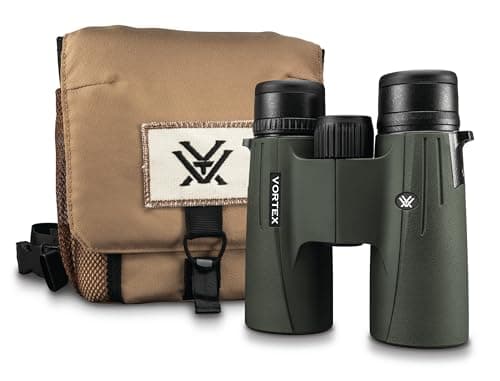
Vortex Viper HD 8x42
The same body and glass as the 10x42 with a 5.25 mm exit pupil instead of 4.2 mm, which is why it looks brighter in the final ten minutes of legal light.
Price as of October 5, 2026. #ad How we earn
A bowhunter's binocular problem is almost the opposite of a western rifle hunter's. The animal is close, the light is usually poor, you cannot move much, and you may be doing it one-handed while holding a bow.
Magnification is the least important spec here
At 30 yards an 8x shows you an animal 30 times closer than it needs to be to judge. The question is never "can I resolve it", it is "can I see it clearly in this light without being caught moving". So the three specs that matter are exit pupil, field of view, and eye relief - and all three favor 8x42 over 10x42.
| Spec | 8x42 | 10x42 | Which wins at 30 yards |
|---|---|---|---|
| Exit pupil (computed) | 5.25 mm | 4.20 mm | 8x42, clearly |
| Published field (Viper HD) | 409 ft | 341 ft | 8x42, clearly |
| Published eye relief (Viper HD) | 18.0 mm | 17.0 mm | 8x42 |
| Resolvable detail at 30 yd | Ample | Ample | Neither - both far exceed the need |
Published figures read from Vortex on 2026-10-05. The last row is the point of the table: the one spec 10x wins is the one that does not matter at this distance.
Quick picks
Ranked by the criteria published on how we review. Tap any row for the full write-up, or go straight to the current price.
| # | Product | Best for | Score | Price |
|---|---|---|---|---|
| 1 | Vortex Viper HD 8x42409 ft of field and 18.0 mm of eye relief, with the brightest practical exit pupil. | Best for bowhuntingLast light and timber | 9.3out of 10 | |
| 2 | 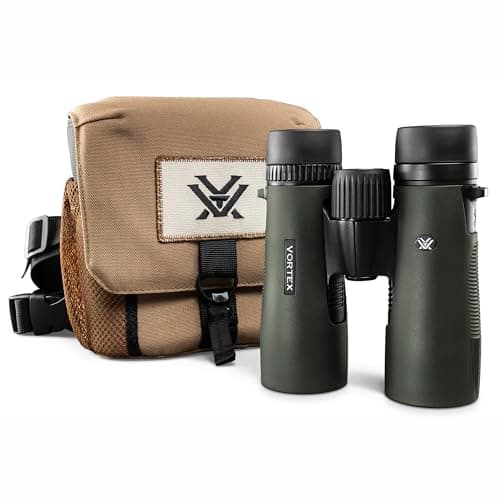 Vortex Diamondback HD 8x42The same format for about $239, with 393 ft and 17 mm published. | Best value for bowhuntingBudget low-light pick | 9.0out of 10 | |
| 3 | 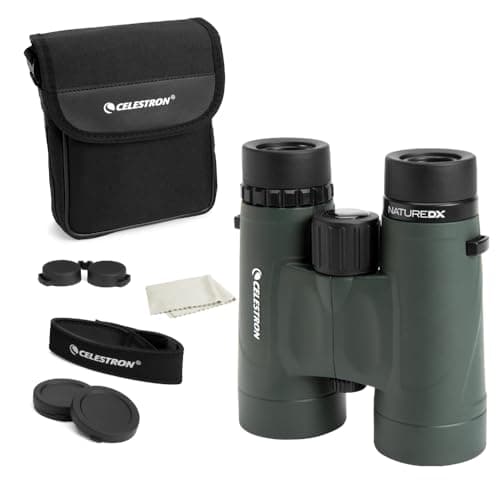 Celestron Nature DX 8x4217.5 mm of published eye relief and a very short close focus. | Best for glasses wearers on a budgetDual-use glassing and wildlife | 8.0out of 10 | $148.99 on Amazon $179.95 17% off |
| 4 | 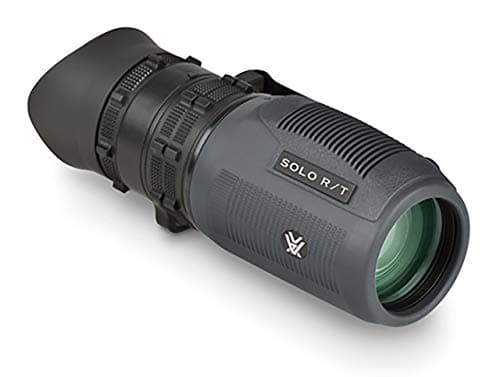 Vortex Solo R/T 8x36A monocular with a ranging reticle - a third the bulk for quick looks. | Lightest optionRanging reticle in a pocket | 8.2out of 10 |
Prices are pulled live from Amazon and were last checked October 5, 2026; if a figure cannot be verified the button reads "Check price" instead. Scores are our editorial judgment against the published ranking criteria, not a test result. #ad How we earn.
The rangefinder is the more important purchase
If you bowhunt and own one optic beyond your sight, it should arguably be a rangefinder rather than binoculars. The difference between 28 and 32 yards is the difference between a lung shot and a gut shot, and at the angles you shoot from a stand, line-of-sight distance is not the number your pins are calibrated for.
From 20 feet up, an animal at 30 yards line-of-sight is about 28 yards horizontally - gravity only acts over the horizontal, so a bow sighted for 30 shoots high. That is what angle compensation fixes. Our bowhunting rangefinder picks, and why the angle matters more close in than far out.
The picks in detail
Price as of October 5, 2026. #ad How we earn
Vortex Viper HD 8x42
The same body and glass as the 10x42 with a 5.25 mm exit pupil instead of 4.2 mm, which is why it looks brighter in the final ten minutes of legal light.
| Magnification | 8x |
|---|---|
| Objective lens | 42 mm |
| Eye relief | 18.0mm |
| Field of view | 409' @ 1000 yds |
| Angular field of view | 7.8º |
| Close focus | 6.0' |
| Weight | 24.5 oz. |
| Height | 5.6" |
| Width | 4.9" |
| Exit pupil (computed) | 5.25 mm |
| Twilight factor (computed) | 18.3 |
Specs verified 2026-10-05 from Vortex's published specification. Exit pupil and twilight factor are computed, not quoted.
What it does well
- 5.25 mm exit pupil is the brightest in the Viper 42 mm line
- 18.0 mm eye relief, the most forgiving in the range
- 409 ft field of view makes finding animals in cover faster
Where it gives ground
- 8x will not resolve a bedded buck at 800 yards
- Costs the same as the 10x42, so the choice is purely about terrain
Skip it if
Most of your glassing is across open basins - you will want the 10x or 12x.
How this score breaks down
- Low-light performance (weight 5)9.5
- Optical quality per dollar (weight 4)9.0
- Field of view (weight 3)9.5
- Eye relief (weight 3)9.5
- Weight and ergonomics (weight 2)8.0
- Warranty (weight 2)10.0
Weights and definitions are published on how we review. These are editorial judgments from published specs and documented consensus, not test results.
At 30 yards you do not need magnification, you need to see cleanly in bad light without moving much. The computed 5.25 mm exit pupil and Vortex's published 409 ft field and 18.0 mm eye relief (verified 2026-10-05) are exactly that combination. The generous eye relief matters more here than anywhere: from a stand you are often braced awkwardly and bringing the glass up quickly.
Price as of October 5, 2026. #ad How we earn
Vortex Diamondback HD 8x42
A 5.25 mm exit pupil and 17 mm of eye relief at the $250 tier, which is the combination most first upgrades actually need.
| Magnification | 8x |
|---|---|
| Objective lens | 42 mm |
| Eye relief | 17 mm |
| Field of view | 393 feet/1000 yards |
| Angular field of view | 7.5 degrees |
| Close focus | 5 feet |
| Weight | 21.8 oz |
| Height | 5.8 inches |
| Width | 5.1 inches |
| Exit pupil (computed) | 5.25 mm |
| Twilight factor (computed) | 18.3 |
Specs verified 2026-10-05 from Vortex's published specification. Exit pupil and twilight factor are computed, not quoted.
What it does well
- 5.25 mm exit pupil, the same figure as the Viper HD 8x42
- 17 mm eye relief works with glasses
- 393 ft field of view is wide for the money
Where it gives ground
- 8x limits you in genuinely open country
- Focus wheel is stiffer than the Viper's in the cold
Skip it if
You glass across canyons - the extra magnification matters more than the brightness there.
How this score breaks down
- Low-light performance (weight 5)8.5
- Optical quality per dollar (weight 4)9.5
- Field of view (weight 3)9.0
- Eye relief (weight 3)9.0
- Weight and ergonomics (weight 2)8.0
- Warranty (weight 2)10.0
Weights and definitions are published on how we review. These are editorial judgments from published specs and documented consensus, not test results.
Bowhunting is the use case where the $250 tier is most clearly sufficient. Inside 50 yards, the transmission advantage of more expensive glass has the least room to express itself, and the exit pupil is identical at 5.25 mm.
Celestron Nature DX 8x42
A 5.25 mm exit pupil, 17.5 mm of eye relief and a close focus near 6.5 ft, which makes it the best of these for wildlife watching as well as hunting.
| Magnification | 8x |
|---|---|
| Objective lens | 42 mm |
| Exit pupil (computed) | 5.25 mm |
| Twilight factor (computed) | 18.3 |
Magnification and objective are the manufacturer's own model designation; exit pupil and twilight factor are computed from them. We could not machine-read Celestron's spec page, so the remaining published figures are not listed rather than guessed.
What it does well
- 17.5 mm eye relief, verified in Celestron's published specs
- Close focus is far shorter than hunting-first designs
- Very light for a 42 mm
Where it gives ground
- BaK-4 prisms without ED glass - chromatic aberration is visible
- Not built to the same abuse standard as hunting-first brands
Skip it if
This is strictly a hunting optic for you - the Diamondback HD is tougher for the money.
How this score breaks down
- Low-light performance (weight 5)7.0
- Optical quality per dollar (weight 4)8.5
- Field of view (weight 3)8.0
- Eye relief (weight 3)9.5
- Weight and ergonomics (weight 2)8.5
- Warranty (weight 2)6.5
Weights and definitions are published on how we review. These are editorial judgments from published specs and documented consensus, not test results.
The longest published eye relief on this page at 17.5 mm (verified 2026-10-05), and a close focus short enough to examine something a few paces from the stand. For a bowhunter in glasses on a budget it is the most comfortable option here, at the cost of visible chromatic aberration.
Price as of October 5, 2026. #ad How we earn
Vortex Solo R/T 8x36
A 4.5 mm exit pupil, 18 mm of eye relief and an MRAD ranging reticle in a unit that weighs a third of a binocular.
| Magnification | 8x |
|---|---|
| Objective lens | 36 mm |
| Eye relief | 18.0mm |
| Field of view | 393' @ 1000 yds |
| Angular field of view | 7.5º |
| Close focus | 16.4' |
| Weight | 9.7 oz. |
| Length | 4.9" |
| Exit pupil (computed) | 4.5 mm |
| Twilight factor (computed) | 17 |
Specs verified 2026-10-05 from Vortex's published specification. Exit pupil and twilight factor are computed, not quoted.
What it does well
- R/T ranging reticle estimates distance without batteries
- 18.0 mm eye relief, verified in Vortex's published specs
- Half the bulk of binoculars
Where it gives ground
- One eye tires faster than two over a long sit
- No depth perception, which matters in cover
Skip it if
You glass for more than a few minutes at a time.
How this score breaks down
- Low-light performance (weight 5)7.0
- Optical quality per dollar (weight 4)8.5
- Field of view (weight 3)7.0
- Eye relief (weight 3)9.0
- Weight and ergonomics (weight 2)9.5
- Warranty (weight 2)10.0
Weights and definitions are published on how we review. These are editorial judgments from published specs and documented consensus, not test results.
Included because bowhunting involves a great many brief confirming looks and relatively few long glassing sessions. Vortex publishes 18.0 mm of eye relief and 393 ft of field (verified 2026-10-05); the computed exit pupil is 4.5 mm, which is usable near legal light. It is not as good to look through as binoculars and it takes up a third of the room. The honest monocular comparison.
Questions people actually ask
What magnification binoculars for bowhunting?
Do bowhunters need binoculars at all?
Binoculars or a rangefinder first for bowhunting?
Are compact binoculars good for bowhunting from a stand?
Sources
- Vortex Viper HD 8x42 published specifications - read 2026-10-05
- Vortex Solo R/T 8x36 published specifications - read 2026-10-05