We earn a commission if you buy through the links on this page, at no extra cost to you. It never changes which products we pick or how we rank them - read the full disclosure.
Reviewed here
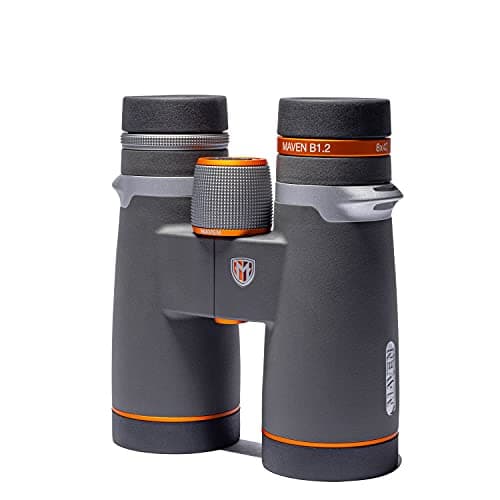
Maven B1.2 10x42
Maven sells direct and skips the dealer margin, which is how a $1,150 binocular ends up competing with glass priced nearer $2,000.
Price as of October 5, 2026. #ad How we earn
The B1.2 is the most interesting binocular on this site, and for most people reading it, the wrong purchase. Both of those things are worth explaining.
What makes it interesting
Maven sells direct. A traditionally distributed binocular carries a dealer margin on top of the manufacturer's; removing it means the same retail price can contain substantially more glass. That is why a $1,150 Maven is routinely compared with binoculars priced nearer $2,000 rather than with ones priced at $1,150, and the comparison is not marketing - it is arithmetic about distribution.
In practice that buys higher-grade extra-low-dispersion elements and a more sophisticated coating stack than the price band normally contains, which shows as better light transmission, cleaner color and an image that holds together further from center.
What we could and could not verify
Being specific about this matters more than usual here. The B1.2 is 10x42, so we can compute its exit pupil (4.20 mm) and twilight factor (20.5) with confidence from the model designation - those are arithmetic. Maven publishes the 8x42 and 10x42 on a single product page, which means the figures we could machine-read from it are ambiguous as to which model they describe. Rather than attribute an ambiguous field-of-view or eye-relief figure to the 10x42, we have left those out.
That is a thinner evidence base than this site's Vortex pages, which carry twelve verified figures each, and you should weigh it accordingly. It is also exactly the situation our methodology says to flag rather than paper over.
Why most readers should not buy it
This site is written for someone upgrading from a cheap pair of binoculars. If that is you, the jump you have already made is far larger than the jump from a $500 binocular to this one. Both are 4.20 mm exit pupil and 20.5 twilight factor. What the extra $650 buys is the last increment of transmission and resolution.
Spent differently, $650 buys a tripod, a binocular adapter and a good angle-compensating rangefinder - and that combination will change what you see and what you can shoot at far more than better glass in the same format will. The $1,000 kit page lays it out.
Who should buy it
- You already own competent mid-range glass and can name what you are missing - usually edge performance or color neutrality in flat light.
- You glass for hours at a time, where small differences in transmission compound into real fatigue differences.
- You are comfortable buying without looking through it first, and you have checked Maven's current return window.
- You are buying a twenty-year optic and the price amortises accordingly.
The B1.2 and its two closest alternatives
Price as of October 5, 2026. #ad How we earn
Maven B1.2 10x42
Maven sells direct and skips the dealer margin, which is how a $1,150 binocular ends up competing with glass priced nearer $2,000.
| Magnification | 10x |
|---|---|
| Objective lens | 42 mm |
| Exit pupil (computed) | 4.2 mm |
| Twilight factor (computed) | 20.5 |
Magnification and objective are the manufacturer's own model designation; exit pupil and twilight factor are computed from them. We could not machine-read Maven's spec page, so the remaining published figures are not listed rather than guessed.
What it does well
- Optically competitive with binoculars costing far more
- Customizable finish when ordered direct
- Unconditional lifetime warranty
Where it gives ground
- Mostly a direct-sale product, so stock on Amazon moves
- No dealer network for hands-on comparison
Skip it if
You want to look through it before buying. Maven's model makes that hard.
How this score breaks down
- Low-light performance (weight 5)9.5
- Optical quality per dollar (weight 4)8.0
- Field of view (weight 3)8.5
- Eye relief (weight 3)9.0
- Weight and ergonomics (weight 2)8.0
- Warranty (weight 2)9.5
Weights and definitions are published on how we review. These are editorial judgments from published specs and documented consensus, not test results.
Maven's structural advantage is real: the margin a dealer would take goes into glass instead. The limitation of this review is that Maven's product page covers the 8x42 and 10x42 together, so we do not attribute specific field-of-view or eye-relief figures to the 10x42 from it.
Price as of October 5, 2026. #ad How we earn
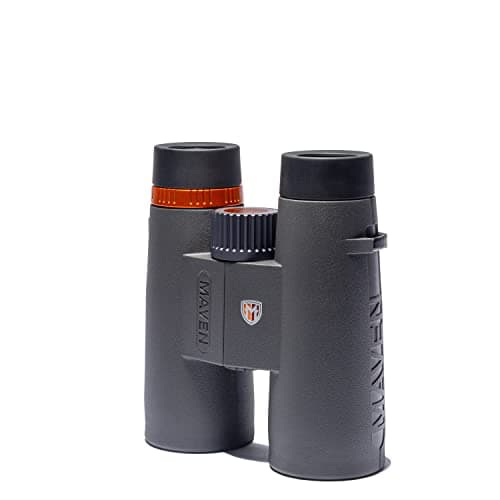
Maven C1 10x42
The C series is Maven's value line: ED glass and the same warranty as the B series, at a price that sits between the Viper HD and the Monarch M7.
| Magnification | 10x |
|---|---|
| Objective lens | 42 mm |
| Exit pupil (computed) | 4.2 mm |
| Twilight factor (computed) | 20.5 |
Magnification and objective are the manufacturer's own model designation; exit pupil and twilight factor are computed from them. We could not machine-read Maven's spec page, so the remaining published figures are not listed rather than guessed.
What it does well
- ED glass with Maven's lifetime warranty
- Lighter than the B1.2
- Direct pricing means no dealer markup
Where it gives ground
- Not as bright at the edges as the B1.2
- Availability on Amazon is inconsistent
Skip it if
You need it this week - direct-sale stock fluctuates.
How this score breaks down
- Low-light performance (weight 5)8.5
- Optical quality per dollar (weight 4)9.0
- Field of view (weight 3)8.0
- Eye relief (weight 3)8.5
- Weight and ergonomics (weight 2)8.0
- Warranty (weight 2)9.5
Weights and definitions are published on how we review. These are editorial judgments from published specs and documented consensus, not test results.
Maven's value line. For most buyers considering the brand, this is the more rational purchase.
Price as of October 5, 2026. #ad How we earn
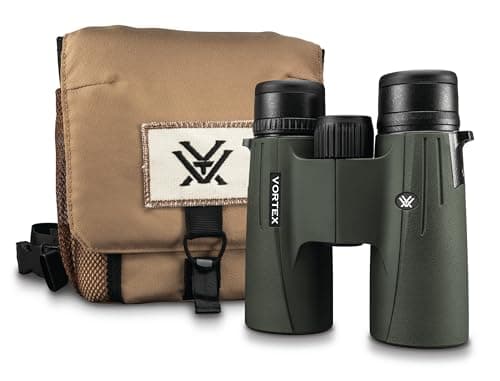
Vortex Viper HD 10x42
The default answer when someone outgrows a $150 pair: 17 mm of eye relief, a 341 ft field of view and glass that holds its edges, at the price where diminishing returns start.
| Magnification | 10x |
|---|---|
| Objective lens | 42 mm |
| Eye relief | 17.0mm |
| Field of view | 341' @ 1000 yds |
| Angular field of view | 6.5º |
| Close focus | 6.0' |
| Weight | 24.9 oz. |
| Height | 5.6" |
| Width | 4.9" |
| Exit pupil (computed) | 4.2 mm |
| Twilight factor (computed) | 20.5 |
Specs verified 2026-10-05 from Vortex's published specification. Exit pupil and twilight factor are computed, not quoted.
What it does well
- 17.0 mm eye relief is generous enough for most glasses wearers
- 341 ft at 1,000 yards is a wide field for a 10x
- Vortex VIP warranty is unconditional and transferable
Where it gives ground
- 24.9 oz is noticeable on a chest harness over a long day
- The 12x50 costs little more if you glass open country
Skip it if
You hunt timber inside 200 yards - the 8x42 Diamondback does that job for less than half the money.
How this score breaks down
- Low-light performance (weight 5)8.5
- Optical quality per dollar (weight 4)9.5
- Field of view (weight 3)9.0
- Eye relief (weight 3)9.0
- Weight and ergonomics (weight 2)7.5
- Warranty (weight 2)10.0
Weights and definitions are published on how we review. These are editorial judgments from published specs and documented consensus, not test results.
The comparison most people are actually making. Head to head.
Questions people actually ask
Is the Maven B1.2 worth $1,150?
How does the B1.2 compare to Swarovski or Zeiss alpha glass?
Can I buy the Maven B1.2 on Amazon?
Should I buy the B1.2 or the C1?
Sources
- Maven B1.2 8x42 and 10x42 product page - read 2026-10-05