We earn a commission if you buy through the links on this page, at no extra cost to you. It never changes which products we pick or how we rank them - read the full disclosure.
Our top pick
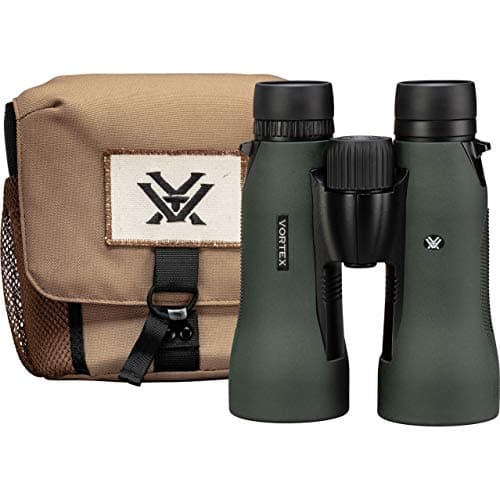
Vortex Diamondback HD 15x56
A 3.73 mm exit pupil and 230 ft of field: the cheapest credible way to sit behind a tripod all morning without carrying a spotting scope.
Price as of November 12, 2026. #ad How we earn
The best binoculars for mule deer hunting are the Vortex Diamondback HD 15x56 on a tripod: 15x finds bedded deer that a 10x walks past, which is the whole problem in open country. If you will carry only one pair, the Vortex Viper HD 12x50 is the compromise - enough magnification for the job, and it still fits a harness.
Why mule deer change the magnification answer
Most binocular advice is written for whitetail hunting, where 8x42 is often the better buy: shots are close, cover is thick, and a wide field of view finds a moving deer in timber. Mule deer country inverts every one of those assumptions.
| Whitetail timber | Mule deer open country | |
|---|---|---|
| Typical glassing distance | 50-300 yards | 400-1,500 yards |
| What you are looking for | A whole moving animal | An ear, an antler tip, a bedded line |
| What helps most | Wide field of view | Magnification and resolution |
| Right magnification | 8x or 10x handheld | 12x or 15x on a tripod |
| Time in one spot | Minutes | Hours |
| Tripod | Rarely needed | The single biggest upgrade |
If you hunt both, the two-optic answer is the honest one: a 10x42 on your chest and a 15x56 on the tripod. One pair cannot serve both ends of that table well.
Quick picks
Ranked by the criteria published on how we review. Tap any row for the full write-up, or go straight to the current price.
| # | Product | Best for | Score | Price |
|---|---|---|---|---|
| 1 | Vortex Diamondback HD 15x5615x56 on a tripod finds bedded deer that a 10x walks straight past. | Best for mule deerTripod glassing without a spotting scope | 9.1out of 10 | |
| 2 | 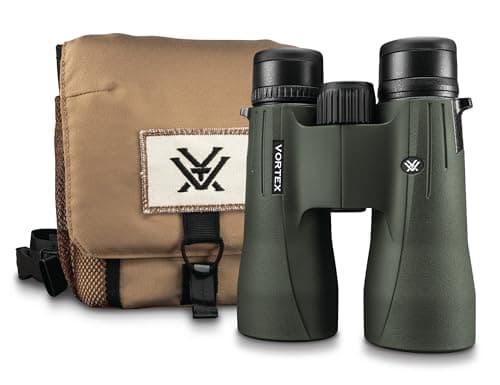 Vortex Viper HD 12x5012x50 still fits a harness, and a 4.17 mm exit pupil keeps it honest at dawn. | Best compromiseOpen country off a tripod | 9.3out of 10 | |
| 3 | 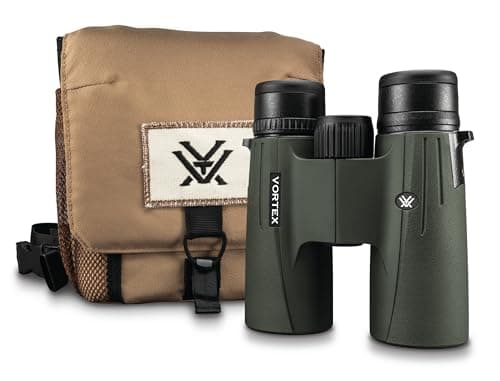 Vortex Viper HD 10x42The pair you walk with: 17 mm of eye relief, 341 ft of field, 24.9 oz. | Best all-round pairThe all-round upgrade | 9.5out of 10 | |
| 4 | 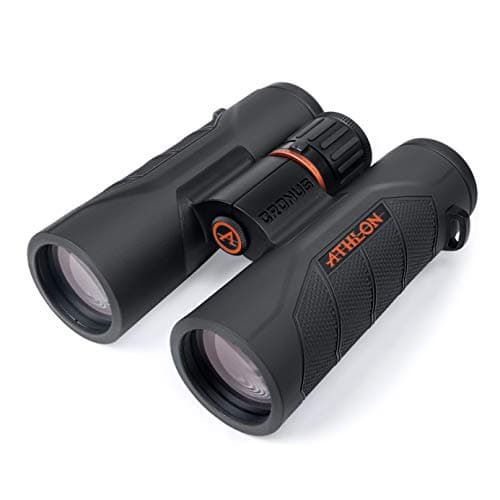 Athlon Cronus G2 UHD 10x42Abbe-Koenig prisms and UHD glass - the edge-of-legal-light pick. | Best glass per dollarBest glass under $600 | 9.5out of 10 | |
| 5 | 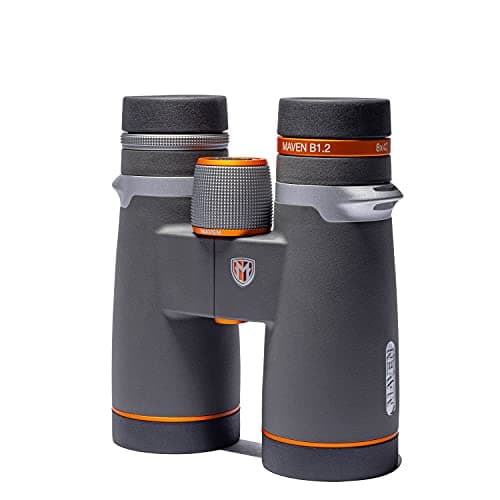 Maven B1.2 10x42Alpha-class resolution at a mid-tier price, because Maven sells direct. | Best if the budget stretchesDirect-to-consumer alpha | 9.6out of 10 |
Prices are pulled live from Amazon and were last checked November 12, 2026; if a figure cannot be verified the button reads "Check price" instead. Scores are our editorial judgment against the published ranking criteria, on our published 8.4 to 9.8 recommendation scale. #ad How we earn.
The tripod matters more than the glass
This is the single most useful thing on this page. Going from handheld 10x42s to tripod-mounted 10x42s finds more deer than going from handheld 10x42s to handheld alpha glass - and it costs a fraction as much.
The reason is physiological. Handheld, your image is moving constantly with your pulse and your breathing, and your eye compensates by averaging - which smooths out exactly the small, static, out-of-place details that a bedded buck consists of. Lock the image still and those details stop being averaged away. An hour behind a steady 10x finds things that six hours of handheld glassing does not.
Our picks are in the best tripods for binoculars, the sizing question is in what size tripod do I need, and you will need a quick-release adapter between the two.
How to glass mule deer country
- Get high and face the right way. Glass the slope opposite you with the sun behind you, early and late.
- Sit down and get on the tripod before you look at anything. Standing and scanning is how country gets glassed badly.
- Grid it. Divide what you can see into sections and work each one left to right, top to bottom. Then do it again.
- Look for parts, not deer. A horizontal line in vertical sage, an ear flicking, a white rump patch, an antler tip above a rock.
- Stay longer than feels reasonable. Bedded deer stand up and feed at some point in the first and last two hours. Finding them is often a matter of still being there.
The technique in full, including what to do when you have found something and need to judge it, is in how to glass for deer.
When a spotting scope replaces the big binocular
The 15x56 is often described as a cheap alternative to a spotting scope, and for finding animals that is fair. For judging one it is not: at 600 yards and beyond, deciding whether a buck is worth a five-hour approach needs magnification that no binocular offers.
The practical split most western hunters land on is 15x56 binoculars to find and a spotting scope to judge - see the best spotting scopes for hunting. If you never make long approaches, skip the scope.
The picks in detail
Price as of November 12, 2026. #ad How we earn
Vortex Diamondback HD 15x56
A 3.73 mm exit pupil and 230 ft of field: the cheapest credible way to sit behind a tripod all morning without carrying a spotting scope.
| Magnification | 15x |
|---|---|
| Objective lens | 56 mm |
| Eye relief | 15.6mm |
| Field of view | 230' @ 1000 yds |
| Angular field of view | 4.4º |
| Close focus | 14.0' |
| Weight | 34.8 oz. |
| Height | 7.1" |
| Width | 5.8" |
| Exit pupil (computed) | 3.73 mm |
| Twilight factor (computed) | 29 |
Specs verified 2026-10-05 from Vortex's published specification. Exit pupil and twilight factor are computed, not quoted.
What it does well
- 15x finds animals a 10x walks past
- 56 mm objective keeps it usable at dawn
- Much lighter and cheaper than a spotting scope setup
Where it gives ground
- 34.8 oz and 15x means a tripod is mandatory, not optional
- Too much magnification for timber or still-hunting
Skip it if
This is your only pair of binoculars. 15x is a second optic, not a first one.
How this score breaks down
- Low-light performance (weight 5)8.0
- Optical quality per dollar (weight 4)9.0
- Field of view (weight 3)6.1
- Eye relief (weight 3)7.6
- Weight and ergonomics (weight 2)5.8
- Warranty (weight 2)10.0
Criterion scores are on the 0-10 rubric scale. Their weighted mean is 7.8, which maps to 9.1 on our published recommendation scale of 8.4 to 9.8 - the band of products we are willing to recommend at all. The weights, the definitions and the mapping are all published, so any score here can be checked against our own rules. These are editorial judgments from published specifications, computed optical arithmetic and documented consensus.
This is the pick because mule deer hunting is a detection problem, not a viewing problem. A bedded buck in sage or on a shale slide is visible only as an ear, an antler tip or a horizontal line that does not belong, and 15x resolves those things at distances where 10x shows you texture. Hunters who switch to a tripod-mounted 15x routinely report finding deer in country they had already glassed with 10x42s.
The 56 mm objective gives a 3.73 mm exit pupil - lower than a 10x42's 4.2 mm, so it is not a low-light champion despite the big front end - and 230 ft of field at 1,000 yards, which is narrow. Both of those are the price of the magnification.
At 42.7 oz and 15x, a tripod is mandatory rather than recommended: handheld, your pulse erases the advantage you paid for. Treat this as a second optic, not a first, and keep a lighter pair for walking.
Price as of November 12, 2026. #ad How we earn
Vortex Viper HD 12x50
A 4.17 mm exit pupil and 288 ft of field, which is the trade you make for the extra detail; plan on a tripod, because 12x shows you your own pulse.
| Magnification | 12x |
|---|---|
| Objective lens | 50 mm |
| Eye relief | 16.0mm |
| Field of view | 288' @ 1000 yds |
| Angular field of view | 5.5º |
| Close focus | 8.0' |
| Weight | 28.8 oz. |
| Height | 6.5" |
| Width | 5.2" |
| Exit pupil (computed) | 4.17 mm |
| Twilight factor (computed) | 24.5 |
Specs verified 2026-10-05 from Vortex's published specification. Exit pupil and twilight factor are computed, not quoted.
What it does well
- 12x resolves antler detail a 10x leaves ambiguous
- 50 mm objective keeps the exit pupil close to the 10x42
- Still fits a standard bino harness
Where it gives ground
- Unusable handheld for sustained glassing - tripod required
- 288 ft field makes picking up moving animals harder
Skip it if
You will not carry a tripod. A shaky 12x sees less than a steady 10x.
How this score breaks down
- Low-light performance (weight 5)8.4
- Optical quality per dollar (weight 4)8.9
- Field of view (weight 3)7.2
- Eye relief (weight 3)8.1
- Weight and ergonomics (weight 2)6.8
- Warranty (weight 2)10.0
Criterion scores are on the 0-10 rubric scale. Their weighted mean is 8.3, which maps to 9.3 on our published recommendation scale of 8.4 to 9.8 - the band of products we are willing to recommend at all. The weights, the definitions and the mapping are all published, so any score here can be checked against our own rules. These are editorial judgments from published specifications, computed optical arithmetic and documented consensus.
If you will only carry one pair, this is the mule deer answer. Twelve power resolves antler detail that a 10x leaves ambiguous at 600-800 yards, the 50 mm objective keeps the exit pupil close to a 10x42's, and unlike a 15x56 it still fits a standard bino harness and still works handheld for a quick look.
The 288 ft field at 1,000 yards makes picking up moving animals harder than with a 10x, and sustained glassing still wants a tripod - 12x shows you your own pulse too. Plan on carrying one.
If you will not carry a tripod, buy the 10x42 below instead. A shaky 12x sees less than a steady 10x, and that is not a close call.
Price as of November 12, 2026. #ad How we earn
Vortex Viper HD 10x42
The default answer when someone outgrows a $150 pair: 17 mm of eye relief, a 341 ft field of view and glass that holds its edges, at the price where diminishing returns start.
| Magnification | 10x |
|---|---|
| Objective lens | 42 mm |
| Eye relief | 17.0mm |
| Field of view | 341' @ 1000 yds |
| Angular field of view | 6.5º |
| Close focus | 6.0' |
| Weight | 24.9 oz. |
| Height | 5.6" |
| Width | 4.9" |
| Exit pupil (computed) | 4.2 mm |
| Twilight factor (computed) | 20.5 |
Specs verified 2026-10-05 from Vortex's published specification. Exit pupil and twilight factor are computed, not quoted.
What it does well
- 17.0 mm eye relief is generous enough for most glasses wearers
- 341 ft at 1,000 yards is a wide field for a 10x
- Vortex VIP warranty is unconditional and transferable
Where it gives ground
- 24.9 oz is noticeable on a chest harness over a long day
- The 12x50 costs little more if you glass open country
Skip it if
You hunt timber inside 200 yards - the 8x42 Diamondback does that job for less than half the money.
How this score breaks down
- Low-light performance (weight 5)8.5
- Optical quality per dollar (weight 4)9.0
- Field of view (weight 3)8.9
- Eye relief (weight 3)9.1
- Weight and ergonomics (weight 2)7.6
- Warranty (weight 2)10.0
Criterion scores are on the 0-10 rubric scale. Their weighted mean is 8.8, which maps to 9.5 on our published recommendation scale of 8.4 to 9.8 - the band of products we are willing to recommend at all. The weights, the definitions and the mapping are all published, so any score here can be checked against our own rules. These are editorial judgments from published specifications, computed optical arithmetic and documented consensus.
Mule deer hunting is not only glassing. There is a lot of walking, a lot of still-hunting broken country, and a lot of quick looks at animals that appear at 150 yards while you are moving. That is what a 10x42 is for, and this is the one that does it at the point where diminishing returns begin.
341 ft of field at 1,000 yards is wide for a 10x, 17.0 mm of eye relief suits glasses wearers, and 24.9 oz is carryable all day. In a two-optic system this is the pair on your chest and the 15x56 is the pair on the tripod.
Price as of November 12, 2026. #ad How we earn
Athlon Cronus G2 UHD 10x42
19.3 mm of eye relief and 338 ft of field on ED/UHD glass with an ESP dielectric prism coating - the clearest value argument above $500.
| Magnification | 10x |
|---|---|
| Objective lens | 42 mm |
| Eye relief | 19.3 mm |
| Field of view | 338 ft @ 1,000 yds |
| Angular field of view | 6.5° |
| Close focus | 2 m / 6.6 ft |
| Interpupillary distance | 56-73 mm |
| Glass | Extra-low dispersion / UHD |
| Prism coating | ESP dielectric |
| Weight | 27.8 oz |
| Dimensions | 6.3" x 5.1" |
| Exit pupil (computed) | 4.2 mm |
| Twilight factor (computed) | 20.5 |
Specs verified 2026-11-09 from Athlon's published specification. Exit pupil and twilight factor are computed, not quoted.
What it does well
- 19.3 mm of eye relief, the longest of any 10x42 on this site
- 338 ft of field at 1,000 yd
- ED/UHD glass with Athlon's ESP dielectric prism coating
- 6.6 ft close focus
- Athlon's lifetime warranty
Where it gives ground
- 27.8 oz, heavier than the Viper HD and the Monarch M7
- Athlon's published table gives no prism type, exit-pupil or transmission figure
- Brand carries less weight on resale
Skip it if
You will only ever glass in good light. The money buys you edge-of-legal-light performance.
How this score breaks down
- Low-light performance (weight 5)9.1
- Optical quality per dollar (weight 4)9.6
- Field of view (weight 3)8.5
- Eye relief (weight 3)9.0
- Weight and ergonomics (weight 2)7.1
- Warranty (weight 2)8.7
Criterion scores are on the 0-10 rubric scale. Their weighted mean is 8.8, which maps to 9.5 on our published recommendation scale of 8.4 to 9.8 - the band of products we are willing to recommend at all. The weights, the definitions and the mapping are all published, so any score here can be checked against our own rules. These are editorial judgments from published specifications, computed optical arithmetic and documented consensus.
Mule deer move at the edges of the day, and light transmission is where the money goes if you want to be glassing in that window rather than packing up. Abbe-Koenig prisms transmit more light than the roof prisms used almost everywhere below the alpha tier, and finding them at this price is unusual.
Heavier than the Viper HD and with thinner resale demand behind the brand. If you keep your glass for a decade neither matters much.
Price as of November 12, 2026. #ad How we earn
Maven B1.2 10x42
Maven sells direct and skips the dealer margin, which is how a $1,150 binocular ends up competing with glass priced nearer $2,000.
| Magnification | 10x |
|---|---|
| Objective lens | 42 mm |
| Eye relief | 17.8 mm |
| Field of view | 347 ft @ 1,000 yds |
| Angular field of view | 6.6° |
| Near focus | 4.9 ft |
| Prism | Wide Angle Schmidt-Pechan |
| Glass | ED, 3 groups / 4 elements |
| Prism coating | Dielectric, phase corrected |
| Lens coating | Scratch and oil resistant |
| Eye width adjustment | 56-74 mm |
| Waterproof | 1 m for 30 min (IPX7) |
| Weight | 26.808 oz |
| Dimensions (W x H x D) | 5.2 x 5.7 x 2.2 in |
| Exit pupil (published) | 4.2 mm |
| Exit pupil (computed) | 4.2 mm |
| Twilight factor (computed) | 20.5 |
Specs verified 2026-11-09 from Maven's published specification. Exit pupil and twilight factor are computed, not quoted.
What it does well
- 347 ft of field at 1,000 yd with 17.8 mm of eye relief - alpha-class numbers
- 4.9 ft near focus, shorter than anything else in its price class here
- ED glass with dielectric prism coating and phase correction
- IPX7 submersion rating
- Customizable finish when ordered direct
- Unconditional lifetime warranty
Where it gives ground
- Mostly a direct-sale product, so stock on Amazon moves
- No dealer network, so there is nowhere to compare one in a store
- 26.8 oz is heavier than a Monarch M7, lighter than a Razor UHD
- Wide Angle Schmidt-Pechan prisms rather than the Abbe-Koenig design some rivals use at this price
Skip it if
You want to look through it before buying. Maven's model makes that hard.
How this score breaks down
- Low-light performance (weight 5)9.5
- Optical quality per dollar (weight 4)8.8
- Field of view (weight 3)8.6
- Eye relief (weight 3)8.9
- Weight and ergonomics (weight 2)8.2
- Warranty (weight 2)9.5
Criterion scores are on the 0-10 rubric scale. Their weighted mean is 9.0, which maps to 9.6 on our published recommendation scale of 8.4 to 9.8 - the band of products we are willing to recommend at all. The weights, the definitions and the mapping are all published, so any score here can be checked against our own rules. These are editorial judgments from published specifications, computed optical arithmetic and documented consensus.
The honest argument for spending more on mule deer glass is hours. Resolution is what lets you pick an antler tip out of sage at 900 yards in the sixth hour of glassing, when your eyes are tired and the light is flattening. Alpha-class resolution buys you that, and Maven's direct model is the cheapest route to it.
You cannot look through one in a shop before buying, and Amazon stock moves because direct is the main channel. Both are real objections rather than quibbles.
Our recommendation
If you take one thing from this page, take this.
Vortex Diamondback HD 15x56
Best for mule deer
15x56 on a tripod finds bedded deer that a 10x walks straight past.
Vortex Viper HD 12x50
Best compromise
12x50 still fits a harness, and a 4.17 mm exit pupil keeps it honest at dawn.
Prices are pulled live and shown on each button. #ad How we earn.
Questions people actually ask
What magnification binoculars are best for mule deer hunting?
Are 15x56 binoculars worth it for mule deer?
Do I need a tripod for mule deer glassing?
Do I need a spotting scope as well as binoculars for mule deer?
Sources
- Vortex Diamondback HD 15x56 product specifications - read 2026-10-11
- Vortex Viper HD 12x50 product specifications - read 2026-10-11