We earn a commission if you buy through the links on this page, at no extra cost to you. It never changes which products we pick or how we rank them - read the full disclosure.
Our top pick
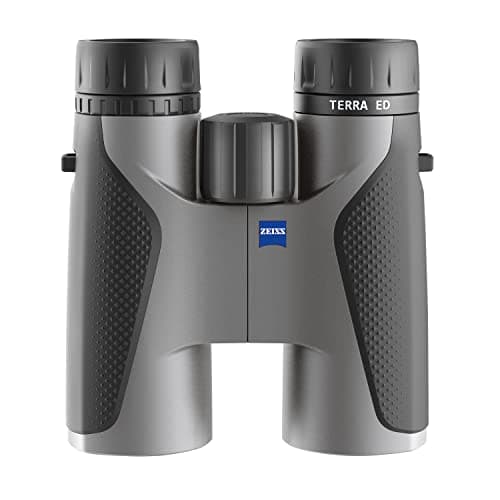
Zeiss Terra ED 10x42
Zeiss coatings and SCHOTT ED glass in the brand's entry line, which is the cheapest way to get a Zeiss view.
Price as of November 12, 2026. #ad How we earn
The best ED glass binoculars for hunting are the Zeiss Terra ED 10x42: SCHOTT ED glass under Zeiss coatings, 88% published light transmission, and the contrast in flat light that is the real reason to buy ED. For a wider view buy the Nikon Monarch M7, for the most glass per dollar the Athlon Cronus G2 UHD, and for last light the Hawke Frontier ED X 8x42 with its 5.25 mm exit pupil.
What ED glass actually does
ED stands for extra-low dispersion. Ordinary glass bends different wavelengths of light by slightly different amounts, so red, green and blue do not land in exactly the same place - which appears as a colored fringe along any high-contrast edge. ED elements are formulated to bring those wavelengths back together.
On a hunt, that abstraction has one concrete consequence: an antler tine silhouetted against a bright sky, or a dark animal on a snow slope, keeps a hard edge instead of a soft purple halo. Fringing is not just ugly - it eats the fine detail you are using to decide whether an animal is worth a stalk. The fuller explanation, including how ED differs from the "HD" badge, is in ED glass vs HD glass.
Quick picks
Ranked by the criteria published on how we review. Tap any row for the full write-up, or go straight to the current price.
| # | Product | Best for | Score | Price |
|---|---|---|---|---|
| 1 | Zeiss Terra ED 10x42SCHOTT ED glass under Zeiss multicoating, with 88% published light transmission and excellent contrast in flat light. | Best ED glass binoculars for huntingEuropean glass on a budget | 9.1out of 10 | |
| 2 | 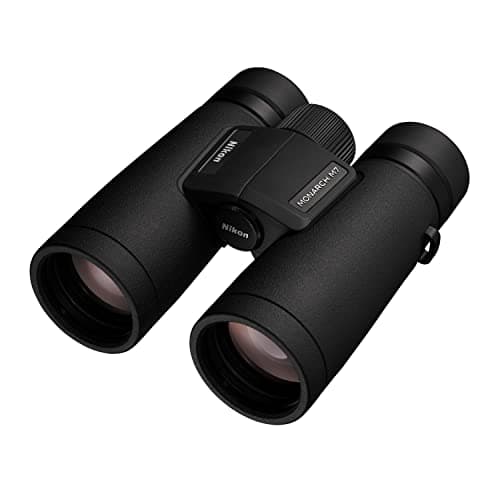 Nikon Monarch M7 10x42ED glass with improved multicoating and a 362 ft field - the widest view in this group, with 16.5 mm of eye relief. | Best field of viewWidest field in the $450 class | 9.4out of 10 | See today's price on the Monarch M7 10x42$445.13 on Amazon $549.95 19% off |
| 3 | 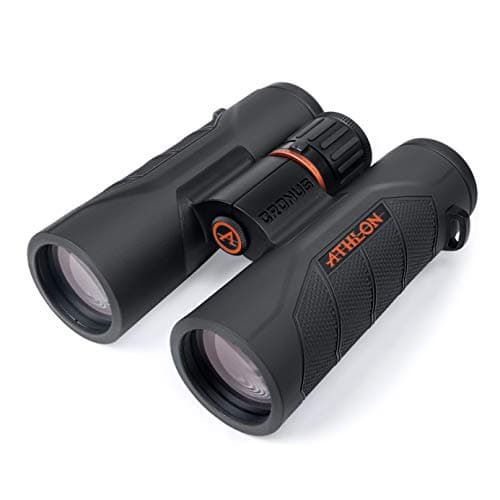 Athlon Cronus G2 UHD 10x42UHD glass with Abbe-Koenig prisms - a prism design normally reserved for four-figure binoculars. | Best glass per dollarBest glass under $600 | 9.5out of 10 | |
| 4 | 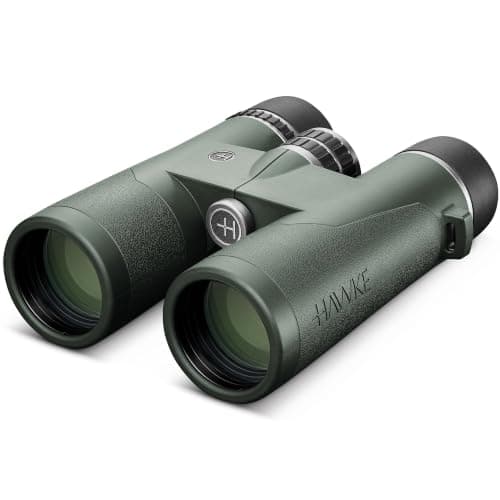 Hawke Frontier ED X Gen 2 8x42ED glass with a 5.25 mm exit pupil - the brightest combination here for the last ten minutes. | Best ED glass for low lightWide-field low-light glassing | 9.5out of 10 |
Prices are pulled live from Amazon and were last checked November 12, 2026; if a figure cannot be verified the button reads "Check price" instead. Scores are our editorial judgment against the published ranking criteria, on our published 8.4 to 9.8 recommendation scale. #ad How we earn.
What to look for in ED binoculars
- Check that ED is a glass claim, not a marketing badge. "HD" is a brand's name for an optical system and may or may not include an ED element. "ED" names the glass type. Only the second one tells you something about the physics.
- Do not trade eye relief for it. The Terra ED's 14.0 mm is the shortest here. Fringing control you cannot get your eye behind is worthless - see how to choose hunting binoculars.
- Consider the prism design too. The Cronus G2's Abbe-Koenig prisms affect transmission more than an ED element does, which is why it outperforms its price in bad light. The background is in roof prism vs porro prism.
- Match the exit pupil to your light. ED glass sharpens edges; it does not gather light. If your complaint is darkness rather than softness, an 8x42's 5.25 mm exit pupil does more for you than any ED element.
- Ignore ED under about $200. At that price the limiting factors are coatings, prism quality and assembly tolerances, and an ED element cannot overcome them.
Price as of November 12, 2026. #ad How we earn
Zeiss Terra ED 10x42
Zeiss coatings and SCHOTT ED glass in the brand's entry line, which is the cheapest way to get a Zeiss view.
| Magnification | 10 x |
|---|---|
| Objective lens | 42 mm |
| Eye relief (exit pupil distance) | 14.0 mm |
| Field of view | 110 m (330 ft) @ 1,000 |
| Angular field of view | 60° |
| Close focus | 1.6 m (5.3 ft) |
| Light transmission | 88 % |
| Weight | 725 g (25.6 oz) |
| Length | 142 mm (5.6 in) |
| Interpupillary distance | 58 - 76 mm |
| Exit pupil (computed) | 4.2 mm |
| Twilight factor (published and computed) | 20.5 |
Specs verified 2026-10-05 from Zeiss's published specification. Exit pupil and twilight factor are computed, not quoted.
What it does well
- SCHOTT ED glass with Zeiss multicoating
- Compact and light for a 42 mm
- Excellent contrast in flat light
Where it gives ground
- Built in China, not Germany, and priced accordingly
- Narrower field than the Japanese competition
- 14.0 mm of eye relief is the shortest in this price class
Skip it if
Field of view is your priority - the Monarch M7 gives you more of it.
How this score breaks down
- Low-light performance (weight 5)8.5
- Optical quality per dollar (weight 4)8.3
- Field of view (weight 3)7.2
- Eye relief (weight 3)6.5
- Weight and ergonomics (weight 2)9.0
- Warranty (weight 2)7.5
Criterion scores are on the 0-10 rubric scale. Their weighted mean is 7.9, which maps to 9.1 on our published recommendation scale of 8.4 to 9.8 - the band of products we are willing to recommend at all. The weights, the definitions and the mapping are all published, so any score here can be checked against our own rules. These are editorial judgments from published specifications, computed optical arithmetic and documented consensus.
This is the cheapest way to get a genuinely Zeiss-corrected view, and the ED element is the reason. Zeiss publishes 88% light transmission and the glass is SCHOTT ED under Zeiss multicoating, which shows up exactly where ED glass is supposed to: a dark antler against a bright sky holds its edge instead of blooming into a purple halo.
Where it is strongest is flat light - overcast, snow, the gray hour - because contrast rather than brightness is the binding constraint there, and that is what the coatings buy you. The published figures are a 330 ft field at 1,000 yards and a 4.2 mm exit pupil.
Two honest caveats. It is built in China rather than Germany and priced accordingly, and the 14.0 mm eye relief is the shortest in this price class - if you wear glasses, try before you commit or buy the Monarch M7 instead.
$549.95 19% off
Price as of November 12, 2026. #ad How we earn
Nikon Monarch M7 10x42
The M5 with a wider field and better coatings; the strongest argument against the Viper HD at a slightly lower price.
| Magnification | 10x |
|---|---|
| Objective lens | 42 mm |
| Eye relief | 16.5 mm |
| Field of view | 362 ft @ 1,000 yd |
| Real angular field of view | 6.9° |
| Apparent field of view | 62.2° |
| Close focus | 8.2 ft |
| Weight | 24.0 oz |
| Length | 5.6 in |
| Width | 5.1 in |
| Exit pupil (computed) | 4.2 mm |
| Twilight factor (computed) | 20.5 |
Specs verified 2026-10-05 from Nikon's published specification. Exit pupil and twilight factor are computed, not quoted.
What it does well
- Wider field of view than the M5 and most 10x42s at this price
- ED glass with improved multicoating
- Comfortable eye relief for glasses wearers
Where it gives ground
- No unconditional transferable warranty
- Focus wheel has more travel than some will like
Skip it if
Warranty matters more to you than optics - Vortex VIP is the better long-term bet.
How this score breaks down
- Low-light performance (weight 5)8.5
- Optical quality per dollar (weight 4)8.6
- Field of view (weight 3)9.5
- Eye relief (weight 3)8.6
- Weight and ergonomics (weight 2)8.6
- Warranty (weight 2)6.6
Criterion scores are on the 0-10 rubric scale. Their weighted mean is 8.5, which maps to 9.4 on our published recommendation scale of 8.4 to 9.8 - the band of products we are willing to recommend at all. The weights, the definitions and the mapping are all published, so any score here can be checked against our own rules. These are editorial judgments from published specifications, computed optical arithmetic and documented consensus.
Nikon's published figures tell the story: 362 ft at 1,000 yards and 16.5 mm of eye relief, which makes it both the widest and the most glasses-friendly pair here. The ED glass and improved coatings over the M5 are what you are paying the difference for, and the improvement is visible on high-contrast edges.
Field of view is an underrated hunting spec. A wider view means less panning to cover a hillside, which means fewer animals slipping through the gap between sweeps. At 24.0 oz it is also one of the lighter 10x42s here.
The compromise is the warranty: Nikon does not offer an unconditional transferable guarantee, so if a lifetime safety net matters more to you than optics, the Vortex route is the better long-term bet.
Price as of November 12, 2026. #ad How we earn
Athlon Cronus G2 UHD 10x42
19.3 mm of eye relief and 338 ft of field on ED/UHD glass with an ESP dielectric prism coating - the clearest value argument above $500.
| Magnification | 10x |
|---|---|
| Objective lens | 42 mm |
| Eye relief | 19.3 mm |
| Field of view | 338 ft @ 1,000 yds |
| Angular field of view | 6.5° |
| Close focus | 2 m / 6.6 ft |
| Interpupillary distance | 56-73 mm |
| Glass | Extra-low dispersion / UHD |
| Prism coating | ESP dielectric |
| Weight | 27.8 oz |
| Dimensions | 6.3" x 5.1" |
| Exit pupil (computed) | 4.2 mm |
| Twilight factor (computed) | 20.5 |
Specs verified 2026-11-09 from Athlon's published specification. Exit pupil and twilight factor are computed, not quoted.
What it does well
- 19.3 mm of eye relief, the longest of any 10x42 on this site
- 338 ft of field at 1,000 yd
- ED/UHD glass with Athlon's ESP dielectric prism coating
- 6.6 ft close focus
- Athlon's lifetime warranty
Where it gives ground
- 27.8 oz, heavier than the Viper HD and the Monarch M7
- Athlon's published table gives no prism type, exit-pupil or transmission figure
- Brand carries less weight on resale
Skip it if
You will only ever glass in good light. The money buys you edge-of-legal-light performance.
How this score breaks down
- Low-light performance (weight 5)9.1
- Optical quality per dollar (weight 4)9.6
- Field of view (weight 3)8.5
- Eye relief (weight 3)9.0
- Weight and ergonomics (weight 2)7.1
- Warranty (weight 2)8.7
Criterion scores are on the 0-10 rubric scale. Their weighted mean is 8.8, which maps to 9.5 on our published recommendation scale of 8.4 to 9.8 - the band of products we are willing to recommend at all. The weights, the definitions and the mapping are all published, so any score here can be checked against our own rules. These are editorial judgments from published specifications, computed optical arithmetic and documented consensus.
The most interesting pair on this page. Athlon's UHD glass controls chromatic aberration as well as anything near the price, but the headline is the prism type: Abbe-Koenig prisms have no reflective coating losses the way roof prisms with a Schmidt-Pechan design do, which is why they normally appear only in binoculars costing considerably more.
In practice that means the edge-of-legal-light performance is a step above what the price suggests, and the eye relief is long. It is heavier than the Viper HD and the brand carries less weight on resale - both are the price of the components. If you will only ever glass in good light, you are paying for a benefit you will not see.
Price as of November 12, 2026. #ad How we earn
Hawke Frontier ED X Gen 2 8x42
Hawke's ED X line puts a genuinely wide field and ED glass in the Viper HD's price bracket, with a 5.25 mm exit pupil for last light.
| Magnification | 8x |
|---|---|
| Objective lens | 42mm |
| Exit pupil (computed) | 5.25 mm |
| Twilight factor (computed) | 18.3 |
Specs verified 2026-10-05 from Hawke's published specification. Exit pupil and twilight factor are computed, not quoted.
What it does well
- ED glass with a wide field of view
- 5.25 mm exit pupil for dawn and dusk
- Lifetime warranty
Where it gives ground
- Smaller service footprint in the US
- Less resale demand than Vortex or Leupold
Skip it if
You want a 10x. This listing is the 8x42.
How this score breaks down
- Low-light performance (weight 5)9.2
- Optical quality per dollar (weight 4)8.8
- Field of view (weight 3)9.0
- Eye relief (weight 3)8.5
- Weight and ergonomics (weight 2)8.3
- Warranty (weight 2)8.7
Criterion scores are on the 0-10 rubric scale. Their weighted mean is 8.8, which maps to 9.5 on our published recommendation scale of 8.4 to 9.8 - the band of products we are willing to recommend at all. The weights, the definitions and the mapping are all published, so any score here can be checked against our own rules. These are editorial judgments from published specifications, computed optical arithmetic and documented consensus.
The 8x option, and the one to buy if your problem is light rather than distance. A 42 mm objective divided by 8x magnification gives a 5.25 mm exit pupil, against 4.2 mm for any 10x42 - and in genuinely poor light, exit pupil is the number that decides whether you see an animal or a shape.
Add ED glass and a wide field, and you have the most capable timber and last-light binocular in this roundup. Hawke's US service footprint is smaller than Vortex's or Leupold's, and resale demand is thinner - worth knowing, not disqualifying. If you want the arithmetic behind exit pupil, it is in exit pupil and twilight factor.
How the picks compare
| Pair | Glass | Exit pupil | Field of view | Eye relief |
|---|---|---|---|---|
| Zeiss Terra ED 10x42 | SCHOTT ED, Zeiss multicoating | 4.2 mm | 330 ft at 1,000 yd | 14.0 mm |
| Nikon Monarch M7 10x42 | ED with improved multicoating | 4.2 mm | 362 ft at 1,000 yd | 16.5 mm |
| Athlon Cronus G2 UHD 10x42 | UHD with Abbe-Koenig prisms | 4.2 mm | Not published by Athlon | Long - figure not published |
| Hawke Frontier ED X Gen 2 8x42 | ED | 5.25 mm | Wide - figure not published | Not published |
Figures as published by each manufacturer. Where a maker does not publish a number we say so rather than estimate it. Exit pupil is the objective diameter divided by the magnification.
Is ED glass worth the money for hunting?
Above roughly $350, yes - because at that price you are no longer paying for ED instead of something more important. Below it, no: the money is better spent on a bigger exit pupil, longer eye relief or a better warranty, all of which change more of your day than fringing control does.
The sharpest way to put it is that ED glass improves the view you already have. It does not fix a view that is too dark, too narrow or too shaky. If your real complaint is one of those three, read how much to spend on hunting binoculars before shopping on glass type, and if you are coming off a genuinely cheap pair, upgrading from cheap binoculars sets the priorities in order.
Our recommendation
If you take one thing from this page, take this.
Zeiss Terra ED 10x42
Best ED glass binoculars for hunting
SCHOTT ED glass under Zeiss multicoating, with 88% published light transmission and excellent contrast in flat light.
Nikon Monarch M7 10x42
Best field of view
ED glass with improved multicoating and a 362 ft field - the widest view in this group, with 16.5 mm of eye relief.
$549.95 19% off
Prices are pulled live and shown on each button. #ad How we earn.
Questions people actually ask
What are the best ED glass binoculars for hunting?
Is ED glass worth it in binoculars?
What is the difference between ED and HD binoculars?
Does ED glass help in low light?
Sources
- Zeiss Terra ED 10x42 published specifications - read 2026-10-17
- Nikon Monarch M7 10x42 published specifications - read 2026-10-17